Atlas7 min read
Puget Sound: Bull Kelp in the Inland Sea
Washington's inland sea shelters floating bull kelp beds that shelter salmon in return. A Coastal Atlas guide to its patchwork beds and citizen science.
Tom Okafor ·
Deception Pass is Washington's most current-swept dive. How to time the slack, where to enter, and what lives on this bull kelp corridor between islands.
Deception Pass is the narrow throat between Whidbey Island and Fidalgo Island at the north end of Puget Sound — the place where an entire inland sea's tide tries to squeeze through a channel barely a few hundred metres wide. On a big exchange, the water runs through the pass far faster than any diver can swim, and standing waves stack up under the bridge like a river rapid in the sea.
That ferocity is exactly why it's worth diving. The current hauls nutrients through the channel endlessly, the walls are upholstered in life, kelp sways over the shoulders of the pass, and on a properly timed slack it is some of the richest cold-water scenery in the Pacific Northwest. On a badly timed one, it will try to take you to sea. This is a guide to doing it right — with the caveat that a proper tide table, not this article, is your actual dive plan.
Puget Sound's tides are large, and every cubic metre entering or leaving the Sound's northern basin passes through a handful of constrictions — Deception Pass chief among them, as our Puget Sound atlas guide explains in regional context. The result is a tidal jet: current accelerates through the narrows four times a day, peaks violently mid-exchange, and pauses — briefly, predictably — at slack water, when the tide turns.
Everything about diving here is organized around that pause. Slack typically lasts long enough for a careful full dive in the bays, but "slack" at a constriction is a window with an address: it arrives at a published minute, widens on neap tides and narrows to nothing on big springs. Local practice is to dive the smaller, neap-tide days and to know, before you suit up, exactly when the window closes. Our guide to reading marine forecasts covers the general skill of planning around tide and swell; Deception Pass simply raises the stakes.
The sensible entry points are the small coves tucked just outside the main channel — Bowman Bay is the established favourite. Its rocky shores drop into bull kelp, sea cabbage and kelp-forest scenery in the 5–15 metre band, with anemone-encrusted boulders, copper and quillback rockfish, and the occasional cabezon guarding eggs. On a good day the canopy feels like a miniature version of the open-coast bull kelp forests to the west.
For experienced divers on a well-chosen slack, the rocky walls diving down toward the channel are the main event: giant plumose anemones in white drifts, red urchins, wolf eels in the recesses, lingcod nailed to the substrate. What you do not do is linger. The moment the exchange begins to build, the pass reasserts who owns it — and the exit current at Deception Pass does not negotiate.
The pass is a biological conveyor: tides flush plankton through, filter feeders grow fat, and everything higher up the food chain follows. Expect:
Deception Pass is absolutely manageable — by divers who respect what it is:
Summer brings the fullest bull kelp canopy, longest days and most comfortable surface intervals — and the thickest plankton blooms, with visibility to match. Autumn is the local favourite: canopy still standing, crowds gone, water clearing. Winter offers the best visibility of the year in exchange for brutal surface conditions and cold that argues for dry preparations; our cold-water diving essentials has the gear logic, and a drysuit is the honest baseline here in every month that ends in ber.
Deception Pass State Park is Washington's most-visited state park, and its underwater edges absorb the pressure that implies. Swim clear of anemone colonies rather than against them, leave the wolf eels to their ledges, pick up anything you find that isn't alive, and don't take so much as a shell — the pass's riches survive because enough divers treat it as a museum with windows.
Not the main pass — the current makes it unsuitable as a first ocean dive. Bowman Bay's sheltered coves on a mild slack can work for newer divers under supervision, but the honest beginner's progression starts at forgiving sites like the Monterey Breakwater before graduating to constrictions like this.
It varies from minutes to the best part of an hour depending on the day's exchange — neap tides give the widest window, big springs the narrowest. Plan for the published slack, build in margin both ways, and let the current, not your computer, decide when to ascend.
Late summer through autumn for canopy and comfort; winter for visibility if you can manage the cold and weather. The pass dives year-round; your tolerance is the variable.
No — the classic dives are shore dives from the coves. The deeper channel and outer walls are boat territory for suitably equipped and experienced teams.
Bull kelp is annual: the canopy builds through spring and summer and thins through winter storms. The anemone walls and rocky life below it are the year-round constant — the kelp is the seasonal crown.
Washington's inland sea shelters floating bull kelp beds that shelter salmon in return. A Coastal Atlas guide to its patchwork beds and citizen science.
Tom Okafor ·
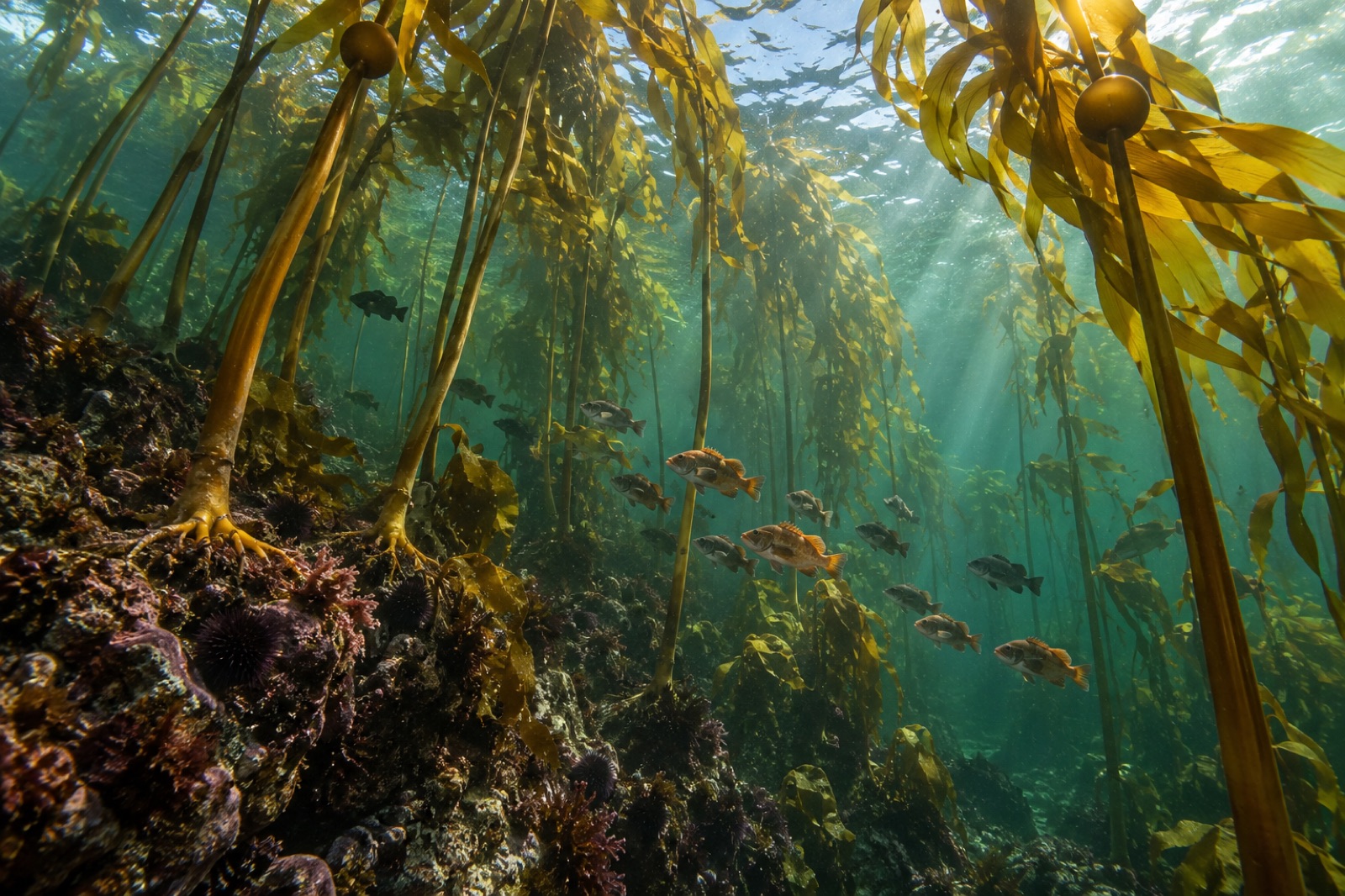
Meet bull kelp, the fast-growing annual giant of North America's Pacific coast — its biology, Indigenous heritage, dramatic decline and the race to restore it.
Dr. Mara Ellison ·
How to assess a shore dive site step by step: wind, swell, entry and exit points, surge and kelp layout — plus the bailout plan every beach dive needs.
Tom Okafor ·