Atlas9 min read
The Cape Peninsula: Kelp Forests at the Edge of Africa
Guide to the Cape Peninsula's kelp forests: two oceans, sea bamboo, seals and sharks, freediving culture, and how a warming world is shifting the reefs.
Tom Okafor ·
At the Cape of Good Hope, cold Atlantic upwelling and False Bay warmth build towering kelp. A practical dive guide to Cape Point's sites, seasons and permits.
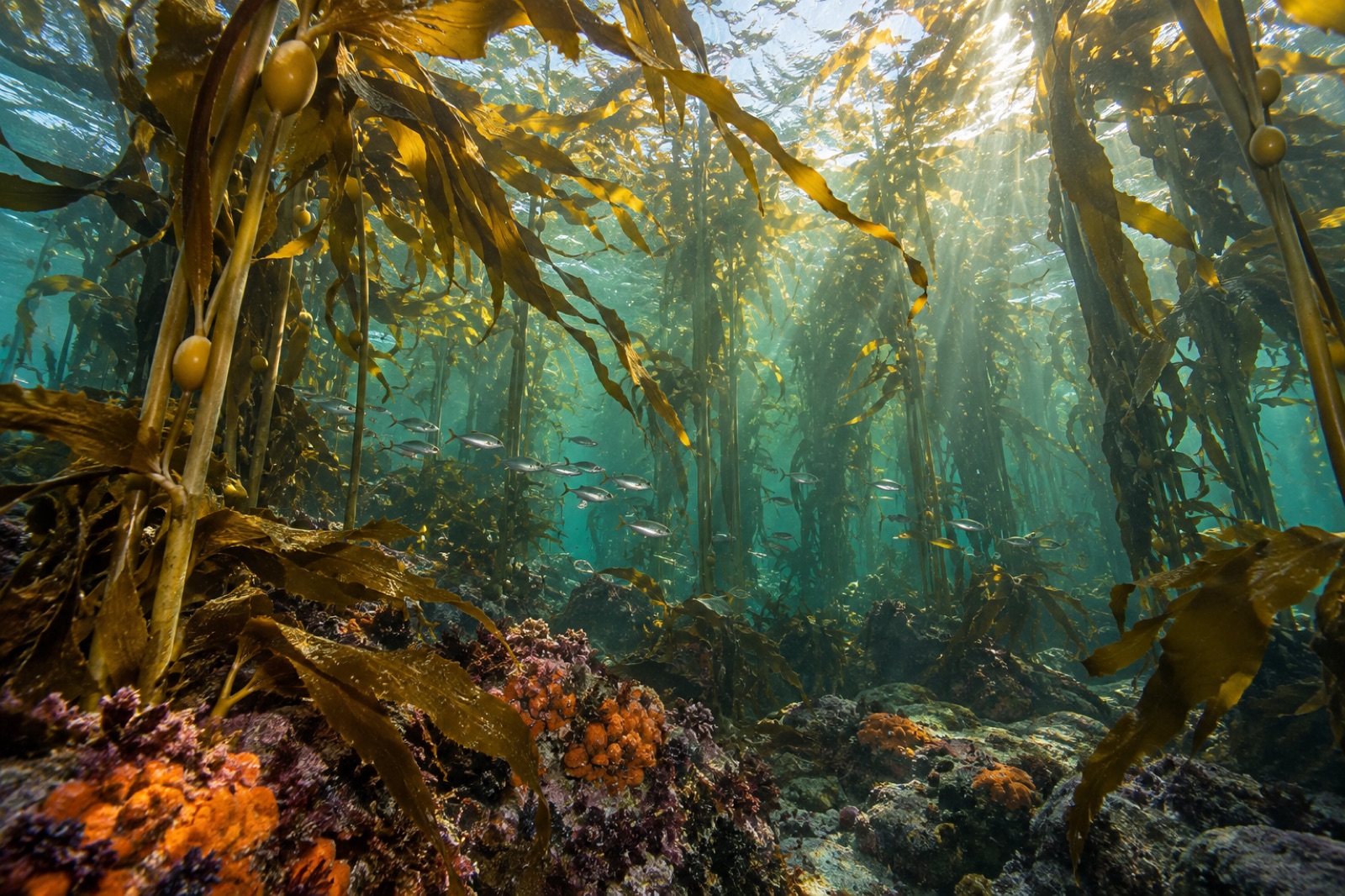
There is a headland at the bottom end of Africa where two current regimes argue all year long — the cold Benguela breathing up the Atlantic side, the warmer Agulhas influence leaning into False Bay — and beneath the argument grows one of the most spectacular kelp forests on Earth. Sea bamboo canopy so thick you navigate by sunbeams; split-fan kelp in the deeper blue; reefs furred with orange wall sponges and noble corals; catsharks curled in every crevice. Cape Point and its flanks are the crown of the Cape Peninsula's kelp coast, and diving here is equal parts planning, weather-reading and surrender. This guide covers the sites, the seasons, the permits and the honest safety picture.
The Cape Peninsula divides two personalities. False Bay, on the east, is the warmer, shallower, more forgiving sea: 13–19°C, gentle entries, colourful reef fish. The Atlantic side — Hout Bay, Oudekraal, the Twelve Apostles — is colder and wilder: 8–14°C, colder still when the summer southeaster drives upwelling and turns the water gin-clear and plankton-loaded in the same week. Cape Point itself sits at the seam, and its dive sites swing between the two personalities depending on wind and season. The kelp that thrives on both is sea bamboo (Ecklonia maxima), whose gas-filled hollow stipe hauls the fronds upright into a true canopy — for the full species story see our South African kelp forests guide.
Windmill Beach (shore, beginner). Two coves of granite boulders a short walk from the penguin colony at Boulders Beach — kelp in five metres, sand gullies, and fish that have never seen a speargun because the zone is protected. This is where to get Cape-water confidence; see our Boulders and Windmill snorkelling guide for the crawl-through-the-kelp version.
Castle Rock (shore, intermediate). Regularly called the best shore dive in South Africa, and on a clear winter day it's hard to argue. Entry off the rocks between Miller's Point and Smitswinkel Bay, then a reef system falling away under kelp into sponge gardens dense with pyjama catsharks, puffadder shysharks, cuttlefish and schools of hottentot and galjoen. Depths to 12–14 metres; the exit needs a calm sea.
Pyramid Rock and Miller's Point (shore/boat, intermediate). A small pyramid-shaped rock in kelp and sand channels, famous for two decades as the place to meet broadnose sevengill cowsharks — the peninsula's prehistoric-looking apex-but-approachable shark. Be honest with yourself about recent history: since orcas began working False Bay's sharks around 2015–2017, sevengill aggregations have thinned and become unpredictable. Go for the kelp, the catsharks and the gully sharks; treat a sevengill encounter as a gift, not a product.
The Smitswinkel Bay wrecks (boat, advanced). Five vessels — navy frigates, trawlers and a dredger among them — scuttled between the 1970s and 1990s to make an artificial reef field, now velveted with invertebrate growth in 25–36 metres of water. This is deep, cold, technical-adjacent Cape boat diving: current, low light, and some of the most photogenic wreckage in African waters.
Buffels Bay and the Point itself (boat, advanced, weather-gated). Inside the Cape of Good Hope section of Table Mountain National Park, the boulder bays and outer reefs at the very tip are glorious, exposed, and diveable only in real weather windows — flat seas and a cooperative wind, usually in the autumn-to-winter gap. When it's on, it's the peninsula distilled: canopy overhead, bronze light, and the feeling of finning at the end of a continent.
Work the water column top to bottom. In the canopy: schools of strepies and fransmadam, seals porpoising through the light shafts. Mid-water: Cape knifejaw, galjoen, red roman, and the ever-present catsharks — pyjama, puffadder and dark shyshark — the peninsula's signature trio, striped and baroque. On the reef: gas flame nudibranchs cruising purple sponge, octopus mothers in dens, cuttlefish flashing semaphore, and walls of orange, red and purple encrusting life that make wide-angle photographers weep with joy. If underwater photography is your aim, our kelp photography guide has the settings to make this light behave.
Open Water covers the shallow shore sites if you're comfortable in cold water and some surge. The Smitswinkel wrecks sit at 25–36 metres and want Advanced (or deep) certification with recent cold-water experience. Technique-heavy sites at the Point itself are for seasoned divers on the day the sea allows.
False Bay: roughly 13–19°C through the year. The Atlantic side: 8–14°C, with upwelling days colder still. A 7mm with hood and gloves is the False Bay standard; a drysuit is the Atlantic-side luxury you won't regret.
White sharks belong to this coast, but their inshore False Bay presence has collapsed since orca predation began in the mid-2010s, and encounters on scuba are now rare. The sharks you're likely to meet — sevengills (if lucky), gully sharks and the three catsharks — are calm company to a diver who behaves.
Yes — the peninsula's trick is that it's almost never flat on both sides at once. Something is diveable nearly every week of the year; you just have to be willing to change sides of the mountain.
For scuba within the Table Mountain National Park MPA — which covers the best of this coast — yes, a recreational diving permit is required, with restricted zones off-limits. Commercial charters handle it; independent divers should arrange theirs in advance and check the current zoning map.
Guide to the Cape Peninsula's kelp forests: two oceans, sea bamboo, seals and sharks, freediving culture, and how a warming world is shifting the reefs.
Tom Okafor ·
A snorkeller's guide to Simon's Town and False Bay — Windmill Beach, Boulders, kelp-fringe marine life, shark-smart safety, seasons and gear for Cape Town's east side.
Tom Okafor ·
Seven gill slits, one rear-set dorsal fin, and fossils deep in its past: the broadnose sevengill is the ancient apex cruiser of temperate kelp coasts worldwide.
Dr. Theo Nakamura ·