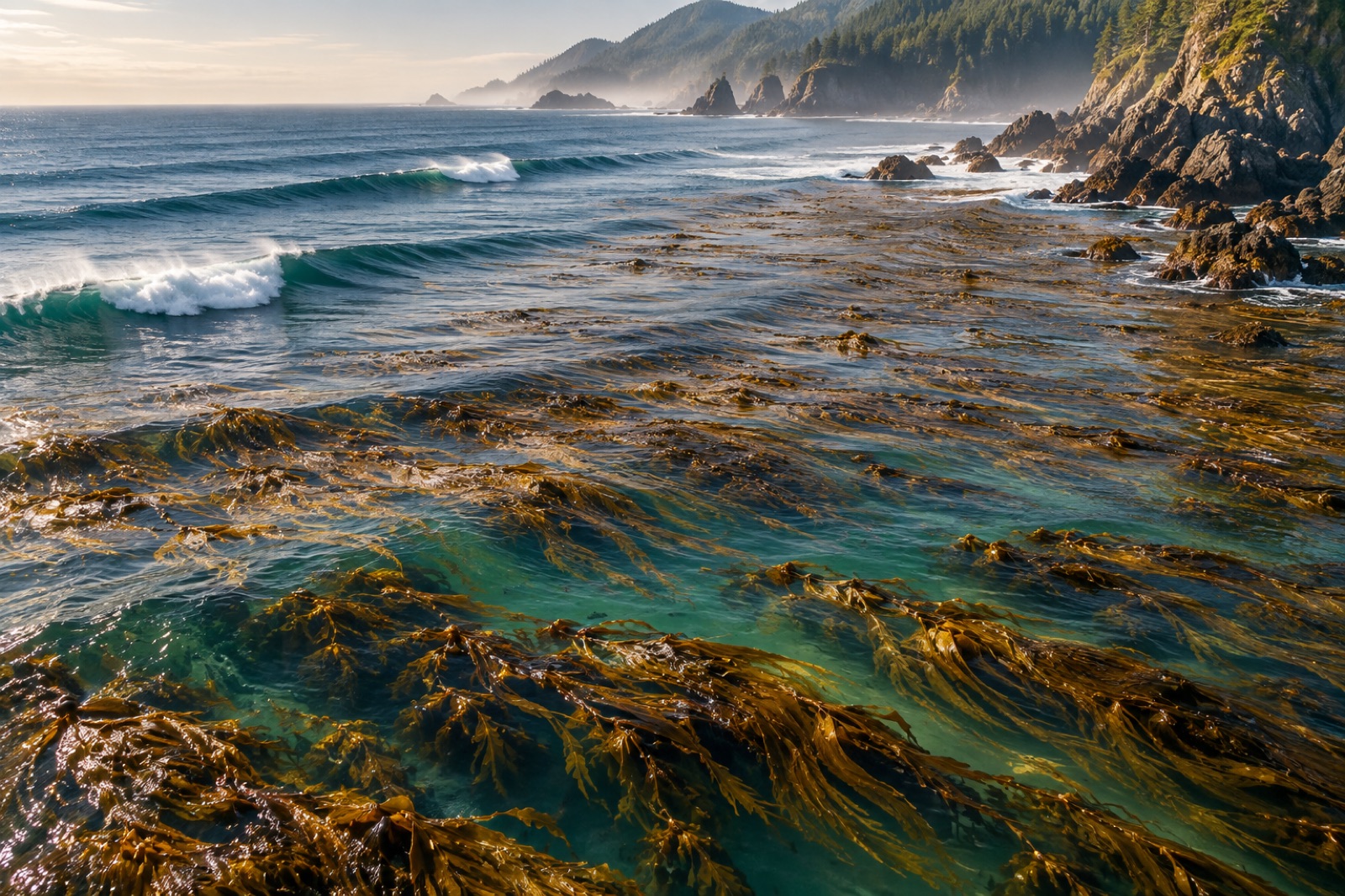
At the very end of Brittany, where the continent runs out of land and admits it, lies a piece of ocean the French call the Iroise: the sea between the tip of Finistère — Breton for the end of the earth — and the islands of Molène and Ouessant, thirty kilometres offshore. It is one of the roughest, most tide-torn stretches of the Atlantic: the world's great lighthouse reefs are here, and ships have been dying on the Chaussée de Sein for two thousand years. It is also, underneath all that motion, the biggest kelp forest in Europe — thousands of hectares of Laminaria forest laid down on reef and boulder, protected since 2007 as France's first marine nature park and since 1988 as a UNESCO biosphere reserve in the Molène archipelago. If our Brittany atlas guide is the story of an industry, this is the story of the sea itself.
An ocean in permanent motion
The Iroise runs on the tide the way other coasts run on weather. Spring ranges here rank among Europe's largest, and all that moving water has to thread a needle: the channels, races and straits between Molène's islets, around Ouessant and up the Fromveur passage, where the current between Molène and Ouessant reaches speeds that turn the sea's surface into standing white water for miles.
For kelp, this is the ideal engine. Current-driven forests never go still: nutrients wash past every blade, waste is swept away, and spores and drift kelp move through the system on every flood and ebb. The physics of why this builds forests is the mirror image of our explainer on how kelp calms waves: the same forest that damps a swell from above is, below, a permanent engine of exchange. The Iroise is that physics at industrial scale.
The forest itself
Two kelp architects share the work, as they do across the northeast Atlantic. Oarweed (Laminaria digitata) owns the shore and the shallows — at the great spring low tides its split blades hiss and slide in thousands at the waterline, and you can stand among them. Tangle kelp (Laminaria hyperborea) owns the subtidal: stipes like walking-stick trunks anchored by grip-fast holdfasts, blades tossed in the surge, in densities that here, in the Iroise, run to the best in the world. A third, the big annual Saccorhiza polyschides, blazes in and out of shallow gaps every season.
Everything a kelp forest is supposed to do, this one does: three-dimensional habitat from holdfast to blade-tip, wave shelter, nursery, food. The understory holds red and turf algae, encrusting sponges and hydroids; the reef structure holds conger, ballan wrasse and pollack; above, the tide races run seabirds by the thousand. What separates the Iroise from comparable coasts is not species so much as sheer continuous extent: forest uninterrupted for dozens of kilometres across one of Europe's most complex archipelagos.
A park the working coast helped build
The Iroise is a protected seascape, but it was never protected from the people who use it — it was protected by them, for them and through them. Two designations overlap here. The Archipel de Molène was named a UNESCO Man and Biosphere reserve in 1988, an early recognition that this was a place where people and nature had negotiated a working coexistence. In 2007 the Parc naturel marin d'Iroise was created — France's very first marine nature park — covering a far larger area and formally built on the co-governance principle: fishermen, kelp harvesters, scientists, sailors, Naval interests (the strategic Brest roads sit within sight), conservationists and the island communes all sit at one table.
That model matters beyond France. It says, in effect: you protect the sea by giving its users standing, not by removing them. It is the same principle behind marine protected areas done well anywhere: the rules hold because the people closest to the water wrote them. The park runs science programs, manages moorings and anchors, patrols seagrass and maërl beds alongside the kelp, and acts as France's living argument that protection is a management practice, not an absence of people.
Molène: the island the kelp kept
Molène is the archipelago's only permanently inhabited island, a few dozen households at the path of the Fromveur, and its story is the Iroise in miniature. Islanders here built an economy on the sea in all its forms — lobster, line fishing, wreck salvage — and on kelp in particular: storm-cast wrack for fertiliser, then burned kelp for the iodine-and-soda trade, then the famous goémon à pied harvesting tradition on the low-tide oarweed, then, into the modern era, the scoubidou boat harvest of tangle kelp that Brittany perfected. When France needed ocean-going pilots for the channels to Brest, the pilots were Molène children of this kelp economy.
The pilots are mostly gone and the fleet is smaller, but the settlement persists: a village above one of the Atlantic's great tide races, growing on the wealth the forest delivered. Walking Molène at low water — the whole kelp margin revealed, the channels boiling in the distance — is one of the Atlantic coast's essential experiences, and a working answer to anyone who thinks environmental protection and a living coast are opposites. The Breton goémon tradition is told in full in our Brittany guide; here the island tells it in the present tense.
Wildlife above and below the forests
- Grey seals. Molène holds one of metropolitan France's small resident colonies of grey seals, hauled out on the low skerries, at the Atlantic edge of the species' range.
- Bottlenose dolphins. A resident population works the Iroise year-round, one of the few well-studied inshore groups in France.
- Basking sharks and sunfish. In spring the plankton bloom draws giants into the races; boats cross fins the size of doors on glassy April days.
- Seabirds. Storm petrels, puffins at the range edge, gannets and rafts of auks over the Fromveur; in autumn, the Iroise is one of Europe's great shearwater stages.
- Under the kelp: conger in the reef, sea urchins and red seaweeds in the understory, and in the gullies the hidden national treasures — pink sea fans inching their way in from the south.
Diving the Iroise: high reward, high consequence
This is the most honest advice in any atlas: the Iroise is a magnificent destination for experienced divers and a dangerous one for the unprepared. The currents that make the forest also command the diving. Local clubs in Brest and on Ouessant run slack-water trips onto the kelp reefs and the famous wreck grounds; the rewards are forests in motion, clear summer light and dense life. Respect the cardinal rules — tide tables and slack windows, local skippers, no solo diving — and note that the sea holds memory: the region's wrecks are graves as well as reefs. The reward-to-risk arithmetic is finest in summer; our winter-diving guide is honest about what the season does and doesn't take away.
If you'd rather stay dry: the ferry crossings (Brest–Molène–Ouessant) and the boat tours of the archipelagos put the kelp channels, the races and the day's wildlife directly in front of you from deck height, and the great spring low tides open kilometres of walkable kelp shore around Le Conquet and Molène.
Key takeaways
- The Iroise Sea, at Brittany's western end, holds Europe's largest continuous kelp forests — oarweed on the shore, tangle kelp through the subtidal — powered by some of Europe's strongest tides.
- The sea is formally protected twice over: the Molène UNESCO biosphere reserve (1988) and the Parc naturel marin d'Iroise (2007), France's first marine nature park, built on user co-governance.
- Molène island is the living core: a small community whose history is the whole arc of the Atlantic kelp economy, from wrack and burned-ash to the modern, monitored goémon harvest.
- Grey seals, resident bottlenose dolphins, basking sharks and seabird riches crown a subtidal system built by the current.
- The Iroise is expert-grade diving — slack-water discipline and local skippers are non-negotiable — with incomparable reward for those who bring the skill.
FAQ
Where exactly is the Iroise Sea?
The Iroise is the stretch of Atlantic between the western tip of Brittany's Finistère peninsula (around Le Conquet and Pointe Saint-Mathieu) and the offshore islands of Molène, Ouessant (Ushant) and the Chaussée de Sein. It fronts the great naval and merchant anchorage of Brest.
How big is the kelp forest here?
The forests in and around the Molène archipelago run to thousands of hectares of continuous kelp — the largest such beds in Europe. Density and extent are monitored as part of the managed goémon harvest and the park's science program.
Can tourists visit Molène and Ouessant?
Yes — regular ferries run from Brest and Le Conquet to Molène and Ouessant, and boat tours circle the archipelagos in season. Book ahead in summer, and check tide tables if you plan to walk the kelp shore.
Is diving in the Iroise safe?
Safe with expertise, dangerous without it. Currents through the channels are among Europe's most powerful; dives are planned around slack water with local operators. Experienced divers are generously rewarded with kelp forests in full surge motion; beginners should build experience elsewhere first.
What makes the Parc naturel marin d'Iroise special?
It was France's first marine nature park (2007) and pioneered the French model of marine protection by co-governance — fishermen, kelp harvesters, scientists, sailors and islanders writing the rules together — since adopted across France's other marine parks.