The Bay of Kotor looks like a fjord and is not one. It is a drowned river canyon — a ria — carved through the limestone of the Dinaric karst and flooded by the post-glacial sea, ringed by near-vertical mountains that plunge straight into the water. It is also the southernmost deeply indented bay in Europe, and the anchor of Montenegro's roughly 300-kilometre coast: a short, almost absurdly mountainous shoreline between Croatia's Dubrovnik and Albania's river-mouth plains. Underwater, that coast grows the last considerable stands of the Adriatic's canopy-forming brown algae — Cystoseira and its renamed kin — forests built not of true kelp but the Mediterranean's own answer to kelp. They are beautiful, understudied, and under mounting pressure from warm water, silt and a spreading army of urchins.
A coast of drowned karst
Montenegro's shoreline compresses an enormous amount of structure into a short distance. North to south it runs through four distinct faces:
- The Bay of Kotor (Boka Kotorska) — the great ria itself, winding 28 kilometres inland through a series of nested basins (Herceg Novi, Tivat, Kotor), connected by narrow straits. Freshwater from mountain springs and the submerged estuarine systems at the bay's head keeps inner-basin salinities varied and water layered.
- The Luštica–Budva open coast — exposed limestone cliffs and platforms facing the open southern Adriatic, where swell, rock and sunlight combine into the region's clearest water and most photogenic dive sites.
- The Bar–Ulcinj south coast — the shore softens past Bar into sandier, more alluvial seabed, with increasing freshwater influence and the great sycamore-and-wetland landscapes of Ulcinj's Bojana River at the Albanian border.
- The offshore edge — the continental shelf dives steeply offshore; Montenegro's water gets properly deep fast, which matters for everything from currents to anchorage.
For a broader picture of this shared shoreline, the Dalmatian coast guide covers the Croatian side of what is, biologically, one Adriatic karst coast.
The forests: Cystoseira, not kelp — but the same work
The Mediterranean does not have true kelps. The laminarian kelps — Laminaria, Macrocystis, the genera behind the famous Pacific forests — barely reach past Gibraltar. What the Mediterranean built instead, over millions of years, are canopy forests from a different family of brown algae: Cystoseira and its close relatives (now reclassified into genera like Ericaria and Gongolaria after taxonomic revision, which is why field guides disagree). The Cystoseira canopy species profile goes deep on this lineage; here is what one stands looks like on Montenegro's shore.
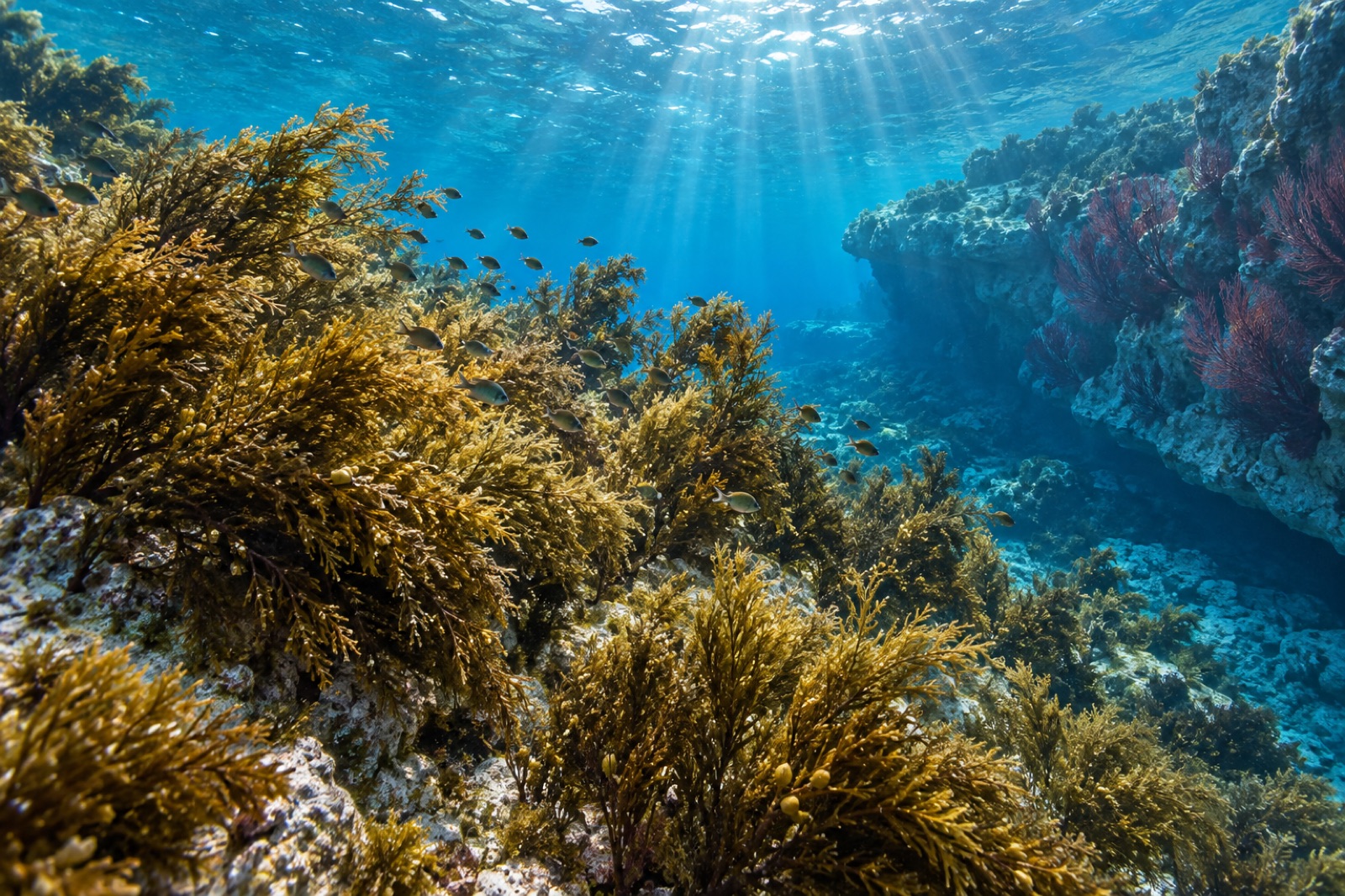
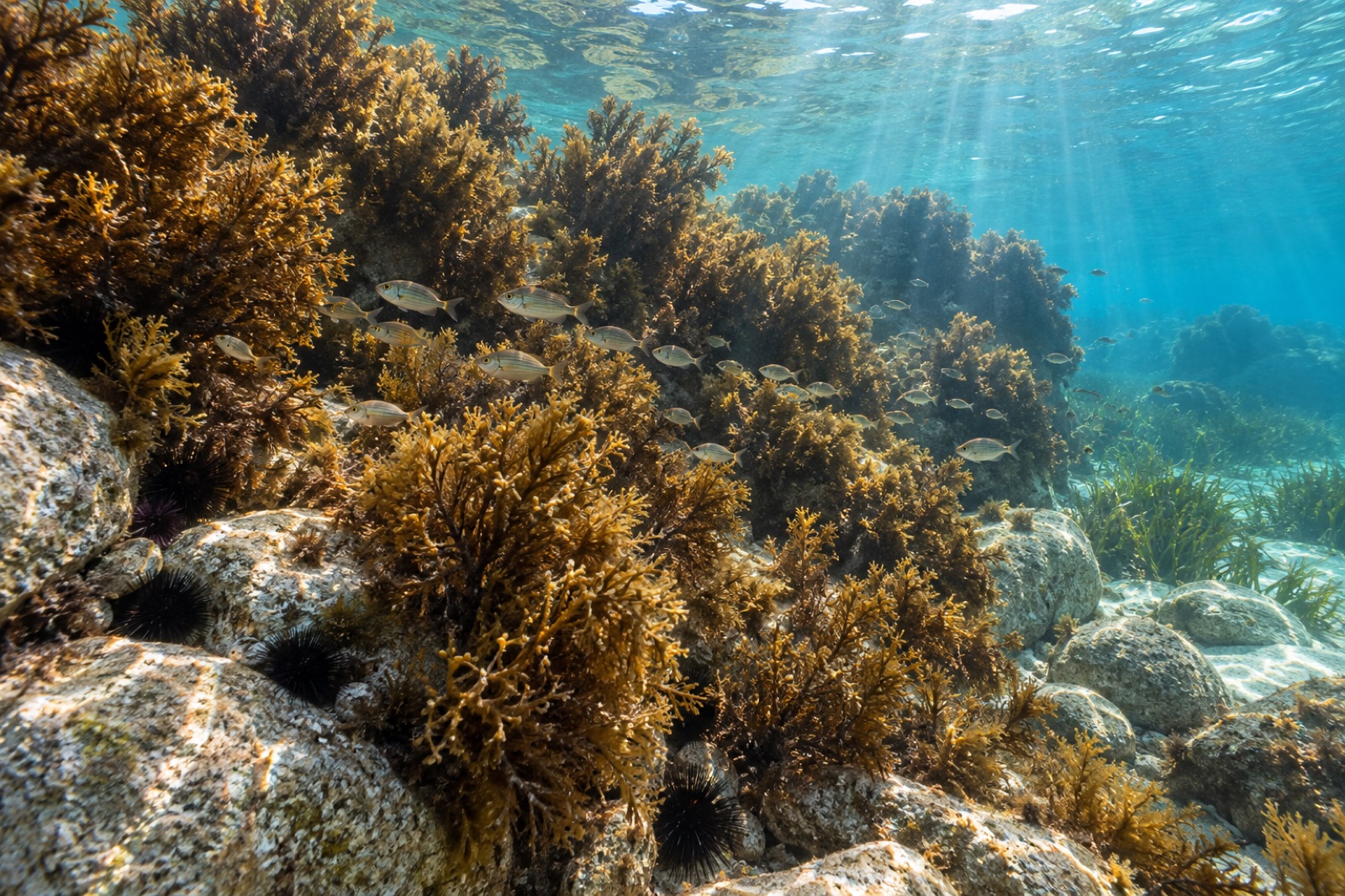
A healthy Adriatic Cystoseira forest typically grows between one and ten metres depth on well-lit, clean rock: fronds up to a metre tall, bushy, branching, and holding their own small pocket of life — tubular hydroids, juvenile damselfish, pipefish tucked vertically into the branches, snails climbing to graze epiphytes. In where the forest stands are intact, visibility runs fifteen metres and more, and the effect is closer to a Mediterranean garden than to the towering cathedral groves of Pacific kelp. Smaller, browner, and a great deal older.
Inside the Bay of Kotor itself, turbidity and freshwater layer the community differently: the canopy is patchier, Posidonia seagrass meadows take more of the floor between rocky outcrops, and the whole system behaves more like a giant semi-enclosed estuary — which throws up its own ecology, discussed below.
Wildlife of the canopy and the bay
Montenegro's marine fauna feels like a condensed, warm Adriatic:
- Ornate and rainbow wrasse, damselfish, salema and bogue — the characteristic small-fish guilds of the canopy fronds, flickering between the fronds in loose schools.
- Moray eels and conger in rocky fissures, at moderate sizes; the really huge groupers of forty years ago are mostly a memory.
- Octopus in the shallow reefs, holding the classic midden of discarded bivalve shells outside dens.
- Seahorses (the short-snouted and, occasionally, long-snouted) in the bay's seagrass and algal fringe — one of the things that makes the inner bay surprisingly rewarding to snorkel for its size.
- Loggerhead turtles passing offshore along the deep shelf edge, and dolphins in wider water; the Adriatic's resident bottlenose populations are concentrated further north, but sightings off Montenegro are not rare.
- Mediterranean monk seal is a historical and faintly present animal: cave-haunting, rare, occasionally sighted, and part of the whole region's conservation stakes.
In the Bay of Kotor, the extra layer of interest is the steep salinity and turbidity gradient: you can snorkel from an open-sea dive site at the bay's mouth through a kilometre of layered, green, almost fjordic water, and end at an outflow where freshwater springs seep through the rock.
Pressures: a forest under three kinds of stress
The state of Montenegro's canopy is a story the whole Mediterranean is telling, with local accents:
- Urchin expansion. The black sea urchin Arbacia lixula — historically a minor player — has been spreading through the warming Mediterranean and is now locally abundant on Montenegrin rock. Alongside the native purple urchin Paracentrotus lividus, urchin barrens can replace complex canopy in a few seasons, and the mechanism is the same trophic release described across the world's kelp coasts: remove the fish that eat urchins, and the urchins mow the canopy down. The dynamics are worth a read in the global context of trophic cascades in kelp forests.
- Silt and nutrients. Karst coasts carry their own risk: intense rainfall over steep, deforested slopes dumps sediment onto the reefs, and coastal development adds nutrients. Canopy algae are poor competitors in murky, nutrient-rich water; this is why the fragments of Cystoseira remaining today cling mostly to the cleanest ledges and offshore rocks.
- Warming. The Mediterranean is warming at roughly twice the global average for the coastal oceans overall; recent summers have set new records in the Adriatic. Cystoseira's resilience is real but finite, and each marine heatwave now resets more ledges bare. The marine heatwaves explainer sets out the mechanism; the Mediterranean earns many of its record months.
- Pressure from anchoring and coastal use. Seagrass beds in the bays suffer direct physical damage from anchors and trampling; small, low, slow-growing and hard to transplant, Posidonia is the Adriatic's most quietly vulnerable ecosystem.
Protection: Montenegro's first marine parks are very young
Montenegro designated its first formal marine protected area in 2021: Platamuni, a stretch of reef and cliff off the Luštica Peninsula, followed shortly by the Katič archipelago off Petrovac. Both are frank about what they can and cannot do — enforcement in a young MPA is a process, not a switch — but the symbolic step matters. Marine protection in the eastern Adriatic has a working template further north, and the comparison with Croatia's more established network is instructive: what a settled MPA looks like on the same coast, decades on. A proposed park around the Tivat salt pans and bay would extend protection into the inner ria, which would be a genuinely new kind of object for the Mediterranean: estuarine-scale protection inside a sheltered ria.
Visiting: what to know
- Visibility and season. Clearest water is June and September–October, just off-peak season; high summer haze reduces clarity in the bay itself.
- Where to enter. Popular shore entries cluster on the Luštica-facing coast (Rose, the cliff sites near Platamuni), around Budva's rocks, and at Katič. Boat dives make Katič and the cape easier.
- Skill level. Sheltered inner-bay snorkelling is accessible to most swimmers; the open-coast cliffs carry swell and should be approached with care and local advice.
- Sensitive sites. Platamuni is a nature reserve — check local rules before diving; the mooring and anchoring framework around Katič is evolving as enforcement matures.
- Supplies. Diving infrastructure is small but growing; most organised diving runs seasonally from Budva, Herceg Novi and Kotor.
Key takeaways
- Montenegro's coast is a compressed karst shore: ria-fjord luxury bays, sheer rock, and the southern Adriatic's remaining Cystoseira canopy forests.
- These are not true kelps, but they do the same ecological work in miniature — sheltering fish, structuring the reef, and marking the coast's health.
- The canopy's three visible stressors are urchin expansion, silt/nutrient loading, and a warming Mediterranean that keeps rewriting records.
- Montenegro's first marine parks (Platamuni and Katič, established in 2021) are very young; success will depend on enforcement and community buy-in.
- For visitors, the Luštica coast and Katič offer the best combination of clear water, reef and structure — with respectful, rule-following access to the new protected sites.
FAQ
Is there actually kelp in Montenegro?
Not in the strict sense: true laminarian kelps do not grow in the Mediterranean. Montenegro's "kelp forests" are stands of Cystoseira and its relatives — canopy-forming brown algae of a different lineage, but functionally similar. See the Cystoseira profile for the full distinction.
When is the best time to dive or snorkel?
June and September–October give the best balance of warmth, clarity and manageable visitation. The Bay of Kotor itself is hazier in high summer; the open-coast points keep their visibility longer.
Are the new marine parks open to visitors?
Platamuni is a protected site with rules in force; Katič is governed by evolving mooring and access arrangements. Always check the current local guidance — the parks are in their enforcement adolescence, and compliance now decides their future.
How threatened is the Cystoseira canopy?
Declining across most of its range, for the same reasons the whole Mediterranean's canopy algae are declining: urchin overgrazing, silt, warming and habitat fragmentation. Montenegro still holds some of the clearest remaining stands on the eastern Adriatic.
Should I worry about the urchins while swimming?
Not from a safety standpoint — Paracentrotus spines are the painful but routine rock-pool variety of anywhere, and the black Arbacia is merely more of the same. The ecological issue is overpopulations on degraded rock, not a general hazard.