Encyclopedia9 min read
Cystoseira: The Mediterranean's Lost Canopy Forests
Cystoseira and kin built the Mediterranean's underwater forests for millennia. Why these canopy algae are retreating, and what it takes to bring them back.
Dr. Mara Ellison ·
A granite-and-limestone island ringed by brown-algal canopies, Posidonia meadows and marine reserves — the Mediterranean's canopy kelp story, up close.
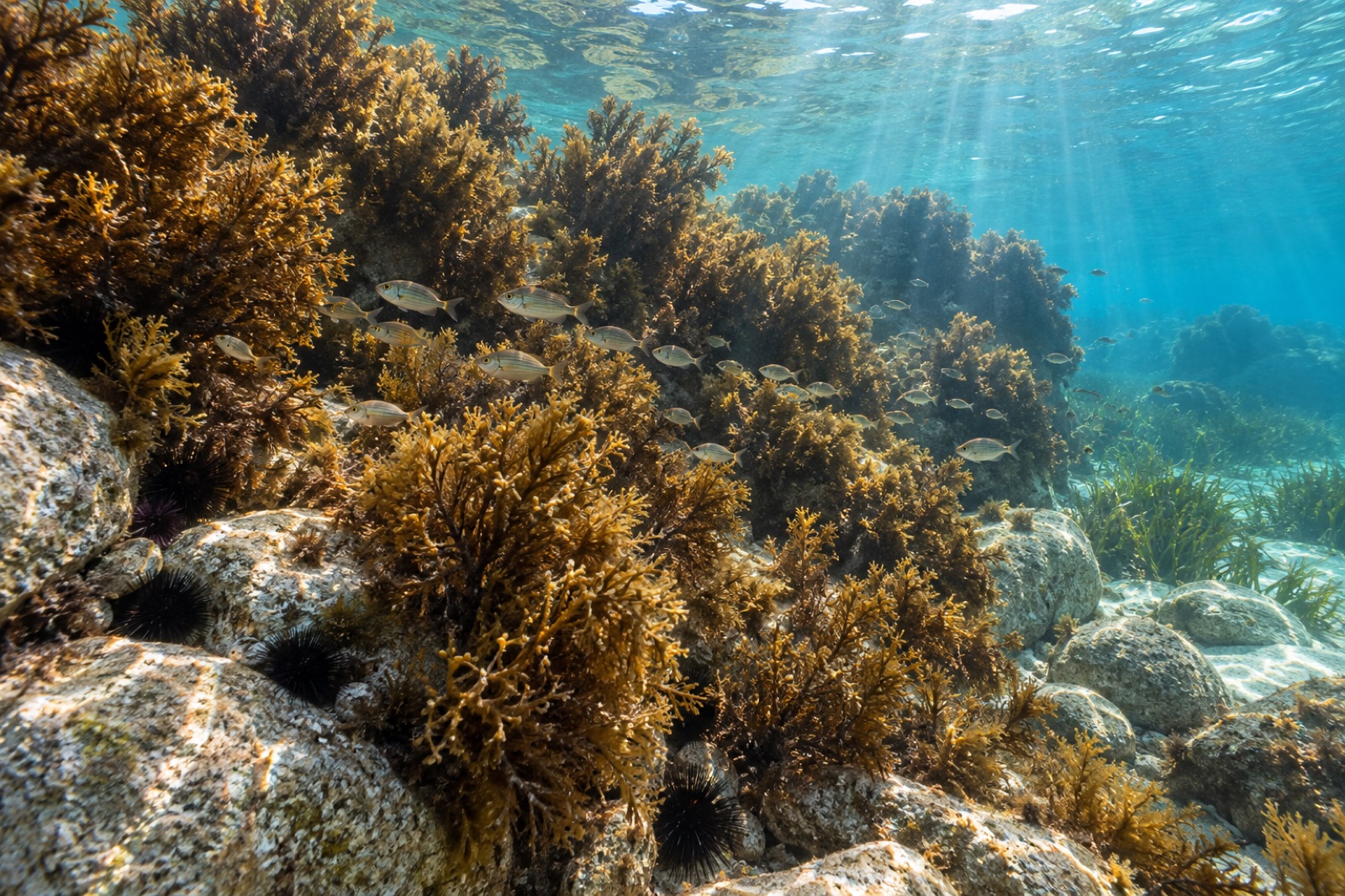
The Mediterranean has no giant kelp. What it has instead — and what Sardinia displays as beautifully as anywhere in the basin — are canopy forests of fucalean brown algae: bushy, metre-long brown seaweeds of the group taxonomists long lumped as Cystoseira and have now split into genera such as Ericaria, Gongolaria and Carpodesmia. Around Sardinia's 1,850 kilometres of granite headland and limestone karst, these canopies once formed a near-continuous shallow-water forest, packed with fish and held up on rock polished by ten thousand years of swell. Much of that forest still stands — more of it, and better protected, than nearly anywhere else in the Mediterranean — but it has frayed, and the story of why is Sardinia's gift to kelp science. This atlas entry tours the coast by rock type, reserve and season.
Sardinia divides naturally into geological provinces. The northeast — Gallura, the Costa Smeralda and the La Maddalena archipelago — is ancient granite, weathered into smooth, sculpted domes that slide underwater into boulder fields. The east coast around the Gulf of Orosei is karst limestone, cut by cliffs, coves and submarine caves. The west mixes volcanic basalt with dune fields and lagoons. Each rock supports a different flavour of canopy, and the marine protected area network stitched along these coasts is what makes Sardinia a living reference library for Mediterranean reef ecology.
Call Sardinia's underwater forest what it is: a canopy forest of brown algae functioning exactly like a kelp forest — shading, sheltering, feeding and structuring an entire reef community, despite being a very different plant lineage. The Cystoseira-group canopies are perennial and long-lived; Ericaria amentacea builds bushy thickets in the surf zone, Ericaria crinita and Gongolaria barbata stand deeper in protected coves, and several species form dense subtidal belts a few metres tall on exposed reef. Fish — seabreams, damselfish, wrasses — live in and patrol the canopy; juvenile groupers hide under it; lobsters and octopuses work the cracks beneath.
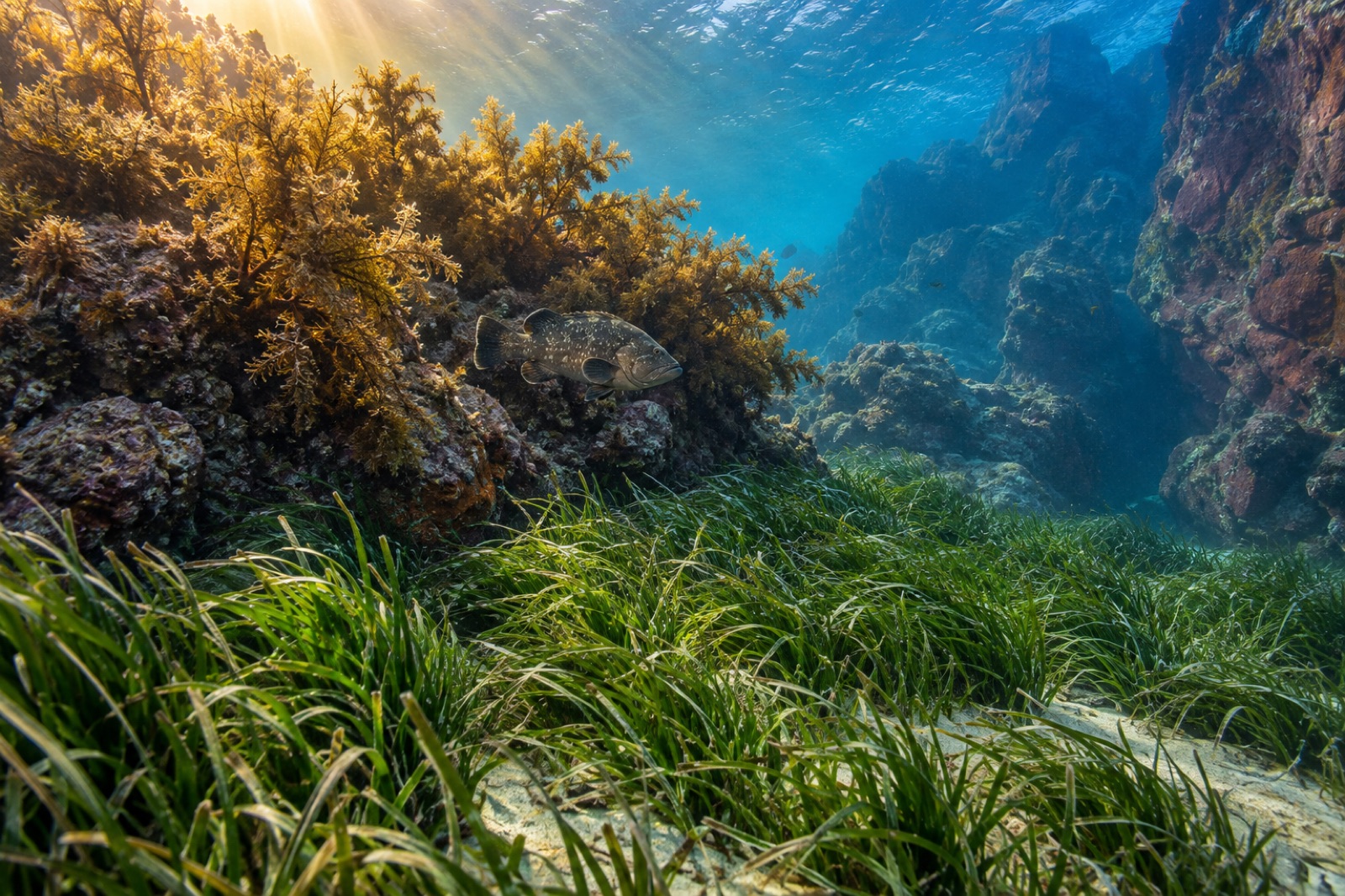
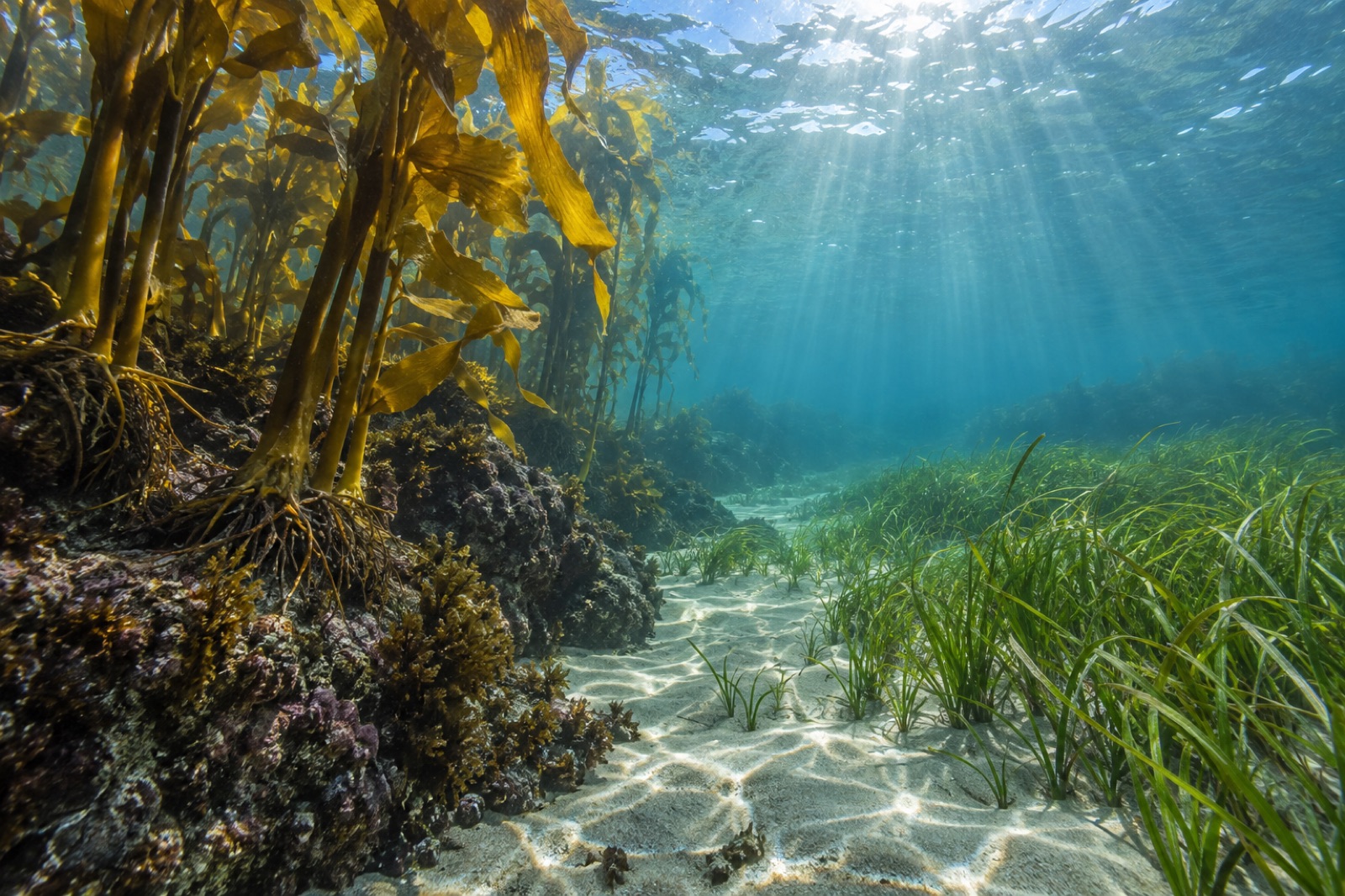
Beneath and between the algae sits the Mediterranean's other great underwater meadow: Posidonia oceanica seagrass, which grows in rhythmic terraces off every sandy bay and supplies food and nursery habitat to a different set of animals. If you're used to thinking of seagrass and seaweed as competitors, Sardinia teaches the better lesson — kelp forests and seagrass meadows here run side by side, the seagrass holding the sand, the canopy holding the rock, both feeding the same food web.
The granitic northeast. La Maddalena Archipelago National Park and the Costa Smeralda's offshore islets preserve Sardinia's wildest shallow canopy. The granite's rounded profiles and deep fissures hold some of the basins' densest Ericaria stands; snorkelling here, you fin through forests of brown fronds over blue water, with schools of salemas and the occasional passing amberjack. The neighbouring Corsican coast shares the same granite and the same canopies, and the two islands together form the Tyrrhenian's canopy heartland.
The limestone east. The Gulf of Orosei is cliff-and-cave country. Where vertical karst dives underwater, the canopy continues downward on shaded ledges, and deeper-water species persist in cold pockets. The drop-offs carry sponges, red gorgonians and the endemic limpets of the submarine caves; swallows of the shore, such as Eleonora's falcons, patrol above.
The volcanic west and south. Basalt shelves and sandy bights alternate. Around the Sinis Peninsula, the Capo Carbonara promontory and the far southwest, canopies run more patchily — here you see most clearly what the Mediterranean has been doing to its forests in the last forty years.
Sardinia's canopies have been pressed from three directions, and the pattern matches biology seen across the Mediterranean:
Overlaying all three, the slow spread of warm-water species — the tropicalisation of the Mediterranean that has pushed parrotfish, rabbitfish and exotic algae into the basin — is steadily rewriting what a "healthy" shallow reef looks like. Sardinia's reserves are where we measure all of it.
Sardinia did something remarkably early and well: it protected its reefs. The island and its immediate islets carry one of the densest networks of marine protected areas in the Mediterranean — Tavolara–Punta Coda Cavallo (1997) off the northeast, the Asinara National Park (1997) in the northwest, Capo Carbonara (1998) in the southeast, the Sinis–Mal di Ventre MPA on the west coast and Capo Caccia–Isola Piana near Alghero, plus La Maddalena Archipelago National Park in the north. Successive studies have shown what you would hope: fish biomass, predator numbers and canopy condition inside the no-take zones all outperform fished neighbouring reefs. The reserves have become the reference sites for Mediterranean restoration — the places where scientists learn what an "undamaged" canopy even looks like, and where young canopy material is collected for reseeding trials elsewhere in the basin.
That quiet function — donor reefs that supply the raw material for regrowing canopies on damaged coasts — is Sardinia's real contribution to the future of underwater forestry. Every cystoseira-transplant experiment from Marseille to Sicily owes something to the holdfasts still standing here.
The classic gateways are Santa Teresa Gallura and Palau (for Maddalena), Olbia (for Tavolara), Stintino (for Asinara) and Villasimius (for Capo Carbonara). Diving and snorkelling are straightforward; the protected zones restrict anchoring and fishing, and the buoys are well marked.
Not giant kelp (Macrocystis) — it's a Pacific species. The Mediterranean's kelp analogues are the fucalean brown algae of the historical Cystoseira group, reclassified into genera such as Ericaria, Gongolaria and Carpodesmia. Functionally they do the same job: canopy, shelter and primary production on shallow reef.
La Maddalena Archipelago National Park for dense Ericaria thickets on granite; Tavolara–Punta Coda Cavallo for the classic combination of canopy, Posidonia terraces and reef fish; Capo Caccia for limestone overhangs and deeper-water species.
A mixture of herbivore release (overfished predators → overgrazing), direct urchin and canopy disturbance, repeated heatwave summers, and competition from turf and invasive algae. The reserves slow all of these but cannot block the heat.
Dusky groupers are reliably seen inside the no-take zones, especially at Tavolara and Asinara. Mediterranean monk seals are effectively gone from Sardinia's mainland shores; sightings are so rare that each one makes the local news.
All three share the canopy ecosystem, but Sardinia's MPA density, early protection dates and geological variety (granite, karst and basalt in one island) make it the most useful living laboratory — it's where the Mediterranean measures what it has lost and tests how to grow it back.
Cystoseira and kin built the Mediterranean's underwater forests for millennia. Why these canopy algae are retreating, and what it takes to bring them back.
Dr. Mara Ellison ·
A coastal atlas guide to Corsica — Cystoseira canopy forests, vast Posidonia meadows, and the Mediterranean's only true kelp in deep water off the island of granite.
Dr. Theo Nakamura ·
Kelp is an alga; seagrass is a flowering plant. How the ocean's two great habitats differ in biology, range, carbon storage and the ways we restore them.
Dr. Theo Nakamura ·