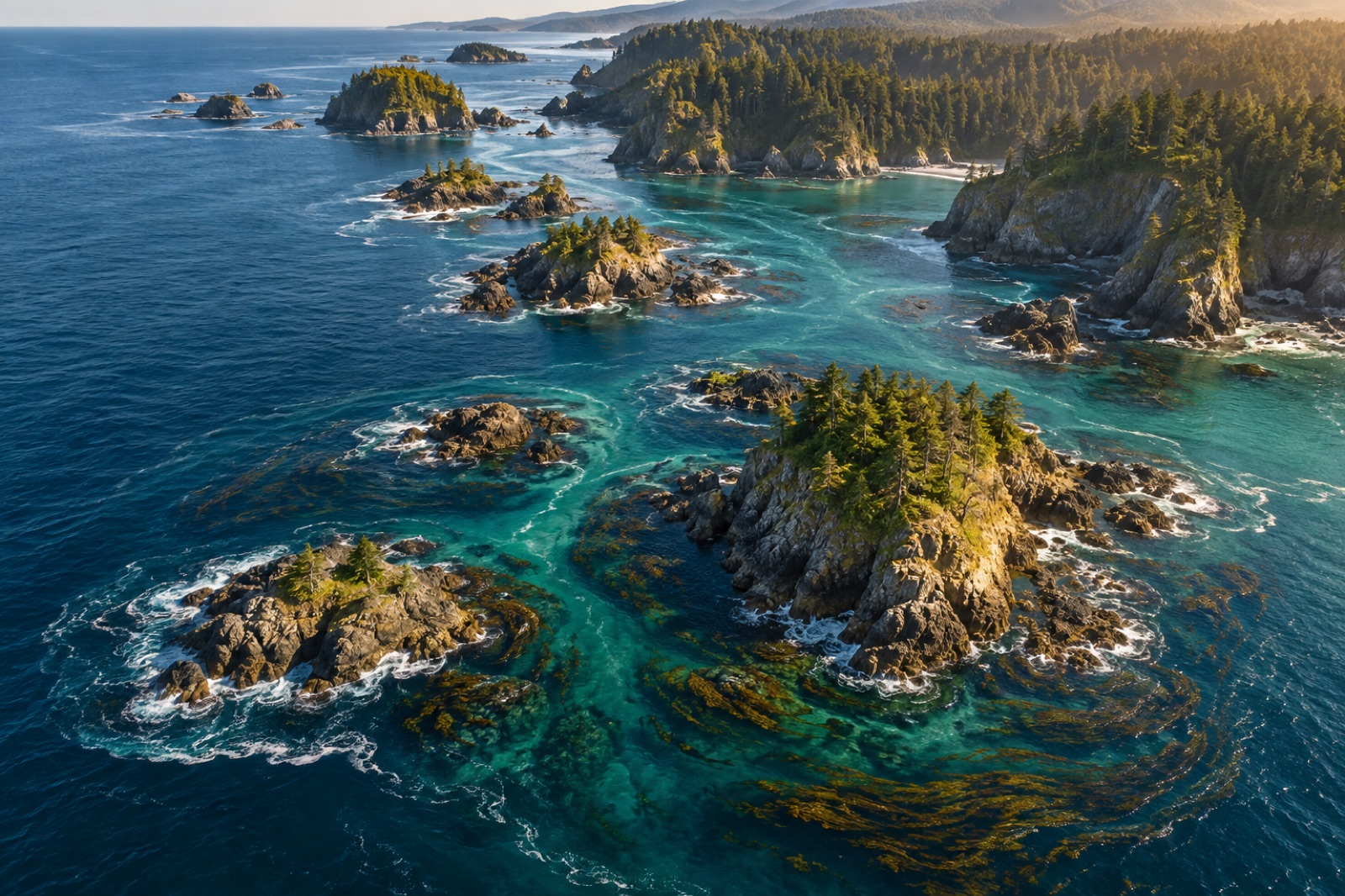
Off the east coast of Tasmania, at the cold edge of Australian kelp country, a sea urchin that used to live comfortably in the mainland warmth of New South Wales now marches south down the reef, turning algal forests into overgrazed pavement as it goes. Off Japan, once-kelp-covered coasts below Honshu have yielded to nibbling tropical surgeonfish and rabbitfish. Around the world, research voyages and dive surveys keep reporting the same quiet shift: warm-water species arriving in places that used to be too cold for them — and staying.
Ecologists call this tropicalization: the poleward transport and establishment of warm-water species and communities into temperate ecosystems that have historically been built around kelp forests. It is the community-scale expression of a trend that individuals have been making for decades — and it is rewriting the rules on reefs that evolved without these newcomers.
Range shifts: the climate signal already in the water
Ocean warming does not arrive evenly; it pools in boundary currents, surges in marine heatwaves, and it pushes the thermal envelope of every species toward the poles. Globally, marine species are shifting their ranges faster than terrestrial species — commonly tens of kilometres per decade — because the ocean has few fences and because most marine larvae ride the currents.
A range shift is not a migration in the seasonal sense. It is a slow re-negotiation of the map: the trailing (warm) edge of a species' range contracts as conditions become deadly, while the leading (cool) edge expands as winters become survivable. Species ride that envelope. On coastlines with strong poleward-flowing boundary currents — the East Australian Current, the Kuroshio, the Leeuwin, the Agulhas — the shift is fastest, because the current carries warm water and colonists in the same direction the climate is heading.
Tropicalization is what happens when the species making those shifts are warm-water herbivores, corallivorous invertebrates and tropical generalists that alter the entire habitat template when they arrive.
How tropicalization unbuilds a kelp forest
A healthy kelp forest is not a static thing; it is an equilibrium between growth and grazing held in check by predators and by the pace at which herbivores work. Tropicalization unbalances that equilibrium through three main engines.
New herbivores that multiply in warm water
Tropical and subtropical herbivorous fish and urchins arriving in temperate reefs consume kelp and turf algae faster than temperate communities evolved to handle. On parts of the Great Southern Reef and Japan, schools of warm-water rabbitfish and parrotfish now crop pioneer kelp nearly as fast as it recruits, and the newly dominant algal community is a low, cropped turf-scape rather than a canopy.
Many warm-water species have appeared seasonally in temperate waters for centuries, dying back or retreating each winter. Tropicalization begins in earnest when winter stops killing them. Once subtropical grazers survive the cold months, their populations build year on year instead of resetting — and so does their pressure on kelp. Tasmania's east coast provides the canonical case: the longspine sea urchin, historically mainland, established in Tasmanian waters once larval delivery and winter temperatures crossed a threshold, and has since converted significant rocky reef from kelp bed to barrens. The front line of that story is charted in the Tasmania East Coast atlas.
Thermal erosion of the defenders
Meanwhile, the resident kelp itself is squeezed. Every kelp species has an upper thermal boundary — explored in detail in our piece on the thermal limits of kelp — and chronic warming erodes its recruitment and growth even before acute heatwaves strike. The new grazers arrive just as the forest's capacity to regrow is weakening. The trap is compounded: grazing weakens the canopy, a thinner canopy lets more light and more grazers in, and the reef flips into an alternative state that is stubbornly hard to reverse.
Where tropicalization is moving fastest
Reports of clear tropicalization are now charted across all the great temperate-kelp strongholds:
- Tasmania and southeastern Australia, where longspine urchins and warm-water fish have marched south down the East Australian Current.
- Southern Japan, where kelp and coralline-covered reefs below Honshu have thinned under subtropical fish grazing, and "isoyake" — barrens formation — has spread along coasts where kelp industries depend on the forest.
- The Mediterranean, where warm-adapted aliens now constitute a significant fraction of shallow-reef biomass, compressing the remaining Cystoseira canopy forests.
- Western Australia, where Leeuwin Current heat events have propelled tropical grazers far into temperate algal meadows.
Not every coast tropicalizes equally. Deep-water upwelling refuges, cold-adapter kelps and predator-intact food webs all appear to slow or resist the shift — which is why thermal refugia and intact top-down control are now central topics in climate-adapted reef management.
What tropicalization is not
Two cautions keep the science honest.
First, tropicalization is not simply "more species." Some temperate reefs gain warm-water colonists and become more diverse, at least locally — the loss is not numerical but functional and structural: the canopy, its productivity, and its cool-water specialists.
Second, not all kelp loss is tropicalization. Nutrient pollution, sediment, urchin release via sea-otter or predator decline, and simple heat stress all kill forests without a tropical herbivore in sight. Careful attribution — time series, fishery-independent surveys and temperature records — is what distinguishes climate-driven community turnover from other insults.
Can a reef resist? Adaptation and intervention
The hopeful news is that tropicalization is a pressure, not an inevitability, and pressure has points of weakness.
Healthy predator guilds slow the front. Where sea urchin predators — lobsters, large fish, recovery-gaining sea otters — are intact, incipient urchin invasions are repeatedly checked. Protecting and rebuilding predator populations is now climate-restoration policy in temperate seas.
Warm-adapted kelp matters more every year. If the canopy's thermal ceiling cannot rise, no grazer management can save the forest. Selective use of warm-tolerant provenances — thoughtfully, locally tested — is moving from experiment to practice in restoration genetics, the very topic explored on the Tidewright platform's Holdfast hatchery program. Sound intervention follows the logic laid out in assisted migration for kelp: move genes, carefully, and only where ecology makes sense.
Marine connectivity cuts both ways. The same currents that deliver warm-water grazers also deliver resistant kelp recruits and predator larvae. Networks of protected, connected reefs — marine connectivity as infrastructure — spread both risk and rescue across a coastline.
None of this halts the climate forcing. It buys forests time, and it keeps enough reef alive that when the climate stabilises, there is something left to spread.
Key takeaways
- Tropicalization is the poleward establishment of warm-water species in temperate, kelp-structured ecosystems — the community-scale expression of climate-driven marine range shifts.
- It proceeds fastest along poleward-flowing boundary currents, where warm water and colonists travel together.
- New warm-water herbivores, winter survival of seasonal colonists, and simultaneous thermal stress on the resident kelp combine into a one-way ratchet toward grazed, canopy-free states.
- Not all kelp loss is tropicalization; attribution requires careful time series and separation from eutrophication, overfishing and heat stress.
- The levers that slow tropicalization are predator protection, warm-adapted seedstock, and connected reef networks — time-buying measures, not cures.
FAQ
Is tropicalization happening everywhere?
Not everywhere, and not equally fast. It is most pronounced where strong poleward currents, rapid warming and vulnerable herbivory-sensitive canopies coincide: southeastern Australia, Japan, the Mediterranean, and Western Australia are leading examples. Upwelling-shadowed coasts and high-latitude refuges are, so far, more resistant.
Does tropicalization mean corals replace kelp?
Occasionally, at the marginal overlap — but kelp and corals rarely directly substitute for one another, because their texture, light and substrate needs differ. More commonly, tropicalization replaces kelp with low turf algae and cropped barrens rather than a coral forest.
Can the warm-water invaders be harvested out?
Targeted harvest is a real management tool — Tasmania's longspine urchin fishery is the textbook case — but it typically controls rather than eliminates the invader, and economics and logistics limit where it can work. It is one leg of an integrated strategy with habitat restoration and predator recovery.
Are species becoming "losers" in range shifts doomed to disappear?
Not necessarily, but some cool-adapted endemics at a continent's poleward edge — with no cooler habitat remaining — are genuinely at risk of range loss without a safety net. Deep-water and upwelling refugia can hold them; translocation is being researched as a last resort.
What should a citizen scientist watch for?
New records: subtropical fish inshore in winter, urchins spreading into kelp beds in dive logs, grazed kelp recruits where none used to disappear. Photos with location and date uploaded to community platforms build exactly the trailing-edge datasets that detect tropicalization early — when responses are still cheap.