Encyclopedia9 min read
Cystoseira: The Mediterranean's Lost Canopy Forests
Cystoseira and kin built the Mediterranean's underwater forests for millennia. Why these canopy algae are retreating, and what it takes to bring them back.
Dr. Mara Ellison ·
A coastal atlas guide to Corsica — Cystoseira canopy forests, vast Posidonia meadows, and the Mediterranean's only true kelp in deep water off the island of granite.
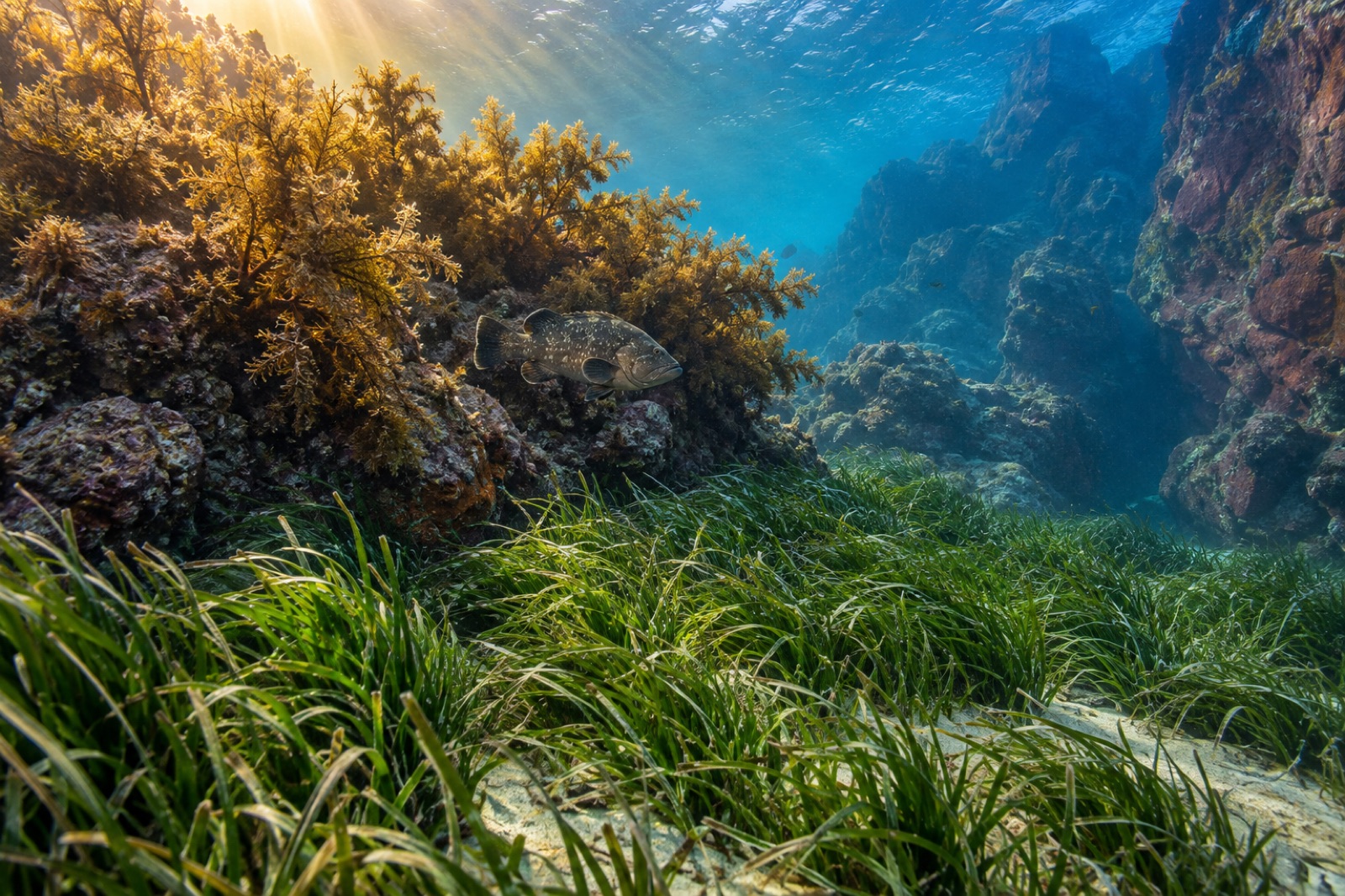
From the deck of the ferry out of Nice or Toulon, Corsica rises out of the Mediterranean like something the Atlantic mislaid — a granite citadel of a thousand metres, ridged and maquis-scented, with a coast line of such geological variety that you can drive from polished porphyry cliffs to white quartz strands in an afternoon. Underwater, the island is stranger and more wonderful still. The Mediterranean has no shallow-water kelp forests of the cool-ocean kind; what it has instead, and what Corsica shows better than almost anywhere, is a layered Mediterranean forest system: a canopy of bushy brown fucoids in the surf, an underwater prairie of seagrass on the sand, and — the island's secret masterpiece — the sea's only true kelp, a deep-water relict hovering on the edge of the light at depths beyond most divers' reach.
To read Corsica's underwater coast properly, picture three stores of structure, stacked by depth.
The upper forest is Cystoseira. The bushy, golden-brown fucoids that Western science piled into the genus Cystoseira — now redistributed across several genera but still the names everyone uses — form the functional equivalent of kelp canopy across the Mediterranean: dense, perennial, highly structured, and the habitat architect for hundreds of Mediterranean reef species. Corsica's rocky coast, especially the exposed points and island fringes, carries some of the best Cystoseira stands in the western Mediterranean — a canopy our species profile explains in detail.
The middle forest is the meadow. Posidonia oceanica, the endemic Mediterranean seagrass, spreads in vast, slow-growing underwater prairies through Corsica's bays and shallows — meadows that can be centuries old, that trap carbon in mats of root and rhizome, and that discipline sand, surge and clarity around every granitic bay. Posidonia is not kelp, and the comparison is instructive rather than interchangeable — we wrote about why in kelp vs seagrass — but ecologically it does the same job the giant kelp forests do in California: it is the island's house-sized underwater biomass, its nursery and its soil.
The deep forest is the island's true kelp. Laminaria rodriguezii — a genuine Laminaria kelp, related in form to the oarweeds of the Atlantic but endemic to the Mediterranean — grows in deep, dim water, typically beginning around fifty metres down and reaching deeper still, on rocky ledges and reef outcrops where cool, clear light barely reaches. Discovered in the nineteenth century, known from the Adriatic and the Balearics, and recorded in deep water around Corsica and nearby islands, it is a relict of a cooler geological Mediterranean — a kelp the sea kept after the climate withdrew. It is nearly invisible to anyone without serious technical diving or scientific gear, and it is one of the great strange facts of the ocean map: a temperate kelp, growing quietly off a Mediterranean island known for cicadas and chestnuts.
Corsica's coast reads differently in each quarter, and the kelp-and-meadow system tracks the rock.
The west coast is the famous one: the serrated red porphyry of the Scandola Peninsula and the Calanques de Piana, the deep gulfs of Porto and Sagone, granite headlands and a coast so steep that depth comes fast close in. This is canopy country — Cystoseira on every sheltered rock face, groupers in the shade of the gulf walls, and Scandola's reserve system protecting a rarely broken stretch of reef. The north, around Cap Corse and the Agriates desert, is wilder and less visited: long schist ridges falling into the sea, remote beaches, and some of the island's clearest water. The east coast softens to sand, where the Posidonia meadows spread across open bay bottom — the diving is plainer, the meadows vaster. And in the south, around Bonifacio, the island switches to white limestone: chalk-white cliffs, caves, and the strait of the Bouches de Bonifacio between Corsica and Sardinia, whose strong current and rocky reefs hold some of the island's most dramatic underwater terrain.
The Scandola Nature Reserve, established in 1975 and listed by UNESCO as part of the Gulf of Porto World Heritage site, is the anchor of Corsican marine protection and a quietly consequential experiment in what even modest protection can do. Inside the reserve, fishing has been limited for half a century; dusky groupers grew back, spiny lobsters returned to their crevices, and the Cystoseira canopy flourished precisely as forest ecologists predicted. Scandola showed what undisturbed Mediterranean reef looks like — which is exactly why the marine-reserve question matters so much in the Mediterranean.
The south is now covered too, in its way: the Bouches de Bonifacio Nature Reserve, the largest in metropolitan France, manages the strait and its approaches with mooring buoys, restricted anchoring and regulated diving — the sort of hands-on, permit-and-buoy management that a heavily visited coast probably requires. And the island's meadows have their own quiet protections: mandatory anchored-buoy fields (donia systems) off harbours began replacing free anchoring over the seagrass years ago, and slowly, the meadow scars heal.
The species list here is pure western Mediterranean, and, at its best, lush. Dusky grouper — the great brown boulder of the reserve reefs — is the flagship; corb and brown meagre drift the canopy edge; gilt-head bream and saddled bream work the Posidonia margins. Octopus and moray use the rock; spiny lobster, where protected, restores itself to a reef one crevice at a time. Over the meadows: cuttlefish in spring, pen shells standing like punctuation in the grass, sea horses occasionally, and everywhere the meadow's endless small economy of pipefish, gobies and wrasse. Nudibranchs in the gulf walls give macro photographers a full summer's work. If you dive Corsica's canopy and meadows and want the wider Mediterranean fucoid story, our Dalmatian Coast atlas piece covers the karst Adriatic's version of this same forest.
The pen-shell story requires an honest footnote: Pinna nobilis, the giant Mediterranean bivalve, suffered a mass die-off across much of its range from 2016 onward, a parasite-driven catastrophe that largely emptied the western Mediterranean meadows of the species and left recovery programmes attempting captive breeding. Corsica's meadows carry that scar; recovery is slow and partial.
Two pressures now define Corsica's underwater future. The first is marine heat. The Mediterranean is warming at several times the global average, and recent summers have produced sustained heatwave conditions that hit shallow Cystoseira particularly hard: bleaching, canopy loss, and access for opportunistic turf algae. The pattern of canopy retreat with heat is now documented across the basin — our explainer on marine heatwaves sets out the physics — and the canopy forests of the shallow, wave-washed coast are on the front line of it. The relict deep-water kelp faces its own squeeze: deep, dim refuges only survive if the water above them stays cool and clear.
The second is the invasive carpet. Rugulopteryx okamurae, a small brown alga that arrived in the Strait of Gibraltar around 2015, has spread with alarming speed along the western Mediterranean, forming dense drifting mats that bury other algae and foul fishing gear. It has been recorded approaching the Ligurian-Tyrrhenian region; its progress into Corsica's waters is watched closely. Any guide to this coast a decade from now may have to be a gloomier book.
Corsica is one of the Mediterranean's great dive islands, and access runs from the easiest shore snorkel to serious wreck and cavern diving.
Conditions are gentler than the Atlantic but not trivial: summer meltemi wind from the northeast can shut the whole east coast, and the sea breeze builds reliably from late morning. Plan mornings; the afternoon belongs to the cafés.
Yes — one species. Laminaria rodriguezii, a true Laminaria kelp endemic to the Mediterranean, lives in deep, dim water beginning around fifty metres down. It is a relict of a cooler Mediterranean and one of the strangest facts of the sea's biogeography. Most of what looks like kelp in shallow Mediterranean water is actually a Cystoseira fucoid.
Absolutely, and you should: the meadows around Corsica's bays are among the easiest underwater prairies on Earth to visit, with pen shells (where they survive), pipefish, cuttlefish and schooling bream over the grass. Enter from the beach, stay off the meadow with your fins, and never touch a pen shell — they are now strictly protected.
The west coast around the gulfs and the Scandola peninsula, and the strait coast around Bonifacio, give the most dramatic stands. But Cystoseira grows on nearly every exposed rocky shore of the island — a granite point, a morning, and a mask are all you need.
Pinna nobilis suffered a parasite-driven mass mortality event beginning around 2016 that emptied most western Mediterranean meadows of the species, including Corsica's. Surviving individuals are now the subject of intensive conservation and captive-breeding programmes; look for the rare standing shell and leave it entirely alone.
Within Scandola, diving is regulated and effectively only by licensed operator; within the Bouches de Bonifacio, operators handle permits and buoys. Shore sites outside the reserves need no permit. Check with the dive centre — regulation here is real, and rangers do come round.
Cystoseira and kin built the Mediterranean's underwater forests for millennia. Why these canopy algae are retreating, and what it takes to bring them back.
Dr. Mara Ellison ·
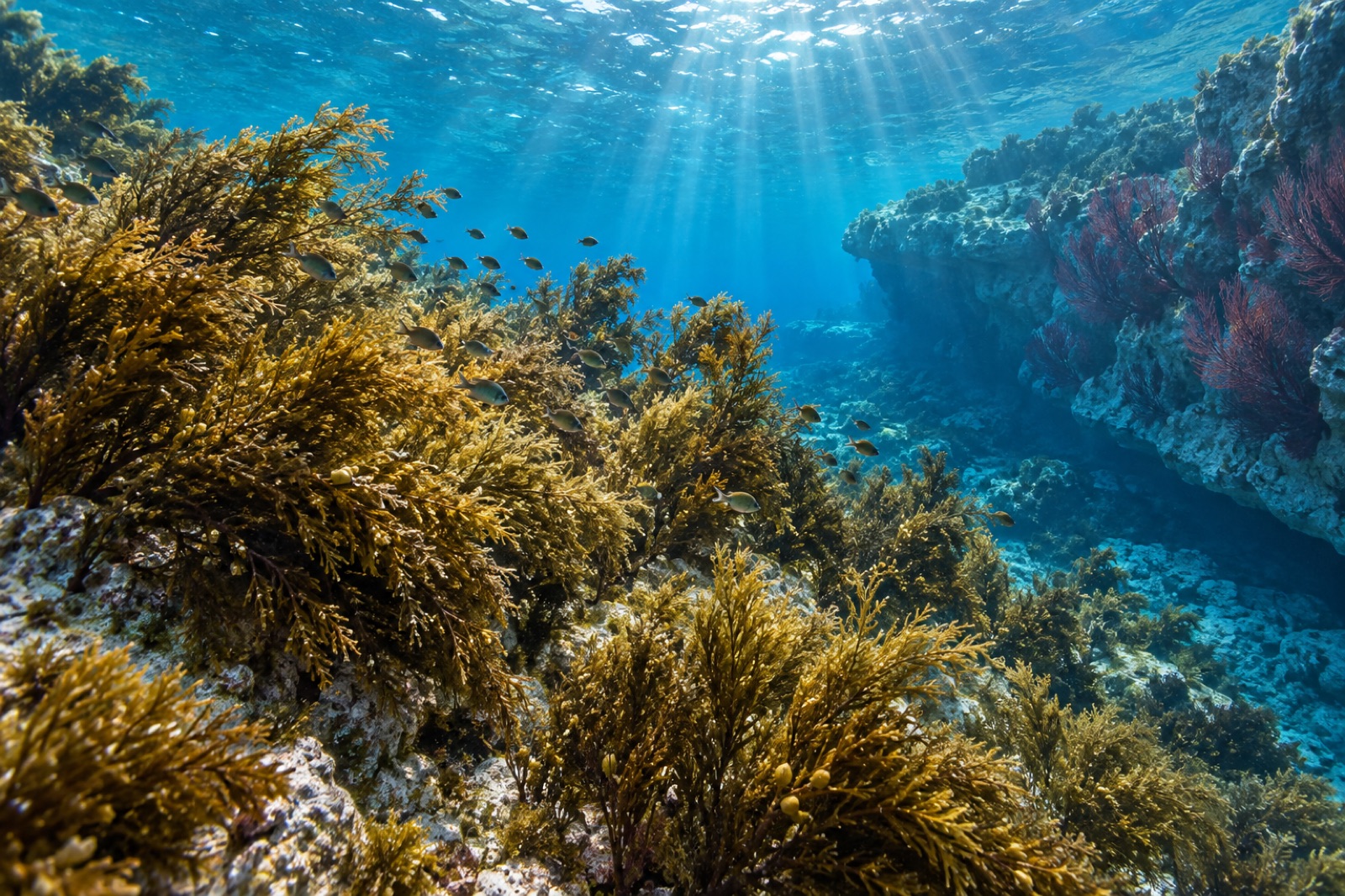
Croatia's island-chained coast grows the Mediterranean's great brown algal canopies on drowned karst — clear water, coralligenous reefs and forests now measured in fragments.
Dr. Theo Nakamura ·
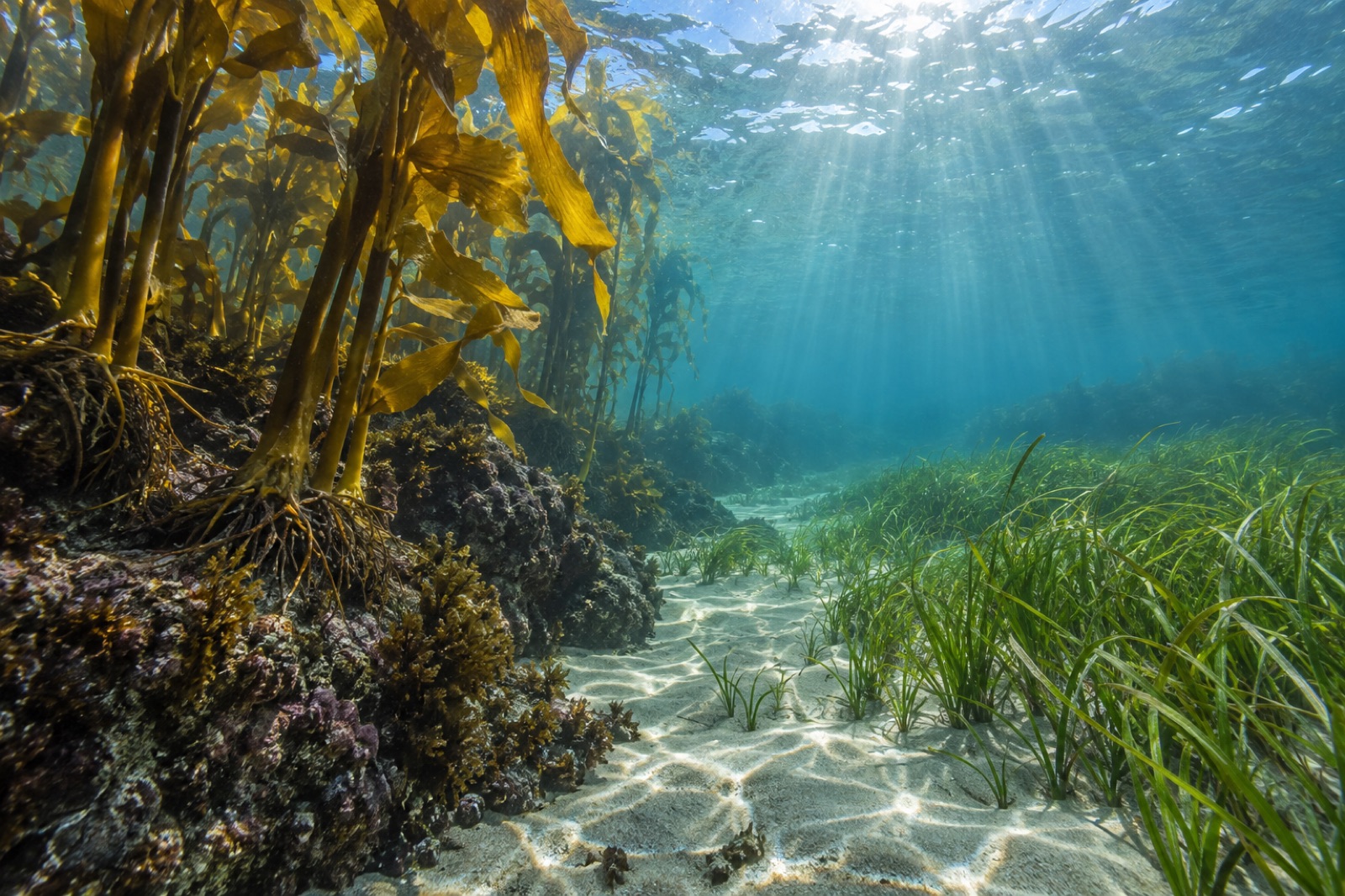
Kelp is an alga; seagrass is a flowering plant. How the ocean's two great habitats differ in biology, range, carbon storage and the ways we restore them.
Dr. Theo Nakamura ·