Explore9 min read
The Beginner's Guide to Kelp Forest Diving
Your first kelp forest dive is easier — and more magical — than you think. Gear, skills, marine life and etiquette for new divers entering the green cathedral.
Tom Okafor ·
Meet the kelp perch, a live-bearing surfperch that hovers in the kelp canopy, sips drifting plankton and picks parasites straight off larger fish.
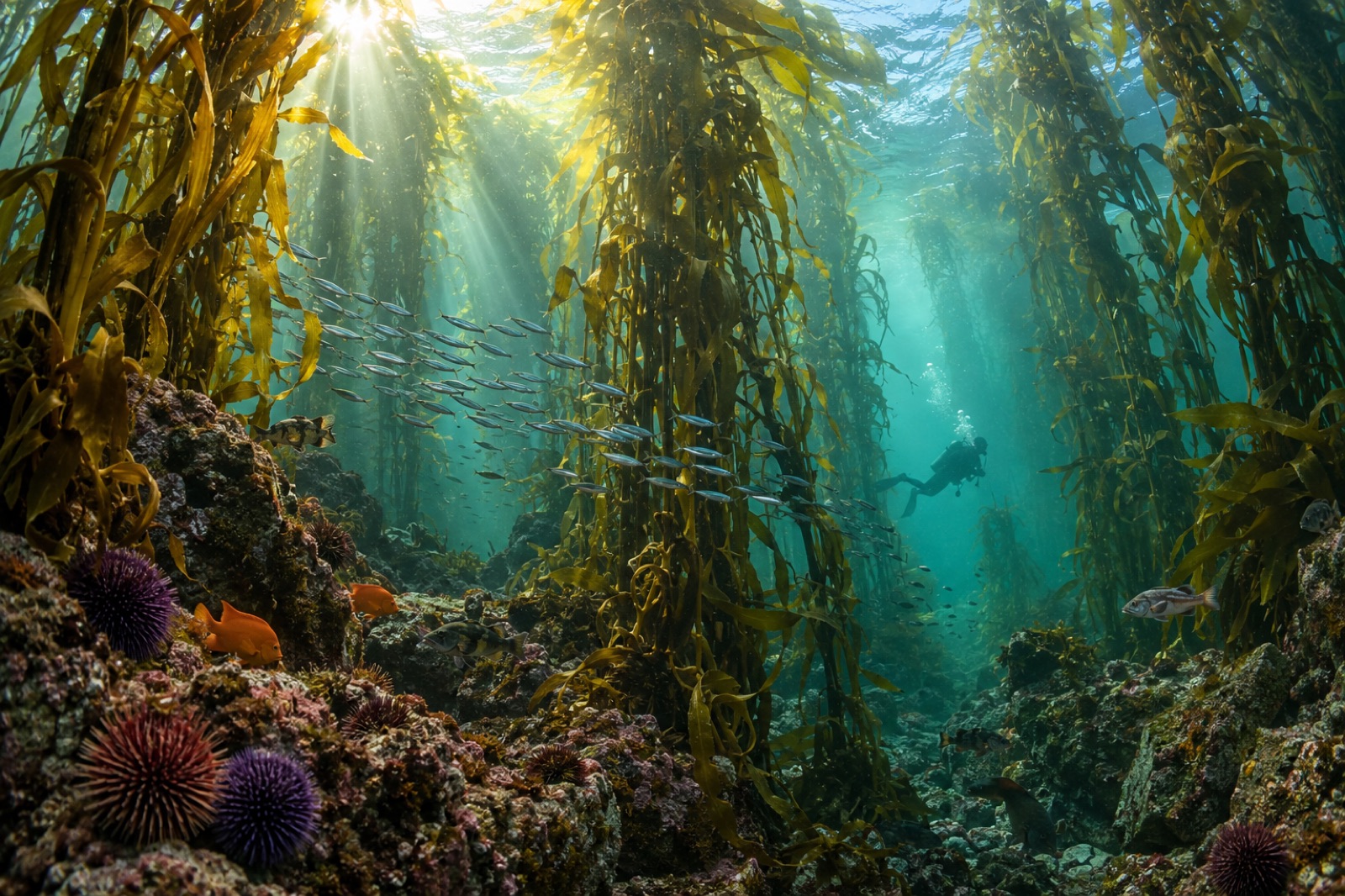
Look up, not down. In a Southern California kelp forest most divers fix on the bottom — the garibaldi guarding its nest patch, the lobster feelers in the rock — and miss the story playing out overhead. In the kelp canopy, where the fronds braid light into lace, hover small coppery fish by the dozen, tipped face-down to the current, trembling their fins as they hold station among drifting gold. Those are kelp perch (Brachyistius frenatus), the emblematic surfperch of the kelp forest — a fish that gives birth to live young, cleans the parasites off fish four times its size, and makes the canopy itself its home range.
| Scientific name | Brachyistius frenatus |
| Common names | Kelp perch; historically "kelp surfperch" |
| Range | Vancouver Island, British Columbia, to northern Baja California |
| Habitat | Kelp canopy and midwater over rocky reef, shallows to ~30 m |
| Size | To about 21 cm; most seen are 10–18 cm |
| Diet | Zooplankton — copepods, amphipods, larval crustaceans picked from open water and frond surfaces; ectoparasites nipped off larger fishes |
| Reproduction | Viviparous: females bear live, fully-formed young |
Surfperches are the odd fishes out among temperate reef communities, and the kelp perch is the oddity's purest expression: it is viviparous. There are no scattered eggs, no planktonic nursery stage. Males court females in autumn, internal fertilization follows, and the embryos develop for months inside the mother, nourished at specialized structures where her blood supply supports them — fish gestation in a genuinely mammalian shape.
Come the warm months, the female releases her brood — commonly a few dozen young, each one a centimetre-long facsimile of an adult — directly into the water column. Her offspring must fend for themselves immediately: no nest, no guarded rock, no drifting larval life. A newborn kelp perch is simply a very small kelp perch, already spending its first hours hovering in canopy gaps.
This lifecycle changes the species' whole relationship with place. A fish that never has a pelagic larva disperses little; kelp perch populations are local things, built reef by reef, and each forest's perch are, to a real degree, that forest's own. It is also a slow-growing, long-ish-lived arrangement — several years to full size, with lifespans reaching toward a decade — so each hovering school in a canopy is a small standing history of its reef.
Kelp perch live where their name says. Day and night they hover in midwater among the stipes, typically a metre or two below the canopy surface in small loose schools, often mixed with shiner perch and other surfperches. The posture — nose slightly down, body angled to the flow, fins sculling to hold position — is a planktivore's, designed to pick small crustaceans one by one out of the moving stream. Copepods, amphipods and larval shrimps are the staples, picked either from open water or off the surfaces of the fronds themselves.
Living in the canopy has a physics to it. The fronds damp and redirect flow, creating pockets of slower water where small prey lingers; the canopy also concentrates light and shadow into a three-dimensional maze that confuses the attacks of larger hunters from below. The kelp forest's wave-damping physics — the same physics described in our explainer on how kelp calms the sea — is thus also the architecture of the kelp perch's kitchen and refuge.
Through the night the fish find refuge deep in the frond tangles, resting so still among the leaves that divers with lights swim right past them.
Here is the kelp perch's small surprise: it is a cleaner. Kelp perch are routinely observed picking ectoparasites — copepod and isopod hitch-hikers — off the bodies and fins of much larger fishes, including California sheephead and kelp bass, which hold conspicuously still, gills flared, fins spread, while fish a fraction of their size work them over. Hosts will queue at established cleaning stations where groups of perch work regular beats.
Cleaning is a valuable service in a forest where parasites, unchecked, exact a real cost — and it is part of the hidden weave of services and interactions, like the hydroid–mite relationships at the other end of the size scale, that holds a reef together. The kelp forest food web, explored in our food web explainer, is not only teeth and appetite; some of it is dentistry.
The reward for the canopy's protection is that the canopy residents are themselves prey — and kelp perch are eaten in quantity by nearly everything larger in the forest. Kelp bass, rockfishes, lingcod and cabezon patrol for them; cormorants and other diving birds fish the canopy edges; sea lions sweep through and leave the water column silvered with scales. When kelp forest surveys count forage fish, perch are a large share of the story — the mid-column engine converting drifting plankton into food available to the bigger fish, and thus into the productivity that whole reefs, fisheries and dive trips are built on.
A mature kelp forest at Catalina Island or along Monterey Bay holds tens of thousands of them; each school a moving reservoir of live biomass that reshuffles within minutes of a predator's pass.
Kelp perch are one of the easiest kelp-forest fish to observe because they are almost indifferent to a slow, neutral diver. Climb gently into the midwater, find a school and hang your own body neutral: the perch soon accept you as another piece of vertical structure and resume feeding within arm's reach. Underwater photographers get their best perch shots against backlighting, fronds in the foreground — techniques we lay out in underwater photography in kelp forests.
For freedivers they are the perfect depth lesson — at home in the 3–10 m band where a breath-hold dive is most comfortable, and forgiving enough to allow a beginner real time with them. If you dive from oyster-cracked California reefs, you'll meet them on nearly every descent; our freediving in kelp guide covers the etiquette of sharing their column without pinning them against the canopy.
Yes. Fertilization is internal and the embryos develop inside the mother, nourished from her circulation. She releases live, fully-formed fry about a centimetre long, which immediately fend for themselves in the water column. No nest is built, no egg is laid.
To roughly 21 cm, but the schools you see in a canopy are mostly 10–18 cm fish — and any school large enough to matter includes generations of similar sizes rather than one dominant size class.
In virtually any Southern California kelp bed, from the Channel Islands down through Catalina and into northern Baja — anywhere fronds canopy 3–15 m water. They are also regular in central California and northward to Vancouver Island, anywhere the canopy stands.
None of the above. They are utterly harmless to divers, and a school will typically ignore or gently part around a neutral, unhurried swimmer.
Kelp perch are small, slim, coppery canopy schoolers; live-bearing surfperches. Kelp greenling are bottom-hugging ambush fish with blue-spotted males, egg clutches guarded by fathers, and a much deeper-bodied profile. Same forest, nearly opposite lives.
Your first kelp forest dive is easier — and more magical — than you think. Gear, skills, marine life and etiquette for new divers entering the green cathedral.
Tom Okafor ·
Meet the garibaldi, California's blazing orange state marine fish — a fiercely territorial damselfish that gardens algae on the kelp forest floor.
Dr. Theo Nakamura ·
How the kelp perch spends its whole life inside the kelp canopy — feeding, cleaning larger fish and raising live-born young — and what canopy loss means for it.
Dr. Theo Nakamura ·