Encyclopedia9 min read
A Field Guide to Kelp Forest Nudibranchs
Nudibranchs are the jewels of the kelp forest: shell-less sea slugs in startling colours. Learn the key groups, the star species and how to find them.
Tom Okafor ·
The hooded nudibranch Melibe leonina is a translucent sea slug that nets plankton from its perch on kelp blades. Biology, diet and where to see one.
Most sea slugs hunt by crawling. The hooded nudibranch (Melibe leonina) fishes. Perched on a kelp blade or an eelgrass frond like a pane of animated glass, it sweeps an enormous fringed hood through the water and snaps it shut over whatever drifts in — copepods, amphipods, larval crabs. From Alaska to Southern California it is one of the strangest and most memorable animals a cold-water diver can meet, and one of the few nudibranchs that truly lives on the kelp rather than beneath it. Here is what it is, how it feeds, and where to look.
| Scientific name | Melibe leonina |
| Group | Nudibranch — a shell-less sea slug in the family Tethydidae |
| Common names | Hooded nudibranch, lion's mane nudibranch (shared, confusingly, with the jellyfish) |
| Size | Commonly 2.5–6 cm; large animals reach about 10 cm |
| Depth range | Low intertidal to roughly 30 m |
| Distribution | Alaska to Southern California on kelp and eelgrass |
| Diet | Planktonic crustaceans — copepods, amphipods, mysids, crab and barnacle larvae |
| Notable traits | Cast-net feeding hood; swims by undulating; smells of watermelon when handled |
Identification is easy once you've seen it and impossible to believe before. The hooded nudibranch is almost entirely translucent: a gelid, faintly greenish body through which the gut appears as a branching, darker tree — the digestive gland running into the cerata. Down each side of the back runs a row of broad, leaf-shaped cerata, usually four to six pairs, edged rough like the blade of a handsaw. At the front, replacing the usual nudibranch head, is the apparatus that gives the animal its name: a wide, circular oral hood, fringed with two rows of short tentacles and looking, collapsed, a little like a spun-glass cabbage leaf.
Behind the hood sit a pair of rhinophores in smooth sheaths, reading the water's chemistry. The whole animal, at rest, hangs in the current with a slight droop that makes it look less like a slug than like part of the water itself — which is exactly the point. To a small fish or a crab looking for lunch, a Melibe spread on a kelp blade reads as sunlight and shadow.
Cerata, hood and rhinophores check every box of the nudibranch body plan described in our field guide to kelp forest nudibranchs — but Melibe has revised the plan for a floating menu.
Most nudibranchs graze — a radula rasping sponge, hydroid or bryozoan off rock. The hooded nudibranch has thrown away the radula altogether and become the slug equivalent of a trawler. Anchored to its blade by the foot, it lifts the hood, spreads it wide against the current, and sweeps slowly through the water column like a fisherman pushing a seine. The hood's inner surface is lined with sensory cells; the moment a copepod or amphipod touches it, the hood snaps shut, the marginal tentacles interlacing like fingers to cage the prey, and the mouth — small, central, at the base of the hood — gets to work.
Watch one feed and the strategy becomes obvious: this is an animal adapted for a pulsed, drifting food supply. Kelp canopies are lousy with planktonic crustaceans — the same soup of copepods and mysids that feeds juvenile rockfish — and Melibe has positioned itself in the middle of the serving line. It hunts most actively when the water is moving, dragging its net through the flow that streams between the fronds.
This places it in an unusual niche in the kelp forest food web: a mid-canopy planktivore, harvesting the same drifting crustaceans as small fishes, then converting them into slug — and slug, in turn, into meals for the few predators willing to sample it.
Where other nudibranchs haunt the understory, Melibe leonina lives up in the architecture. Its two great habitats are giant and bull kelp fronds and eelgrass meadows — both vertical, flexible surfaces standing in moving water. A big kelp forest on a summer day may host dozens per dive; an eelgrass bed at the right season can yield one on every other blade.
Life on a flexible surface in moving water is an engineering problem. The hooded nudibranch solves it with a foot that grips by mucus and with a body plan that sheds load: flat, light, hydrodynamic. When a frond breaks or it loses its grip entirely, it deploys its party trick — Melibe swims. Released from its perch, it throws its body into violent side-to-side flexes, hood trailing, and wriggles horizontally through the water with real, if wobbly, direction. The point isn't travel; it's reaching the next blade before reaching the bottom, where a translucent slug is exposed on open sand.
The leaf-like cerata are not just gut extensions and gills. They are decoys. A fish that nips a swimming Melibe is likely to come away with a ceras — the slug casts it off by autotomy, the detached lobe twitching in the water while the animal flexes away. The lost ceras regrows over weeks. It is the same expendable-appendage logic as a lizard's tail, executed by an animal made mostly of water.
And then there is the smell. Divers and researchers who handle hooded nudibranchs report it consistently: a faint, distinctly watermelon scent when the animal is disturbed. The chemistry behind it isn't fully worked out, but the function is plainly defensive — a signal or a repellent in a body with no shell and no spines. Enjoy the report second-hand; nudibranch etiquette is to look, film and leave the animal on its blade.
The hooded nudibranch is an annual animal, and a boom-and-bust one. Some years a reef will be carpeted with them — late summer and autumn are the classic season — and the next year the same dive site holds none. Reproduction keeps pace with the boom: hooded nudibranchs are simultaneous hermaphrodites, and mated pairs lay small white egg ribbons glued to kelp and eelgrass, each holding thousands of eggs.
The eggs hatch in about a week to ten days into free-swimming veliger larvae, which spend weeks in the plankton — the same current-riding dispersal strategy that connects reefs up and down the coast, the subject of our explainer on larval dispersal. Settlement follows where the water smells of kelp or eelgrass, and the metamorphosed juveniles — each the size of a rice grain, hood already functional — climb onto the blades to repeat the cycle. From hatchling to ten centimetres of fishing glass in one growing season; a single year is the whole arc.
The classic arenas are the sheltered kelp beds and eelgrass meadows of the Pacific Northwest — Puget Sound and British Columbia's inside waters are famously productive in late summer — but healthy canopy from Alaska down to the Monterey Bay kelp beds produces them. Look mid-water, not on the rock: scan the fronds with a slow, close pass, and check any blade that has a translucent paw-print shape splayed against it. Because the animal is centimetres of gel on a metre of kelp, this is precisely the quarry that rewards the techniques in our macro photography guide — a macro lens on a well-lit Melibe, gut-tree glowing through glass, is one of the great portfolio shots of cold-water diving.
No conservation listing hangs over the species, but it is an obligate of living kelp and eelgrass — when forests fall to heatwaves, as described in Marine Heatwaves 101, the blade-dwellers fall with them. A reef rich in hooded nudibranchs is, by definition, a reef whose canopy is alive.
Small planktonic crustaceans — copepods, amphipods, mysid shrimp, and the larvae of crabs and barnacles. It catches them not by hunting but by sweeping its open hood through the water and snapping it shut on contact, the fringing tentacles closing like the fingers of a cupped hand.
This one can. Detached from its blade, Melibe leonina flexes its whole body side to side and travels horizontally well enough to reach another frond or blade — an escape move, not migration. Fewer than a handful of nudibranchs worldwide swim at all; on the Pacific coast the Spanish shawl is the other famous swimmer.
The scent is real and reliably reported from Alaska to California, usually described as fresh watermelon. It comes from skin compounds released when the animal is stressed or handled, and its role is defensive — chemical advertising of unpalatability from a shell-less, spineless body. It's a reason not to handle them: every whiff a diver smells is an animal having a very bad moment.
Not exactly rare — patchy. The species is annual and boom-bust, so a reef may teem with them one autumn and hold none the next. Range-wide it is common where kelp canopy and eelgrass persist; what it cannot survive is the loss of the living blades themselves.
Late summer through autumn, in sheltered kelp beds or eelgrass meadows at 3–20 metres, from Puget Sound and British Columbia south to Monterey. Dive mid-day, stay shallow and slow, and search the fronds blade by blade — the animal is camouflage defined, and rewards the patient eye.
Nudibranchs are the jewels of the kelp forest: shell-less sea slugs in startling colours. Learn the key groups, the star species and how to find them.
Tom Okafor ·
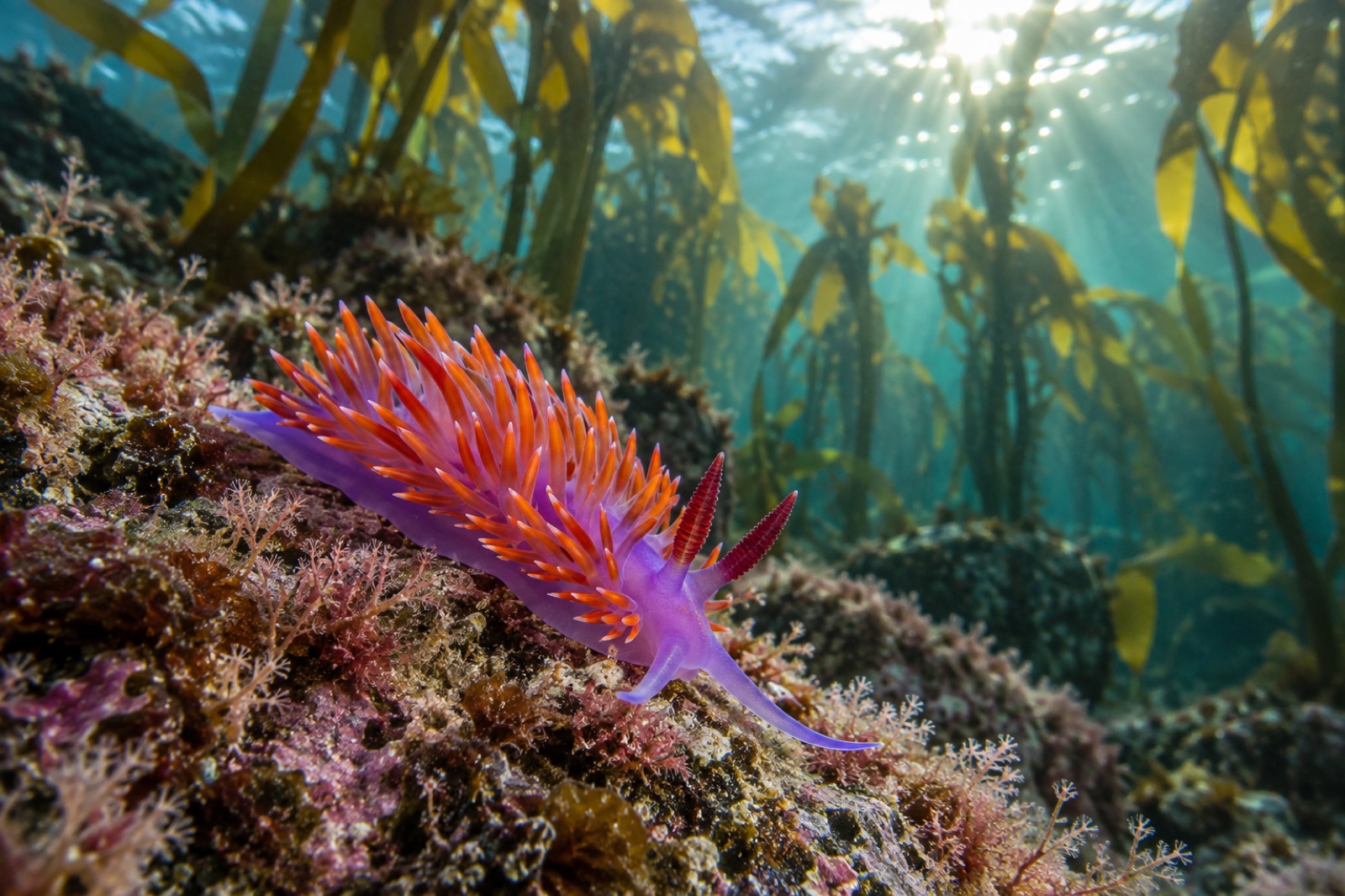
The Spanish shawl Flabellinopsis iodinea is a purple-and-orange aeolid nudibranch that steals stinging cells from hydroids. Identification, diet, habitat.
Dr. Mara Ellison ·
The sea lemon Peltodoris nobilis is a fist-sized, lemon-scented nudibranch that grazes sponges on Pacific kelp reefs. Identification, biology and ecology.
Dr. Theo Nakamura ·