Encyclopedia9 min read
A Field Guide to Kelp Forest Nudibranchs
Nudibranchs are the jewels of the kelp forest: shell-less sea slugs in startling colours. Learn the key groups, the star species and how to find them.
Tom Okafor ·
The Spanish shawl Flabellinopsis iodinea is a purple-and-orange aeolid nudibranch that steals stinging cells from hydroids. Identification, diet, habitat.
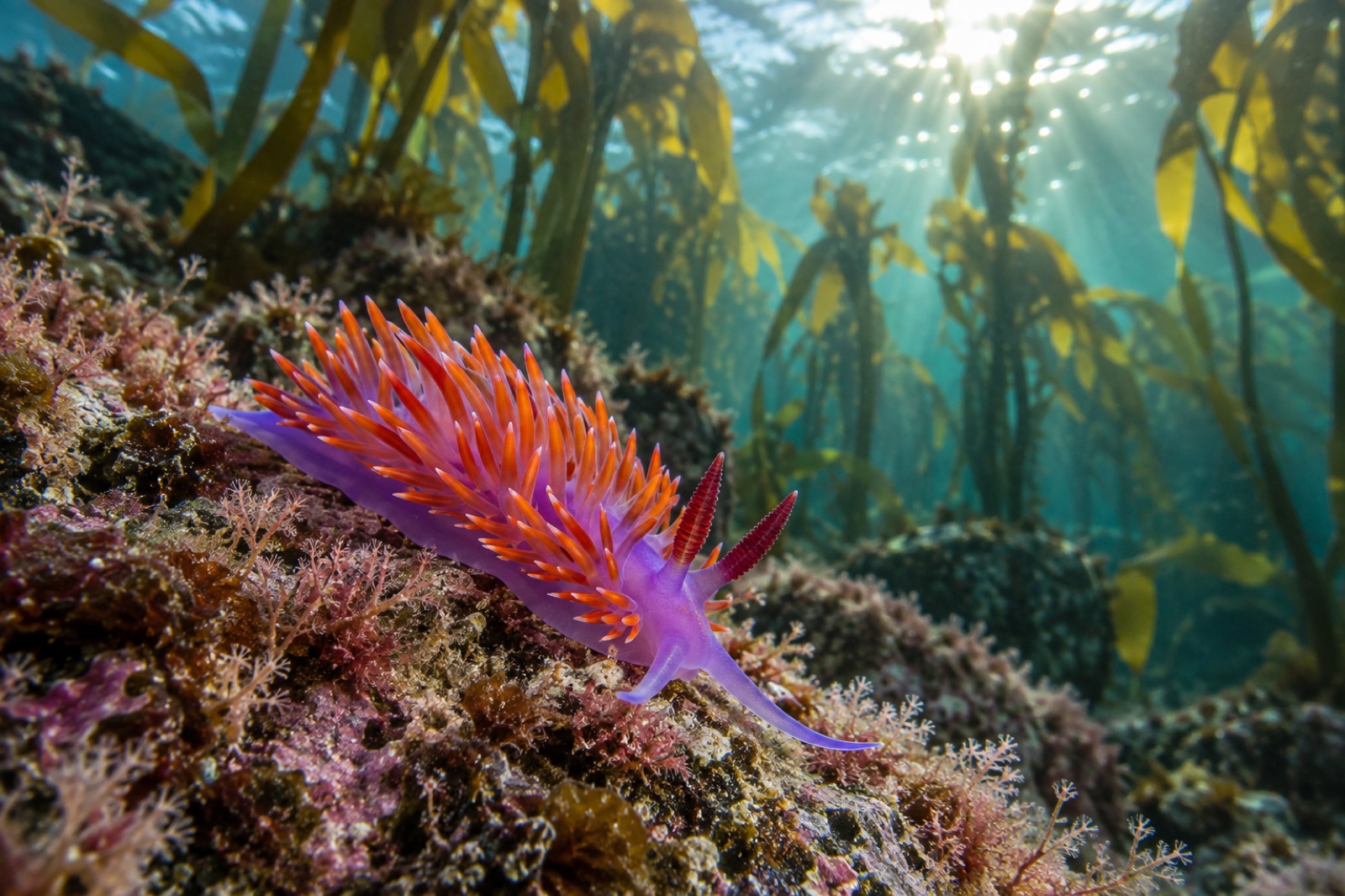
Ask a Southern California diver to name one sea slug and you will almost always get the same answer: the Spanish shawl (Flabellinopsis iodinea). It is the kelp forest's most photographed invertebrate — a thumb-length flame of purple body, orange cerata and crimson rhinophores, crawling the rocks of reefs from Monterey to Mexico as if colour were a free resource. For this animal it nearly is: the gaudiness is an honest warning, and behind it lies one of neatest weapons in marine biology. This is the species profile — what it is, what it eats, and where to find it.
| Scientific name | Flabellinopsis iodinea (long known as Flabellina iodinea) |
| Group | Aeolid nudibranch — a shell-less sea slug that weaponises prey's stinging cells |
| Common names | Spanish shawl, iodine flabellina |
| Size | Commonly 4–6 cm; the largest approach 9 cm |
| Depth range | Shallow subtidal to about 40 m |
| Distribution | Central California south through Baja California and into the Gulf of California; strays recorded to British Columbia |
| Diet | Hydroids — especially Eudendrium |
| Notable traits | Aposematic purple-and-orange colouring; steals nematocysts; can swim by undulation |
Nothing else on the northeast Pacific reef looks like this. Three colour fields do the identification:
The expectant pattern — purple below, orange above, red in front — is so consistent that a one-metre glimpse confirms the species. The only plausible confusions are other aeolids, all of which are drabber by an order of magnitude; our field guide to kelp forest nudibranchs walks through the aeolid family tree that Flabellinopsis sits in.
Colour this loud, in a soft-bodied animal with nowhere to hide, announces defence — and the Spanish shawl's defence is genuinely worth announcing.
The cerata are not decoration. Each one is a branch of the digestive gland wrapped in skin, and at its tip sits a sac called the cnidosac. As the shawl eats, it does something that borders on science fiction: it digests everything except the stinging capsules. The hydroid's nematocysts — microscopic harpoons that fire on contact — pass through the slug's gut intact, are sorted into the cerata, and are filed, still armed, into the cnidosacs at the tips.
A fish that bites a Spanish shawl gets a mouthful of stolen stings. The slug has, in effect, harvested its enemy's weapons factory and worn it as a coat. Zoologists call the sequestered arsenal kleptocnidae; divers call it, after a careless glove, memorable. The orange-and-purple livery is classic aposematism — a warning pattern that educated the local predators over evolutionary time, and that a photographer can read at a glance.
Refinements pile on: the slug is reportedly immune to the stings it doesn't use (mucus-lined gut prevents discharge in transit), and the cerata grade from fully armed to fresh, so the defence replenishes with every meal. It is the same deep strategy — weaponised grazing — that the big sponge-eating dorids like the sea lemon play with chemistry instead of harpoons.
Spanish shawls eat hydroids — the small, feathery, plant-like colonial animals that crust over rocks, kelp holdfasts and any bare surface in the flow. The favoured genus on California reefs is Eudendrium, a bushy pinkish hydroid, and the association is reliable enough that an experienced hunter finds the slug by finding its food: scan Eudendrium colonies in the 5–25 metre band and check each one slowly.
The feeding itself is methodical — the oral tentacles press into the colony, the radula rasps, polyps and all go in, and the stings emigrate to the cerata. A well-fed shawl is visibly fatter through the mid-body as the digestive gland fills; a hungry one shows thinner, more translucent cerata. In the kelp forest food web this makes the shawl a specialist second-tier consumer: hydroid in, stolen artillery out, and a standing lesson to any juvenile fish learning what not to bite.
Like all nudibranchs, Spanish shawls are simultaneous hermaphrodites — every individual carries both sexes, and any two that meet can mate, trading sperm in a side-by-side embrace. Both partners then lay eggs. The egg mass is the second identification classic of the species: a pink-to-coral ribbon coiled into a loose rosette, often compared to a tiny rose, glued to rock or hydroid substrate.
Each coil holds thousands of eggs. They develop for a week or two, depending on temperature, and hatch into planktonic veliger larvae that ride the currents — the dispersal phase detailed in our explainer on larval dispersal — before settling onto hydroid-encrusted reef. Growth is fast by slug standards, life is short (a year, perhaps two), and a reef's shawl population turns over with the seasons.
When startled — by a wave surge, a clumsy fin, a lobster — the shawl does one more improbable thing: it lets go and swims, throwing its body into lateral undulations and wriggling off the rock into open water. It is a poor swimmer and a conspicuous one, but the point is escape, not travel; the hooded nudibranch of the northern canopy uses the same trick, convergently, from a drifting perch.
The Spanish shawl is a warm-temperate species. Its stronghold is Southern California and Baja — the reefs of the Channel Islands and Catalina Island are among the most dependable shawl ground anywhere — and its range runs south into the Gulf of California. North of Point Conception it thins: Monterey Bay holds them in good years, and strays have been logged far further north when warm water carries larvae or adults astray, but a purple shawl in the Pacific Northwest is an event worth reporting.
Look on rocky reef with hydroid cover between 5 and 25 metres — reef edges, ledges, the rock margins of kelp beds. Mid-day light shows the colours best; a torch makes the cerata fluoresce visually against the dark. Because the animal is small, slow and indifferent to divers, it is the ideal first subject for practising the techniques in macro photography in kelp forests. At shore-entry sites like Monterey's Breakwater, patient searchers find them in single-digit depths.
The species carries no conservation listing and in the core of its range is abundant. Its fortunes rise and fall with the hydroid turf it grazes — and the turf rises and falls with the health of the reef around it.
Not through unbroken skin in any serious way — but the cerata are loaded with functioning nematocysts stolen from hydroids, and sensitive skin, eyes or lips can react to a careless touch. There is no reason to handle any nudibranch: your grip strips protective mucus and stresses the animal, and the slug's defences are for its protection, not your entertainment.
Aposematism — warning colouration. A soft, slow, shell-less animal survives by advertising its defences, and the Spanish shawl's defence (a coat of stolen stings) is real. Evolution wrote the price list on the label: bright, slow, exposed — and unbothered, because educated predators leave it alone.
Hydroids — small colonial animals that grow in feathery tufts over reef rock and kelp holdfasts. The bushy pinkish genus Eudendrium is the favourite on Southern California reefs, and locating a colony is the standard way divers locate the slug.
The Channel Islands and Catalina Island reefs, 5–25 metres, on rock with hydroid cover — among the most reliable nudibranch habitat in the world. Catalina's Casino Point and the reefs off Monterey's Breakwater in warm years are classic spots. Mid-day light flatters the colours; the animal sits still for photographers.
Most are 4–6 centimetres — about a thumb joint. Exceptional animals approach 9 cm. The juveniles divers find on hydroid tufts in summer are barely a centimetre and already wear the full purple-and-orange uniform.
Nudibranchs are the jewels of the kelp forest: shell-less sea slugs in startling colours. Learn the key groups, the star species and how to find them.
Tom Okafor ·
The hooded nudibranch Melibe leonina is a translucent sea slug that nets plankton from its perch on kelp blades. Biology, diet and where to see one.
Dr. Theo Nakamura ·
The sea lemon Peltodoris nobilis is a fist-sized, lemon-scented nudibranch that grazes sponges on Pacific kelp reefs. Identification, biology and ecology.
Dr. Theo Nakamura ·