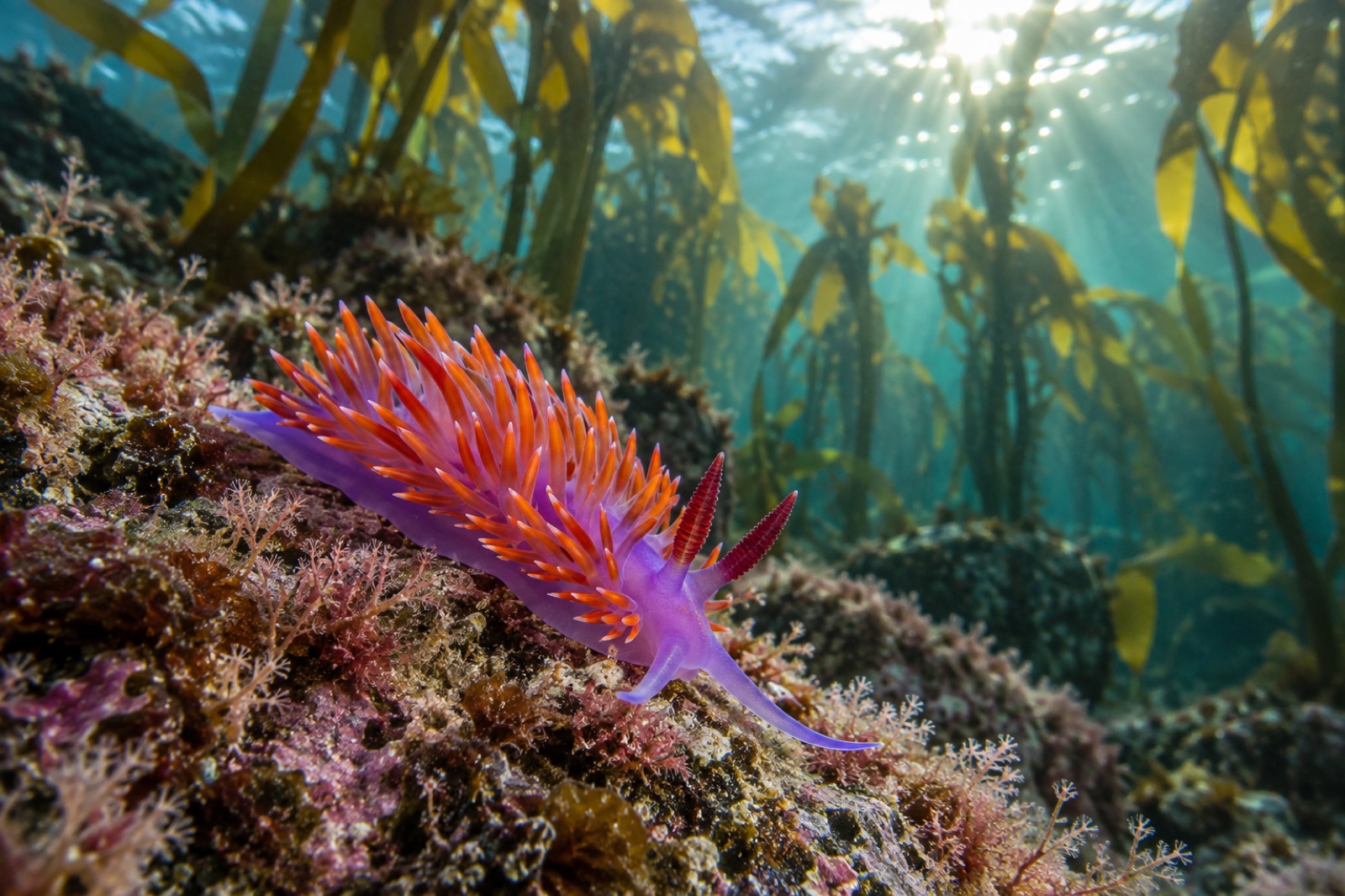
The Spanish shawl (Flabellinopsis iodinea) is the one sea slug nearly every cold-water diver wants on their life list — a finger-length flare of purple body, orange cerata and crimson rhinophores that looks photoshopped even when it's sitting on your dive slate. The good news: it is common, diurnal, slow-moving and utterly indifferent to cameras, which makes it one of the most findable nudibranchs in North America if you know what it's standing on. This is the field guide: where to dive, when to go, what to search for, which lookalikes to rule out, and how to come home with a photograph that does it justice. For the full biology, start with our Spanish shawl species profile; this article is about the hunt.
Fast facts
|
|
| Scientific name |
Flabellinopsis iodinea (formerly Flabellina iodinea) |
| Group |
Aeolid nudibranch — a shell-less sea slug |
| Core range |
Central California to Baja California and the Gulf of California; strays north to British Columbia in warm years |
| Depth |
Shallow subtidal to about 40 m; commonly 5–20 m |
| Size |
Usually 4–6 cm |
| Diet |
Hydroids, especially Eudendrium species — not anemones, despite much repetition of the claim |
| Best arenas |
Southern California's kelp reefs; the Channel Islands hold the densest sightings |
Read the habitat, not the kelp
Here is the single most useful thing to know about finding a Spanish shawl: you do not look for the slug, you look for its food. Spanish shawls specialise on hydroids — especially bushy Eudendrium colonies, which grow as pale, ferny tufts a few centimetres tall on rock faces, ledges and the shaded sides of boulders. An Eudendrium patch is both larder and landmark, and a nudibranch working one may stay on it for days, grazing the polyps down like a sheep mowing a paddock.
So the search pattern is: swim slowly at two to four metres off the reef, scanning rock surfaces rather than kelp fronds, and stop at every hydroid tuft. Look across it, then along it at eye level — the slug's purple body is vivid face-on but disappears into shadow when you're staring straight down at the reef. If you find a patch strung with fine pinkish-white lace, stop: that's a Spanish shawl egg ribbon, and the owner is rarely more than a fin-kick away.
On a healthy Southern California reef, hydroid habitat is everywhere — which is why divers who combine a nudibranch hunt with canopy scenery usually have the best days of all.
The best dive sites
The Channel Islands are the Spanish shawl's showroom. Anacapa and Santa Cruz in particular hold hydroid-rich reef at friendly depths, and a day boat out of Ventura or Santa Barbara in summer will put you on sites where two or three shawls per dive is unremarkable. Our Channel Islands atlas guide covers the parks, the boats and the seasons. San Miguel, at the cold western end of the chain, also produces them on its sheltered sides.
Casino Point, Catalina Island is the classic shore dive and probably the easiest place in the world to see this species. The underwater dive park's kelp corridor and rocky ledges hold hydroids in quantity; the guided entry steps mean you can be face-to-face with a shawl twenty minutes after parking. See our Casino Point dive guide for logistics.
Laguna Beach coves — Shaw's Cove and Crescent Bay are locally famous — offer Spanish shawls to shore divers and strong snorkellers right off Orange County. On the mainland, Point Loma's kelp edges and the La Jolla canyon rim also produce, and Monterey Bay marks the cooler, patchier northern end of the regular range.
When to go
Spanish shawls are present year-round in Southern California; there is no closed season to plan around. Two rhythms matter more than the calendar:
- Follow the hydroids. After winter storms reseed the reefs, hydroid colonies flush in spring and summer, and nudibranch numbers and egg ribbons build behind them. Late spring through autumn is reliably the richest period.
- Watch the warm years. In strong El Niño or marine heatwave summers, planktonic Spanish shawl larvae ride warm currents far north of the usual range, and scattered adults turn up in Northern California and even British Columbia. Those records — eagerly logged by divers — are small data points in a big story about species moving with a warming ocean.
Time of day is less critical than water clarity, but a morning dive after a calm spell gives you the best odds: settled visibility, slanting light through the canopy, and hydroids throwing long shadows that make a purple slug pop against the rock.
Lookalikes to rule out
Three animals cause most "Spanish shawl" misidentifications on the Pacific coast:
- The opalescent nudibranch (Hermissenda opalescens) is the commonest. It shares the orange-and-blue palette, but read the pattern: blue-white racing stripes along the body, an orange line down the midline, and cerata in shaggy bands rather than the Spanish shawl's smooth blaze of uniform orange. It's a worthy sighting in its own right — we profile it in the opalescent nudibranch.
- Phidiana hiltoni has wine-red to brown cerata with pale tips and a rougher, tigerish look. It's pugnacious — it will attack other nudibranchs, Spanish shawls included — so two aeolids squaring off on a hydroid patch are worth watching from a respectful distance.
- Flabellina trilineata, the three-lined aeolid, is white-lined and ghost-pale; beautiful, but nobody who has seen both confuses them twice.
And the anemone question deserves a straight answer, because the Internet is wrong about it. Some guides say the Spanish shawl eats anemones and steals their stinging cells. The nematocyst-stealing machinery is real — every aeolid runs it — but the prey here is stinging hydroids, principally Eudendrium. The slug digests the polyp's soft tissue and moves the unfired stinging capsules into sacs at its cerata tips, turning lunch into artillery. The anemone-hunting aeolid on these reefs is the shag-rug nudibranch; the shawl is a hydroid specialist.
Photographing one well
A Spanish shawl is, photographically, a gift and a trap. The colour is so saturated that easy shots look great — and so does every other diver's. What separates the portfolio frame:
Get to eye level. The money shot is the rhinophores and oral tentacles, face-on, cerata rising like a lick of flame behind. That means lying on your elbows in the sand channel beside the reef, not hovering above it. Stay off the hydroid patch itself.
Use the canopy light. Spanish shawls sit under kelp, and a strobe can flatten them into costume jewellery. Try one frame with the sunball high behind the fronds and the strobe dialled down as fill; the cerata rim-light like stained glass. Technique fundamentals are in our guide to macro photography in kelp forests, and the site's own notes apply double here: braced buoyancy, slow breathing, and never, ever move the animal to a prettier background.
If you want the swimming shot — a Spanish shawl flexing free of the reef is extraordinary — do not make it happen. Disturbed animals swim, but so do escaping ones, and a slug off its hydroid is a slug exposed. Photograph swimmers you meet mid-water on your own dive.
Logging what you see
Spanish shawl sightings are genuinely useful data. Because the species hugs a temperature-sensitive northern edge, verified records — date, site, depth, photo — sent to community science platforms feed directly into range-shift tracking used by researchers and by restoration teams choosing monitoring sites, ours included. A photograph a diver takes for fun on Saturday can be a datapoint in a heatwave study on Monday. Take the shot, log the record, leave the slug on its hydroid.
Key takeaways
- Don't search for the slug — search for bushy Eudendrium hydroid tufts on rock faces, then look along them at eye level; pink-white egg lace means the owner is close.
- The densest, most reliable sites are the Channel Islands and Catalina's Casino Point; the species is present year-round, richest late spring through autumn.
- Spanish shawls eat hydroids, not anemones — though they do genuinely steal stinging cells and redeploy them in their cerata.
- Rule out the opalescent nudibranch (striped, banded cerata), Phidiana hiltoni (dark, white-tipped, aggressive) and the pale three-lined aeolid before logging your sighting.
- Shoot at eye level with ambient canopy light plus gentle strobe fill; never move or provoke the animal for a frame, and add a verified record to community science platforms when you're done.
FAQ
Where is the easiest place in the world to see a Spanish shawl?
Casino Point on Catalina Island — a stair-entry shore-dive park with kelp forest, hydroid-covered ledges and calm-water protection. Even first-week divers regularly find them there between eight and fifteen metres, within a short swim of the entry steps.
Do Spanish shawls sting?
Not to divers. Their stolen nematocysts are calibrated for prey the size of copepods and for fish-scale predators; you would feel nothing through neoprene, or bare skin. Touching them is still off the table — for the slug's sake, not yours. Handling stresses the animal and can strip its cerata.
How big do they get, and how long do they live?
Most you meet are four to six centimetres; giants approach nine. Like nearly all nudibranchs they are annuals — the whole arc from veliger larva to flame-patterned adult to egg ribbons takes roughly a single year, which is why a reef can be dripping with them one summer and quiet the next.
Why did someone report a Spanish shawl in British Columbia?
Because it probably was one. In strong warm-water years the planktonic larvae disperse far north on the current, and adults have been recorded well outside the core range. Those records are a large part of why divers are asked to log unusually northerly sightings — the northern edge of this species is a live climate instrument.
Can I keep one in a home aquarium?
Please don't — and few shops should sell you one. Aeolids that specialise on hydroids starve on standard aquarium fare, and their stinging-cell artillery doesn't belong in a closed system with other animals. The kelp forest is the aquarium for this species; dive it instead.