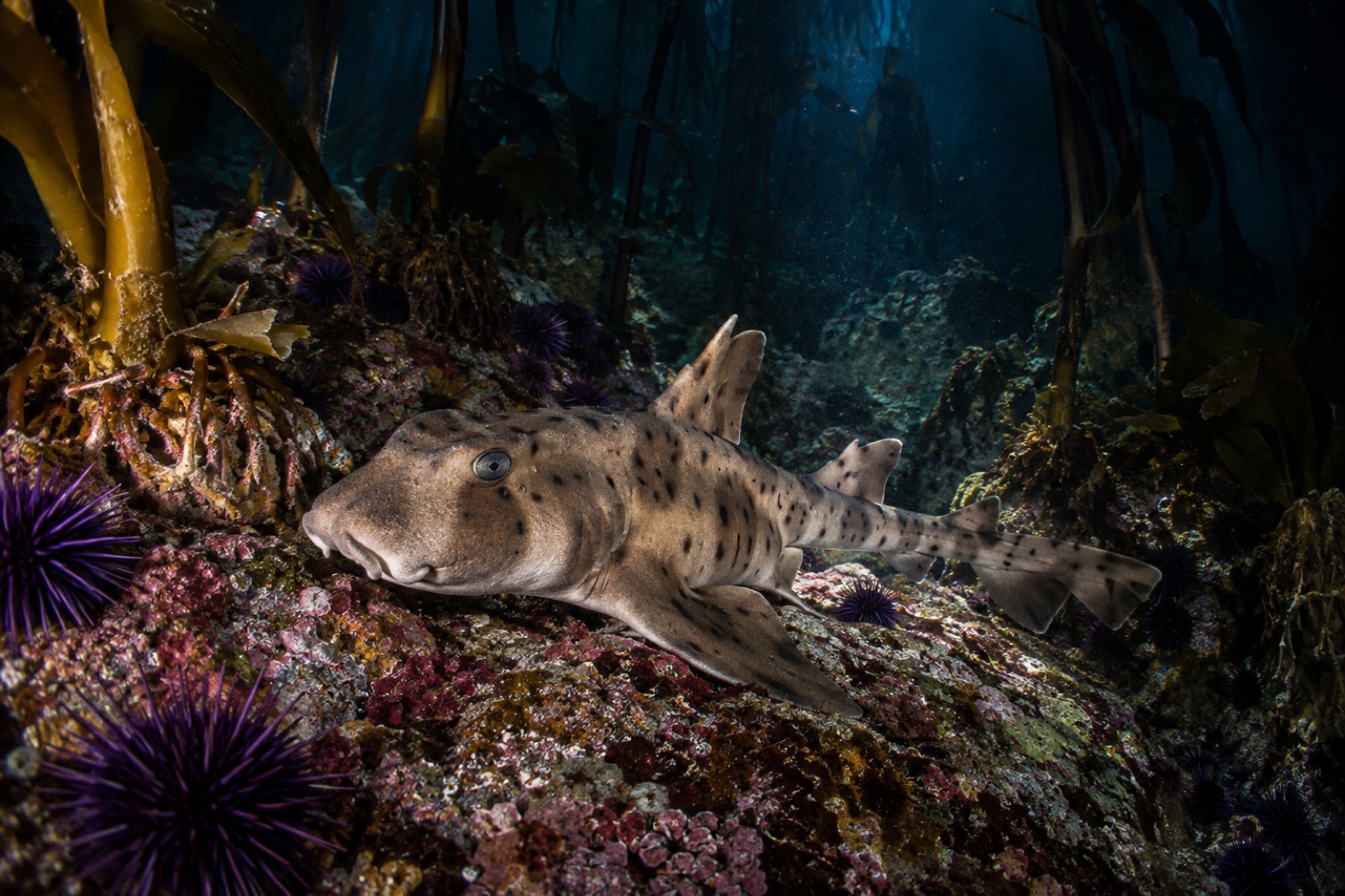
On a night dive through a southern California kelp bed, your light picks out an animal the day shift never shows you: a stocky shark squatting in a rocky pocket, blunt-headed, spine-shouldered, patterned in dark spots on tan, utterly unmoved by your presence. The horn shark (Heterodontus francisci) is the Pacific coast's armoured night specialist — a small, harmless, astonishingly old-fashioned shark that spends its days sleeping in rocky recesses and its nights shuffling through the kelp on a steady patrol for sea urchins, abalone, crab and anything small enough to be crunched. It is one of the few sharks on Earth whose diet consists largely of spiny echinoderms and molluscs, one of the few that lays eggs shaped like a ship's auger — and, in the quiet economy of the kelp forest, one more predator keeping the urchin's appetite in check.
Fast facts
|
|
| Scientific name |
Heterodontus francisci |
| Group |
Bullhead shark, family Heterodontidae, order Heterodontiformes |
| Size |
Usually under 1.0 m; maximum around 1.2 m |
| Lifespan |
Long for its size; commonly 20–30 years in aquariums; slow-growing |
| Depth range |
Intertidal shallows to ~150 m; usually in the top 30 m |
| Range |
Eastern Pacific: central California to the Gulf of California, with populations to Ecuador and Peru |
| Status |
Not threatened; bycatch in gillnets is sporadic; rarely retains value in the fishery |
Names, and how to recognise it
"Horn shark" refers to the two stout spines rising immediately in front of each dorsal fin — the animal's armament and its name. Older texts and fishermen call it "bullhead" or "California horn shark"; in Spanish it is dormilón — "the sleepy one" — a word that captures its torpid daytime persona exactly.
Recognition is by the shape more than any colour: a heavy, blunt head with a short rounded snout and a distinctive pig-like profile; heavy ridges over the eyes; a stout, cylindrical body; the two horn-tipped dorsal fins set far back along the back; and, most distinctively among sharks, two kinds of teeth — small pointed gripping teeth at the front of the mouth and, behind them, molar-like flat crushing plates. Adults are tan-grey to dark brown, densely speckled in small dark spots; juveniles paler, with dark saddles instead of spots. There is no other shark in its range that looks remotely like it — leopard shark included — because nothing else on the coast wears spines over the dorsal fins or carries a crusher's bulldog mouth.
A member of a very old family
The heterodontiform sharks — the order containing horn sharks and their Port Jackson cousins — are a living remnant of a lineage older than most modern shark families. Their anatomy is antique: the horned fins, the pig snout, the dual tooth form, the spiral-flanged egg. There are fewer than a dozen living species worldwide, all benthic, all slow, all small, all specialised crunchers. The California horn shark is the northeast Pacific's representative of this sturdy, persistent, unfashionable clan, and its deep evolutionary age is one of the small pleasures of meeting it — the animal on the reef floor in front of your light is, in body plan, older than the reef itself.
The armour, and what it eats
The horn shark's fins spines are the first thing a predator encounters, and field observations document large predatory fish — and even other sharks — with horn shark spines embedded in their mouths, killed by choking on a prey item that refused to be swallowed. It is passive armour at its most effective.
The mouth is where the specialisation lives. The front teeth grip; the rear plates crush. Diet studies find the horn shark's gut dominated by sea urchins — purple sea urchin prominent among them — supplemented by abalone, other snails and limpets, crabs, shrimp, small benthic fishes. It takes urchins whole, spines and all, which is how one accumulates the horn shark's most charming quirk: a purple-stained tooth plate and, in some animals, purplish-tinged fins spines. The pigment of the prey's test leaches into the predator's own hard tissue — a shark stained by its dinner.
Feeding is slow and methodical. The shark cruises the bottom at night, sets on an urchin, and — where the urchin is wedged — sometimes anchors the animal with its front teeth and uses its own stiff body as a lever to tear the prey free. A large prey item too big to take down whole is worked on patiently, piece by piece, sometimes over a protracted meal. A bigger shark would outrun an urchin; the horn shark out-crunches it.
That diet has an ecological context worth noting: a shark that eats urchins is, structurally, a friend of kelp. The horn shark is no sea otter in system-level impact — it is too scarce, too slow — but the principle described in trophic cascades in kelp forests — predators constraining grazers protecting forest — runs through it. Sheephead, spiny lobster and the big predatory sea stars are others on the same side of the fight; the horn shark earns its place on their team.
The egg case: the auger of the seafloor
The horn shark lays eggs, and the egg is a small marvel. The case is a tapered, screw-flanged spiral — the "auger" — anchored when the female deposits it into a rocky crevice where the flanges lock it in place against surge and predator. Each egg contains a single embryo nourished by a large yolk, developing over roughly seven to nine months; the hatchling emerges at perhaps 15 cm and starts life as a miniaturised adult that has never needed to be taught anything.
Egg-laying, rather than live-bearing, makes the horn shark biologically cheap at reproduction per offspring — many eggs, spread across crevices through a season — but slow in aggregate, because each is a single-progeny investment of many months. It also leaves a field signature for divers: once you know the auger shape, you begin finding old egg cases wedged in reef cracks all through southern California kelp beds, both the occupied dark-brown fresh ones and the pale empty cases the currents carry to the beach as "mermaid's purses."
By day, the sleeper
The horn shark's daytime personality is the dormilón name made literal. Individuals hold favoured rocky recesses — pockets and crevices at the bases of reef structures, sometimes at the base of a kelp stipe clump in a protected corner — and return to them; animals observed day after day occupy the same few square metres. The daytime response to an approaching diver ranges from utterly indifferent to a slow unhurried departure. Nobody has ever been threatened by a horn shark. Nobody has ever been chased by one. The hazard profile of the species is essentially "shark shaped like furniture."
The practical guidance for divers is therefore civilisational rather than safety-related: don't handle (the spines can puncture gloves, and handling does stress the animal); don't block a resting shark's escape route to deeper water; give a daytime horn shark the deference due a sleeper. These are the same practices outlined in the kelp forest diving guide — courtesy that costs nothing and keeps encounters easy on the animals.
A quiet constant of the kelp coast
The horn shark is not a conservation flagship, not a crisis, not a headline. It is simply a durable, unpretentious, modestly common shark of the Pacific kelp coast — a small piece of the system's integrity, an urchin-eater of the night shift, and one of the animals that makes a kelp forest night dive the distinct experience it is. On any dark drift through the forest, the possibility that the low shape on your light beam is a horn shark, asleep in a crevice it has used for years, is one of the pleasures of the coast.
Key takeaways
- The horn shark (Heterodontus francisci) is a small, harmless, spiny-finned shark of Pacific kelp beds, central California to Peru.
- Dual dentition: pointed gripping teeth in front, molar-like crushing plates in back — a mouth built for urchins, abalone and crabs.
- Its dorsal fin spines are genuine armour; predators have died trying to swallow it.
- It lays distinctive screw-shaped egg cases (the "auger") wedged into crevices, with a single embryo developing inside for seven to nine months.
- By day it sleeps in favoured rocky recesses, returning repeatedly; at night it patrols the kelp floor on feeding rounds.
FAQ
Are horn sharks dangerous to divers?
No. The fin spines can puncture carelessly handled sharks, but the species is slow, small, placid by day and never confrontational; it is one of the most harmless sharks a diver will meet.
Why are horn shark teeth sometimes purple?
Their diet is dominated by purple sea urchins, and the pigment from the urchin's test stains the shark's own hard tissue — the crusher plates and sometimes the fin spines take on a purplish cast, essentially a bath in the prey's pigment.
What is the "mermaid's purse" on the beach?
The empty, screw-flanged egg case of a horn shark. A live case is dark brown and tightly wedged in a reef crevice by the female; after the juvenile hatches, the pale empty case travels with the current and washes ashore.
How can I tell a horn shark from a leopard shark at night?
Instantly by shape: the horn shark is stocky and blunt-headed with two horn-tipped dorsal fins and a speckled pattern; the leopard shark is slender and smooth-headed with saddles, spots and no spines. Their night-time ecologies are also different — the leopard cruises sand flats; the horn works the rock.
Do horn sharks help kelp forests?
Modestly, via their diet: every urchin eaten is a grazer removed from the reef floor. They are one thread of the predator community — sheephead, lobster, sea stars, otters — that the kelp forest's trophic cascade depends on.