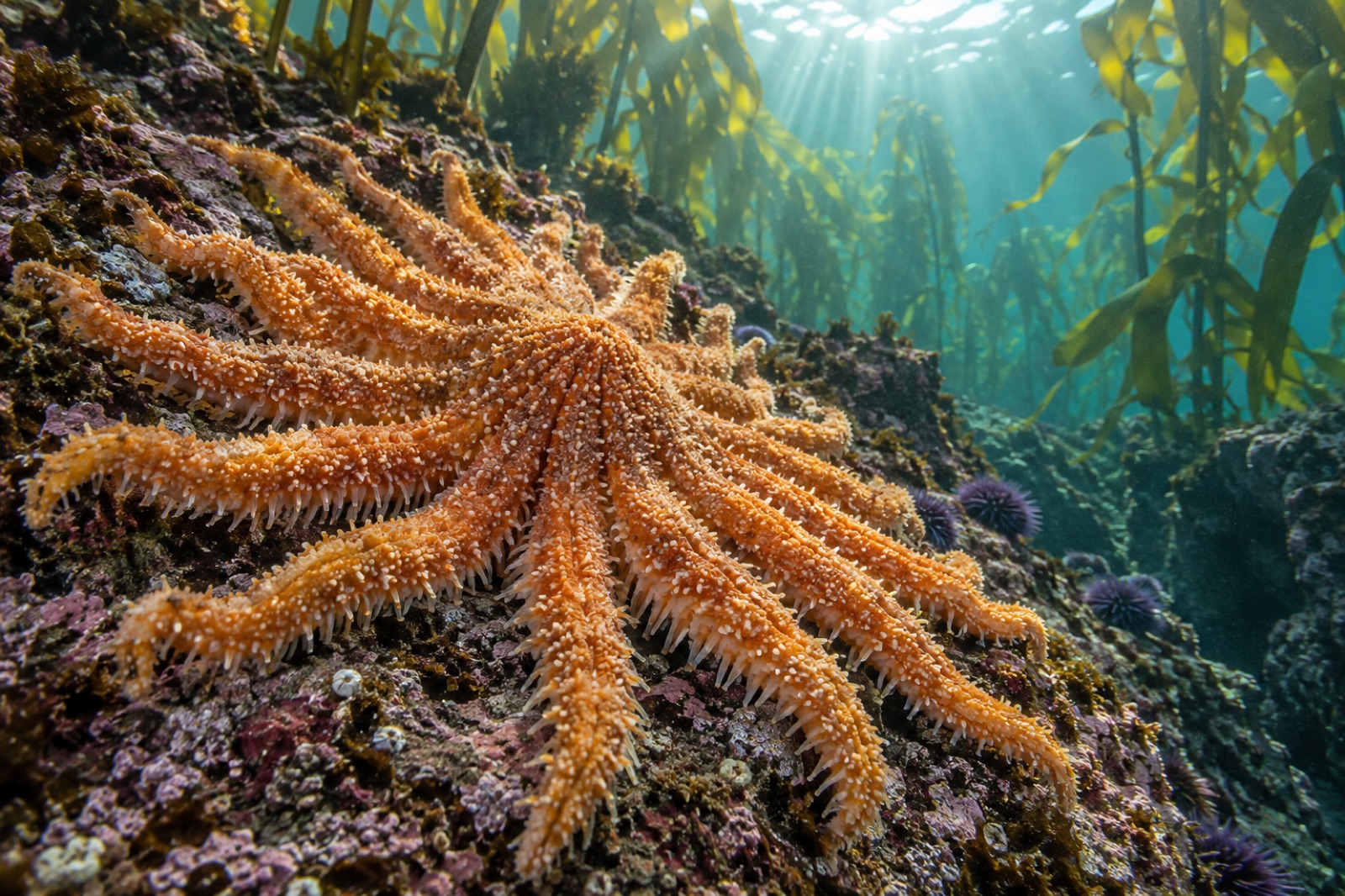
By day, a basket star is a disappointment: a fist-sized knot of beige cordage crammed into a rock crevice, easily mistaken for fishing line or a dead sponge. By night, on a cold-water reef, it becomes one of the most startling animals in the ocean. The knot unwinds. Five arms fork, and fork again, and fork a fourth time, opening into a laced fan of tendrils the size of a dinner platter. Anchored by its lower arms to a high point of rock, the basket star turns its whole body into a fishing net, sieving the current for plankton branch by branch. Divers who meet one on a night dive off Alaska, British Columbia or Norway tend to remember the moment the way you'd remember seeing a myth behave perfectly normally.
The best-known species on the Pacific kelp coasts is Gorgonocephalus eucnemis, the common basket star — an animal that links the brittle stars it descends from to something altogether more baroque.
Fast facts
|
|
| Scientific name |
Gorgonocephalus eucnemis (Müller & Troschel, 1842) |
| Group |
Class Ophiuroidea, family Gorgonocephalidae — the branching brittle stars |
| Range |
Circumboreal: Bering Sea and Aleutian Islands south to California in cold deep water; also the Arctic and North Atlantic |
| Depth |
From about 10 m (where water stays cold) down past 1,000 m; mostly 15–200 m on temperate coasts |
| Size |
Fan up to roughly 50–70 cm across; central disc up to about 14 cm |
| Feeding |
Suspension feeding on zooplankton — copepods, krill, larvae, arrow worms |
| Body plan |
Five arms that branch dichotomously, thousands of tendrils; all organs in the central disc; no anus |
| Behaviour |
Coiled tight by day, fanned into the current by night |
Anatomy of a living net
The name Gorgonocephalus means "gorgon head," and the anatomy earns it. Where an ordinary brittle star has five simple arms, a basket star's arms divide at every opportunity — each fork doubling the catching surface, so that a fully spread adult deploys several thousand fine tendrils. Microscope work on ophiuroid skeletons shows why this is possible: ophiuroid arms are built around a chain of hinged, vertebra-like ossicles, and basket-star arms articulate so flexibly that each tendril can coil independently around anything that touches it.
Three details turn that flexibility into a fishing system:
- Hooked spines and tube feet. Every tendril is lined with tiny hooks and suckerless tube feet. A copepod brushing the fan is gripped, glued with mucus and passed along the tendril to the arm's food groove, which works the parcel down to the mouth on the underside of the disc.
- A mouth with five jaws, no exit. Like all ophiuroids, the basket star has no anus. Everything enters and leaves through the five-toothed mouth under the disc — one reason the arms can be pure catching gear with no gut inside them.
- A disc that is all engine. The central disc, up to 14 cm across, holds the stomach, gonads and the nerve rings that coordinate thousands of tendrils. It is, relative to the fishing gear it drives, remarkably small.
Colour runs from bone white through cream, salmon and orange to mottled brown-red, often with darker banding on the arms. Against deep cold water the effect is ghostly: a white gorgon fan held motionless in the beam of a dive light.
A night-shift suspension feeder
The basket star's day is organised around one asset and one liability. The asset is that fan — an enormous catching area. The liability is that the fan is fragile, slow to build and expensive to repair. So the animal hides it away in daylight, coiled among rocks or sponges where fish and crabs can't easily pick at it, and deploys it in darkness when the plankton rises and most visual predators are hampered.
Come dusk, the basket star climbs. It uses its lower, stouter arms as climbing gear, working up onto a boulder top, a sponge, a gorgonian coral or a kelp-adjacent ledge — anywhere that sits a body-length higher than the surrounding rock. Higher perch, faster, cleaner current. Then the arms unroll into the flow.
Each arm series faces the current like a row of seine nets. When a tendril closes around prey, the motion is quick and sure; watch one closely and the whole surface of the fan appears to shiver as catches are reeled in. On productive nights the net comes in heavy — basket stars in strong-current areas are effectively harvesting the same plankton conveyor that feeds the kelp forest above them, just on the night shift.
Divers in Puget Sound treat finding an open basket star as a dividend: approach slowly, and it stays open; bump it or light it harshly, and the whole fan shrinks inward in seconds, a magic trick in reverse.
Cold water, deep water, dark water
Why don't temperate-dive regulars in California see basket stars on every reef? Temperature and light. Gorgonocephalus is a boreal animal. Its comfort zone is genuinely cold seawater, and on the Pacific coast that means the Aleutians, Alaska and British Columbia in the shallows, with the range extending south mostly as a deep-water species — off California it occurs, but hundreds of metres down, below the warmth.
That distribution makes the basket star a useful marker of cold, well-flushed habitat. During strong upwelling seasons, when deep, cold, nutrient-rich water bathes the shelf, basket stars feed well and appear where currents run hardest. They are creatures of the conveyor belt: the same physics that keeps kelp forests fed keeps their fishing nets full.
In the North Atlantic and Arctic, close relatives achieve similar outposts — northern Norway's fjords, including the walls off Lofoten, host basket stars on current-swept rock within diving depths, where the dark season makes daytime expansion less costly.
Reproduction and a slow life
Basket stars are broadcast spawners: males and females release eggs and sperm into the water column, and fertilisation happens in the open sea. The larvae drift as plankton — ironically, the same planktonic world the adults fish for food — before settling to the bottom and metamorphosing into miniature, barely-branched juveniles that add forks as they grow.
Growth is slow. A fully fanned adult with a hand-span disc may be many years old and, like other long-lived cold-water invertebrates, probably measures its life in decades. Regeneration helps: a basket star can regrow lost arm sections, though rebuilding a mangled fan is a long project. That slow biology gives the animal a survivor's risk profile — invest in one excellent net, defend it by hiding, and stay in place for a very long time.
Their patience shows up on the reef, too. Where basket stars occur, they often occur in numbers, lining every high point of a current-swept ridge like a row of parked satellite dishes waiting for dark.
Where the basket star fits in the kelp system
Basket stars are not kelp-forest animals in the strict canopy sense — most live deeper and darker than the kelp itself. But they belong to the same cold-water reef community, and they matter to it in three ways:
- They link plankton to the benthos. Every night a fanned basket star converts drifting animals into reef biomass — the same benthic-pelagic transfer that connects the water column to the seafloor, done visibly.
- They are structure. A coiled basket star is habitat: small crabs, scale worms and amphipods live among the basket's folds, using the animal as a prowling platform.
- They are food, rarely. Large sea stars, including the sunflower sea star, will take basket stars, and their shed tendrils feed the detritus chain. Their main predators seem to be time and storms.
For the restoration ecologist, basket stars are a quiet benchmark. They recruit slowly and need stable, current-fed rock; you cannot install them. When old reef records show basket stars on a ridge that has since degraded, their former presence is evidence the site once ran a strong, cold plankton conveyor — precisely the conditions new kelp will also need.
Seeing one responsibly
- Go at night, go cold. Northern night dives — Whytecliff or Puget Sound — are classic basket-star water. Check current-swept high points between 15 and 40 m.
- Dim your light. Bright white light collapses the fan. Use a red filter or the lowest setting once you've found one.
- Never touch the arms. The tendrils tear exactly as advertised — brittle. Photograph from the current's side, watch the tendrils work, and count yourself lucky.
- Log the sighting. Location-tagged photos on community science platforms genuinely help map this species' southern, deep edge — see our guide to shoreline and dive citizen science.
Key takeaways
- The basket star (Gorgonocephalus eucnemis) is a branching brittle star: five arms that fork repeatedly into thousands of tendrils forming a living fishing net.
- It feeds at night, anchored to high points, sieving zooplankton from cold currents; by day it coils into an unrecognisable knot.
- It is a boreal species — shallow in Alaska, British Columbia and northern Europe, deep-water only farther south — so it marks cold, current-fed reef habitat.
- Slow-growing, long-lived and slow to recruit: presence of basket stars signals a stable, plankton-rich reef.
- Kelp restoration and basket stars share a requirement: strong, clean, cold flow. Where the conveyor runs, the gorgons unfurl.
FAQ
Is a basket star a starfish?
It is a cousin, not a starfish. Basket stars are ophiuroids — brittle stars — with all organs in a central disc and the arms as distinct, skeletal appendages. True starfish carry their gut and gonads down the arms and move on suctioned tube feet.
How big does a basket star get?
The folded coiled state fits in two hands; fully expanded, a large Pacific basket star fans roughly half a metre across, occasionally more, on a central disc up to about 14 cm wide.
Where can divers see basket stars?
In cold boreal water: the Aleutians, southeast Alaska and British Columbia reliably; the San Juan Islands and Puget Sound in Washington; Norwegian fjords in the Atlantic. Farther south they live below recreational diving depths.
What do basket stars eat?
Zooplankton — copepods, krill, crab and fish larvae, arrow worms, anything the tendrils can coil around. Prey is glued with mucus and walked down the arms to the mouth under the disc.
Do basket stars sting or bite?
Not at all. They have no venom and their jaws handle millimetre-scale prey. The only hazard in an encounter runs the other direction: their arms are fragile, and a careless fin-tip costs the animal months of regrowth.