Encyclopedia8 min read
Eastern Blue Groper (Achoerodus viridis): Species Profile
Meet the eastern blue groper, the friendly, urchin-crunching giant wrasse of New South Wales reefs — every adult blue male began life as a female.
Dr. Theo Nakamura ·
The banded morwong is a slow-growing, site-loyal grazer of Tasmania's kelp reefs — a fish that can live for generations and taught fisheries a hard lesson.
On a rocky Tasmanian reef beneath a cathedral of golden kelp, the fish most likely to hang motionless at head height — deep-bodied, blunt-headed, banded black-and-white like a referee's jersey — is the banded morwong (Cheilodactylus spectabilis). It is not a fast fish, nor a wide-ranging one, nor a fish with much interest in leaving home. Instead it is something rarer in reef ecology: an elder. Banded morwong are among the most long-lived reef fish in temperate seas, with individuals rivalling the human generations that have come and gone above them — and their story, including one of the sharper fisheries spikes-and-crashes of southern Australian history, is a near-perfect case study in why longevity and site loyalty change everything about how a species should be managed.
This profile covers identification, distribution, biology, and the conservation lessons of a quintessential kelp-reef resident.
| Scientific name | Cheilodactylus spectabilis |
| Family | Latridae (trumpeters and morwongs) — note: morwong taxonomy has been revised; often formerly grouped in Cheilodactylidae |
| Size | Commonly 40–60 cm; old females larger |
| Colour | Silver-white with ~6–8 dark vertical bands; thick, rubbery lips |
| Range | Cool-temperate Australasia: southern Australia (southern NSW, Victoria, Tasmania) and New Zealand |
| Habitat | Rocky reefs and kelp forest, shallow subtidal to ~30 m |
| Diet | Small crustaceans and other benthic invertebrates pinched from the reef |
| Notable trait | Extreme longevity and site attachment — fish hold home reefs for decades |
The banded morwong is one of the easiest temperate reef fish to name. Look for a deep, compressed, almost carp-like body wrapped in bold vertical bars — dark chocolate bands alternating with silver-white — running from back to belly, fading on very old animals. The head is blunt, the eyes gold, and the mouth a pair of fleshy, distinctly rubbery lips — a vacuuming tool for picking crustaceans off rock. There is no mistaking it for anything else on the reef; the only confusion possible is with a juvenile boarfish at a glance, and that confusion survives about a second. The species' scientific name, spectabilis — spectacular — is fair.
Banded morwong are fish of the cool-temperate kelp margins. Their Australian range runs from southern New South Wales down the Victorian coast and around Tasmania — the seas of the Great Southern Reef — and the species is also found in New Zealand waters. Wherever they occur, their habitat preference is strikingly tight: the rocky subtidal reef, from kelp-fringed shallows to deeper ledges, with kelp forest the signature habitat. They are fish of the same wave-washed rocky coasts covered by our Tasmanian east coast and Bicheno guides, hanging in kelp cathedral clearings by day in loose groups and single soldiers on patrol.
The biology of banded morwong is defined by two features that set them apart from most familiar reef fish.
Banded morwong grow slowly and live long — very long. Ageing studies of otoliths (ear-stones) from Tasmanian waters have shown that animals reach ages measured in multiples of decades, with very old females recorded at ages around nine decades and beyond — an almost avian lifespan for a fish barely half a metre long. They do not mature quickly, reaching breeding age in mid-childhood at the earliest and taking the better part of a decade to reach full size. Every big, boldly banded fish you meet on a Tasmanian reef may have been grazing it since motorways were young.
A useful evolutionary consequence of this: it is a species structured like a protogynous-like generalist of longevity — think of it in the same long-family lineage as the wrasses and parrotfish, but a strictly non-sex-changing species; both sexes persist in long, stable adult lives, with females outgrowing males and dominating the oldest age classes.
The second pillar of its biology is attachment to place. Tagging and acoustic-telemetry work has shown banded morwong to be among the most site-loyal reef fish studied: adult fish hold small home ranges around a given reef, return to it after seasonal movements, and can occupy the same rocky patch for years — even decades — at a time. A banded morwong's life story is written on a scale of a few hundred metres of kelp-covered reef.
The ecological role they fill is that of mobile, mid-sized invertebrate grazer: picking amphipods, crabs and other small life off rock and kelp holdfasts (see our explainer on who's eating whom in the kelp forest food web), part of the housekeeping guild that keeps small invertebrate communities in balance — along with the eastern blue groper, the balanas and the wrasses that work the same reefs.
Banded morwong earned unusual fame in fisheries science for a 1990s episode that has become the textbook example of what happens when longevity meets a sudden market. Through the early and mid-1990s, a live-fish export trade boomed in Tasmania: banded morwong, being handsome, respectable-eating and easy to handle, were trapped and shipped live to Asian restaurant markets at high prices. Because the species is long-lived, slow to mature and loyal to home reefs — precisely the biology that removes the stock's ability to rebound — the intensively fished Tasmanian populations fell hard and fast: catches collapsed within a few years, by as much as around half or more on heavily fished eastern reefs, and the fishery had to be sharply restructured with size limits, a restricted season and tight regulation to pull it back from the edge.
The episode is now a standard cautionary lesson in temperate reef fisheries: species that live long, breed late and stay home cannot be fished like fast, mobile species; a two-decade-old fish that disappears in season one takes thirty years to replace. Tasmania's banded morwong fishery continues today, tightly managed, as one of the better-known examples of recreational and fishing-sector reform grounded in basic life-history biology.
The conservation outlook for banded morwong is, by coastal fishery standards, reasonable — the species is widespread in Tasmania and New Zealand and is again common on Tasmanian reefs under current management. But its biology keeps its outlook hostage to its setting in two ways:
The fish is not hard to see: any moderately healthy rocky kelp reef on the Tasmanian east or southeast coast — out of Bicheno, around the Tasman Peninsula, off the Maria Island marine reserve — will usually offer a small school of them hanging two to five metres off the bottom in kelp shade, drifting in loose bands like striped balloons. They tolerate close approach better than most reef fish — the old ones seem to have nothing left to prove. They are well worth watching, in the way of any long-lived animal: you are looking at a resident, not a tourist.
Because its biology is the opposite of a replaceable stock: the fish mature slowly, live for many decades and rarely leave their home reef. A sudden live-export fishery in the 1990s removed old, reproductively valuable fish faster than the slow life cycle could replace them; catches collapsed within years and the fishery was restructured with size and season controls.
Otolith ageing has shown Tasmanian banded morwong can live for several decades, with the oldest recorded females reaching ages in the vicinity of ninety years or more — an extraordinary lifespan for a reef fish of half a metre.
Small benthic crustaceans and invertebrates — amphipods, small crabs, shell fragments — pinched from rock and kelp surfaces with their rubbery-lipped mouths, part of the grazing guild that regulates kelp-reef invertebrate communities.
On rocky kelp reefs across Tasmania, Victoria and southern New South Wales, typically two to five metres off the bottom in kelp shade. On Tasmania's east coast — Bicheno, Maria Island, the Tasman Peninsula — they are among the most commonly encountered large reef fish.
They are a respected table fish, and the Tasmanian live-fishery of the 1990s was built on exactly that esteem. But their biology argues for restraint: they take many years to reach plate size. Today recreational and commercial take in Tasmania is regulated with minimum size and seasonal limits designed around that life history.
Meet the eastern blue groper, the friendly, urchin-crunching giant wrasse of New South Wales reefs — every adult blue male began life as a female.
Dr. Theo Nakamura ·
Kina is Aotearoa's endemic sea urchin — treasured kaimoana, a kelp grazer, and the engineer behind New Zealand's barren reefs. Here is its biology and its story.
Dr. Mara Ellison ·
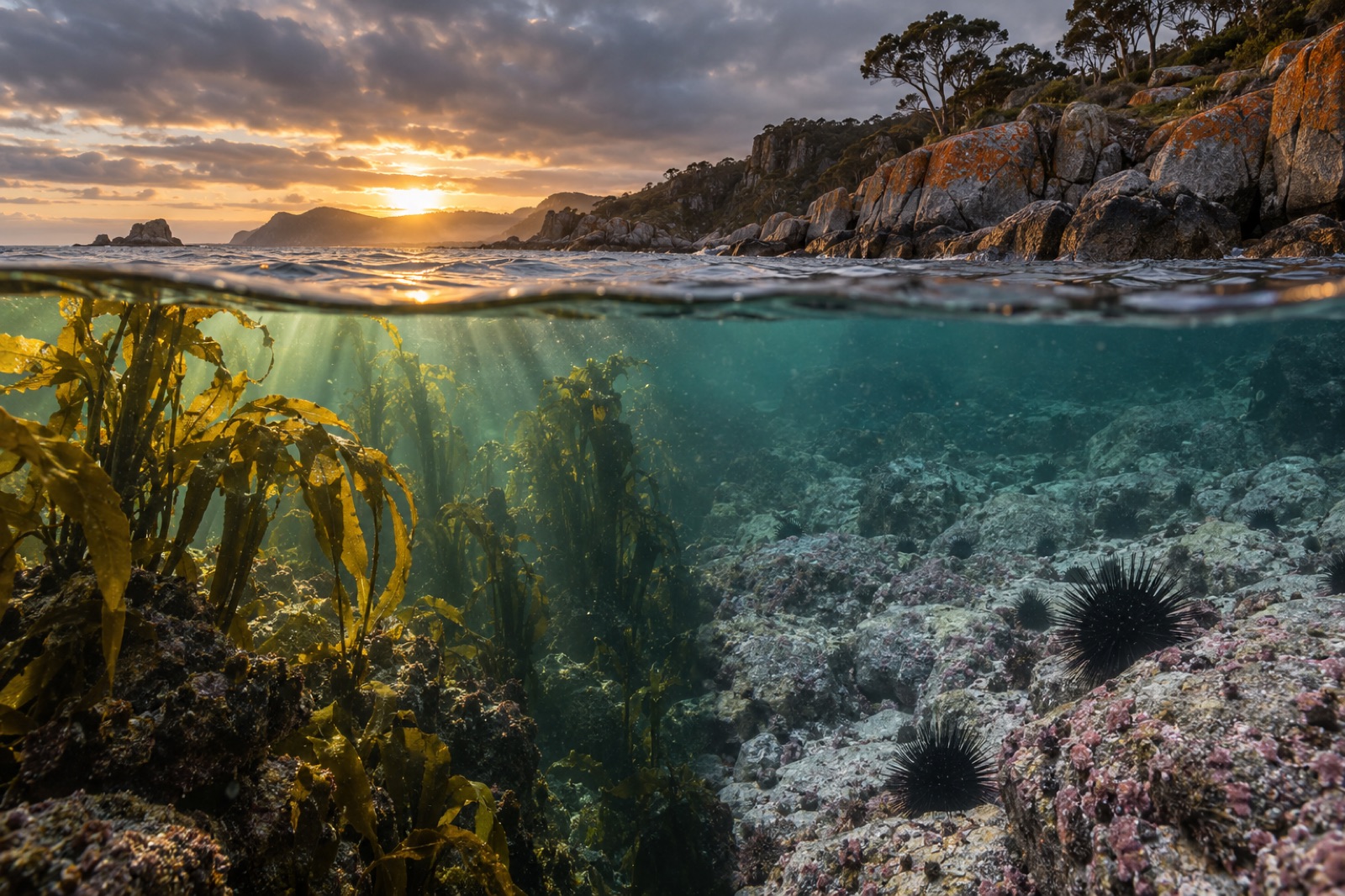
Tasmania's east coast has lost the vast majority of its giant kelp forests to warming seas and urchins. Explore what happened here, and what's coming back.
Dr. Lena Fischer ·