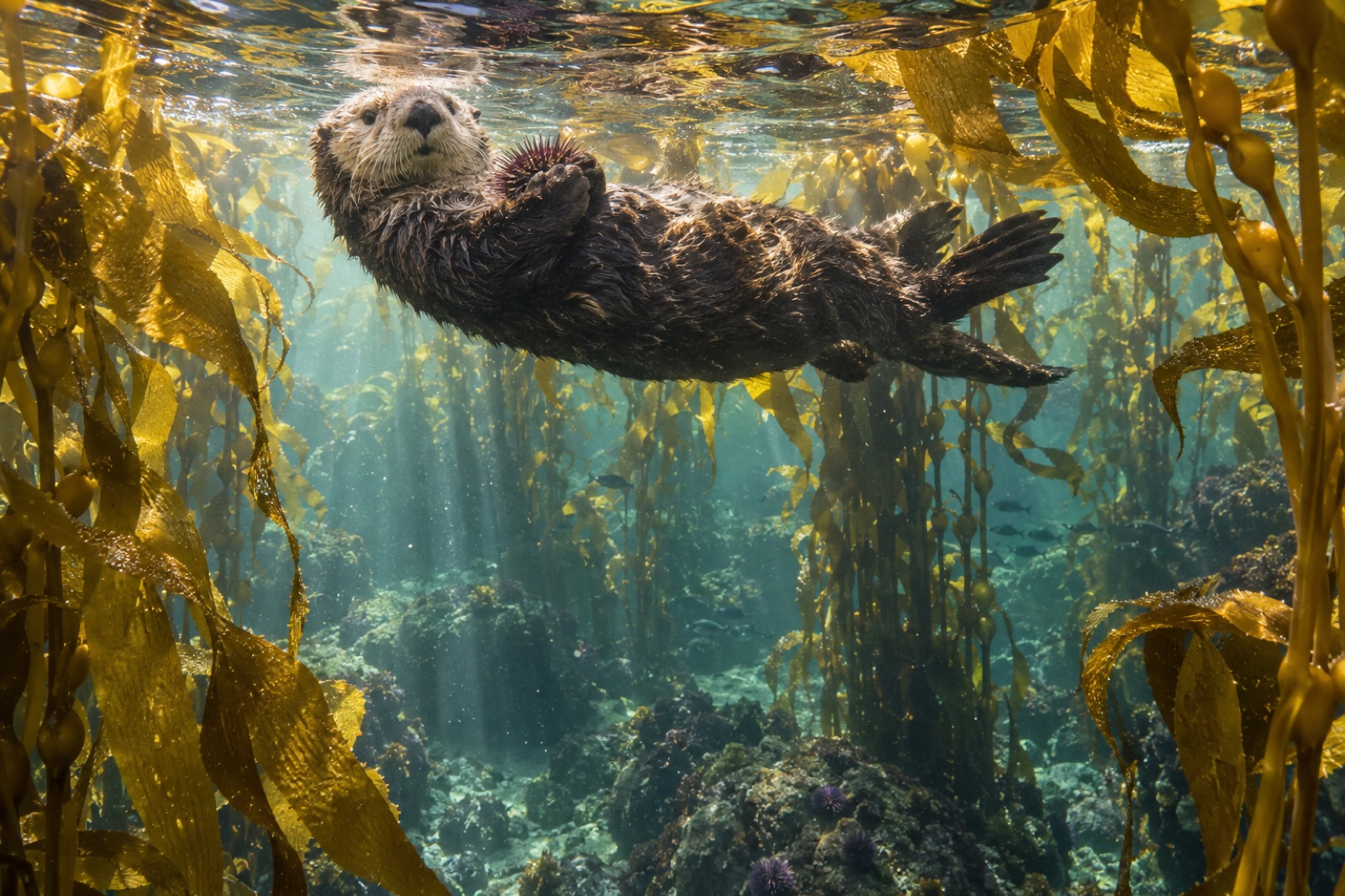
Stand on a Scottish or Norwegian kelp rock at low water and you are standing over someone's territory — a big, thick-lipped, olive-green fish that owns a patch of forest the way a foreman owns a workshop. The ballan wrasse (Labrus bergylta) is the largest wrasse in European waters, a fixture of rocky kelp coast from Norway to Morocco, and one of those fish whose biography reads like a full job description: it builds nests, changes sex, crushes sea urchins, and runs a parasite-cleaning service that has lately made it famous in a place it never evolved for — the salmon farm. This is its life, on the reef it actually belongs to.
Fast facts
|
|
| Scientific name |
Labrus bergylta |
| Group |
A wrasse — family Labridae, order Labriformes |
| Size |
Commonly 30–45 cm; record fish around 60 cm and 4+ kg |
| Depth range |
Shallow sub-littoral to about 30 m (occasionally deeper); strongly associated with rocky kelp ground |
| Distribution |
Northeast Atlantic: Norway to Morocco, including the western British Isles, the Azores (as a distinct local form) and Madeira; enters the western Mediterranean |
| Diet |
Hard-shelled invertebrates — crabs, mussels, limpets, sea urchins — crushed with pharyngeal teeth; also fishes cleans parasites from other fish |
| Life history |
Protogynous hermaphrodite (female first, changing to male); long-lived — fish over 20 years are regular, and some approach 30 |
| Reproduction |
Spring–summer spring; males build and guard nests of algae in rocky hollows |
Recognising a ballan
The ballan is a solid, deep-bodied, big-scaled wrasse — noticeably heavier through the shoulders than its smaller relatives like the corkwing or goldsinny. Colour is treacherous in this species: adults range through olive, chocolate-brown, reddish and marbled purple-brown, often with pale flecking, and the same fish looks different in kelp shadow and open light. Better field marks are structural:
- Thick, fleshy lips — the wrasse family signature, but pronounced in the ballan; the mouth is small for the body, protrusible, and armed with strong canine-ish front teeth.
- Large scales (fewer on the lateral line than in corkwing) and a single long dorsal fin with a spiny front half.
- Tail with a rounded-to-slightly-wavy margin in adults — juveniles and small fish are harder, and young ballans are often bright emerald green, almost tropical-looking, hiding in shallow weeds.
On a dive it behaves like the boss it is: unhurried, holding station, watching you. Where the small wrasse flick and scatter, the big ballan rotates to face you.
Life on the kelp rock
The shell-crusher's day
The ballan's feeding kit lies in its throat. Like all wrasse it has pharyngeal jaws — a second set of teeth on the gill arches that mill food after the mouth has picked it up — and in the ballan those pharyngeal teeth are stout crushers built for shell. The fish works along the forest floor and the kelp holdfasts, prising crabs from crevices, plucking limpets and mussels, crunching green sea urchins and their kin. Nothing about it is delicate: watch one feed and you see the temperate reef's engineering department at work — each crab removed, each young urchin crushed, adjusting the grazer community that the kelp itself answers to. The mechanics of that adjustment — predators thinning urchins so that forests stay forests — is the substance of our explainer on trophic cascades in kelp forests, and the ballan is the North Atlantic's own chapter of it.
The cleaning station
The ballan's other job is the one that changed its fate. Ballan wrasse pick ectoparasites — including sea lice — off the skin and fins of other fish, and will queue-tend customers that come and pose for attention; juveniles clean intensively, and even large adults clean opportunistically. On a wild reef this is a modest side-hustle of mutual benefit. On a salmon farm, where hundreds of thousands of fish concentrate in a cage and sea lice become an industry-defining plague, it looks like a service worth paying for — which is exactly what has happened, with consequences we come to below.
The nest and the sex change
Ballan are protogynous sequential hermaphrodites: every fish begins its reproductive life as a female, and the largest, oldest females in a neighbourhood change sex to become the territory-holding males. In spring, a big male clears a hollow in the rock or among stones, pads it painstakingly with chopped seaweed — a nest, not a scrape — and courts visiting females over it with quivering displays, then guards the mass of adhesive eggs, fanning and mouthing them clean until they hatch into drifting larvae.
This system has a vulnerability built into it, the same one that shadows the California sheephead on the far side of the world: fishing that selects big fish strips out males first and scrambles the local breeding structure. Because males are large, territorial and site-faithful, a coast can lose its nest-keepers quickly and quietly, and the females — still abundant — have no one to spawn with.
Conscripted: the salmon-farm chapter
Since the 2010s, the Norwegian and Scottish salmon industries have deployed cleaner fish — wrasse and lumpfish — stocked into net pens at enormous scale to eat sea lice off the farmed fish as a biological alternative to chemical and mechanical lice treatments. Ballan wrasse became a principal species in this system, alongside corkwing and goldsinny, supplied partly by hatchery production but very substantially by wild capture: pot fisheries specifically developed along the kelp coasts to catch wrasse and truck them to farms.
For the wild kelp reefs this is a new and strange pressure — a high-volume fishery landing precisely the fish that crush urchins, clean parasites and anchor the breeding structure of the reef's wrasse guild. The science around it has matured quickly: monitoring of caught-fish size distributions and local densities in heavily fished areas of Norway and the west of Scotland prompted management responses — closed seasons protecting the spawning period, minimum and maximum landing sizes, and effort controls. Whether the reef's full functional role recovers under those rules is a live research question, and one of the more instructive cases anywhere of an aquaculture solution exporting pressure back onto a wild ecosystem — the mirror-image problem to the one our own Harvest programme is designed to solve by growing help rather than extracting it.
Conservation and the honest picture
The ballan wrasse is not a rare animal, and Labrus bergylta as a species is not at the brink. But "common" and "unpressured" are different words. The species is long-lived, slow to mature, strongly site-attached, and big-fish-selected by both recreational anglers and the cleanerfish trade — the classic profile of a fish that can be depleted locally while still looking fine in a stock assessment drawn at ocean-basin scale. Marine protected areas and no-take zones on kelp coasts — Lundy Island is the British exemplar — do measurable good for exactly this kind of fish: big, territorial, resident, and quick to benefit when simply left alone.
Watching one well
The ballan is, fortunately, a fish you can study from a snorkel. Pick a kelpy, bouldery shore — the west coast of Scotland, Norway's mid-coast, Brittany's great Laminaria beds (see our Brittany atlas guide) — fin slowly along the rockweed line and down to the first kelp, and be competent and quiet. The small wrasse will mob you. The ballan, if the neighbourhood still has one, will simply be there: a dark, heavy-shouldered presence easing between the stipes, lips thick, eye on you, running the workshop. It is one of the great character fish of the encyclopedia — a reef with a big ballan on it is a reef that is still, in at least this one sense, being managed.
Key takeaways
- The ballan wrasse (Labrus bergylta) is Europe's largest wrasse, a site-faithful resident of kelpy rock coasts from Norway to Morocco, living 20–30 years.
- It is a hard-prey specialist, crushes crabs, molluscs and young sea urchins with pharyngeal jaws, and so helps keep the reef's grazer community in balance.
- All ballan start life female; the biggest become territory-holding males that build seaweed nests and guard the eggs — a system easily disrupted by big-fish-selective fishing.
- Its parasite-picking behaviour led to mass deployment as a "cleaner fish" on salmon farms, supplied largely by wild capture-known coasts — a new fishery pressure now being managed with closed seasons and size limits.
- Locally depletable but not globally rare; marine protected areas visibly benefit it because it is resident, territorial and long-lived.
FAQ
Can ballan wrasse really change sex?
Yes — all wrasse share the capacity, and the ballan is a classic protogynous (female-first) sex changer. Social cues trigger it: when the big male of a patch disappears, the largest female begins the transition, and within weeks to months is functioning as a male. It is one of the reasons size-selective fishing is especially consequential for the species.
Why are ballan wrasse put into salmon farms?
Because they eat sea lice — small parasitic crustaceans that afflict farmed Atlantic salmon — directly off the skin of the fish. Stocking cleanerfish is a biological lice-control strategy that reduces the need for chemical treatments. The system is imperfect (cleanerfish welfare and effectiveness are debated), but the underlying cleaning behaviour is entirely real and evolved.
How big do ballan wrasse get?
A large adult is typically 40–50 cm; the record fish run to about 60 cm and over four kilograms. Because they live for decades and keep growing slowly, genuinely huge ballans are mostly found where they are protected or lightly fished.
Where is the best place to see one?
Any kelpy, boulder-strewn shore in the northeast Atlantic: the Scottish sea lochs, Norway's kelp coast, Brittany, Galicia. They are in shallow water — often within the first few metres below low tide — and tolerate close, slow approach better than most big fish. A mask, a calm day and patience are the whole equipment list.
Do ballan wrasse matter to kelp restoration?
Yes, as part of the reef's self-regulation. Predators that thin young urchin populations help keystone kelp recruits survive the vulnerable first months. When Tidewright assesses a restoration site's readiness — part of the Holdfast site-matching process — the presence or absence of a fish community still able to police grazers is one of the ecological signals on the scorecard.