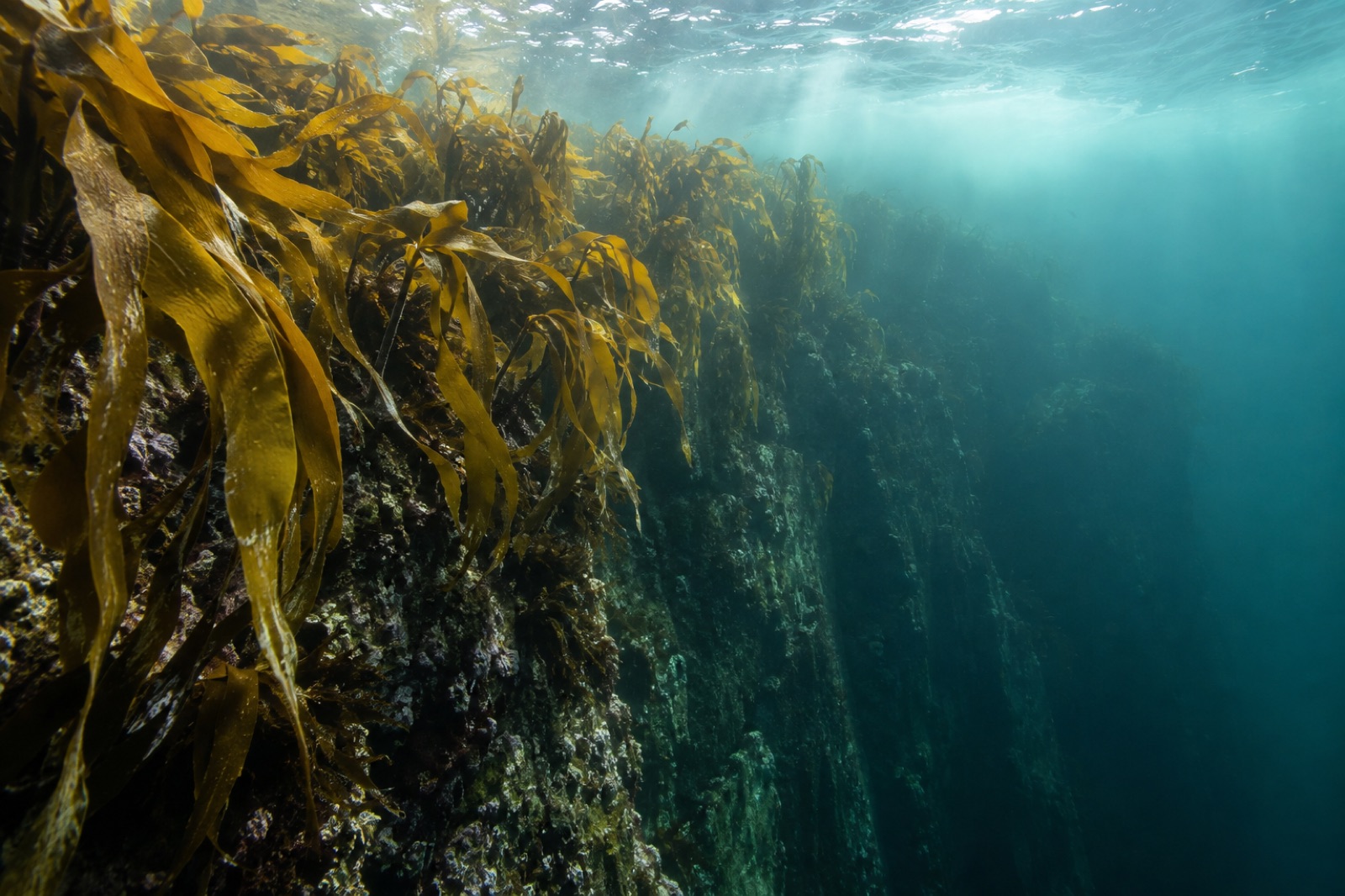
Stand on a headland at slack water and the sea looks like a single sheet of glass. Come back six hours later and the same water is moving with intent — streaming through the channel, boiling in seams over the reef, smoking past the rocks. That twice-daily slosh is the ocean's turnstile, and in many of the world's richest kelp regions it is also the ocean's kitchen: tidal mixing is one of the main ways deep, cold, nutrient-laden water gets lifted, stirred and delivered to the sunlit layer where seaweed and plankton can use it.
Upwelling gets the headlines — and our upwelling explainer deserves them — but upwelling is seasonal and wind-driven. Tidal mixing runs every day, twice a day, on lunar time, in precisely mappable places. If upwelling is the coast's seasonal harvest, tidal mixing is its dependable daily bread. Here's how it works, where it happens, and why so many kelp forests seem to know exactly where it is.
The problem mixing solves: two oceans stacked on one
To see why mixing matters, start with the problem it fixes. Through spring and summer, sunlight warms the surface ocean, and warm water floats. The result is a stable two-layer ocean — a warm, sunlit but nutrient-starved surface layer sitting on a cold, dark, nutrient-rich deep layer. This is stratification, and on calm coasts it can hold for months.
Plankton blooming in the lit surface layer quickly exhaust the nutrients up there — the nitrate, phosphate and silicate that drifted up from depth or washed off land last winter. Growth stalls, not because of light or warmth but because the pantry is locked below the thermocline. Kelp sitting in shallow water faces the same arithmetic all summer.
What the coast needs is a spoon. Tides, wind and internal waves each supply one, in different places and on different clocks. Wind mixing is powerful but intermittent and weather-dependent. Tidal mixing is the opposite: weaker per stroke, but relentless and predictable to the minute, centuries into the future.
Where tides turn into mixers
Tides themselves are not mixing — the slow, basin-wide rise and fall moves water too gently. Mixing happens where the tide is forced to move fast. Three geographies do that reliably.
Sills and narrows
Where a deep basin or fjord meets the sea behind a shallow sill, or where an island chain squeezes the tide into a strait, tidal currents accelerate. Fast flow over rough bottom generates turbulence — the same physics as a rapid in a river, less photogenic from above but far bigger. That turbulence grinds the stratified water column together, blending warm surface water downward and — the part ecosystems care about — dragging cold nutrient water upward. Fjords with shallow entrance sills are the classic textbook case: each flood tide over the sill renews the basin with ocean water and leaves the sill waters mixed and fertile.
Banks and shoals
A shallow bank standing in deep water forces the whole tidal flow up and over it. Over the bank, friction between current and seabed stirs the water column; on the bank's flanks, the flow accelerates and shears. The famous result is a place where nutrients flare in the middle of otherwise stratified summer seas — some banks hold essentially permanent production through the warm months while surrounding waters bloom briefly in spring and go hungry.
Headlands and island wakes
Flow around a point of land has to speed up, and fast flow past an irregular coast sheds eddies, boils and upwellings downstream — "island stirring." Watch the water off a kelpy headland at mid-tide and you can often read this directly: smooth, glassy slicks marking upwelling seams where deep water is being wound to the surface, metres from where you stand.
Tidal fronts: where the mixed meets the stratified
One of the loveliest structures in coastal oceanography is the tidal-mixing front. In shelf seas there are regions that tides manage to mix top to bottom all summer and regions they never touch. The boundary between them is a front — often a sharply visible line on satellite images, and frequently a line you can see from a boat: ruffled, tinted, sometimes foam-streaked water on the mixed side, calm blue-green on the stratified side.
Oceanographers describe the balance with a simple ratio: how much energy the tide delivers at the seabed versus how much buoyancy the stratification provides. Where tidal stirring wins, the water column stays mixed; where buoyancy wins, it stratifies. The front sits at the tipping line, and it barely moves from month to month because both ingredients — tide strength and surface heating — are slow and stable.
Fronts are feeding grounds. The mixed side keeps supplying nutrients; the stratified side has light-stabilised plankton populations; and along the boundary, converging surface flow concentrates plankton, bait and everything that eats them. Fish aggregate at fronts; seabirds can read them from altitude. And kelp, it turns out, does well on either side — close enough to the mixing to be fed, shallow enough to keep its light.
The fortnightly pulse: springs and neaps
Tidal mixing has a built-in heartbeat. Spring tides around full and new moons run strong; neap tides a week later run weak. Because mixing scales steeply with current speed, the difference is bigger than the tide heights suggest — spring tides can mix a water column that neaps leave almost entirely alone.
That pulse shows up in biology. Surface temperatures over banks and narrows drop on springs and rebound on neaps as the mixing relaxes and reasserts. Nutrient supply, plankton blooms and even the light climate under the canopy all breathe on a fourteen-day cycle. Ecologists who sample on a weekly schedule sometimes catch themselves aliasing the spring-neap pulse into their data — a nice illustration that the ocean's calendar is as important as its clock. For the broader tide story — moon, sun and the long rise and fall — see how tides work.
Why kelp coasts and mixing zones overlap so often
Kelp needs three things: rock, light and nitrogen. Rock maps the geology; light sets the depth; nitrogen is where mixing earns its keep. A kelp forest through a stratified summer is a forest on a diet, and warm, nutrient-poor summers are exactly when kelp declines — growth slows, fronds bleach and thin, heat tolerance frays.
Coasts with strong, shallow tidal mixing deliver nutrients through the critical season. This is one reason — alongside upwelling — that some of the Earth's great kelp provinces occupy tide-torn geography: archipelagos, sounds, straits, island chains and broken headland coasts where the tide is forever rushing somewhere. It is also why deep, wave-exposed headland sites facing the open current often hold lusher forest than sheltered inshore bays at the same latitude, and why restoration scientists pay close attention to tidal flow when picking sites: you cannot add mixing after the fact, but you can choose to work where the ocean already stirs itself.
In Tidewright's own site surveys — and this is a fictional company, so take the framing as illustrative — tidal exchange through channels and over sills is one of the physical variables mapped before any Holdfast line is laid. A site can have perfect substrate and cruelly nutrient-poor summer water; the survey is how you find out early.
Reading mixing from the shore
You don't need a research vessel to see tidal mixing at work:
- Temperature maps. Satellite sea-surface temperature on a calm summer day shows cool tongues and patches over banks, sills and narrows — cold signatures of deep water recently stirred up. (For the limits of satellite SST, see our piece on how satellites measure sea surface temperature.)
- Front lines. From a boat or a high cliff, look for colour boundaries, foam streaks and ruffled/smooth water contrasts at mid-tide near headlands.
- The fortnight feel. Regular swimmers, divers and fishers know the neap-week water runs warmer and clearer in shallows; that's stratification winning while the moon gives the mixer a rest.
- Buoy data. Coastal buoys that log temperature through the water column show the signature directly: stratified traces that collapse to a single temperature on strong spring tides.
Key takeaways
- Tidal mixing is the quiet, daily nutrient supply of many coasts — where seasonal wind-driven upwelling is episodic, tides stir on lunar time without fail.
- Mixing happens where tides are forced to move fast: over sills, across banks, through narrows and around headlands.
- Tidal fronts mark the boundary between mixed and stratified water, concentrate food and barely move all summer — fixed addresses in an otherwise drifting ocean.
- The spring–neap pulse modulates mixing on a 14-day cycle, and biology rides that beat.
- Kelp forests favour tide-stirred geographies because strong mixing keeps nitrogen coming through the stratified summer — a core consideration in restoration site selection.
FAQ
Is tidal mixing the same as an ocean current?
No. Tidal currents reverse with the tide — water sloshes back and forth rather than travelling downstream. But the turbulence they create against rough, shallow topography does the mixing; the water doesn't have to go anywhere for nutrients to be lifted. Residual currents and fronts can then carry that enriched water along the coast.
Which mixes the ocean more: wind or tides?
Globally, wind — storms stir the ocean on huge scales. But near coasts in summer, wind mixing is unreliable while tides are constant, and in narrows, sounds and over banks, tides are often the dominant local mixer. The two usually work together, with tides setting the dependable baseline.
Can tidal mixing bring up too much of anything?
Yes — the same stirring that lifts nutrients can suspend bottom sediments, murking the water and cutting light to kelp after big spring tides, and it can also vent low-oxygen or low-pH deep water into shallow habitats. Fertility and stress come up the same pipe; the balance depends on the site.
Do fish benefit from tidal mixing directly?
Mostly via the food it feeds: mixing fuels plankton growth, plankton feed baitfish, baitfish feed everything else. Fronts add a second mechanism, concentrating plankton and larvae along converging surface flow so predators can feed in a narrow lane instead of hunting the whole sea.
Does climate change affect tidal mixing?
Tides themselves are essentially immune — the moon isn't warming. What changes is their opponent: stronger summer stratification from a warming surface requires more mixing energy to break down, so some regions may mix less effectively in future even with unchanged tides. Shelf-sea fronts are already observed shifting as the balance tips.