Science7 min read
The Kelp Forest Food Web: Who Eats What
A map of the kelp forest food web — from drifting fronds and grazing urchins to otters, octopus and rockfish — and why detritus powers most of it.
Dr. Mara Ellison ·
The Arctic's first bloom happens in the dark, inside the sea ice. How sympagic algae prime the polar food web — and why thinning ice changes it all.
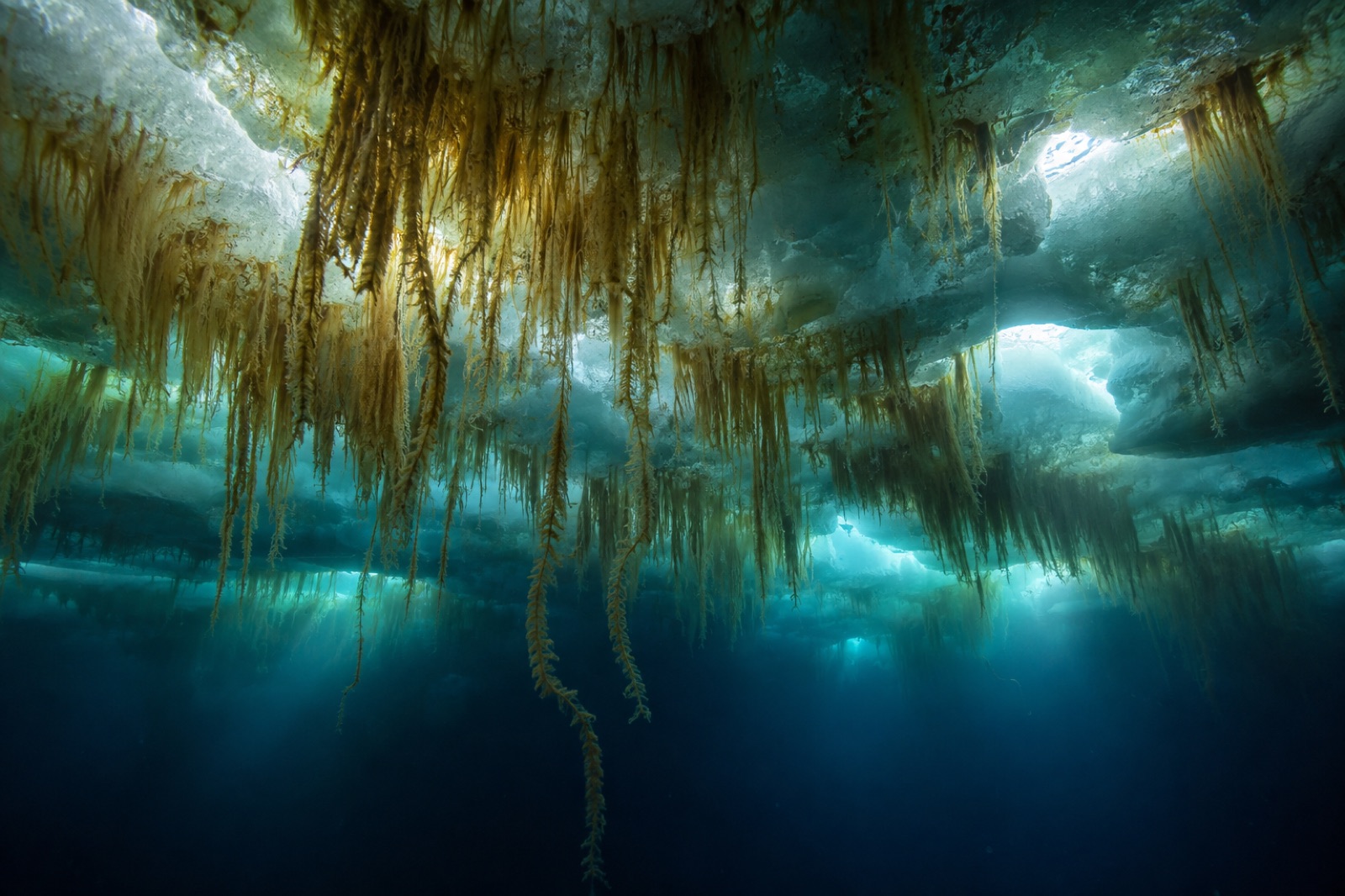
Every polar spring, the Arctic's first meal is cooked in a kitchen most people never imagine: inside the sea ice itself. Months before the open water turns green, a layer of algae fastened to the underside of the floes wakes up in the returning light and starts photosynthesising in near-darkness. These sea-ice (or sympagic) algae can deliver the year's first pulse of food to a food web that has been running on empty since autumn. Here is how that hidden meadow works, who depends on it, and why its fate is bound up with that of every polar coastline — including the kelp forests now spreading along newly ice-free shores.
Sea ice is not a solid block. As seawater freezes, salt is expelled from the growing crystal lattice and concentrated into tiny pockets and channels of ultra-salty brine — a plumbing system threaded through the bottom of the floe. Those brine channels are habitat. Into them move bacteria, flagellates, ciliates and, above all, microscopic algae, dominated by cold-loving pennate diatoms such as Nitzschia frigida. The whole assemblage — microbes, grazers and all — is called the sympagic community, from the Greek for "ice-associated".
The densest life sits in the lowest few centimetres of the ice, where brine channels stay connected to the seawater below and nutrients can replenish. Turn a floe over at the right time of year and its underside is stained golden-brown with living pigment. In parts of the central Arctic, the centric diatom Melosira arctica grows in metre-long hanging strands, an upside-down meadow trailing beneath the ice — among the strangest sights in polar science and, when it grows thick, a substantial standing crop of food dangling directly into the water column.
Living inside the year's coldest structure takes serious adaptation:
The polar production year has a choreography, and the ice algae go first.
1. The in-ice bloom. When daylight returns but the ice still caps the sea, the sympagic community blooms inside the floe. Because this happens weeks to months before open water appears, it is often the first new carbon entering the food web since autumn.
2. The ice-edge bloom. As the floes retreat, meltwater spreads a fresher, lighter layer over the surface. That stratified lid traps phytoplankton in sunlit water — our primer on ocean stratification explains why layers matter — and a classic ice-edge bloom ignites just seaward of the retreating front, tracking it like a green shadow.
3. The pelagic summer bloom. Finally, in open water, the wider phytoplankton community takes over until nutrients run down.
How much of the whole year's production comes from the ice itself? Estimates vary enormously by region and year — from a few percent in dynamic, quickly clearing seas to half or more of total primary production in some heavily ice-covered waters in some years. The honest answer is "a modest slice on average, but a decisive one": what matters is less the tonnage than the timing. The ice-algal pulse arrives when grazers are coming off winter starvation and beginning reproduction.
The short answer: almost everyone, directly or after a few handoffs.
This is the same architecture that powers a kelp forest food web, drawn on a different substrate: a fixed primary producer blooming on a schedule, a queue of grazers calibrated to the calendar, and a detrital overflow that feeds everything below.
Arctic kelp forests and sea ice are closer neighbours than a map suggests. Around Svalbard, Greenland, northern Alaska and the broader North Atlantic and Arctic, the spring ice edge often sits directly over rocky, kelp-suitable bottom. Three connections matter:
The Arctic Ocean's old, thick, multi-year ice has been thinning and shrinking for decades, replaced by a younger, more seasonal cover. For the sympagic community the consequences cut both ways, and honest science is still sorting the balance:
Rising ocean heat content underwrites all of these shifts: the ice's loss is the surface expression of a heat budget that has been changing for two generations.
Ice cores bored through floes and melted down in the dark remain the workhorse measurement. Ice-tethered profilers and under-ice ROVs now photograph and sample the floe underside across whole seasons — it was ROV survey work that revealed how extensive the hanging Melosira meadows can be. And because satellites cannot see through ice, researchers increasingly validate models against biological archives: the annual growth bands of long-lived Arctic clams record each year's food supply in shell chemistry, a library of past ice edges.
Yes. Brine channels within the ice hold liquid water year-round, hosting bacteria, algae and small grazers — a functioning, if miniature, ecosystem running at temperatures and salinities that would kill most marine life.
Regional estimates span from a few percent of annual primary production to over half in heavily ice-covered waters in some years. Even at the low end, the ice-algal bloom's early timing makes it disproportionately important to grazers ending their winter fast.
Cells are released into the water column, where some seed the following phytoplankton bloom while much of the material clumps and sinks — fertilising seafloor communities across the shallow Arctic shelves.
Sometimes — under-ice phytoplankton blooms through melt ponds are real and were considered impossible not long ago. But thinner ice is also shorter-lived and more ponded, so the long-run trend for the in-ice habitat itself is downward.
On Arctic coasts, the sea-ice system dictates light, nutrients and wave exposure for kelp. Restoration planning on those shores has to model the ice edge and its future as carefully as it models water temperature — part of the habitat is the ice.
A map of the kelp forest food web — from drifting fronds and grazing urchins to otters, octopus and rockfish — and why detritus powers most of it.
Dr. Mara Ellison ·
Seawater filters sunlight within metres — reds vanish first, blues travel deepest. How underwater light sets the depth limits, seasons and colour of the world's kelp forests.
Dr. Lena Fischer ·
At 78°N, Svalbard's fjords hold kelp forests in polar light, growing under sea ice and beside glaciers. A guide to the High Arctic's underwater forests — and what's changing.
Dr. Mara Ellison ·