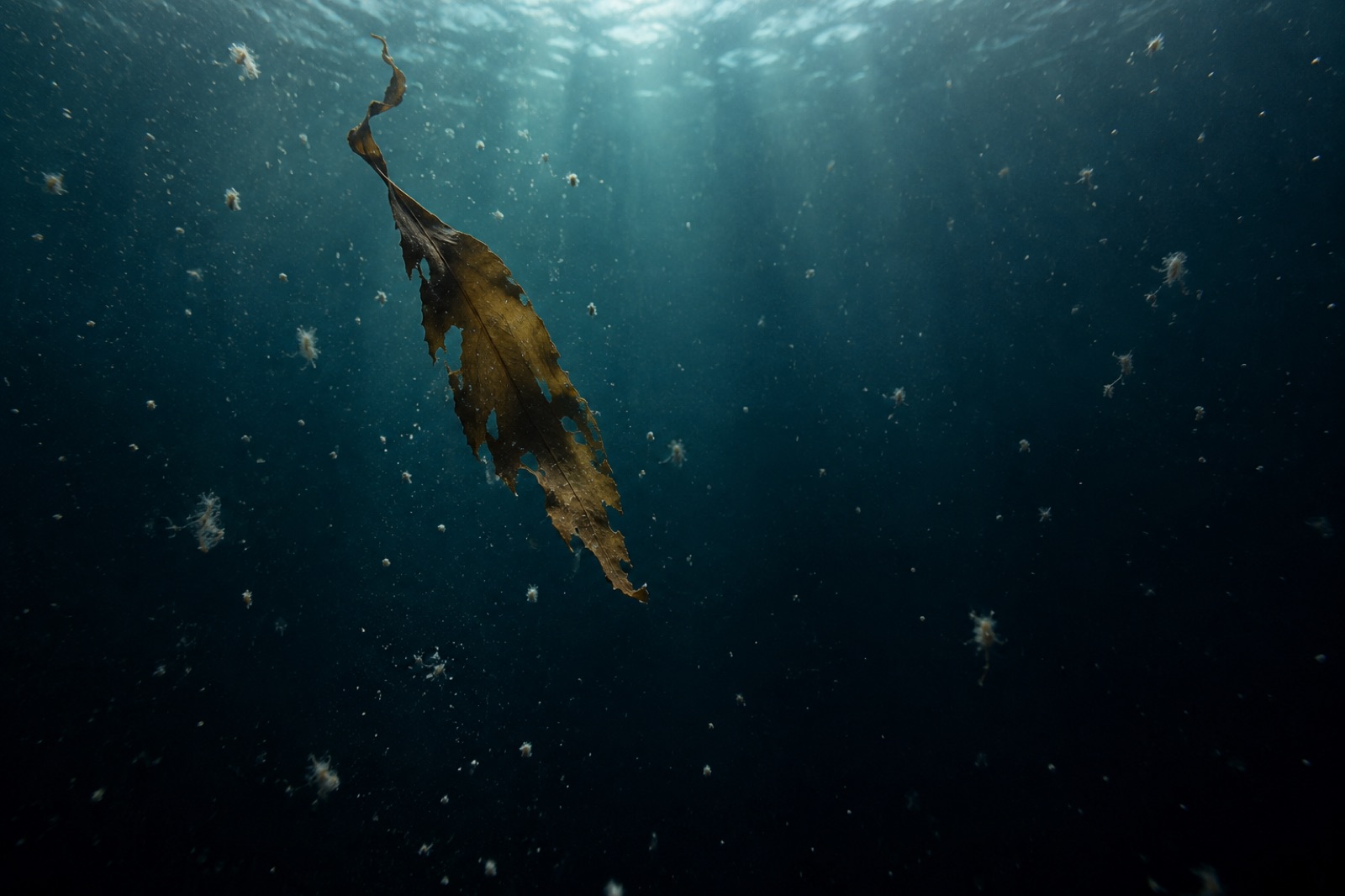
Every blue-carbon conversation eventually arrives at the same hard question: where does the carbon end up? A kelp blade fixes carbon in weeks; the climate only cares what happens over centuries. For carbon that leaves a kelp forest, there are many roads and only two real destinations — deep water that stays away from the atmosphere for a very long time, and burial: organic carbon incorporated into seafloor sediment and sealed below the reach of decomposers. Burial is the quiet finish line of the entire marine carbon story. This article explains what burial physically is, how rarely a kelp blade completes the journey, how scientists prove it happened, and what that means for honest carbon claims.
(The journey itself — how kelp fragments travel, drift and sink — has its own explainer: the deep-sea export pathway. Here we start at the moment of arrival.)
The two endpoints of exported carbon
When carbon fixed by kelp escapes the coastal food web, it faces a fork:
- Sequestration in deep water. Carbon dissolved or suspended below roughly 1,000 metres — the ocean's well-isolated interior — cannot exchange with the atmosphere until ocean circulation returns that water to the surface. Depending on the basin, that can mean centuries. This is storage in water, not sediment.
- Burial in sediment. Particles that settle onto the seafloor and are incorporated into accumulating sediment layers, passing below the biologically active surface zone. This is storage in rock-in-waiting — the same mechanism that, over geological time, built the planet's fossil carbon deposits.
Both are legitimate long-term stores, but they differ in mechanism, measurability and durability. Burial is the more permanent of the two — and the harder to attribute to any particular forest.
What burial actually is — and what defeats it
Burial is not simply "a piece of kelp landed on the bottom." The seafloor's top few centimetres are a working ecosystem. Burrowing worms, crustaceans and microbes churn it — a process called bioturbation — constantly re-exposing buried material to oxygen. Carbon only counts as buried when it passes below this active zone into sediment that will not be disturbed again on ecological timescales.
Three conditions decide whether a particle completes that passage:
- It must arrive intact enough. Microbes colonise sinking particles immediately; the marine snow conveyor — the slow rain of organic aggregates — is simultaneously a dining service. Fast-sinking, dense material fares far better than small, slow particles, which is one reason drift kelp and wrack fragments matter: whole blades sink fast when they finally waterlog.
- Oxygen must be scarce, or burial rapid. Decomposition is microbial respiration; it needs oxidants. In organically rich, rapidly accumulating sediments — fjords, submarine-canyon fans, continental-margin depocentres — material is buried faster than it can be eaten, and the deeper layers become oxygen-poor, stalling decay. Fjords, with their sills and deep basins, are world-class carbon burial grounds for exactly this reason.
- The sediment must keep accumulating. Burial only "locks" when centuries of new sediment stack on top. Margins with steady supply of river sediment, or canyon-fed deep fans, provide this. Bare, swept abyssal plains mostly don't.
Get all three and organic carbon can persist for millennia — radiocarbon in deep-margin sediments routinely records carbon that has been out of circulation for many thousands of years. Fail any one and the carbon is respired back into the water column within months to decades.
The gauntlet: how little actually gets buried
It helps to be blunt about the arithmetic, because it disciplines every claim built on it. Of the carbon a kelp forest fixes, the large majority is grazed, decomposed or respired within the coastal system itself — this is normal ecology, not failure. Of the fraction exported offshore — the pathways mapped in where kelp carbon actually ends up — most is again eaten or remineralised during transit through the water column, particularly in the microbial engine room of the twilight zone. What reaches the seafloor as intact organic matter, in a place where sediment is accumulating fast enough to bury it, is a small residue of a small residue.
Published estimates of the total share of macroalgal production reaching long-term storage span a wide range and remain an active research frontier — geography, species and season all move the number, so there is no defensible global average to slot into a spreadsheet. Seascapes help or hinder enormously: a forest backed against a submarine canyon that delivers fragments straight to a deep, accumulating basin is in a different league from one exporting onto a shallow, well-mixed shelf.
None of this makes burial unimportant. Kelp forests are so productive that even small long-term storage fractions are climatically meaningful — the same arithmetic that underpins the cautious optimism in our honest accounting of kelp carbon. It does mean that "the carbon is buried" is a claim that must be demonstrated, not assumed.
How scientists prove burial happened
Burial is unusual among climate claims in that it leaves durable physical evidence. Four toolkits do the proving:
Sediment traps
Funnel-shaped collectors moored at depth catch particles arriving from above, measuring the flux of carbon toward the seafloor through time — season by season, through blooms and storms. Our explainer on sediment traps covers the method in depth. Traps prove delivery, not burial — but they bracket the input side of the ledger.
Sediment cores
A core tube pressed into the seafloor recovers the layered archive. Scientists date the layers (using natural and bomb-era radiometric clocks), measure organic carbon down-core, and compute burial rates: grams of carbon per square metre per year actually retained. Cores are the closest thing blue carbon has to a receipt.
Fingerprinting the carbon's origin
Bulk sediment carbon mixes sources — kelp, phytoplankton, river material. To attribute buried carbon to macroalgae specifically, researchers use stable isotope signatures, lipid biomarkers and, increasingly, environmental DNA preserved in sediments, which can identify kelp tissue in millennia-old layers. Attribution science has improved dramatically in the past decade and underpins any serious attempt to credit a specific ecosystem.
Dissolved and refractory carbon
Not all export is particulate. Kelp releases dissolved organic carbon, some of which microbes convert into chemically stubborn, "refractory" forms that persist for centuries to millennia — an invisible but potentially large store, washing through the deep ocean. It is real, measurable with care, and extremely difficult to tie back to a particular project boundary.
What burial means for carbon claims
Burial's millennial timescale is why it carries so much weight in carbon accounting — and why it demands so much discipline:
- Durability classes must be honest. Buried sediment carbon and deep-water dissolved carbon sit at different points on the durability spectrum; both are far longer-lived than biomass, and the framework in durability vs permanence explains why claims should be graded accordingly rather than averaged.
- Attribution, not vicinity. A project that restores a forest near a burial hotspot has not thereby buried its carbon. Credible approaches estimate project-specific export and delivery with site data — tracers, transport models, local core evidence — rather than borrowing global means.
- Baseline burial counts too. Margin sediments were burying carbon before any project existed. Only the increment above the natural baseline belongs in a ledger — the same additionality logic, applied to the abyss.
- Monitoring extends beyond the farm fence. If exported carbon is part of a project's claim, its monitoring plan has to follow the carbon off-site — which is why our own Canopy Ledger pairs canopy mapping with offshore transport modelling and partner sediment programs. At Tidewright this remains research-grade work; our published figures on deep-sea delivery are illustrative, and we treat burial-linked claims as our most conservative category.
The encouraging truth is that burial science is cumulative and verifiable: every trap, core and isotope dataset narrows the uncertainty. The discouraging truth — small fractions, long journeys — is simply what honesty sounds like when a claim reaches a thousand-year timescale.
Key takeaways
- Burial — organic carbon sealed below the seafloor's biologically active layer — is the most durable endpoint of marine carbon, with persistence measured in millennia where sediment keeps accumulating.
- Three conditions make burial work: particles must survive the falling gauntlet, decay must be stalled by low oxygen or rapid covering, and sediment must keep stacking.
- Only a small fraction of kelp production completes the journey; the exact fraction is site-specific and still an open research question, so global averages should never back a project claim.
- Burial is provable: sediment traps measure delivery, sediment cores measure retention, and isotopes, biomarkers and sediment DNA attribute the carbon to its source.
- For carbon claims, buried carbon earns the strongest durability class — and therefore the strictest tests of attribution, additionality and project-specific evidence.
FAQ
Is carbon "buried" the moment it touches the seafloor?
No. The top centimetres of sediment are constantly reworked by burrowing animals and microbes. Carbon counts as buried only once it passes below this active zone into sediment that stays undisturbed for centuries or more — which is why burial rates are measured down-core, not at the surface.
How long does buried kelp carbon stay buried?
Where burial conditions are good — low oxygen, steady sediment accumulation — the retention timescale is millennia; radiocarbon in deep-margin sediments routinely records carbon thousands of years old. It is the longest-lived carbon store a coastal ecosystem can feed, short of geological transformation itself.
Why are fjords and submarine canyons especially good at burial?
Fjords trap organic matter behind shallow sills in deep, often oxygen-poor basins where terrestrial sediment also accumulates quickly. Submarine canyons capture drifting kelp and channel it directly into deep fans where sediment piles up — a fast conveyor from forest to secure storage.
Can a kelp restoration project claim burial-based carbon credits today?
Only cautiously, and mostly not yet through mainstream registries. Methodologies are young, and any defensible claim needs site-specific export measurements, evidence of delivery to an accumulating sink, and subtraction of the natural baseline. Most credible programs treat burial-linked carbon as a monitored research outcome rather than an immediately saleable credit.
What is the difference between deep-water storage and sediment burial?
Deep-water storage keeps carbon dissolved or suspended in water masses isolated from the atmosphere by stratification — secure for decades to centuries until circulation resurfaces them. Sediment burial locks carbon into accumulating seafloor deposits — secure for millennia. Both matter; they sit in different durability classes and are measured with different tools.