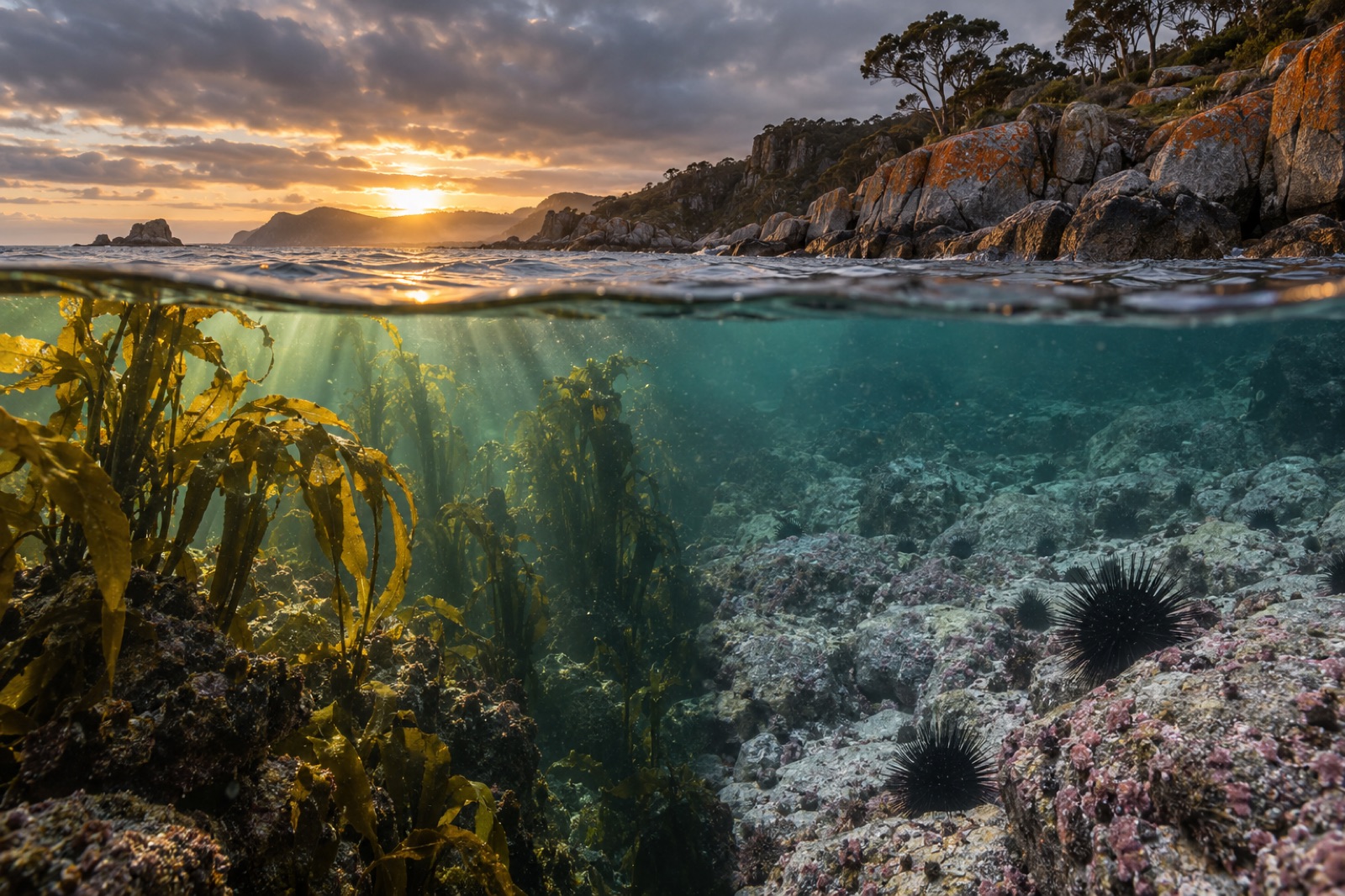
Maria Island floats just four kilometres off Tasmania's east coast across the shining narrows of Mercury Passage — a sloping, forested island of painted sandstone, convict ruins and some of the most protected temperate reef in southern Australia. No visitor cars, no shops, no noise beyond pardalotes and swell. For divers and snorkellers, it is the essential waypoint on Tasmania's kelp coast: a place to see what an east-coast reef looks like when it is left mostly alone.
Getting your bearings
Maria (pronounced "mah-RYE-ah") is a single island that reads as two, joined by a narrow sandy isthmus. The ferry from the town of Triabunna — roughly a 30–40 minute crossing — lands at Darlington on the sheltered western shore, where a World Heritage-listed convict probation station is now the island's only settlement: no permanent residents beyond rangers, and accommodation either in the old penitentiary bunkhouse or the campground.
Above the waterline the island is a national park in its entirety. Below it, a marine reserve declared in 1991 wraps significant stretches of coast in no-take protection. It was among Tasmania's first substantial marine protected areas, and three-plus decades of protection make it a living reference for the rest of the east coast.
Why this island matters for kelp coasts
Tasmania's east coast has suffered one of the fastest kelp collapses on record — around 95 percent of its giant kelp gone, much of it replaced by urchin barrens. Maria Island matters because it lets scientists and divers compare: protected versus fished reef, predator-rich versus predator-poor, recovering versus barren.
The island's situation in Mercury Passage gives it a flow of cooler, cleaner water, and its reserve bays hold dense common kelp (Ecklonia radiata) with rich understorey. Scattered remnant stands of giant kelp have been recorded in this region — rare now, and closely watched. Our monitoring teams (Tidewright's fictional east-coast program) use Maria Island as a control site against which Canopy Ledger satellite maps of the mainland barrens are compared.
Below the waterline: reef, kelp and urchins
What you'll see
- Common kelp forests in 5–15 metres, fronds swaying low over the reef, packed with wrasse, leatherjackets and weedfish.
- Sponge and ascidian gardens in the deeper, clearer passages, with vivid encrusting life in yellows and violets.
- Crayweed and golden kelp on the shallower wave-washed points.
- Long-spined urchins — present here too, a reminder that the island is a refuge, not a fortress. Comparing urchin densities inside and outside no-take zones is precisely the science the reserve enables.
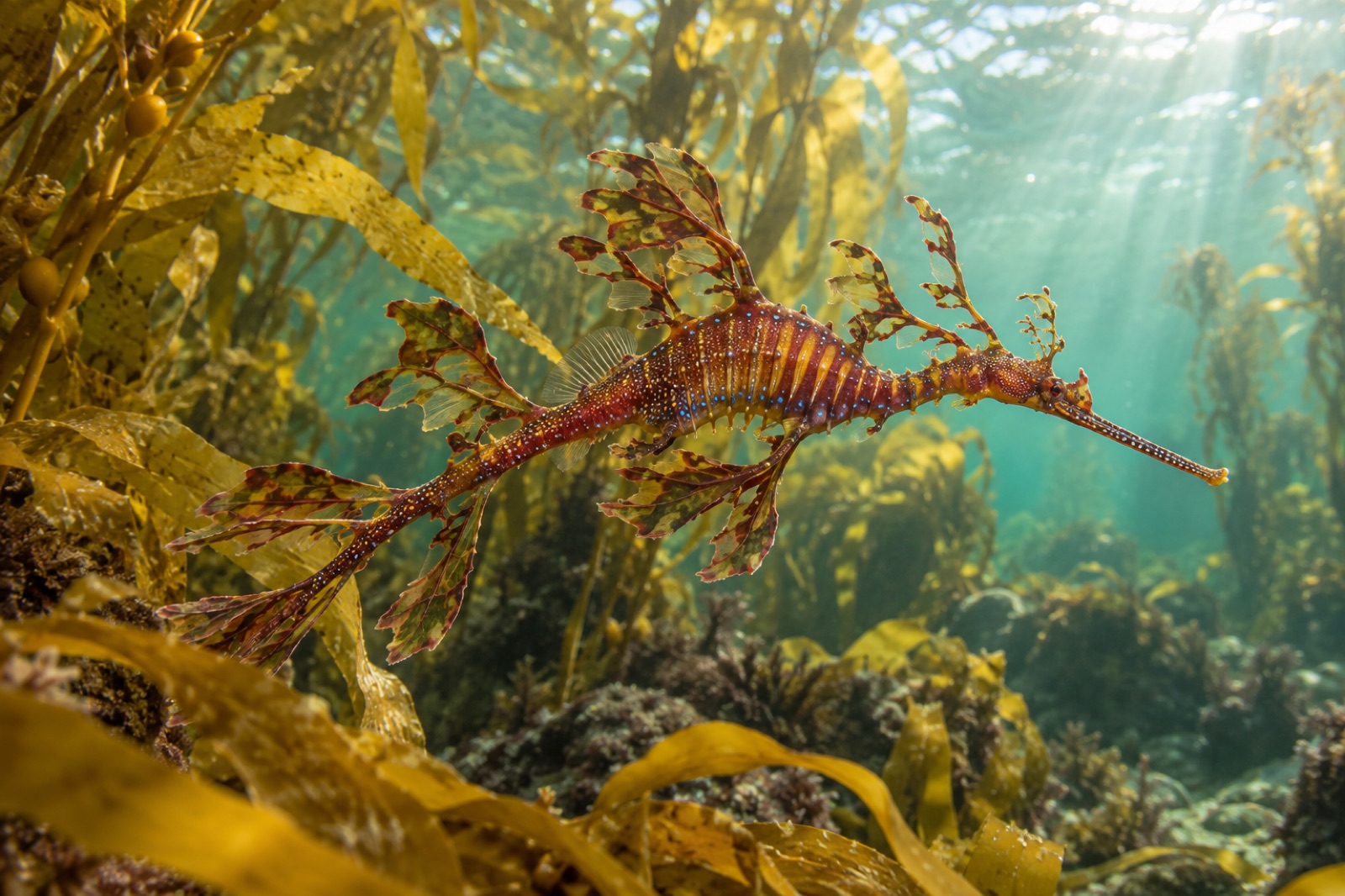
And the charismatic extras: draughtboard and Port Jackson sharks resting under ledges, big southern rock lobster in the protected zones, and — for the patient and lucky — weedy seadragons drifting in the kelp edge like animated reef décor.
Snorkelling for families
Darlington's sheltered bays and the isthmus beaches offer shallow, calm granite-reef snorkelling in the right weather — wrasse, schools of baitfish, and kelp fronds in two metres of water. It is cold (bring a thick wetsuit even in summer), but it is the easiest wild kelp snorkel on the coast.
Above the waterline: walks, cliffs and wildlife
You will come for the ocean and stay for the land. Maria Island carries some of Tasmania's most accessible wildlife encounters — Forester kangaroos grazing Darlington's lawns, wombats that barely glance up, Cape Barren geese, the tiny and endangered forty-spotted pardalote in the white gums, and an insurance population of Tasmanian devils introduced to the island disease-free.
Two walks every visitor should make:
- The Painted Cliffs — an hour's easy walk from Darlington to swirling, honeycomb-patterned sandstone the colour of desert dunes, carved by groundwater percolating through the rock. Go two hours either side of low tide.
- The Fossil Cliffs — a limestone face packed with the fossil shells of creatures that died in a shallow sea roughly 300 million years ago. Even non-geologists gasp.
Stronger walkers climb Bishop and Clerk (about 620 m, scrambling near the top) for the panorama: the isthmus, Mercury Passage, and the Freycinet ranges floating over the water.
Planning your visit
- Ferry: Triabunna to Darlington, around 30–40 minutes each way; book ahead in summer. Seas in Mercury Passage can turn the crossing lively.
- On-island transport: none. It is walking or bicycle — which is half the point.
- Stay: the Darlington penitentiary bunkhouse (book early) or the campground; bring all food and take all rubbish out.
- Diving: treat it as a proper temperate dive — 7 mm wetsuit or drysuit. Water runs roughly 12–18 °C through the year, clearest in autumn and winter.
- Dogs and drones: leave both at home; this is a national park.
Maria Island and the bigger Tasmanian story
Think of Maria Island as the control group in a coast-wide experiment. The east coast's kelp loss tells us what warming and urchins do unopposed; the island's reserve bays tell us what reefs do when left in relative peace. Restoration programs between those two bookends are where the future of the Great Southern Reef is being written — and a morning spent finning through Maria Island's kelp is the fastest way to understand what is at stake. For more on diving Tasmania's temperate reefs, see our Dive & Explore hub.
Key takeaways
- Maria Island is a car-free national park off Triabunna, with a World Heritage convict station at Darlington and a marine reserve declared in 1991.
- Its protected bays hold dense common kelp forest, sponge gardens and big lobster — a reference point for the degraded mainland coast.
- Remnant giant kelp stands have been recorded in the region; the island anchors recovery science for the east coast.
- Don't miss the Painted Cliffs at low tide, the 300-million-year-old Fossil Cliffs, and Tasmania's easiest up-close wildlife.
- Bring everything you need, take everything out, and pack a thick wetsuit — the water is cold, clear and worth it.
FAQ
How do you get to Maria Island?
By passenger ferry from Triabunna on Tasmania's east coast — Triabunna is roughly 1.5 hours' drive from Hobart. The crossing takes about 30–40 minutes and is weather-sensitive, so build flexibility into your plans.
Is Maria Island good for beginner snorkellers?
Yes, in calm conditions. The sheltered Darlington bays and the isthmus beaches offer shallow granite-reef snorkelling with kelp and reef fish in a few metres of water. The limiting factor is cold: a 7 mm wetsuit keeps beginners comfortable.
Are there really Tasmanian devils on Maria Island?
Yes. A disease-free insurance population was introduced to the island as part of the response to devil facial tumour disease. Sightings aren't guaranteed — they're most active at dawn and dusk around the island's roads and clearings.
What was the convict station at Darlington?
The Darlington Probation Station (1825–1832) was a convict outpost whose ruins — penitentiary, commissariat store, convict bunkrooms — survive remarkably intact. It is part of the Australian Convict Sites World Heritage listing, and the bunkhouse is now visitor accommodation.
Can you dive Maria Island independently?
Experienced divers with full temperate gear and local knowledge sometimes arrange charters from Triabunna. Conditions are genuinely exposed on the island's seaward side, and there is no dive facility on the island itself, so guided boat operations from the mainland are the realistic route for most visitors.