Encyclopedia8 min read
Giant Green Anemone (Anthopleura xanthogrammica): Species Profile
The giant green anemone is a solar-powered predator of Pacific tidepools and kelp-forest edges. Its biology, symbiosis and decades-long life.
Dr. Mara Ellison ·
Aggregating anemone (Anthopleura elegantissima) species profile: clonal armies, tentacle wars, symbiotic algae and survival at the top of the rocky shore.
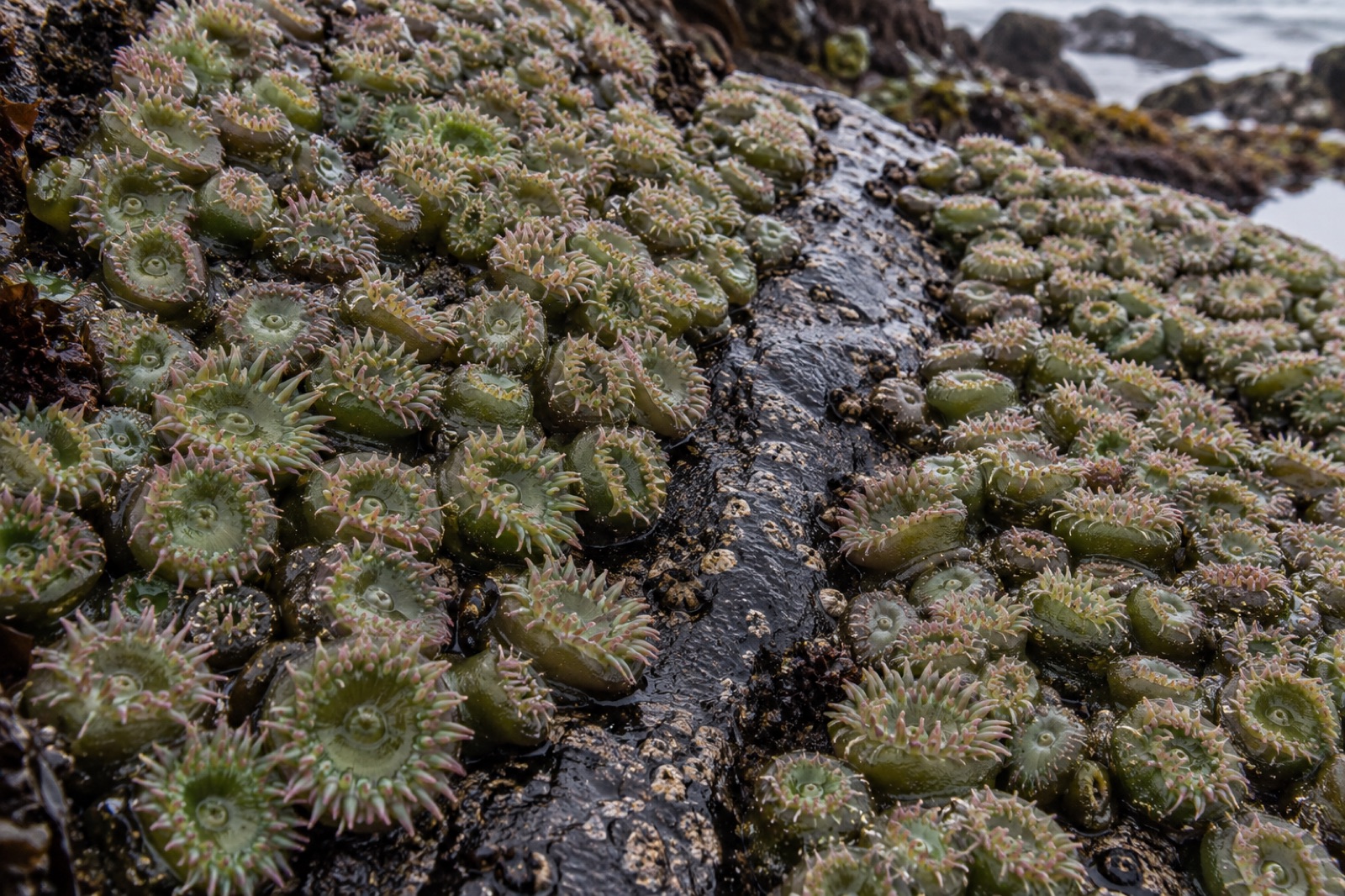
Walk almost any exposed rocky headland on the Pacific coast of North America at low tide and you will find, just above the mussel band, a rock face upholstered in flower-ettes: hundreds of small anemones, each crowned with stubby tentacles tipped faintly pink, pressed edge to edge in a living carpet. This is the aggregating anemone, Anthopleura elegantissima, and the carpet is stranger than it looks. Those hundreds of individuals are not a crowding of strangers. They are, typically, one animal — a single genotype copied over and over by cloning — and the straight, bare seam running down the middle of the rock, where the carpet abruptly stops and another begins a few centimetres away, is a front line. The aggregating anemone is at war, permanently, with its clone next door.
| Scientific name | Anthopleura elegantissima |
| Group | Sea anemone, class Anthozoa, phylum Cnidaria |
| Size | Small: oral disc usually 2–4 cm across; individuals may carpet square metres of rock |
| Lifespan | Individual polyps live years; a clone line may persist for decades or longer |
| Depth range | Middle and upper intertidal, on exposed rock; occasionally shallow subtidal |
| Range | Eastern North Pacific: roughly Alaska to Baja California |
| Status | Abundant; a classic indicator of exposed rocky-shore health |
Most animals commit to being one body. The aggregating anemone treats individuality as a business decision. Its primary way of expanding is longitudinal fission: a polyp elongates, pinches down the middle through the mouth, and splits into two genetically identical daughters, each regenerating its missing half within days. Repeat for years and the result is a clone — potentially thousands of polyps, all one genetic individual, occupying a patch of rock that can outlive every researcher who studies it. Because each polyp feeds independently (on copepods, small crabs, drifting mussel larvae and scraps delivered by the surf), a big clone collects energy across its whole footprint while a solitary animal of equal total size could harvest only one polyp's worth. Cloning is, ecologically, a way of being simultaneously small and enormous.
Sexual reproduction happens too. In late spring and summer, polyps release eggs and sperm into the water; fertilised larvae drift in the plankton for weeks — the dispersal lottery described in our explainer on larval dispersal — before settling on new rock and founding a new clone. So every carpet on the headland is both an old local empire and, at its origin, a recent immigrant.
Here is where elegantissima becomes genuinely peculiar. Genetically identical polyps tolerate each other completely; polyps from a neighbouring clone do not. Where two clones meet, each fields a warrior caste on its border — polyps that grow larger than ordinary feeders and develop inflated white fighting tips called acrorhagi below their tentacles. Acrorhagi are packed with a distinct type of stinging cell found nowhere else on the animal, and they have one job: when a border polyp touches a non-clonemate, it rears over and slaps its acrorhagi against the opponent. The stings peel patches of tissue off the victim. The loser retreats or dies; the line moves a millimetre. And so the bare, anemone-free seams you see between aggregations are no-man's-lands maintained by perennials of slow-motion combat, front lines that can hold their position for years.
This is one of the clearest cases in any animal of altruistic division of labour: warrior polyps fight, do not grow properly and almost never reproduce, sacrificing their own reproductive prospects for the clone — which works, evolutionarily, because every polyp in the carpet shares the same genes. Watching a border for a patient half hour on a low tide, you can sometimes see the engagements happen: a lunge, a held contact, a slow recoil.
Like its much larger relative the giant green anemone, A. elegantissima runs on symbiosis. Its tissues host photosynthetic algae — both zooxanthellae and green zoochlorellae — whose sugars supplement the carnivorous diet and whose pigments give healthy crowns their olive-to-emerald cast with those pink-tipped tentacles. Clones in sunny, high pools lean more heavily on their algae; deeply shaded carpets look browner. The partnership buys the anemone a crucial advantage on the high shore, where feeding time is short between tides and every free calorie helps. It also creates a vulnerability: heat-stressed animals bleach, expelling their symbionts and going pale, and bleached clones on sun-baked rock grow slowly and fight poorly. In the hot, calm low tides of summer — the pools-as-refuges physics we describe in rockpools as refugia run in reverse when water sits motionless in full sun — the aggregating anemone is among the first animals in the zone to show stress.
The aggregating anemone's real genius is desiccation management. Its name-giving behaviour — crowding — is itself a survival strategy: polyps packed shoulder to shoulder shade and humidify one another when the tide is out. Individuals add protection by sticking bits of shell and gravel to their sticky columns, and at low tide each contracts into a small, grit-crusted dome that seals moisture in. A carpet of contracted clones looks, to the untrained eye, like rough, sandy rock — which is partly the point.
Predators exist but work around the edges. Several tidepool sculpins nip tentacles; the leather star — profiled in our leather star guide — eats anemones outright; and the pale aeolid nudibranch Aeolidia papillosa grazes aggregating anemones while stealing their unfired stinging cells for its own back. But a healthy carpet under a mobile predator regime mostly persists and slowly expands. The keystone logic of this shore — the same tidepool arena where the ochre sea star's famous experiments on mussel beds run a metre below — is that everything eats everything given enough years, and the clonal carpet's defence is not invulnerability but redundancy: you can graze an empire's margin, but you cannot easily kill a thousand-bodied animal.
Aggregating anemones reward the slowest kind of tidepooling. Look on surf-facing rock in the mid-to-high zone, just above the mussels, on any Pacific headland from Vancouver Island — see our Vancouver Island coast guide — down through Monterey Bay. Wet your finger before the lightest touch (or better, don't touch), never pry at the rock, and step on bare stone rather than carpet; our tidepooling etiquette guide covers the full code. Bring patience and look for the front lines: the dead-straight, anemone-free gutters between two carpets are where the biology gets theatrically good.
Both, and that is the point. Each polyp is a physiologically complete individual that feeds itself, but the polyps in a carpet are clones — genetically identical copies produced by splitting — cooperating like a colonial animal. Biologists use the word "genet" for the whole clone and "ramet" for each polyp.
That is a war zone. Each carpet is a clone, and border polyps of both clones grow fighting structures called acrorhagi and sting any non-clonemate they touch. The mutual damage keeps both armies a few millimetres apart, maintaining the bare gutter — sometimes for years at the same spot.
No. Their stinging cells cannot penetrate human skin. A fingertip on a wet tentacle feels a faint sticky tug, nothing more. The standard tidepool rule — wet hands, gentle or no touching, never pull anything off the rock — is for the animal's protection, not yours.
Size, sociability and shore position. The giant green anemone is a solitary animal up to 25 cm across living in low pools and surge channels; the aggregating anemone is a few centimetres across, lives crowded in clone carpets on higher, more exposed rock, and is the one with the clone wars. If the anemones are small and shoulder-to-shoulder, they are elegantissima.
Individual polyps die constantly and are replaced by fission. Whole clones can be killed by extreme heat events, smothering sand or scarring storms, but partial survival is the norm — and because any surviving polyp can regrow an army, clone lines on stable rock are thought to persist for many decades.
The giant green anemone is a solar-powered predator of Pacific tidepools and kelp-forest edges. Its biology, symbiosis and decades-long life.
Dr. Mara Ellison ·
Strawberry anemone Corynactis californica: the cloning corallimorph that carpets kelp forest reefs — how it feeds, clones and spreads.
Dr. Theo Nakamura ·
Meet the ochre sea star, the purple tidepool predator whose removal in a famous 1960s experiment coined the keystone species concept.
Dr. Theo Nakamura ·