Science11 min read
Estuaries and Kelp: Life Between River and Sea
Estuaries layer fresh water over salt in shifting gradients. How estuarine circulation works, where kelp's brackish limit lies, and why the river–sea edge matters.
Dr. Theo Nakamura ·
The starry flounder is the North Pacific's most river-loving flatfish, banded in orange and black. How to identify it, where it hunts, and why estuaries need it.
The starry flounder (Platichthys stellatus) is the flatfish that never read the rule book about staying in the sea. It is a proper flat-bottomed bottom-dweller — eyes on one side, pancake body, ambush jaw — found along the whole North Pacific rim from Santa Barbara to the Bering Sea and across to Japan and Korea. But unlike nearly every other flatfish on the coast, it is genuinely at home in rivers. Sport fishermen have pulled starry flounders from sweet freshwater more than a hundred kilometres from the ocean, and the species moves between salinities with a ease more typical of salmonids than of halibut's cousins. It is also one of the most striking small flatfishes you will ever see: a rough, star-studded body rimmed with bands of orange and black so bold they look printed.
| Scientific name | Platichthys stellatus |
| Group | Flatfish (family Pleuronectidae) |
| Common names | Starry flounder, emery wheel, grindstone |
| Size | Commonly 30–45 cm; exceptional fish to roughly 90 cm and 9 kg |
| Range | North Pacific: Santa Barbara (rarely) to the Bering Sea, and across to Japan and Korea |
| Habitat | Estuaries, bays and rivers; also sand flats and kelp-edge margins to about 300 m |
| Diet | Clams, worms, crabs, shrimp, small fishes |
| Lifespan | Females can live more than two decades |
| Party trick | Switches between salt and fresh water; changes colour to match the bottom |
Three features close the case on a starry flounder, and any one of them will do.
The bands. The dorsal, anal and tail fins carry alternating bars of deep orange and near-black. On the eyed side the contrast is dramatic — a fish wearing a warning pattern it does not, in fact, need to be. No other Pacific flatfish wears that livery, and no photograph needs a scale card once you can see the fins.
The stars. The skin of the eyed side is armoured with rough, star- or boulder-shaped bony tubercles, which give the species its name and its old nicknames (old-timers still call it the "emery wheel" or the "grindstone" for what it does to a thumb run the wrong way). A starry flounder feels like fine sandpaper even before you get to teeth.
The left-eyed riddle. Most starry flounders in California and Alaska put both eyes on the left side of the head. But a variable share of the stock runs the other way — eyes on the right side instead. On the Asian side of the Pacific, right-eyed forms can be common; on the American side, left-eyed ones dominate. It is one of the best-known examples in fish biology of a species still deciding which way is up, and a reminder that in flatfish, body asymmetry is a construction project: the larva begins life upright and symmetrical, swims with plankton, then pays down a reshaped skull so one eye migrates over the head to join the other before it settles.
Confusions are few once the bands are seen. California halibut is more oval, mottled gold without the fins' bars. Diamond turbot and Pacific sanddab are smaller and finer. Arrowtooth flounder is far softer and lives much deeper.
The starry flounder's superpower is osmoregulation — the internal hardware that decides how a fish manages the salt inside it against the salinity outside without drying out or drowning in its own tissues. Most flatfishes live in one environment or the other. Platichthys walks the whole gradient.
Adults spawn in winter to early spring in shallow coastal and lower-estuary water along most of the range, releasing buoyant eggs into the water column. The eggs drift offshore for a few days and the larvae ride currents for weeks before settling out. What the young fish do next is the distinctive thing: they move up into estuarine nurseries, rear on amphipods, copepods and small shrimp among eelgrass and sand flats, and then spend years in the brackish width where river and sea argue. As they grow, some migrate seaward into full marine habitat; others push far inland, recorded well beyond the tidal limit in big river systems — past 100 kilometres up the Columbia in the old records, and deep into the Sacramento system in California.
Life in those rivers is not idle. The fish work soft bottoms and drift edges for clams and worms, riding the river's slow conveyor. It is one of very few genuinely marine families whose members can be part of both a delta's fish fauna and the shelf's.
A starry flounder is not a canopy fish — it does not live on blades or hide in holdfasts. Its relationship to kelp is about geometry: the kelp bed builds the reef edge, and the flatfish works the sand and gravel margin immediately beside it.
The pay-off is simple. Kelp forests leak. Continuously, they shed blades and tissue, and storms shed more. Most of this detritus is consumed before it goes far — by amphipods, worms, crabs, kilted clams in the understory — and the sand immediately beyond a kelp bed is one of the richest floors on the coast precisely because the forest throws food at it. Our explainer on drift kelp and wrack walks through how that food moves. A flounder lying still on that sand is sitting at the receiving dock of the forest's export economy, waiting for the storm-displaced crab or clam the kelp edge supplies.
Watch a bull kelp bed after the first big autumn blow and the economics become visible: idle stingrays and flounders re-position with the tide line, reds and rockfishes hover at the margin, and every half-hour a rotten tassel of bull kelp delivers another fresh shipment. That edge, not the surface canopy, is where the flounder's life touches the forest's.
Starry flounder have supported shore and pier fisheries for generations, especially in Oregon, Washington, British Columbia and Alaska. They take baited rigs on the bottom, they are abundant in places where fishing effort is modest, and they are genuinely good to eat — the flesh is white, fine and mild, closer to a small turbot than to a heavier halibut. Old fisheries from California's piers kept steady winter counts. They rarely reach trophy size by Pacific flatfish standards — a 4-kilo fish is memorable — but they are a reliable, resilient staple.
In management terms the species sits on the safe side of the North Pacific's flatfish portfolio: no endangered listing anywhere in the range, catch rules set state by state on the American side, and local abundance that reads well wherever its estuarine nurseries have been left alone. That last clause matters. The starry flounder depends on estuary quality — on the clean sand, warmed-and-cooled mixlines, and intact eelgrass that raise its young — in a way few other nearshore fish do. Where levees, fill and channelization have shrunk estuaries, fewer young starrys recruit. Where restoration opens channels and reconnects tidal flats, they come back.
For the rough, star-shaped bony tubercles that stud the eyed side of its skin — an armour that gave it old west-coast nicknames like "emery wheel" and "grindstone." Stars, not stars as in brightness.
Most American-side fish do, but a consistent minority are right-eyed, and on the Asian side of the Pacific right-eyed individuals are considerably more common. It is one of the best-known natural cases of a flatfish species with flexible body symmetry.
Yes. It is a genuinely euryhaline species and the most freshwater-tolerant flatfish on the Pacific coast. Records put it more than a hundred kilometres upstream in big rivers, living and feeding far from the tidal line.
Very. The flesh is fine, white and mild — closer to turbot than to heavier flatfishes. They take simple baited rigs on sandy bottoms and are a traditional Pacific pier-and-shore catch, within local regulations.
Sandy shallows in Puget Sound, San Francisco Bay, Willapa Bay, and the sand margins next to kelp beds along the Oregon, Washington and British Columbia coasts — anywhere between roughly 3 and 30 metres with a mixed sand-and-gravel bottom in cool water.
Estuaries layer fresh water over salt in shifting gradients. How estuarine circulation works, where kelp's brackish limit lies, and why the river–sea edge matters.
Dr. Theo Nakamura ·
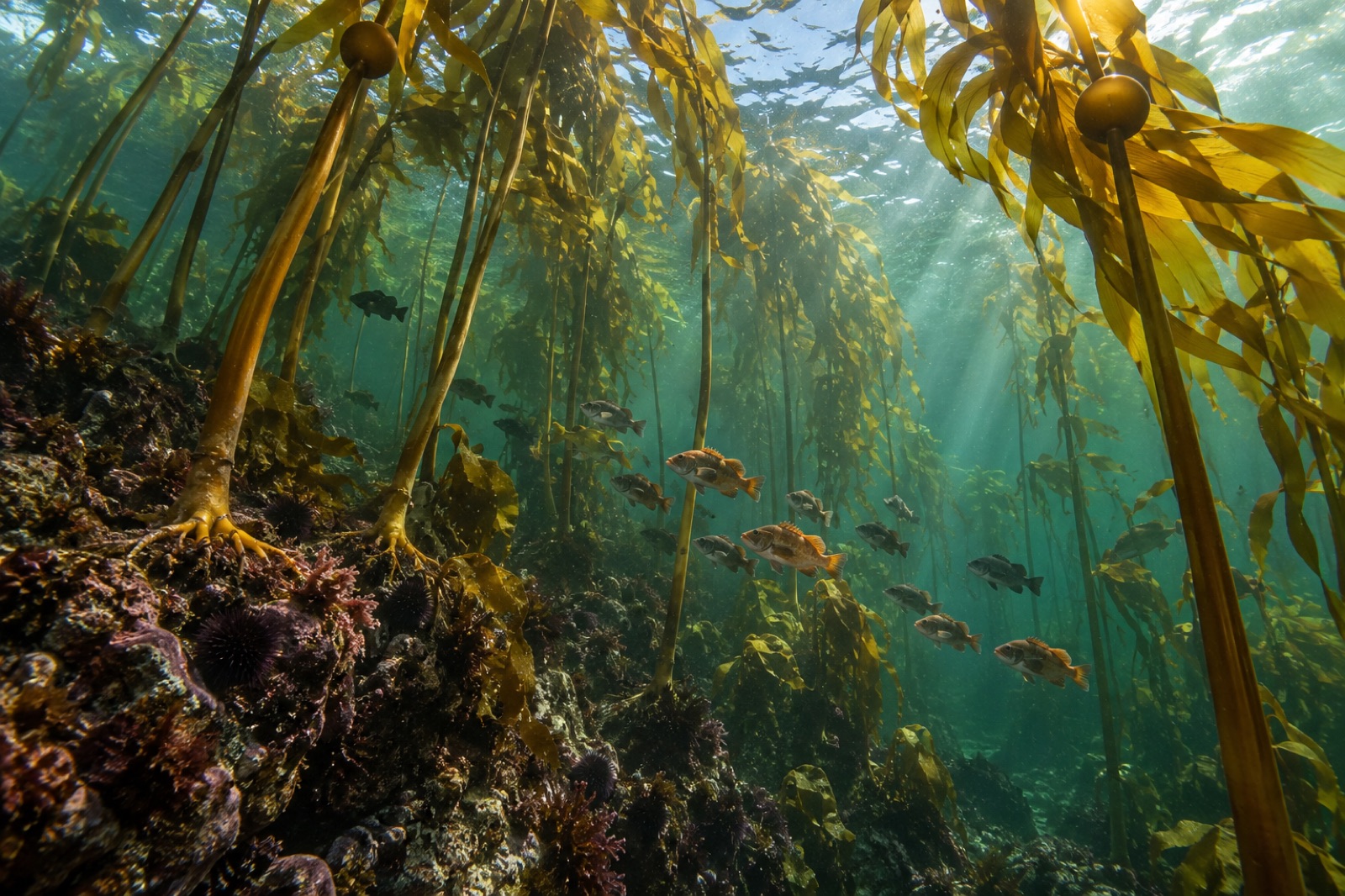
Meet bull kelp, the fast-growing annual giant of North America's Pacific coast — its biology, Indigenous heritage, dramatic decline and the race to restore it.
Dr. Mara Ellison ·
Washington's inland sea shelters floating bull kelp beds that shelter salmon in return. A Coastal Atlas guide to its patchwork beds and citizen science.
Tom Okafor ·