Farming9 min read
Harvest Timing: When Kelp Biomass and Quality Peak
When should you harvest kelp? How the biomass-versus-quality trade-off works, species-by-species seasons, and the sampling routine that catches the peak.
Naomi Reyes ·
Seaweed farming runs on an 18-month loop, from sorus collection to harvest to gear refit. A season-by-season planner for temperate kelp farms in both hemispheres.
Part of a learning path
This article is stop 7 of 10 on So You Want to Farm Seaweed — The honest route from first tide to first invoice.
A seaweed farm looks seasonal from the shore — lines appear in autumn, weights of wet kelp come ashore in spring — but on the water it runs on a continuous eighteen-month loop. The week you harvest this year's crop sits beside the week you are collecting sorus tissue for next year's, and the summer lull in between is when every shackle, splice and anchor strap gets its annual inspection.
This calendar is written for temperate kelp farms — the sugar kelp, kombu and oarweed operations that dominate current commercial farming — with northern-hemisphere months named first. Southern-hemisphere farmers shift everything by six months. Adjust a few weeks earlier or later for your latitude; hold the sequence firm, because the sequence is the biology.
What follows is each phase with its dominant risks and the habits that keep the calendar honest.
The farm year starts at the hatchery, not at the dock. Kelp reproduction is tied to shortening days and cooling water, so the weeks when wild sori ripen are fixed by biology and cannot be rescheduled for convenience.
Dominant risks: early heat spikes that discharge your collected sori in transit; delayed inoculation that pushes out-planting into storm season.
Before any seeded string leaves the hatchery, the farm site itself has to be ready: anchors set, longlines tensioned, marker and safety gear in place, every shackle accounted for.
This is the shortest, highest-stakes window in the kelp year. Your goal: seeded twine on grow-lines in the sea, still in cool (ideally sub-12 °C for Saccharina species) water, before the winter swell season peaks.
A useful framing borrowed from Tidewright's Holdfast nursery programme: treat out-planting as the handover moment of the whole chain, with named owners before and after. The batch is the hatchery's responsibility until it's tied off, and the field team's from that moment.
Winter is when temperate kelp actually grows. Short days and cold, nutrient-rich water are the species' natural setting; the farm mostly needs you to stay out of its way and watch.
What you are guarding against all winter is invisible: "Epiphyte season is coming." As soon as day length turns in spring, bryozoans, spirorbid worms and hydroids will colonise every blade. Healthy dense kelp in January earns you a wider harvest window in May.
Spring compresses the year. Light returns, nutrients are still high, and the same conditions that accelerate kelp also wake everything that wants to live on it.
Harvest is the calendar's pinch point — weeks of work compressed into the few weeks when blades are at peak quality before fouling and warming water degrade them.
With gear hauled, summer becomes the farm's annual maintenance and thinking season.
Wherever you farm, resist treating dates from a neighbouring region as your own. Two farms 200 km apart can differ by three weeks on optimal out-planting day after a warm upwelling shift; read Upwelling Explained before assuming the calendar you borrowed still fits a changed coastline.
For annual kelps like sugar kelp, no — spring out-planting faces warming water and epiphyte season long before the plants reach harvestable size. Some perennial species and tropical setups run different calendars, but for the temperate standard, autumn out-planting is not a convention so much as an ecological requirement.
Hold it in the hatchery at the cool end of its range with reduced light to slow growth — one to three weeks of holdback is usually survivable. Beyond that, quality suffers; a better fallback is to push nursery acclimation later and out-plant slightly larger twine. The worst option is deploying into warm water because the twine was "ready".
Shift your entire risk profile a season earlier: deploy as soon as heat breaks, tighten the spring harvest window, add margin to processing capacity, and pre-book buyer contracts with contingency language. The patterns in El Niño and Kelp apply to farm calendars as much as to wild forests.
At the end of the previous harvest. Every piece of gear ordered in refit season arrives with months of dry-shop time to splice and pre-fit; gear ordered in autumn arrives, inevitably, the day you want to deploy lines.
Growth sampling, post-storm integrity checks, and record-keeping. The farm mostly wants distance in winter — the risk of human damage to storm-stressed gear exceeds most benefits from tinkering. Bundle observations with check visits, keep them short, and stay off the lines in heavy swell.
When should you harvest kelp? How the biomass-versus-quality trade-off works, species-by-species seasons, and the sampling routine that catches the peak.
Naomi Reyes ·
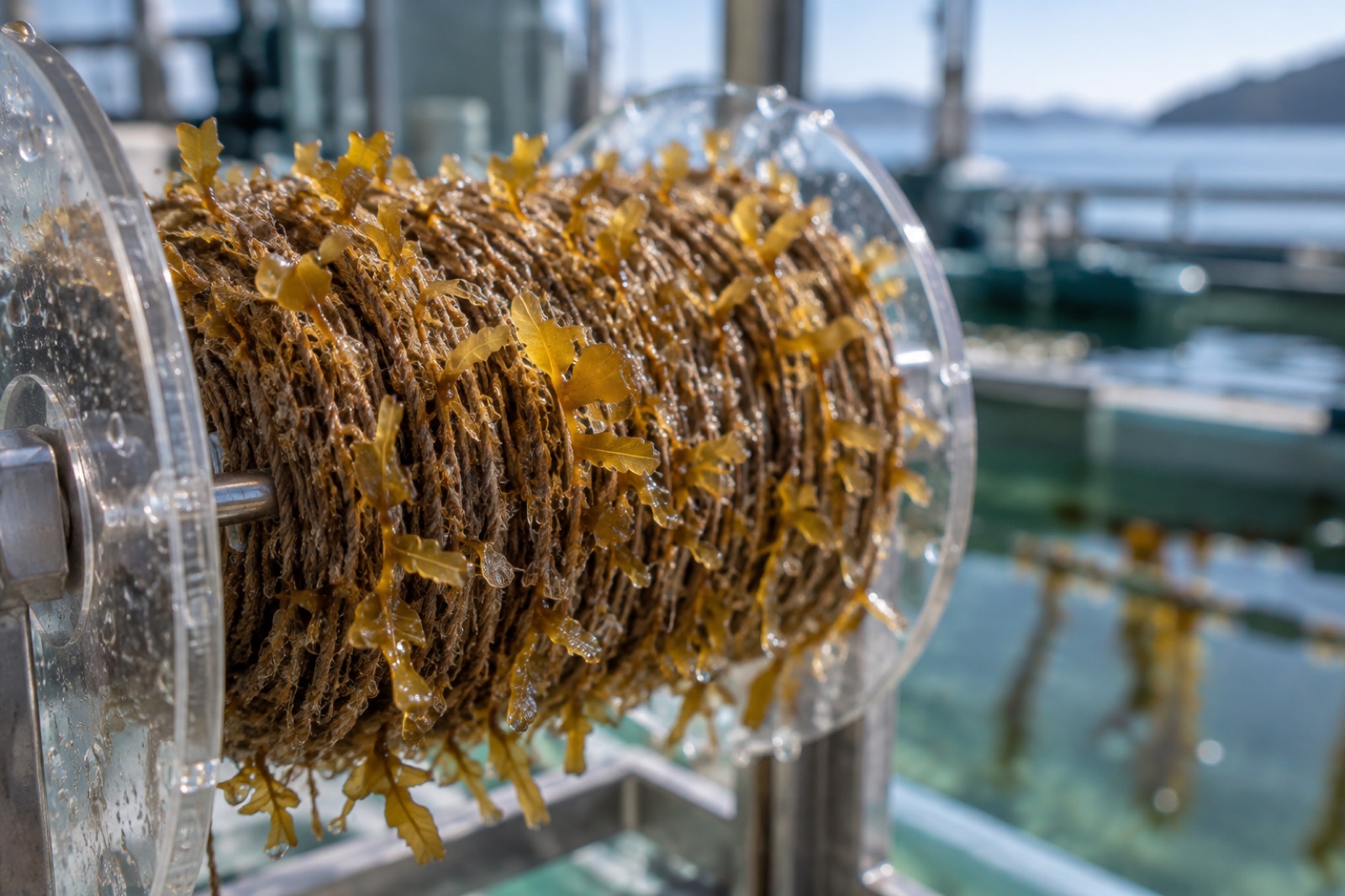
Seed string is the kelp farm's starter crop. This step-by-step guide covers sorus collection, spore release, inoculation density, incubation and out-planting.
Naomi Reyes ·
How to design and prepare a seaweed farm for storm survival: load cases, safety factors, storm checklists, and the preparation that decides what breaks.
Naomi Reyes ·