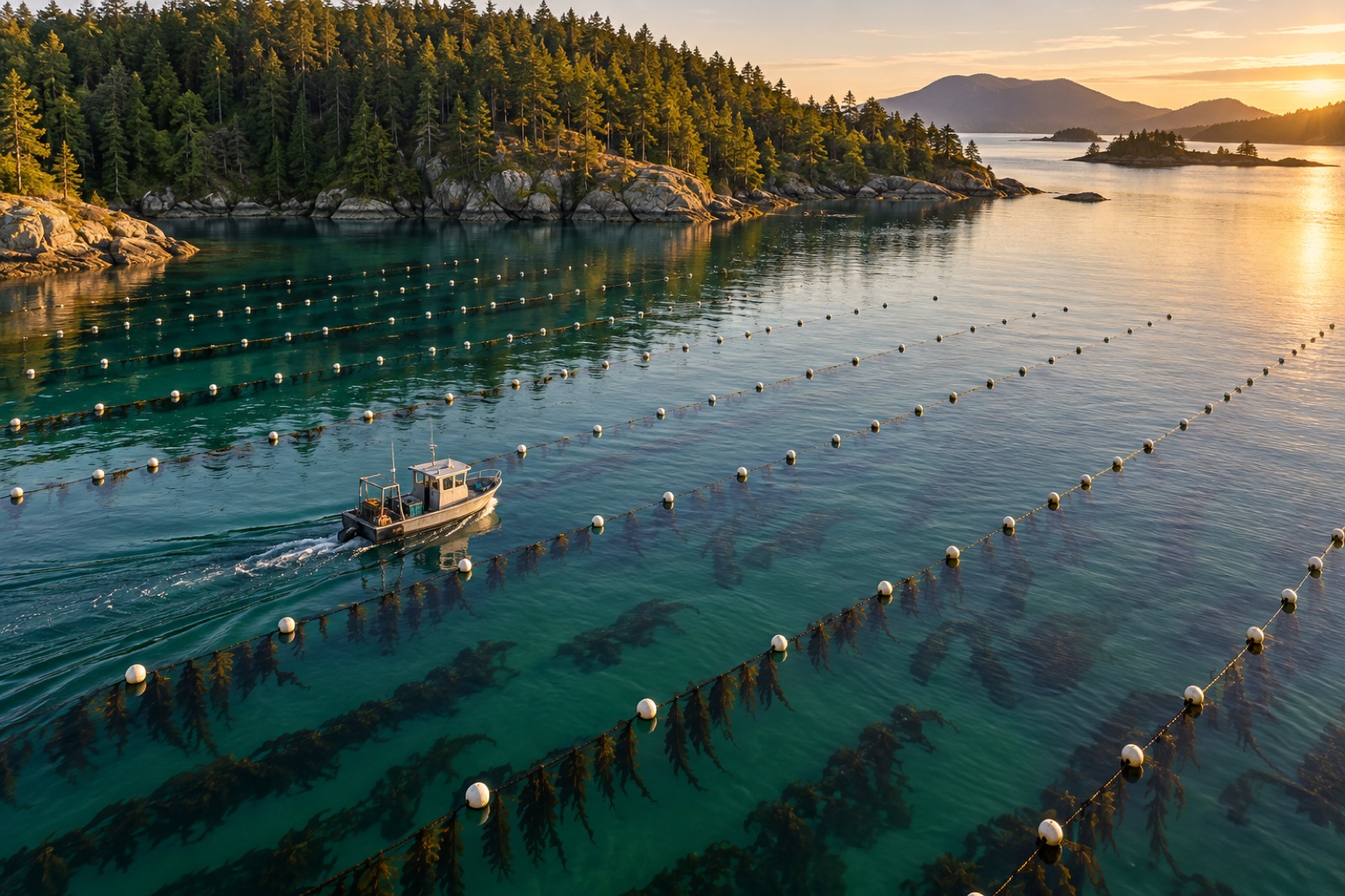
Most seaweed farm losses reported in regional newsletters are not biological failures. They are the quiet sound of a mooring giving way: a helical anchor ploughing a furrow through soft sediment in a February gale, a rope strop parted at a thimble, a chain dragged a hundred metres sideways with four longlines wrapped around it. The crop above is fine. The geometry below decided otherwise.
Anchoring and mooring are unglamorous compared to seed science, but they are the difference between a farm and a debris field. This guide covers the anchor types in practical use, how scope and load paths actually work on a longline grid, material choices, and the annual inspection discipline that holds it all together. It assumes you have a grid in mind — see Longline Design for Seaweed Farms if not — and a site with known depth, sediment and exposure (Choosing a Farm Site).
What a mooring system actually has to survive
Before choosing hardware, be honest about loads. A kelp longline grid sees:
- Steady drag from current on lines, floats, and (in season) tonnes of wet kelp acting as an underwater sail.
- Wave loading — sharp, cyclical snatch loads that peak with the worst storm of the year, not the average day.
- Dynamic motion — lines rising and falling, floats surfing seas, all of which multiplies effective loads beyond any static calculation.
- Growth over the season — a spring kelp line carries far more drag than the autumn line you anchored for.
A working rule in small-farm engineering: design moorings for the worst single week of the ten-year record at your site, then add margin, then build to inspection. This is why storm-proofing is a companion craft, not a separate topic.
The four anchor families
1. Deadweight anchors
Concrete blocks or steel masses set on the seabed. Holding is purely gravitational: what they weigh, they hold, minus buoyancy and minus sliding.
- Pros: indestructible, cheap, no specialist installation, work on any bottom, visible and recoverable.
- Cons: enormous weight per unit of holding on soft bottoms; rely on sediment friction that sand waves and currents can undercut; lift barge needed for large units.
- Use where: hard or mixed bottoms, small shallow farms, and as secondary or backup anchors anywhere.
As sizing intuition, a single cubic metre of concrete submerged still weighs roughly 1.4 tonnes against vertical lift — and much less against horizontal sliding once sediment slides. Deadweights are honest, weak-per-kilogram anchors; treat them as such.
2. Helical (screw) anchors
Steel shafts with helical plates, screwed into the seabed by torque motor or diver. Think of them as giant ground screws.
- Pros: exceptional holding per kilogram, immediate full capacity, precise positioning, minimal seabed footprint.
- Cons: need competent sediment (firm sand and mud are ideal; rock and boulders defeat them), and need equipment to install. Installation torque is your proof test — if it screws in firmly, it will hold.
- Use where: the mainstay of serious kelp and shellfish farms in suitable sediment.
3. Drag-embedment anchors
Adapted from mooring and shipping practice: fluke-style anchors (Danforth, Bruce, plough patterns) dragged into position, where they set by ploughing into sediment.
- Pros: strong in the right seabed, familiar to any marine contractor, no diver needed.
- Cons: demand scope and set distance — you tug them in with the vessel — and are poor on rocky or weedy bottoms where the flukes skate instead of bite.
- Use where: long deep-water moorings, exposed sites where a set-and-forget anchor with a long trajectory is acceptable.
4. Driven piles and rock bolts
For nearshore, shallow or rocky sites where engineers can drive steel piles into the seabed or bolt into bedrock.
- Pros: the strongest options where applicable; rock bolting into reef is how permanent moorings survive decades.
- Cons: maximum regulatory touch (you are modifying the seabed), specialist installation, and usually overkill for seasonal kelp grids.
- Use where: permanent infrastructure, terminal corners of large commercial grids, or a flagship farm that must survive everything.
Scope, catenary and the load path
Scope is the ratio of total mooring line length (anchor to connection point) to water depth. It decides the angle at which your line pulls the anchor — and most anchor types only hold against a near-horizontal pull.
- 3:1 scope (three metres of line per metre of depth) is the common minimum for working kelp farms.
- 4:1 to 5:1 is prudent on soft bottoms, exposed sites, or anywhere a storm snatch could lift the line angle.
- Chain section at the bottom — a few metres of heavy chain directly at the anchor eye — keeps the pull angle low even as the line above lifts, adds abrasion resistance where the rope meets seabed, and acts as sacrificial chafe gear.
The load path matters as much as the anchor. Follow the force: kelp canopy → grow line → headline → bridle → riser → anchor line → chain → anchor. Every transition is a potential weak point. Design each connection (shackle, thimble, splice, or chain link) to outlast everything on either side of it, and never put a knot where a splice belongs — a bowline loses half a rope's strength where a proper eye splice loses almost none.
Floats are structural, not decoration
Submerged floats take wave-driven surge off the grid and keep crop lines out of the surface turbulence zone. But every float is also a small sail. Surfacing floats in a gale are the source of the classic snatch load that rips out marginal anchors: keep floats submerged below the wave trough zone, sized for the deepest expected enforce position of the lines, with buoyancy in surplus, not at parity.
Seaweed-scale worked logic (not a substitute for engineering)
For a small coastal farm — four longlines of 100 m each in 10 m of water, moderate exposure — the arithmetic that working farmers share goes roughly:
- Estimate worst-case drag on the worst exposed line using kelp biomass × wet drag coefficient at worst-case current and wave state. For big spring lines in 1–2 m seas, single-line storm loads can exceed several hundred kilograms.
- Assume imperfect load sharing — your corner anchors carry much more than their theoretical share when a swell runs down the grid axis.
- Multiply by a safety factor of at least 3 against worst-week loads.
- From the resulting holding requirement, pick the anchor type and count. In firm sand, helicals sized for that requirement are compact and provable. In soupy mud, deadweights or extra helicals share the job.
The honest summary: do the sum yourself for intuition, then have someone qualified do it again for real. Marine engineering is cheap compared to losing a farm, and many aquaculture insurers require exactly that.
Materials: what lives underwater for a decade
- Rope: HMPE (e.g., Dyneema-class) or high-tenacity polyester for the loaded sections. Polypropylene is cheap and floats, but UV- and abrasion-weak; use it where economics demand, but replace on a two-year clock, not a ten-year one.
- Chain: galvanised, renewed at the first sign of wasted links. Where the chain meets an anchor, use a proper bow shackle — never a threading of rope through the eye; you are inviting a honed edge and a slow saw.
- Shackles and hardware: rated, galvanised or stainless where corrosion is predictable, and never mixed-metal in contact (stainless shackles on galvanised chain accelerate galvanic loss in seawater).
- Buoys: string-line oyster floats and trawl floats live longer than pretty buoys in the real world, and they are cheaper to replace.
Inspection: the calendar component
Anchoring is a maintenance craft, not an installation event. The annual discipline:
- Post-storm, every storm: from the boat — line tensions, float positions, any listing buoys, evidence of drag (crop lines rendered aslant of their expected geometry).
- Quarterly dive or camera pass: anchor line condition where it meets seabed, chain wear at the bottom bend, marine growth on critical shackles.
- Annual haul-out of a rotating sample — one anchor in five or ten — inspected on the dock, not in the water. It is astonishing how many "fine" moorings fail under hands-on eyeballing.
- Documentation: a simple spreadsheet per anchor — type, set date, install torque or weight, last inspection, next due — is worth more than the anchor in an insurance conversation.
Where crew dive time is scarce, underwater camera and ROV approaches adapted from recreation work, or the survey tooling used on restoration sites, translate directly.
A kelp farm's mooring is also habitat infrastructure — or damage, depending on care. Good practice keeps true to the same ecological logic as the crop:
- Minimum footprint: helicals and piles disturb a square metre; dragged chains sweep wide arcs. Choose line geometries that keep contact zones small and predictable.
- No entanglement additions: streamer-free lines, snug float attachment, and no loose rope tails. The farm is only a force for ocean recovery if it isn't also a hazard to wildlife moving through it.
- Reporting and removal: your permit likely requires season-end gear plans; leaving lines to become ghost infrastructure forfeits the good faith you need from neighbours — regulators, fishers, and the boating public alike.
Tidewright's own field programmes treat mooring integrity as a core environmental KPI, not a footnote — a farm that stays put is the baseline of ocean stewardship, and the same engineering culture supports the Drifter deployment operations offshore.
Key takeaways
- Design moorings for the worst week in the ten-year record at your site, multiplied by growth across the season and a real safety factor.
- Match anchor type to seabed: helicals in firm sediment, deadweights as honest-but-weak ballast, drag anchors on long deep pulls, piles and bolts in shallow hard bottom.
- Keep the pull angle low: 3:1 scope minimum, more where it matters, plus bottom chain as sacrificial insurance.
- The load path is the design. Every shackle, splice and bend must outlast its neighbours.
- Inspection is the calendar layer of anchoring: post-storm boat checks, quarterly wet passes, annual dockside haul-out samples, and written records.
- Keep the farm's seabed footprint small and snag-free — moorings are environmental infrastructure or environmental damage, never neutral.
FAQ
How do I know my seabed type without a survey?
Start with charts and local knowledge, dredge or grab samples from a boat, and ask the harbour master or local fishers — the people who have anchored there for decades know. For anything beyond a hobby rig, pay for a proper sediment survey; soil assumptions kill farms.
Can I use boat anchors for a kelp farm?
For very small, very short-season trials, portable fluke anchors can hold a few lines. For a real farm, no — aquaculture needs anchors designed for long-term, set-and-monitor deployment with known holding capacity, not on-demand retrieval.
Do mooring lines harm marine mammals?
Unattended vertical lines and slack loops are a genuine entanglement risk in whale and dolphin habitat. Keep lines taut, eliminate hung loops overnight, use breakaway-rated components where regulators require them, and observe exclusion seasons during migration windows. Most of the risk is solvable with geometry and vigilance.
How long does mooring hardware actually last?
Galvanised chain and shackles in seawater typically offer 5–10 years; HMPE and polyester lines last longer than polypropylene but still fatigue; helical anchors in good sediment are long-lived but should be inspected as though they are not. Treat every component as replaceable on its own clock, and the grid is maintainable.
What happens when a mooring fails anyway?
Cell phone on, boat ready, no blame culture: document immediately, retrieve drifting gear before it crosses navigation or habitat, notify the authority listed in your permit, and report to neighbours. Then rebuild with the failed component upgraded — the failure was a finding; the discipline is what you do next.