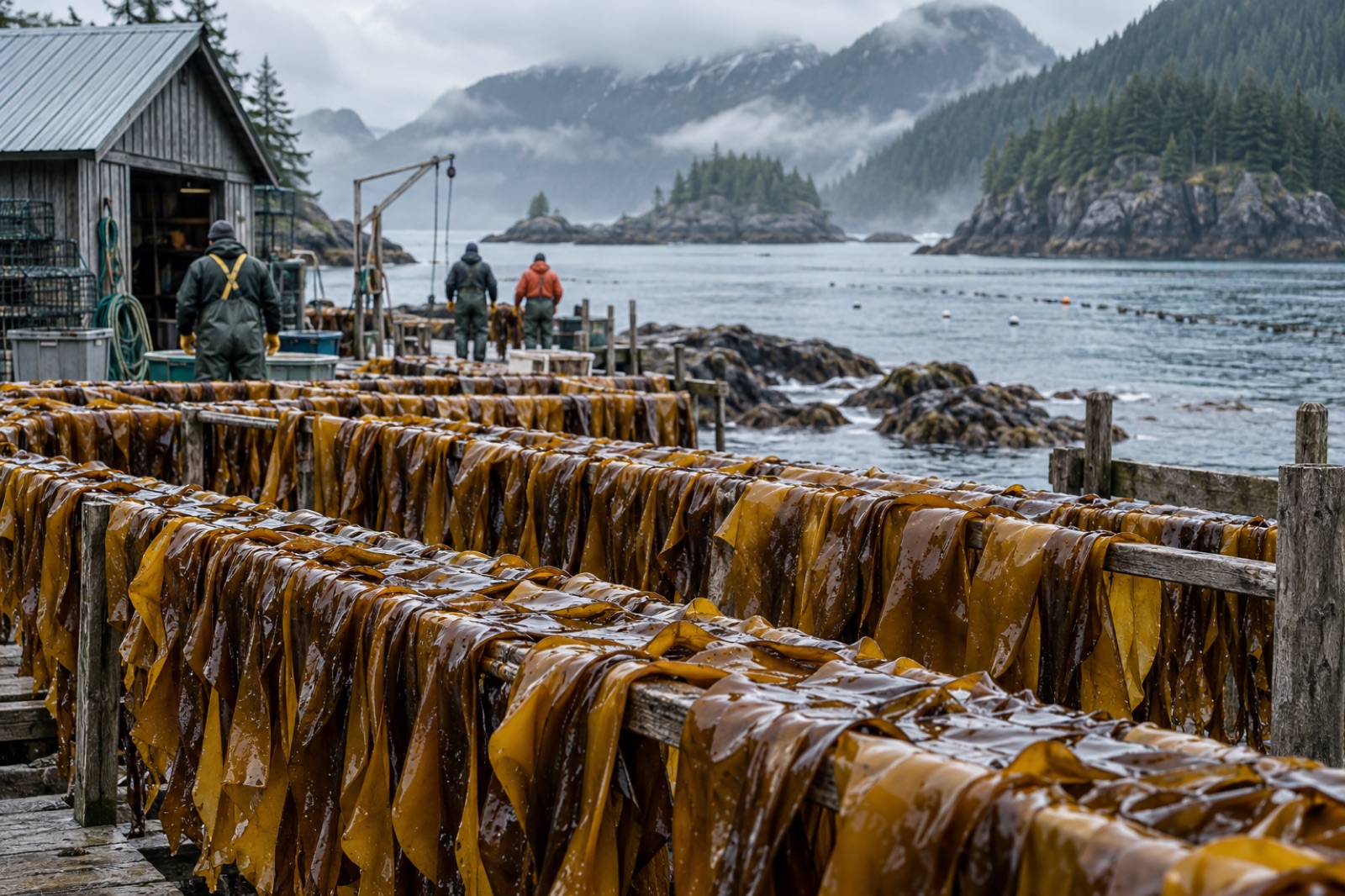
Open a kitchen drawer and you probably won't find it; open a processed food, a tube of toothpaste, a wound dressing or a pot of textile printing paste, and alginate is likely there, quietly holding the texture together. Alginate — more precisely, the family of alginic acid salts — is one of the largest industrial uses of seaweed on Earth, and almost all of it comes from brown seaweeds: tangle kelp, oarweed, giant kelp, knotted wrack, and their relatives.
For a kelp farmer, the alginate industry is one of two big-volume destinations for raw material (the other being food). Understanding how alginate is made tells you exactly what buyers want and why their specifications look the way they do.
The chemistry, briefly
Alginate is a polysaccharide built from two sugar units: mannuronic acid (M) and guluronic acid (G). They're arranged in blocks along the chain — stretches of M, stretches of G, and mixed stretches. The ratio matters enormously because guluronic blocks bind calcium ions strongly, zipping chains together into a gel.
- High-G alginate makes stiff, brittle gels: good for firm textures, dental impressions, pharmaceutical delivery.
- High-M alginate makes softer, more elastic gels and thicker solutions: good for stabilising drinks and sauces.
Species differ in their native M:G ratio. Laminaria hyperborea stipes run high in guluronic; some Macrocystis material runs higher in mannuronic. A kelp farmer's species choice therefore has direct consequences for alginate quality.
Inside the plant, alginate sits in cell walls as a flexible matrix — it's what lets a kelp blade bend in surge without snapping. That biological function (flexible strength) is exactly what industry exploits.
From kelp to powder: the industrial process
Commercial extraction is wet, hot and fussy. The basic flow, which has changed little in eighty years:
1. Harvest and pre-processing
Kelp is landed, either fresh or dried. Frozen or well-dried material can be stored, which is why many processors run on dried imports rather than local fresh supply. Raw material quality — moisture, ash, contamination, age — sets the ceiling on everything downstream. The disciplines of post-harvest processing and grading are therefore not optional niceties; they're the difference between industrial and extract-class feedstock.
2. Acid washing
The kelp is chopped and soaked in dilute acid. This does three things: it converts alginate in the biomass to insoluble alginic acid; it strips out salts, pigments (fucoxanthin, chlorophyll), and some mineral matter; and it softens the tissue for the next step. A rinse in water follows.
The acid-washed biomass goes into sodium carbonate solution at moderate heat. Alginic acid converts to soluble sodium alginate and comes out of the cell walls into a thick, viscous brown liquid. The insoluble residue — cellulose, proteins, remaining solids — is filtered out.
4. Precipitation
The crucial step. Calcium chloride is added to the extract; alginate precipitates as calcium alginate in long, fibrous strands that can be pulled from the water and pressed. This is the step that separates the alginate from everything else that dissolved with it.
5. Conversion and purification
The fibrous calcium alginate is treated with acid to return it to alginic acid, then neutralised with sodium carbonate (or potassium, ammonium, or another base, depending on the target salt). The result: pure sodium alginate.
6. Drying and milling
The purified material is pressed, dried and milled into powder or granules, then standardised to a guaranteed viscosity and gel strength. Each lot is blended and certified against spec — food-grade, pharmaceutical, or industrial.
Total yield is modest: a tonne of dry kelp typically returns 150–300 kg of alginate, depending on species and grade.
The grades and what they demand
The alginate industry sorts product into three broad tiers:
Food grade. Used as a thickener and gelling agent (E400–E405 on ingredient lists), in ice cream, sauces, salad dressings, beer foam stabilisation, and — famously — in the "spherification" of modernist cooking, where a flavoured liquid dropped into an alginate bath forms a gel-skinned sphere. Food-grade alginate must pass purity, heavy metals, and microbiology specs for human consumption.
Pharmaceutical grade. Wound dressings (alginate forms a soft, moist gel that absorbs exudate and is easy to remove), dental impression material (the pink powder that sets fast in the tray), and drug-delivery capsules. Stricter purity and consistency; commands the highest prices. This tier cares deeply about high-G fractions and gel predictability.
Industrial grade. Textile printing (alginate thickens dye pastes and washes out cleanly), paper coating, welding rod coatings, and a scatter of technical uses. The cheapest tier, but also a volume channel for raw material that doesn't meet food specs.
What the process means for a kelp farm
If you sell into the alginate channel, your buyer is effectively running a chemistry plant on your material. Their real requirements:
- Species identity and M:G ratio. They buy species, not blends. A consistent supply of one kelp species is more valuable than mixed brown seaweed.
- Alginate content. Older stipes and certain species are richer. Younger blades may be sold into food instead; selling your entire crop into alginate rarely optimises revenue.
- Contaminant profile. No diesel, no derricks of rope fibres, no plastic, minimal sand. Foreign material shows up in the product or fouls equipment.
- Drying or stabilisation. Fresh kelp shipped wet will rot in transit. Either dried on-farm at industrial quality (see drying methods compared) or stabilised with formalin under controlled protocols (declining in favour of food-safety reasons).
Pricing is per dry tonne, typically a few hundred US dollars — commodity territory. That means alginate is a volume business, and small farms rarely make sense on alginate alone. The economics only work at scale or in combination with higher-value channels (food, extracts, cosmetic ingredients).
New uses on the horizon
Alginate research is active. Areas drawing serious industrial interest include:
- Seaweed-based packaging films that biodegrade — an active research and pilot-scale field alongside kelp biostimulants as a high-value downstream for farmed biomass.
- Hydrogels for agriculture and wound-care formulations with tuned gel profiles.
- Encapsulation for probiotics, enzymes and flavour compounds in food.
None of these are yet large-volume markets for raw kelp, but they signal demand for consistent, documented supply — which is precisely what a well-run farm can offer that a wild harvest can't.
Tidewright and the alginate story
Tidewright's Harvest division works with kelp grown both for food and for industrial extraction. We don't operate alginate plants ourselves; we contract with established extractors and we match species and farms to grade. Where we differ from a traditional supplier is in traceability: every tonne we deliver comes with harvest-date, location, drying method and contaminant testing attached — see our fisheries and aquaculture solutions page for how that works in practice.
We also view the alginate industry as an important demand signal. When alginate buyers bid for traceable kelp from restoration-adjacent farms, restoration gets funded from two directions at once.
Key takeaways
- Alginate is a structural polysaccharide from brown seaweeds, built from mannuronic and guluronic acid blocks; the M:G ratio determines how it gels.
- Industrial extraction is acid-washing, alkaline extraction, calcium precipitation, re-conversion, drying and milling — a chemistry plant, not a kitchen process.
- Grades are food, pharmaceutical and industrial; each has its own purity, viscosity and gel-strength specs.
- Farms sell into alginate by weight of dry, clean, single-species biomass; prices are commodity-level, so volume and reliability rule.
- New uses (packaging films, hydrogels, encapsulation) are promising but not yet high-volume.
FAQ
Is alginate safe to eat?
Yes. Food-grade alginate (E400–E405) has a long regulatory history and is widely used in dairy, baked goods and processed foods. The quantities pass through the digestive system mostly unabsorbed.
Which seaweeds make the best alginate?
For high guluronic content and strong gels: Laminaria hyperborea (tangle kelp), some Lessonia, and certain Macrocystis. For higher mannuronic content, some other Macrocystis material and Durvillaea. Species choice is a buyer-level decision.
Can I make alginate at home or on a small farm?
Not practically. The chemistry is safe in itself, but doing it well — controlling viscosity, purity and consistency — is the work of a properly equipped plant. Your opportunity is to grow the raw material well, not extract it yourself.
Why does alginate matter for kelp farmers if prices are low?
Because it provides a floor price and volume outlet for kelp that doesn't meet food grade. A farm with a food channel plus an alginate channel has far more resilience than a farm with only one buyer.
What's the difference between alginate and carrageenan?
Both are seaweed-derived hydrocolloids, but from different species with different chemistry. Alginate comes from brown seaweeds, sets in the presence of calcium and is cold-setting. Carrageenan comes from red seaweeds, gels with potassium or calcium, and often needs heat to dissolve and set. They're used in overlapping but distinct applications.