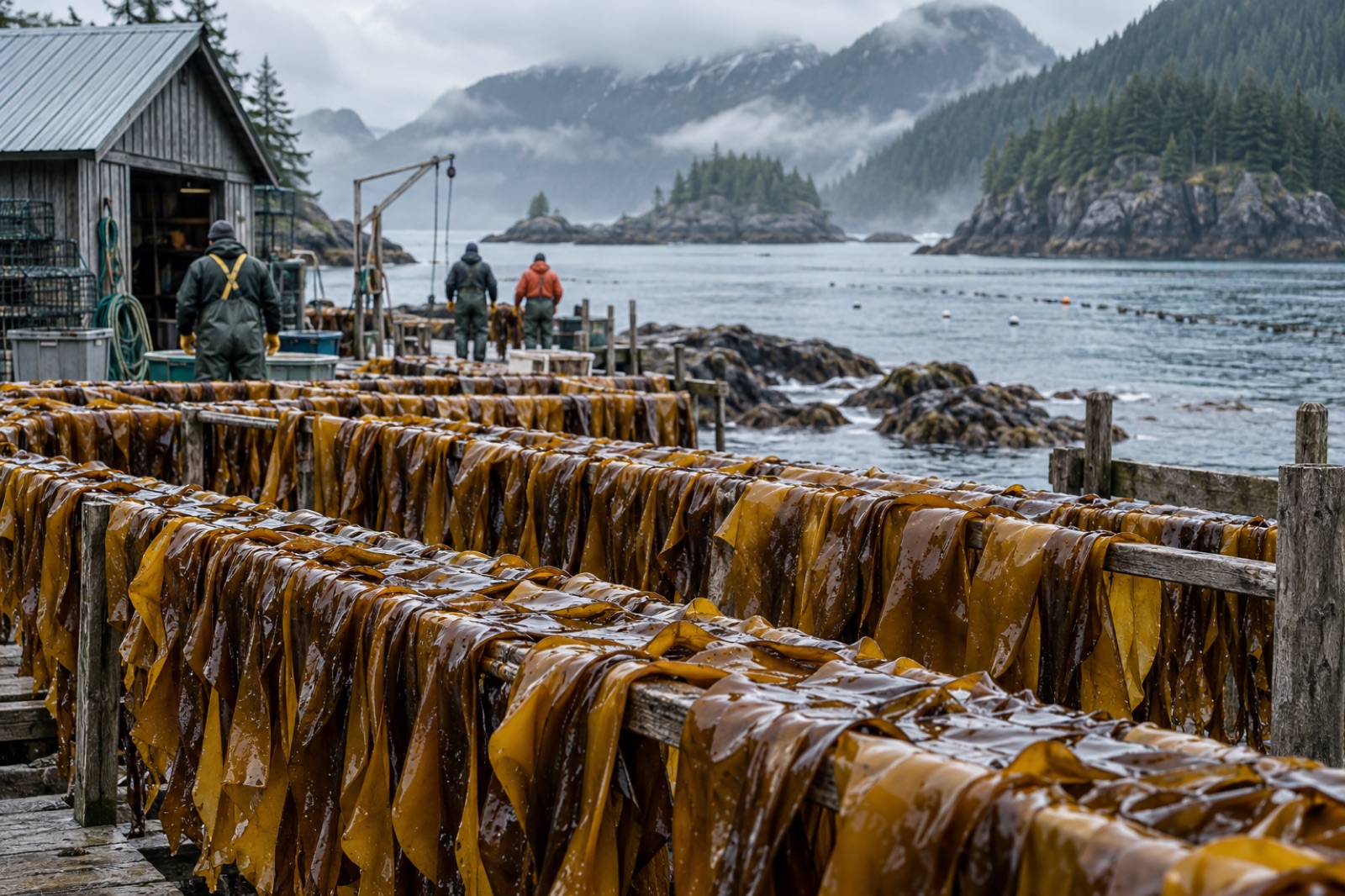
The hardest part of seaweed farming is not growing the kelp. It is selling it. Most failed farm business plans share one assumption: that a buyer will appear at harvest, pay the price in the spreadsheet, and handle the rest. Real buyers are specific. They want a particular species, in a particular form, at a particular moisture level and contaminant profile, delivered on a schedule — and they quote prices against those specifications, not against your hopes. This article maps who actually buys farmed seaweed, how grading works, what honest price ranges look like, and how to put yourself in a position of strength before the first blade hits the deck.
If you are still working out whether your numbers can survive, our breakdown of seaweed farm economics covers the cost side; this piece is about the revenue side it depends on.
The five real buyer categories
Nearly every farmed kelp sale in the world falls into one of five channels. Each has different volume thresholds, quality demands and payment cultures.
1. Processors and consolidators
The default channel for most farms. A processor buys wet or partially dried kelp by the tonne, handles drying, milling or extraction, and sells onward into food, feed or industrial markets. They pay the lowest prices but take the largest volumes and absorb your processing risk. Many will contract your entire crop before seeding — the strongest de-risking move available to a new farm.
2. Food companies and ingredient brands
Brands buying dried kelp, flakes, powders, or noodles-ready raw material for human consumption. They pay meaningfully more than processors — often two to four times — but demand food-safety documentation, heavy-metal and microbiological testing, consistent colour and texture, and reliable supply. Breaking in usually means starting with a small trial volume and a certificate of analysis, not a full-crop pitch.
3. Agriculture and biostimulant makers
Manufacturers of seaweed extracts used as crop biostimulants buy in volume and care less about food-grade cosmetics and more about bioactive content and supply security. Some contract directly with farm groups. Our article on the kelp biostimulant pipeline walks through what those buyers measure. Price sits between commodity and food grade, with strong volume appetite.
4. Feed and additive buyers
Kelp meal for livestock feed and emerging additives for ruminant methane reduction are volume markets with strict consistency requirements. The methane-additive space is species-specific and research-heavy; ordinary sugar kelp goes in as commodity feed meal at commodity prices. Do not price your crop against headlines about premium additives unless your species and chemistry genuinely qualify.
5. Direct and local sales
Farm-gate sales to chefs, fishmongers, farmers' markets and CSAs. Highest price per kilo by far — fresh sugar kelp to a good restaurant can out-earn every other channel on a per-weight basis — but volumes are tiny, logistics are yours, and it only works where the cuisine culture supports it. Treat it as margin, not as a market plan.
How buyers grade your crop
Grading is where price is actually decided, and it surprises almost every first-time seller. A single landing of kelp is typically assessed on:
- Species and part. Whole blades, stipes and sporophylls are different products with different prices. Buyers specify; blending them tanks the grade.
- Moisture and form. Wet weight pays the least because the buyer pays for water and drying risk. Air-dried, milled or blanched-and-frozen product commands more — but only if you can produce it consistently, as covered in our guide to post-harvest processing.
- Cleanliness. Biofouling — hydroids, bryozoans, barnacle spat — directly reduces grade. Some buyers reject heavily fouled loads outright; others discount steeply per percentage point.
- Harvest condition. Kelp cut at peak condition grades higher than kelp harvested late, eroding or epiphyte-covered. This is why harvest timing is a pricing decision, not just an agronomy one.
- Contaminants. Heavy metals, iodine (for food use), and microbial counts. Food buyers want lab certificates, increasingly per batch.
- Traceability. Food-grade buyers increasingly require harvest dates, site records and handling logs. Keep them from day one even if your first buyer doesn't ask.
Honest pricing: what to actually expect
Prices vary by species, region and year, so treat any single figure with suspicion — including these. But the shape of the ladder is consistent:
- Wet, unprocessed kelp to a processor: the floor of the market. Often priced in the low tens of dollars per wet tonne-equivalent — enough to cover harvest and delivery, rarely enough to fund a farm by itself.
- Dried whole-leaf or milled kelp: a step-change up, routinely several times the wet price per dry kilo, because you have absorbed the drying cost and risk.
- Food-grade dried product with certificates: the top of the bulk ladder, where quality documentation matters as much as the kelp itself.
- Direct-to-kitchen fresh: priced per kilo like a vegetable, not per tonne like a commodity — at wine-bar margins and farmers'-market volumes.
The single most useful exercise before your first season is to price your crop three ways — all to a processor, half dried and sold to food buyers, and 10% direct — and make sure the farm survives on the first scenario alone. Everything above it is upside.
Contracts, offtakes and the handshake problem
An offtake agreement — a buyer's commitment to purchase your crop at agreed specifications and price — is the foundation of a financeable farm. Banks and grant programs ask for it; so should you. Working patterns that hold up:
- Trial-then-contract. Sell a processor a defined trial volume in year one with agreed specs, convert to a multi-year offtake after a successful delivery. Nearly every durable buyer relationship in the industry started this way.
- Spec sheets, not adjectives. Attach written moisture, fouling and contaminant specifications to the contract. "Good quality kelp" is a dispute waiting to happen.
- Delivery windows. Kelp degrades fast. Contracts should specify harvest-to-delivery hours and who owns the cold chain.
- Price review clauses. Multi-year agreements need an annual price renegotiation mechanism. Fixed prices over multiple seasons benefit nobody once costs move.
Avoid exclusivity to a single buyer unless the premium justifies it, and avoid handshake deals entirely. Verbal enthusiasm at a dockside meeting is not an offtake.
Building a position of strength
The farmers who get good prices share three habits. First, they talk to buyers before seeding, not after harvest — ideally multiple buyers in different channels, so a single rejection can't sink the year. Second, they keep processing options open: access to drying capacity, even rented or cooperative, converts a distressed wet sale into a patient dried sale. Third, they treat quality data as an asset. Three seasons of clean lab results and on-time deliveries turn you from a speculative supplier into a buyer's preferred grower, and preferred growers negotiate from strength.
Programs like Tidewright Harvest exist partly to make this easier: our restoration-adjacent farms pool processing and marketing so small growers can access food-grade and biostimulant contracts they couldn't reach alone. Whether or not a channel like that exists near you, the principle travels — aggregation raises prices.
Key takeaways
- Line up real buyers before seeding; an offtake agreement with written specifications is the difference between a business plan and a hope.
- The five real channels are processors, food brands, biostimulant makers, feed buyers and direct sales — each with distinct volumes, prices and demands.
- Grading is decided by species and part, moisture and form, cleanliness, harvest condition, contaminants and traceability — not by effort.
- Wet kelp at the farm gate is the price floor; drying and food-grade certification are where margins live.
- Price your farm's survival on the processor scenario; treat food-grade and direct sales as upside.
- Quality records — lab certificates, harvest logs, delivery history — compound into negotiating power season over season.
FAQ
When in the season should I start talking to buyers?
Long before seeding — ideally six to twelve months ahead. Food and biostimulant buyers plan their procurement well in advance, and a processor who knows your crop is coming can reserve drying capacity for you. Arriving at harvest with wet kelp and no buyer means accepting whatever price the nearest processor names.
Is it better to sell wet kelp or dry it myself?
Dry it if you reliably can, because dried product consistently earns several times more per kilo of kelp solids. But drying demands capacity, weather or energy, and speed — a tonne of wet kelp spoils fast. Many small farms split the crop, drying what their setup handles and selling the overflow wet. Don't promise a buyer dried product you can't deliver on schedule.
What is a certificate of analysis and why do buyers want one?
A certificate of analysis (CoA) is a lab report covering contaminants (heavy metals), microbiology and sometimes iodine and nutritional content for a specific batch. Food-grade buyers require them because their own regulators and customers require proof of safety upstream. Budget for CoA testing from your first season; it is a cost of market access, not an optional extra.
Can I make a living selling seaweed direct to restaurants?
Rarely on its own. Direct sales pay the highest price per kilo but move small volumes and demand your time on logistics and relationships. They work well as a margin layer on top of a bulk contract — and as a proof-of-quality signal — but almost no small farm survives on farmers'-market volumes alone.
My crop has heavy biofouling. Is it unsellable?
Not necessarily. Processors buying for meal or compost often accept fouled kelp at a discount, and some biostimulant makers care little about surface fouling. What fouling kills is food-grade pricing. Better still, prevent it: harvesting at the right time, per our harvest timing guide, removes most of the problem before it prices you.