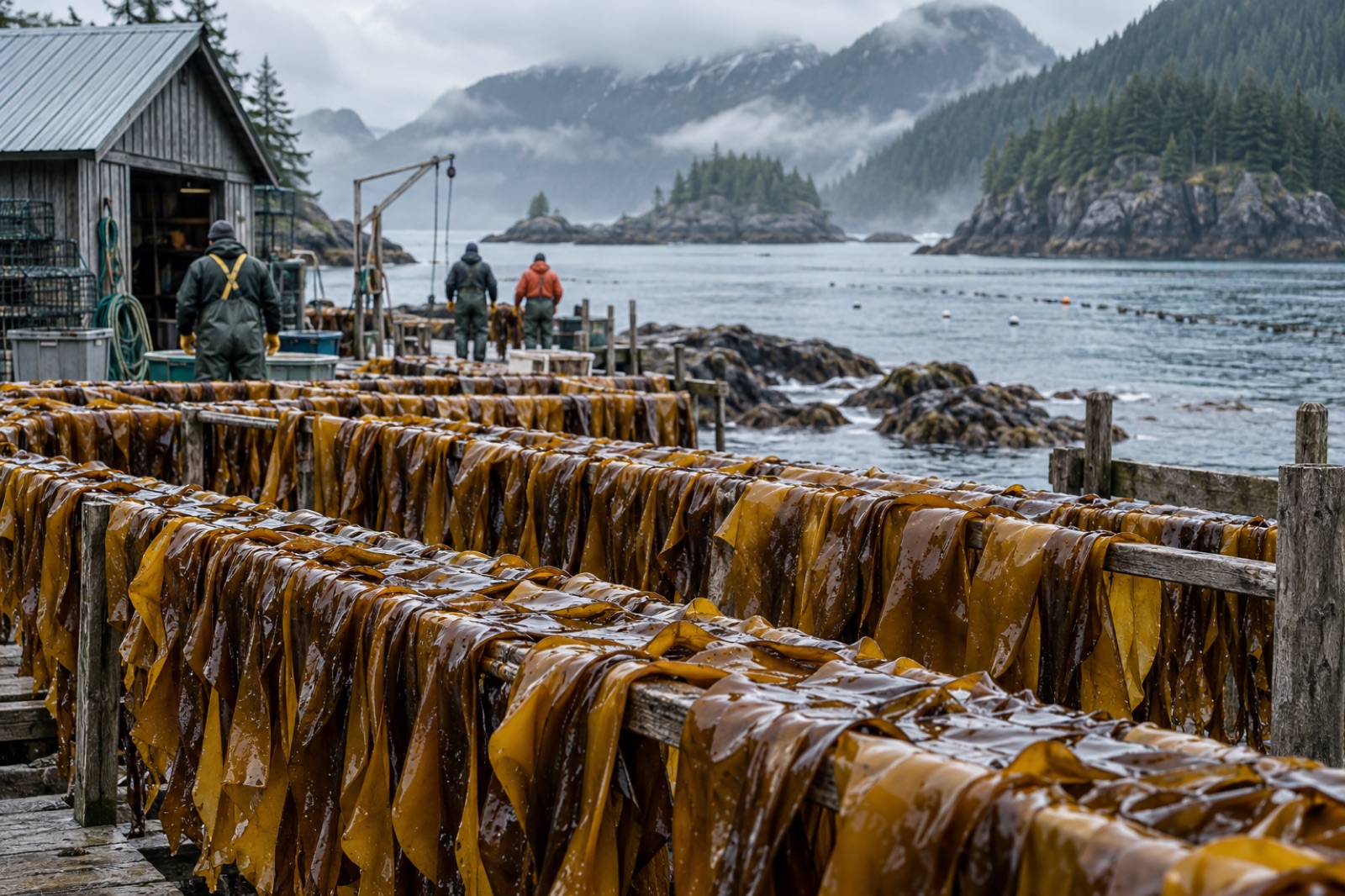
Somewhere on the land, not far from most kelp farms, there is a crop field being sprayed with an extract made from seaweed. The idea that ocean algae can make terrestrial plants grow better sounds like marketing copy, but it rests on decades of legitimate agronomy — alongside, it must be said, decades of overclaiming. Kelp biostimulants are one of the most important markets for farmed kelp and one of the most misunderstood products in agriculture. This article explains what these extracts actually are, what they plausibly do in soil and on leaves, how they move from blade to bottle, and what honest expectations look like for growers on both ends — the kelp farmer selling into this channel and the land farmer buying from it.
It sits alongside our pieces on selling a seaweed crop and post-harvest processing, which cover the market and the handling in more depth.
What a biostimulant is — and is not
The regulatory definitions vary by jurisdiction, but the concept is consistent: a biostimulant is a substance or microorganism applied to plants or soil to stimulate natural processes — improving nutrient uptake, stress tolerance or crop quality — rather than supplying nutrition itself. This is the critical distinction:
- Fertilisers feed the plant. Nitrogen, phosphorus, potassium: they supply building blocks in quantity.
- Biostimulants nudge the plant. They work at tiny concentrations, influencing physiology rather than feeding it.
Kelp extracts are biostimulants with a modest fertiliser side-benefit. Most contain some nutrients and trace minerals, but at application rates of litres per hectare, they supply a trivial fraction of a crop's NPK needs. Anyone selling kelp extract as a fertiliser replacement is overselling. The honest value proposition is different: modest, real effects on stress tolerance, root development and quality that can pay for themselves in good years and difficult ones alike.
Chemically, kelp extracts are complex mixtures, and the complexity is the point. The bioactive fractions researchers and manufacturers focus on include:
- Polysaccharides — alginates, laminarin, fucoidan. These large sugar molecules can act as elicitors: plant surfaces recognise them as foreign and respond by priming defense and stress-response pathways. Well-documented in laboratory work.
- Betaines and osmoprotectants — compounds that help plant cells manage water and salt stress.
- Plant-hormone-like activity — extracts show auxin- and cytokinin-like effects in bioassays. This is the most contested claim: the concentrations of actual hormones in most commercial extracts are low, and how much of the field effect comes from direct hormone action versus indirect signalling is genuinely unresolved science.
- Minerals and trace elements — real, but at biostimulant application rates, nutritionally marginal.
The honest summary: kelp extracts plausibly work through a combination of signalling, stress protection and priming, not through a single magic molecule. That matters for buyers, because it means quality and consistency of the whole extract — not the concentration of any one ingredient — is what results depend on.
The production pathway is more industrial than romantic:
1. Raw material and timing
Species matter, and so does harvest condition. The industry standard species for decades has been Ascophyllum nodosum (knotted wrack) for cold-process extracts, with farmed kelps — Macrocystis, Laminaria, Saccharina — increasingly used, especially where farms guarantee steady, traceable supply. Kelp cut at peak condition per good harvest timing practice carries different active chemistry than end-of-season eroding blades, and pays better accordingly.
Three industrial families dominate:
- Alkaline hydrolysis — the old workhorse. Kelp is digested with alkali at heat, breaking tissue into a dark liquid concentrate. Robust and cheap, but harsh conditions degrade some delicate compounds.
- Cold processing / micronisation — mechanical milling and aqueous extraction without heat or harsh chemistry, preserving more of the native biochemistry. Commands premium prices.
- Fermentation and enzymatic extraction — newer approaches using controlled microbial or enzymatic breakdown to free bioactive compounds under gentle conditions.
The crude extract is filtered, stabilised (pH, preservation, oxygen control), sometimes concentrated or dried, and blended into a finished product. Reputable manufacturers then run bioassays — seed germination, root-growth and stress-recovery tests — as batch quality control, because chemistry alone doesn't predict field performance.
4. The farm gate back at the ocean
For the kelp farmer, this pipeline defines the buyer relationship. Biostimulant makers buy in volume, care greatly about species consistency, cleanliness and supply security, and care little about the cosmetic appearance that food buyers prize. Prices sit between commodity and food grade, and multi-year contracts are common — which is why this channel anchors many farm business plans, as our farm economics piece explains.
What growers should actually expect in the field
Strip away the brochures and a sober picture emerges from the trial literature:
- Effects are real but typically modest. Under controlled conditions, treated crops often show better germination, root growth and recovery from stress. Yield gains in the field are usually single-digit percentages — meaningful at farm margins, invisible if you expect a transformation.
- Stress is where they shine. The strongest and most consistent benefits appear under drought, salinity, heat and transplant stress — precisely when crops need help most. In an era of erratic weather, that stress-buffering value is the core of the economic case.
- Results are context-dependent. Soil type, crop, application timing and extract quality all modulate outcomes. A product transformed one grower's citrus and did nothing measurable for another's wheat; both experiences are real.
- They complement, never replace, agronomy. Biostimulants are the last 5–10% after seed, soil, water and fertility are right — not a substitute for any of them.
For a land farmer, the honest buying advice is: run your own trial strips for a season, against untreated areas, under your own conditions. For a kelp farmer, the honest selling advice is: grow clean, consistent, well-timed biomass with the records to prove it, then let the manufacturer's formulation earn the rest.
Why this market matters to ocean restoration
For Tidewright, the biostimulant channel is one of the ways restoration pays for itself. Our restoration-adjacent farms under Tidewright Harvest supply kelp into agricultural inputs as well as food, and the revenue funds the reef work that is our core mission. When a coastal government or grower buys kelp biostimulant traced back to a restoration program, a litre of crop spray becomes, in a small but real way, funding for a kelp forest. That's the loop we're trying to build at scale — restoration that carries its own weight, described in our fisheries and grower programs.
Key takeaways
- Kelp extracts are biostimulants, not fertilisers: they prime plant stress-response and growth processes at tiny concentrations rather than feeding the crop.
- The active fraction is a complex mixture — polysaccharides, betaines, hormone-like signalling — so whole-extract quality and consistency matter more than any single ingredient.
- Production runs blade → timed harvest → extraction (alkaline, cold or enzymatic) → formulation and bioassay testing.
- Field effects are real but modest, and largest under drought, salt, heat and transplant stress; they complement good agronomy, never replace it.
- For kelp farmers, biostimulant makers are volume buyers who prize species consistency, cleanliness and secure supply — ideal anchors for multi-year contracts.
FAQ
Do kelp biostimulants actually work?
Yes, with realistic expectations. Decades of agronomic trials show genuine effects on germination, root development and especially stress tolerance, with typical field yield gains in single-digit percentages. They are not a miracle input, and results vary with crop, soil, timing and product quality — but the underlying signal is real, and the stress-buffering benefit is the most consistent part of it.
No. At labelled application rates, the nutrient contribution is small. Their role is stimulating plant processes, not feeding the crop. They work alongside a sound fertility program, not instead of one, and any vendor claiming otherwise should be treated with caution.
Which kelp species make the best biostimulant?
Ascophyllum nodosum is the long-established industry standard for cold-process extracts. Farmed kelps — Macrocystis, Laminaria, Saccharina (sugar kelp) — are increasingly used, particularly where farmed supply offers consistency, traceability and volume that wild harvest cannot. Species affects extract chemistry, so manufacturers typically lock to a species rather than blend casually.
As a kelp farmer, how do I sell into the biostimulant market?
Grow the species the buyer specifies, at consistent quality, with clean handling and traceable records — and start the conversation before seeding, since these buyers plan supply well ahead. Biostimulant makers are among the most attractive customers a farm can win: volume appetite, multi-year contracts and tolerance for crop that wouldn't make food grade. Our guide to selling a seaweed crop covers the contracting side.
How do I evaluate a kelp biostimulant product as a buyer?
Ask for the species and extraction method, batch bioassay results and independent trial data — and then run your own side-by-side strips for a season before scaling. Beware of products claiming to replace fertiliser or delivering huge headline yield promises; the honest products claim modest, stress-focused benefits and have the data to back them.