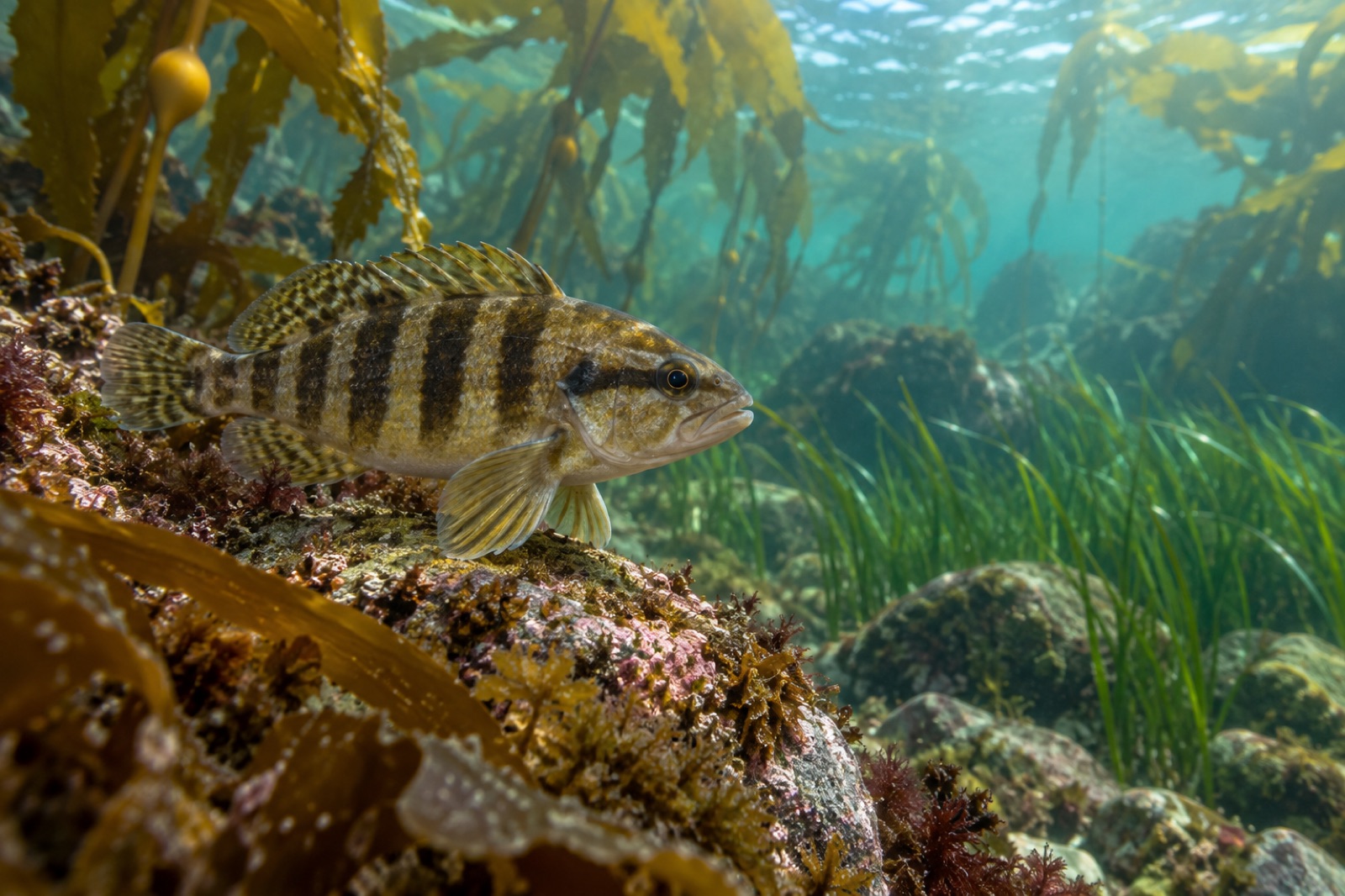
The masked greenling (Hexagrammos octogrammus) is a small bottom fish of the far North Pacific: a stout-bodied, big-headed ambush predator with a dark band through the eye like a bandit's mask and five or six dusky bars down its flanks. It lives in the shallowest part of the northern kelp world — kelp fringes, eelgrass edges and rocky sand channels from northern Japan and the Sea of Okhotsk through the Aleutians to the Gulf of Alaska — and it is one of the most reliable first sightings a cold-water diver can make in Alaska. This profile covers how to identify it, how it differs from its better-known cousins, and the surprisingly demanding family life that fills its winters.
If you know the kelp greenling from British Columbia or the whitespotted greenling from the Aleutians, you already know the body plan. The masked greenling is the family's quiet, shallow-water northerner: less gaudy than the males of its relatives, more at home in two metres of surge over eelgrass than on a deep reef face, and easily the most under-appreciated greenling in the water.
Identification: the mask and the bars
All greenlings share a silhouette — a heavy head, a big perch-like mouth, a long continuous dorsal fin, a body that tapers toward a squared-off tail — and the masked greenling is no exception. Adults typically run 20 to 30 centimetres, putting them squarely in the smaller half of the family.
The name comes from the face. A dark stripe runs back through the eye, cutting the head in half like a domino mask, with finer dark lines radiating onto the cheek. The body is olive-brown to grey above, paling toward the belly, and marked with a series of broad, dark vertical bars or saddles — usually five or six — that fade and intensify with the fish's mood and background. Fine pale spotting often dusts the head and back. Breeding males darken dramatically, sometimes to near-charcoal, and the contrast of the pale fin edges stands out against the gloom.
Telling it from the other greenlings
In Alaska, the two confusions are the kelp greenling and the whitespotted greenling. Kelp greenling males carry brilliant sky-blue spots on a grey-to-brown body, and neither sex wears the crisp eye-mask or the strong vertical barring. Whitespotted greenling males are famously red-mottled and usually sit on rockier, slightly deeper structure — read the whitespotted greenling profile for that comparison in full. The painted greenling is a different genus altogether: smaller, slimmer, and vertically banded in cream and rust-red, with no mask. If you are in shallow northern water, over or near vegetation, and the fish has a clean dark band through its eye and tidy bars down its side, you are almost certainly looking at octogrammus.
Range and habitat: shallow, cold and northern
The masked greenling is a creature of the western and northern Pacific rim. Its range arcs from the coasts of northern Japan and the Korean far north, through the Sea of Okhotsk and the Kuril chain, along Kamchatka, across the Bering Sea and the Aleutian arc, and into the Gulf of Alaska. On the North American side it thins out through Southeast Alaska, becoming scarce to absent in the temperate waters where the kelp greenling takes over.
Depth preference sets it apart from the rest of the family. Masked greenlings are shallow-water fish: intertidal at the top of their range, common in one to fifteen metres, rarely reported much deeper than about fifty. They work the transition zones — the outer edge of eelgrass meadows, the understory of bull kelp fringes, rock-and-sand mosaics in surge channels — places most reef fish species treat as corridors but the masked greenling treats as home.
In the Aleutian Islands and around Kodiak, a masked greenling sitting on a rock at eelgrass depth is close to a guaranteed sighting. In Southeast Alaska's inside waters, including around Sitka Sound, it shares the shallows with sculpins, gunnels and young rockfish, holding station on any piece of hard structure with a view.
Hunting style: stillness, then a jab
Like all its family, the masked greenling is an ambush feeder. It props itself on its pelvic fins — greenlings habitually perch rather than hover — and reads the water immediately ahead of it, tipping its head to check angles without giving away its outline. Prey is small and benthic: amphipods, shrimp, crabs the size of a fingernail, polychaete worms, and occasionally larval and juvenile fishes.
The strike is the smallest fraction of the performance: a fast dart of a body-length or less, a snap, an immediate return to an almost identical perch. Watch one for five minutes and you will see perhaps two moves. For a fish that seems to do so little, it runs a substantial daily energy budget through tiny, precise take-and-hold predation — the same model the family runs everywhere, executed here in the coldest, most surge-washed shallows any greenling occupies.
Its own predators are the standard roll-call of the northern shallows: lingcod where the ranges meet, larger sculpins and greenlings, halibut cruising the sand channels, river otters in the surf zone, and diving birds — guillemots and cormorants — that work the kelp edge from above.
The guarded nest: winter's hard bargain
Masked greenlings breed in the cold half of the year, shifting with latitude from late autumn into winter. Males take territories on clean, current-washed rock in the shallows and court females with darkened colour and fin displays. A female lays a dense, coherent mass of small eggs fixed directly to the rock or to robust algae, and a successful male may accumulate the clutches of several females in one nest site.
Then comes the part that defines greenling biology: the male guards. He fans the egg mass, mouths away sediment and settles between feeding forays he mostly doesn't make. For weeks, through the worst water temperatures of the year, he holds the rock against everything that fancies a mouthful of eggs — sculpins, crabs, other greenlings. It is the same deep-investment strategy you see in the kelp greenling and the rock greenling, and it carries the same cost: guarders emerge from the season thin, and the biggest, most experienced males run the highest-quality territories for the longest time.
When the larvae hatch they disperse into the plankton briefly, then settle to the shallow vegetated habitat the species calls home. Growth is fast by northern standards, and the young fish are among the most abundant small predators of the summer eelgrass edge before joining the adult pattern of perched, patient stillness.
Masked greenlings are mid-level links in the shallow kelp forest food web: they convert the invertebrate productivity of eelgrass and kelp understory into fish biomass, and they are converted in turn by everything larger. Because they sit at the seam between vegetated shallows and open rock, their abundance is a rough gauge of how well that seam is working — a healthy fringe habitat holds greenlings roughly in proportion to its structural complexity.
They are also part of what makes the northern kelp ecosystem distinctive. Where southern kelp forests stack their small-predator guild with wrasses, surfperches and bass, the far northern system leans on greenlings, sculpins and gunnels — cold-adapted, benthic, and built around ambush rather than pursuit. The masked greenling is emblematic: unflashy, local, and everywhere once you learn to look.
Conservation: secure, but tied to the shallows
The masked greenling is not assessed as threatened and carries no listing. It is too small for a targeted fishery — it appears in subsistence catches in parts of Alaska and as bycatch in nearshore gear, but no commercial or recreational fishery is built around it — and its enormous range across some of the least-developed coastline on Earth buffers it against local pressures.
Its vulnerabilities are habitat-shaped rather than fishing-shaped. A fish confined to the top few tens of metres on temperate-to-subarctic coasts lives exactly where marine heatwaves bite hardest, where nearshore development lands, and where shifts in eelgrass and kelp cover show up first. Nobody tracks masked greenling populations directly; what we watch instead is the fringe habitat it depends on. Protect the shallow vegetated edge of the northern kelp coast — as marine protected areas and careful coastal management increasingly do — and the masked greenling takes care of itself.
Key takeaways
- The masked greenling (Hexagrammos octogrammus) is a small North Pacific reef fish, 20–30 cm, identified by a dark stripe through the eye and five or six dark vertical flank bars.
- Its range arcs from northern Japan and the Sea of Okhotsk through the Aleutians to the Gulf of Alaska, thinning southward through Southeast Alaska.
- It is the shallowest-living greenling: kelp fringes, eelgrass edges and rocky surge channels from the intertidal to about fifty metres.
- Males guard benthic egg masses through the winter, a high-cost parental strategy shared across the greenling family.
- It faces no directed fishery and no listing; its long-term security tracks the health of shallow kelp and eelgrass habitat.
FAQ
How do I tell a masked greenling from a kelp greenling?
Look for the mask and the bars. Masked greenlings carry a clean dark band through the eye and regular dark vertical barring on the flanks. Kelp greenlings — especially males — show blue spotting instead of barring, lack the eye-mask, and generally hold deeper, rockier ground. Range helps too: south of the Alaska Panhandle you are in kelp greenling country.
Why is it called "masked"?
For the dark stripe that runs backward through the eye onto the gill cover, like a bandit's mask. The scientific name octogrammus — roughly "eight lines" — refers to the dark lines and bars of the head and body.
Can you eat masked greenling?
They are edible and appear in small-scale subsistence catches in Alaska, but their small size and shallow-water habits mean no fishery targets them. The family as a whole yields mild, white flesh; the greenlings' ecological value as mid-level predators outweighs their table value in most places.
Where is the best place to see one?
Alaska, in shallow water: the Aleutian reefs, Kodiak's kelp fringes and protected inside waters around Sitka all hold them at snorkelling and easy scuba depths. Look along the outer edge of eelgrass beds over rock, and get low — they perch at reef level and hold still.
Does it live on the US West Coast?
No. The masked greenling's North American range effectively ends in Southeast Alaska. Washington, Oregon and California divers looking for small barred bottom fish are seeing other species — painted greenlings, sculpins or young rockfish — not octogrammus.