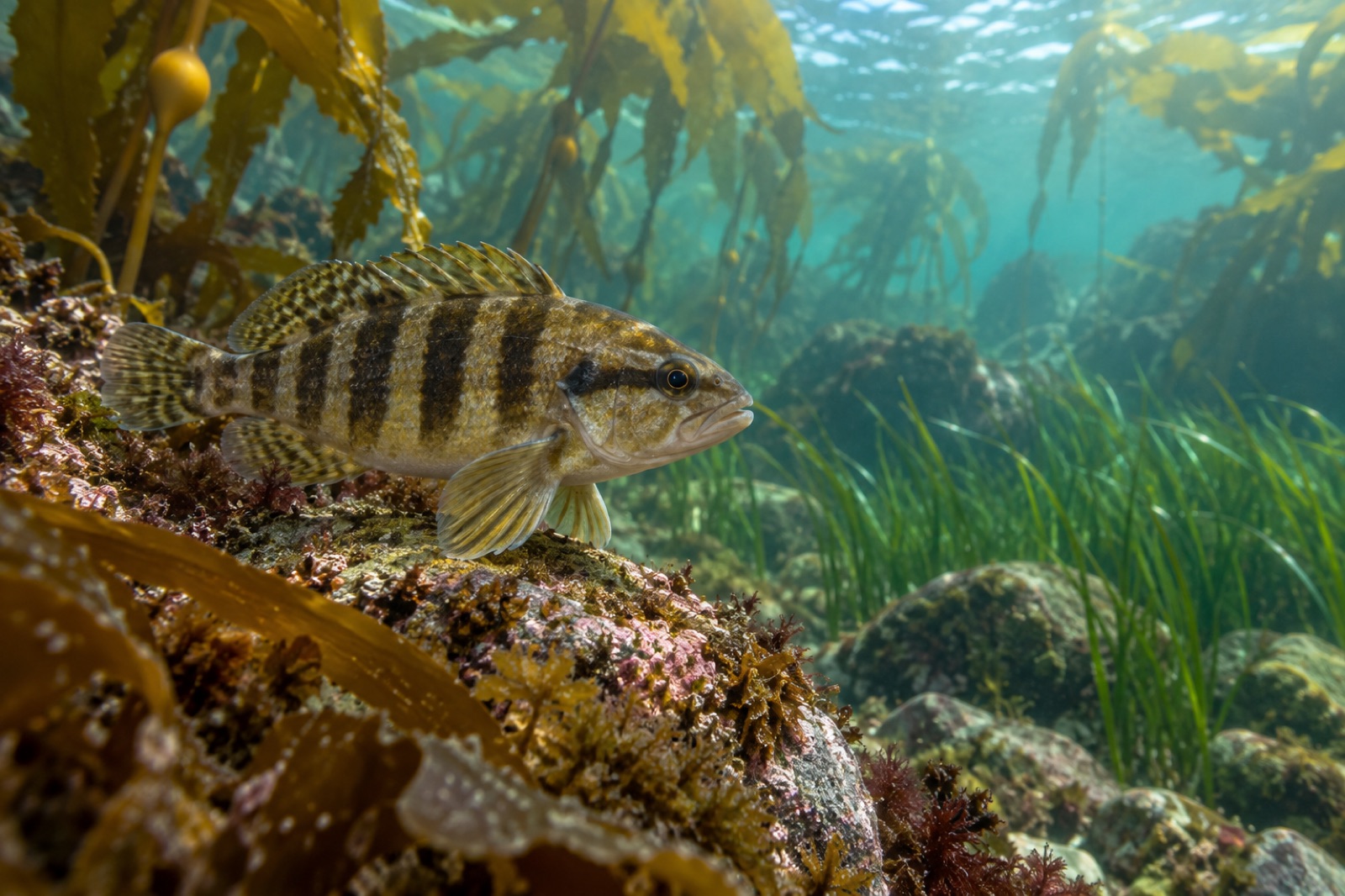
On the rocky reefs of the North Pacific, from the fogbound Aleutians to the granite shores of Washington state, one fish seems to wear as many costumes as the forest it lives in. The whitespotted greenling (Hexagrammos stelleri) is a study in contrast: males radiate in rich reds, siennas and oranges, splashed with pale spots, while females blend into the reef in muted greys, greens and browns. Both are stout-bodied, wide-mouthed and habitually motionless — yet they are ambush hunters of real consequence, and the males are among the most obsessively protective parents in the kelp forest.
They are also one of the most rewarding fish a temperate diver can learn to read. If you can tell a female stelleri from a male, and a mature male from a juvenile, you have taken a real step toward reading a North Pacific reef. And if you have ever drifted over cold, clear water above northern rock and spotted a red-and-white flash that calmed into stillness before you could focus on it, you have probably met one.
Identification: the two-faced fish
The whitespotted greenling belongs to the greenling family, the Hexagrammidae — a group of stout, almost beautifully finished bottom fishes found almost entirely in the cool North Pacific. The body's lines are strong: a heavy head, a slightly tapered rear, a long continuous dorsal fin with both spiny and soft sections, and a mouth built for picking arthropods cleanly off rock. But the colours are the identity.
Adult males are perhaps the coast's most striking bottom fish: base colours from chestnut to brick-red to olive, nearly covered in pale blue-white spots and irregular blotches. The face alone rewards attention — a red-brown head marked by pale blue spots, and under the eye a row of blue streaks. Females and young males wear a second palette: grey-brown to green, darker blotches, paler narrow bars, and a series of pale spots running along the back. Older males can pass through a half-mix of both wardrobes while in transition, making identification lessons rewarding and occasionally humbling.
Between the sexes you can confirm identity by the fins: both have the long dorsal line and pelvic fins that sit high and forward on the body; both show the continuous lateral line and the smoothly scaled skin that catches light like poured glass. The kelp greenling is its nearest relative — a more southern and more delicately spotted species with sharply different facial patterns. Painted and rock greenlings have their own shape and colour vocabulary.
Where to look for it
Hexagrammos stelleri is a reef and rock fish. It lives on and immediately over rocky bottom: reef faces, boulder fields, rock-sand edges and deeper kelp gardens where the canopy meets broken ground. Depth range runs from just below the low tide line to a hundred metres or more, though the populations divers see are mostly in the shallower tens of metres. It is uncommon in soft-sediment bays, uncommon far from rock, and absent from the open water column.
The overall range tells the colder-water story: from the northern Japanese coasts, through the Kuril chain, the Sea of Okhotsk, the Bering Sea and the whole of the Aleutian arc, then down the North American west coast through British Columbia to about Puget Sound and Washington's outer coast. It is a cold-water indicator on the American side of the range; where it thins out, the mix of warmer-water greenlings and sculpins thickens.
A life lived sideways: how whitespotted greenlings hunt
Greenlings are ambush predators of the reef's surfaces. The whitespotted sits almost motionless — pinned against a rock, half-melted into its background colour — and reads the water like a cat. When a small crustacean, a shrimp, a polychaete worm or a tiny fish unrolls across its window, the whitespotted's strike is sudden, tiny and precise: a fast jab of the mouth that rarely reveals the fish's presence to its next prey.
This hunting style explains two things any observer notices. The first is the peering. Whitespotted greenlings constantly tilt and tip their heads, banking themselves to get different angles on the reef ahead without actually swimming. The second is the vanishing act. When disturbed — and only when truly disturbed — they abandon their position with a short dash and a heavy landing into cover. Few fish of their size can disappear into such ordinary-looking reef so completely.
The whitespotted feeds mainly on benthic crustaceans and invertebrates, with small fishes — the younger greenlings, rockfish and gobies — working into the diet of larger adults. In turn it is preyed upon by lingcod, halibut, large rockfish, and at the shallow edges by seabirds and river otters. Bigger greenlings themselves sometimes take smaller greenlings; the family holds few niceties.
The winter nest guard
The reproductive season is one of the reef's most interesting small dramas. In late autumn and winter — often beginning in September or October in the Aleutians and lasting through the coldest water — males establish nesting territories on clean rock surfaces and attract females to lay egg masses. A female deposits a thick, tidy cluster of purple-to-olive eggs stuck directly to the rock, and the male may accumulate clutches from several females on the same site. Then his transformation is complete: he stops eating, darkens some of his reds, and guards the nest through the whole deep-water winter, fanning the eggs, driving off predators, and spending weeks in perfect patience while his own energy disappears into the vigil.
Guarders pay for it. By spring, males from the nest season are thin, frayed and a long way from summer condition, yet their nests hatch with some of the highest success rates of any reef fish in the region. This parental investment is part of why older males' red colours carry so much information on the reef — they signal not just sex but condition and likely guarding success.
Habitat and ecology in the kelp forest
Whitespotted greenlings usually live on the edges of the kelp forest rather than beneath its tallest canopy: reef-sand margins, dense understory rock, deeper surge channels and the faces of isolated boulders. In the northern kelp forests where they are abundant — the Aleutian reefs of the Aleutian Islands and the seasonally ice-touched shores of Alaska — they are a standard component of the reef fish community, to the point that divers there read their colour, position and calm as a baseline for a reef's overall health.
Their presence, though, depends on substrate complexity and food. Greenlings do not cut it when the reef is flattened into urchin barrens, when algae disappear from the rock, or when the structural habitat that feeds the food chain thins out. Research on North Pacific kelp forest loss has consistently found that the benthic fish community — greenlings among them — contracts sharply when the forest-reared productivity and frond cover go, then rebuilds as the forest recovers. It is part of why reef monitoring programmes in the north count greenlings as indicators of ecosystem condition: the family doesn't colour much unless the system beneath them is working.
Conservation and how this fish is faring
The whitespotted greenling is considered reasonably secure across most of its range, without any listed-threat categorisation. It is not a major commercial or sport fish anywhere — too small, too benthic, and too widespread on hard-to-fish bottom — though northern nearshore fisheries sometimes take some, and it is part of the generalist reef fish assemblage in subsistence and sport catches around Alaska. Compared to its larger relatives like the herring-nursing kelp greenling, it has less fishery pressure and less data.
The real long-run influence on whitespotted populations is habitat. Kelp forest integrity in the Aleutians, the health of the urchin-repressed reefs off the north Pacific coasts, and the pace of warming in shallow northern water all show up in greenling populations. As with many temperate reef fish, the species itself isn't in crisis — it is a resilient, widely spread animal with an intact range — but the reef it belongs to is under stress, and the greens in its camouflage change its priorities slowly with the environment.
Watching one in the wild
The best whitespotted-greenling diving is northern and cold: Alaskan reef systems, the Aleutians, the north British Columbia passages and the outer islands. In American waters, the outer coast of Washington and Puget Sound's northern rock reefs give reasonable, if thinner, sightings. In Asia the range includes the north Japanese coasts and the dedicated reef diving of Hokkaido's outer shores.
Approach slowly and get level. They don't look at you as an immediate threat if you keep still; males in particular, when guarding a nest, will hold position with extraordinary nerve while you hover. Use red-wavelength light if you're in cold water anywhere north — the flash of males against the grey-green reef under red filter is one of the prettiest temperate underwater images available.
Key takeaways
- The whitespotted greenling (Hexagrammos stelleri) is a North Pacific reef fish with extreme sexual dichromatism — males in red, white and blue spot; females in muted greys and greens.
- It is an ambush predator that sits motionless on rock, feeding on benthic crustaceans and small fish, and it depends on structurally complex reef rather than open sand or plain turf.
- Winter males guard nest egg masses through the coldest months, often for weeks, with high nest hatch success and substantial personal cost.
- It is an ecological indicator of northern kelp-forest reef condition, appearing consistently on healthy substrates and thinning out where the forest goes.
- Range runs from northern Japan through the Aleutians down to Washington state; it is not a significant fishery target and is currently considered secure across its extent.
FAQ
How do I tell a whitespotted greenling from a kelp greenling?
Kelp greenlings (Hexagrammos decagrammus) have finer, more evenly distributed spotting and a more southern range, with subtler facial pattern and generally lighter body tone. Whitespotted males are much more dramatically red-and-white mottled and carry the blue facial spots prominently. If you're in Puget Sound north or in Alaska, a red-mottled greenling is usually stelleri.
Why are males so much more colourful than females?
The red-heavy male colouration is thought to signal condition and guarding quality to females choosing nest sites, while females' drabber palette prioritises camouflage against the varied reef they move across. The gender-different camouflage itself shapes behaviour — males sit still on their territories and dare you to find them; females roam more and vanish.
Is the whitespotted greenling good to eat?
It is eaten in some northern subsistence and occasional sport catches and is considered a decent-tasting white fish. It is too small and too habitat-specific to be a big fishery, and in conservation terms it is the reef that needs the attention, not the fish — eating one isn't what hurts it.
When is nesting season?
Late autumn into winter, with spawning through the colder months and males guarding eggs through the worst of the water temperature. A winter diver on a northern kelp reef with the patience to hover near clean rock may find a guard on his nest — one of the better temperate-water nature observations available.
Does it occur in the Atlantic?
No — all the greenlings are a North Pacific family. The Atlantic has its own cold-water reef fishes, but nothing in the Hexagrammos family; if you see a greenling-shaped fish on an Atlantic reef, it will be a sculpin or another family wearing roughly the same camouflage coat.