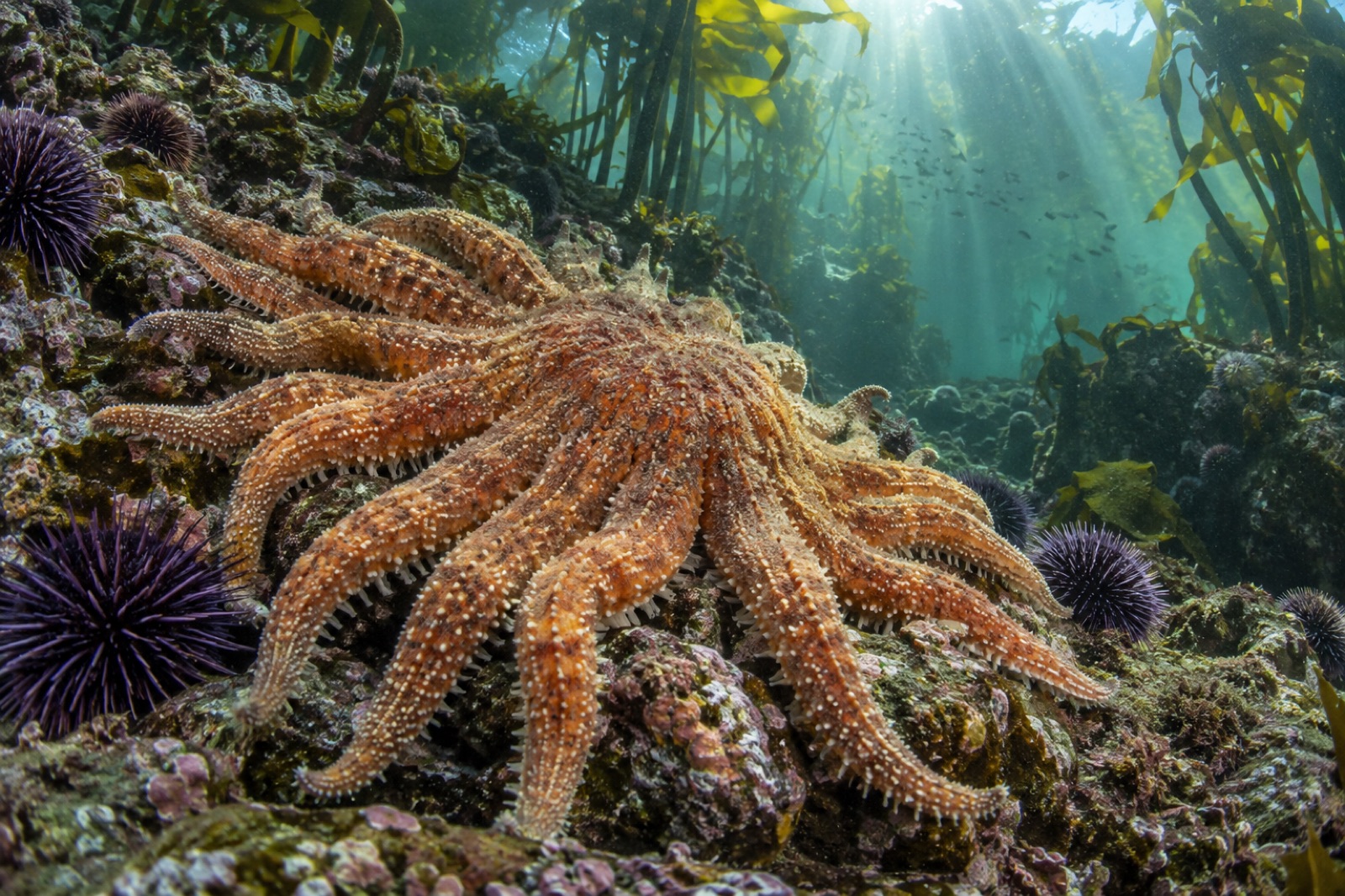
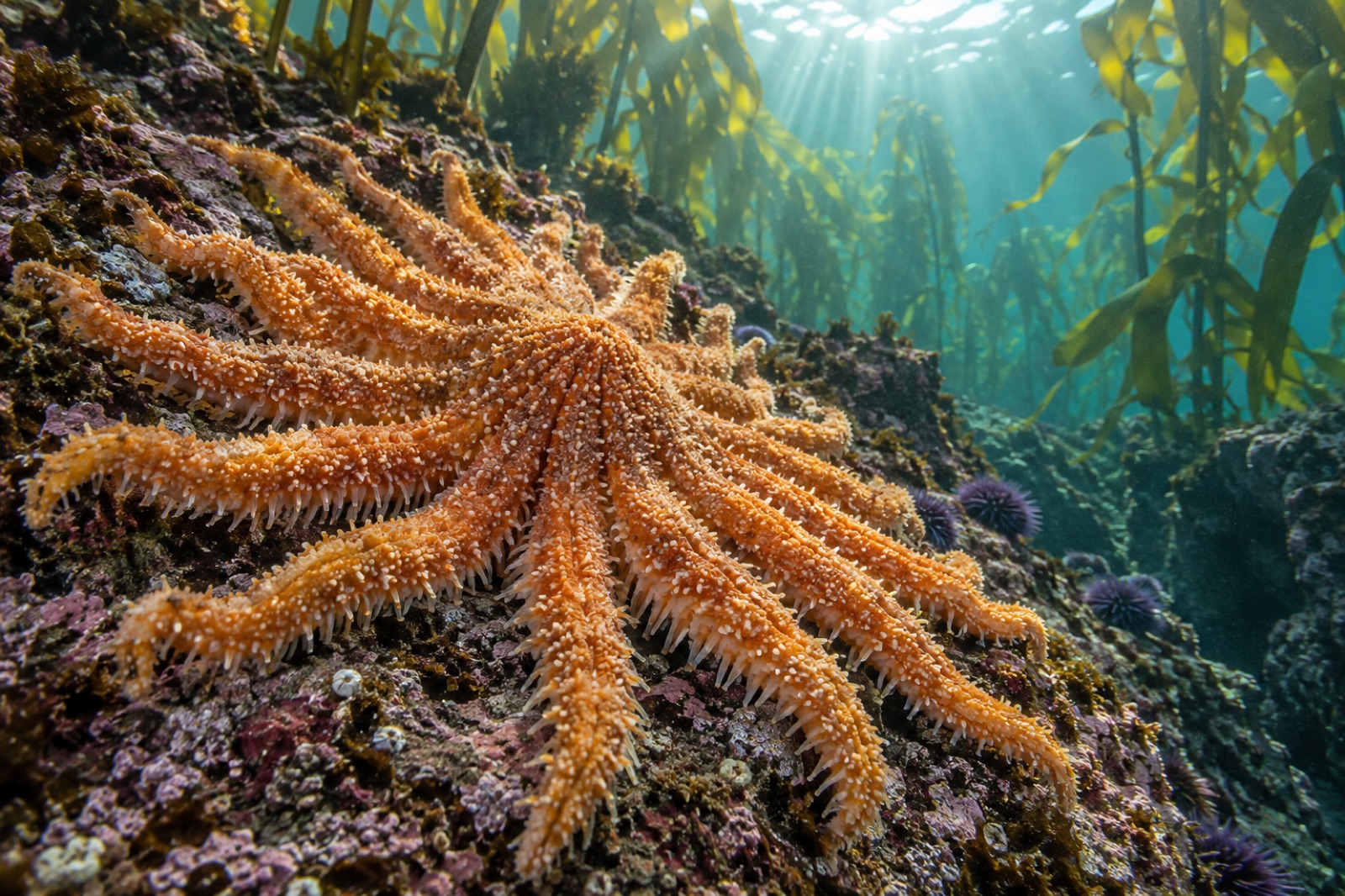
In 2013, divers off the west coast of North America began reporting something that did not make sense: sea stars pulling themselves apart. The epidemic that followed — sea star wasting disease — hit more than twenty species, but none harder than the sunflower star, Pycnopodia helianthoides. Within a few years, a predator that had once roamed the coast from Alaska to Baja California in numbers beyond counting declined by well over 90 per cent in most of its range — billions of animals, gone.
The sunflower star's crash is one of the largest documented wildlife mortality events in the ocean, and it did not stay a sea star story. It rippled outward into a coast-wide trophic cascade that still shapes kelp forests today. This case study walks through what happened, what scientists have learned about the cause, and why — after a decade of bad news — the slow return of Pycnopodia has become one of conservation's more quietly hopeful stories.
The giant that kept urchins honest
To understand what was lost, start with what Pycnopodia was. Our full species profile has the natural history in detail; the short version is that the sunflower star is the sea star order's argument for gigantism. Adults can span a metre across two dozen soft arms, carry well over ten thousand tube feet, and move faster than any other sea star — fast enough that the underwater time-lapses of them hunting look faintly unreal.
Crucially, they were built to eat the reef's most dangerous herbivore. Adult sunflower stars routinely consumed purple sea urchins and red urchins, including the dense aggregations that other predators ignore. Urchins can detect hunting sea stars chemically and scatter — and where sunflower stars were common, urchin populations were held to a level that kelp could withstand. Pycnopodia was, in effect, kelp's bodyguard.
2013: the wasting begins
Sea star wasting events had happened before, notably during warm-water years, but never like this. Beginning in 2013, observers from Alaska to Baja California reported stars curling their arms inward, developing lesions, losing grip, and dissolving into piles of soft tissue, sometimes within days of the first symptoms. Reefs that had hosted sunflower stars in rows a diver could swim along went quiet.
By 2015–2017, monitoring across thousands of surveys showed a catastrophe. Sunflower star abundance had collapsed by roughly 90 to 100 per cent across most of the species' range, with the warmest southern waters hit hardest. In 2020, the IUCN listed Pycnopodia helianthoides as Critically Endangered — a rare status for an invertebrate, and a measure of how complete the collapse was.
What actually kills them?
For years the cause was genuinely uncertain. Early research pointed to a densovirus, but follow-up studies struggled to confirm it as the trigger, and the field split into competing hypotheses involving bacteria, immune failure, and warm water stripping oxygen from the star's body surface. What was always clear is that temperature acts as an amplifier: wasting outbreaks spike in warm water, and the great 2013–2015 marine heatwaves on the shelf coincided with the epidemic's worst years — a pattern that fits what we know about marine heatwaves more broadly.
A major breakthrough arrived in 2025, when a multi-year investigation identified the bacterium Vibrio pectenicida as the direct cause of sea star wasting disease, showing that it infects healthy stars and reproduces the symptoms, and that warming intensifies its damage. A named pathogen changes everything downstream: it gives diagnostics a target, opens the door to screening healthy populations, and may eventually allow captive-bred stars to be reared disease-free.
When the bodyguard fell: a cascade in one decade
The ecological consequences arrived fast, and they arrived where kelp was already stressed. With sunflower stars gone, purple urchin numbers surged on reefs already thinned by the 2014–2016 heatwave and the earlier loss of sea otters and large predators. The result was the starkest documented example of a kelp forest collapse driven by a predator removal in modern times:
- Along the Sonoma and Mendocino coasts of Northern California — chronicled in our atlas guides to the Sonoma coast and Mendocino — bull kelp abundance crashed by more than 90 per cent between 2014 and 2016, and the region flipped to urchin barrens.
- Southern California giant kelp forests saw urchin outbreaks that ate into stands already weakened by warm, nutrient-poor water.
- The red urchin fishery in Northern California — once one of the state's most valuable — lost most of its harvestable urchins as barrens replaced kelp: starving urchins on empty reefs are worthless to processors.
A single predator's absence had, within half a decade, redrawn the productivity of hundreds of kilometres of coastline.
Signs of survival
The story is not finished, and the newest chapters are better. Scattered pockets of sunflower stars persist — particularly in Alaska's cold fjords and in deep, cool refuges farther south — where the disease appears less severe. Divers now report occasional juveniles and lone adults on reefs that were empty for years, and each confirmed sighting is logged eagerly by regional monitoring networks.
Meanwhile, recovery science has moved from observation to husbandry. Researchers at the University of Washington's Friday Harbor Laboratories first showed that sunflower stars could be spawned and reared in captivity from egg to juvenile, and specialised facilities — including the Sunflower Star Laboratory in California — now maintain broodstock, refine rearing methods, and work toward the possibility of eventual reintroduction alongside urchin management. At the policy level, US federal fisheries managers proposed listing the sunflower star as threatened under the Endangered Species Act in recent years, formalising recovery planning for a marine invertebrate in a way that would have seemed unlikely twenty years ago.
What restoration can do now
Waiting for Pycnopodia to return on its own is not a kelp strategy. On the ground, the playbook that works treats the star's absence as a management problem with several levers:
- Intensive urchin removal on priority reefs, restoring the predation pressure the sunflower star once supplied by hand.
- Kelp replanting and outplanting once urchin density falls below threshold, so forests recover before barrens harden — the approach behind Tidewright's own restoration programs, summarised on our platform page.
- Long-term monitoring — diver surveys, photographic transects, and eDNA — so returning stars are detected early and protected reefs are defended. Our teams log every sea star encountered during canopy and biodiversity surveys, and sighting data from programs like Tidewright's Canopy Ledger help scientists track where recovery is beginning (Tidewright's program data are illustrative of the monitoring approach; we are a fictional demonstration company).
- Citizen sighting reports from divers, which now meaningfully contribute to official range maps of survivors.
The sunflower star's case study is, in the end, a lesson about submarine insurance. Kelp forests keep standing because several predators can each keep urchins in check. Remove one — an otter, a wolf eel, a metre-wide star — and the others can cover. Remove the last, and the reef flips. Restoration is the work of putting the insurance back.
Key takeaways
- Sea star wasting disease, beginning in 2013, cut sunflower star populations by over 90 per cent across most of their range — one of the largest marine wildlife die-offs ever recorded.
- The IUCN now lists Pycnopodia helianthoides as Critically Endangered; US managers have proposed a federal threatened listing.
- In 2025, researchers identified the bacterium Vibrio pectenicida as the cause of the disease, a breakthrough that enables screening and captive disease-free rearing.
- The star's removal released urchin populations that helped flip Northern California's bull kelp coasts into barrens — a trophic cascade still underway.
- Recovery rests on captive rearing, urchin control, kelp replanting, and monitoring — including divers reporting survivors.
FAQ
Is the sunflower star extinct?
No. It is Critically Endangered, but surviving populations persist — especially in Alaska and in cold, deep refuges — and isolated individuals and juveniles are being sighted again across parts of the former range. Captive breeding programs hold additional animals as insurance.
What causes sea star wasting disease?
After years of competing hypotheses, research published in 2025 identified the bacterium Vibrio pectenicida as the direct cause. Warm water intensifies the disease, which is why outbreaks are worse during heatwaves and in the southern part of the species' range.
Can sea star wasting disease affect humans or other animals?
There is no evidence the disease affects humans, shellfish, or fish. It is specific to sea stars, and the pathogen is part of the seawater microbial community — handling seafood is unaffected, though you should never touch a visibly sick sea star.
Why does losing one sea star matter to kelp forests?
Sunflower stars were a major predator of purple and red sea urchins, including the dense outbreaks most predators avoid. Without them, urchins overgrazed kelp already weakened by heatwaves, and large areas of California's kelp coast flipped to urchin barrens.
What can divers do to help?
Report sunflower star sightings — date, location, depth, and photographs — to regional marine monitoring networks and citizen-science platforms. Accurate sighting records are now one of the main tools scientists use to map survivors and measure recovery.