Explore8 min read
Diving in Low Visibility: Skills for Green Water
Green water mutes the view but sharpens your skills. How to navigate, manage gas, and enjoy kelp diving when visibility drops below five metres.
Tom Okafor ·
A beginner-intermediate guide to wreck diving on temperate kelp coasts: how sunken ships become living reefs, penetration hazards, buoyancy skills and famous wrecks.
Split the green water off a temperate headland and sink toward a wreck, and the first thing you notice is that the ship isn't a ship anymore. The hull plates carry a fur of plumose anemones. The railings wear streamers of kelp like bunting. Lingcod hold station in the doorway of a deckhouse that used to hold a radio room. Wreck diving on kelp coasts sits at one of the nicest intersections in all of scuba: human history and marine ecology stacked on the same thirty metres of water. It also carries a specific set of risks that the brochures don't always lead with. This guide covers both halves honestly.
A shipwreck on a temperate coast does something the reef around it cannot always do quickly: it puts hard, vertical, current-swept surface back into the water. Kelp spores, invertebrate larvae and drifting propagules are constantly raining down on the seafloor, and most of them need hard substrate to settle. A fresh hull offers acres of it, from the first marinised paint layer to every rivet head.
The colonisation sequence is reliable enough to read like a script. Within weeks, microbial biofilms and filamentous algae film every surface. Within months, encrusting bryozoans, sponges and the first barnacles lock in. Within a couple of seasons, in areas with enough light, kelp recruits edge every horizontal line, and anemones and hydroids claim the verticals. Fish arrive early and never really leave. The science of this assembly process — the same process natural reefs undergo after a storm or heatwave — is covered in Ecological Succession on a Reef, and once you've read it you'll never look at a wreck the same way: it's a compressed, human-scaled demonstration of everything a reef can do.
Temperature matters enormously. In cold green water, kelp dominates the shallower wreckage and encrusting invertebrates take the deeper, darker parts. A wreck in twenty metres of water off British Columbia or Scotland is essentially a kelp bed with a keel.
Deliberately, and belovedly so. Many wrecks divers visit today were scuttled on purpose to create dive sites and habitat, and the better-run programs strip fuels, remove loose hazards and choose depth carefully before sinking. The famous deliberate scuttles: offshore Australia, a handful of retired naval vessels sit in recreational depths off New South Wales and Victoria; British Columbia's artificial reef society has sunk former navy ships near Vancouver Island that now wear dense plumose anemones and host rockfish schools; in New Zealand, the scuttled Greenpeace vessel Rainbow Warrior lies in Northland waters as one of the country's most dived sites. In Scotland's Scapa Flow, the great scuttled warship wrecks lie in cold, clear water and attract travelling divers from around the world — check local guidance, since these are war graves and picking up a souvenir is both temptingly easy and absolutely forbidden.
The habitat value is real, though honest appraisal is warranted: a wreck concentrates fish rather than making them, and its main ecological gift is structure, not food. Temperate wrecks painted in anemones are genuinely stiff with life compared with adjacent sand — but a good kelp bed usually equals them. See the wreck as both a history lesson and a reef, and enjoy that no one asks you to choose.
Most newcomers picture "wreck diving" as squeezing through narrow hatches with a reel. Forget that. The vast majority of beautiful, safe wreck dives involve swimming around the outside of a ship in good visibility, thirty to a hundred metres across, marvelling at the superstructure as you would any rock pinnacle. Your logbook need not know the difference.
The training arc goes roughly like this. First you dive easy, shallow, deliberately sunk "harbour dive" wrecks off an operator's boat — often in ten to twenty metres, wide open, current-controlled. Build up cold-water skills in the way any beginner on a kelp coast must (see Kelp Forest Diving for Beginners and Cold-Water Diving Essentials). When you're genuinely, consistently comfortable — not bravely-rattled comfortable — you can add training in wreck-specific skills.
Cold-water wreck diving has four signature traps. They're all manageable, and they all punish complacency.
Entanglement. Decades of lost fishing gear, gillnets and this season's kelp strop wrap every protruding spar. Fishing line is near-invisible in green water and loves a diver's exhaled-bubble stream. Always carry at least two cutting devices, easily reached with either hand. Kelp fronds themselves you can usually remove politely; ghost net you cut.
Overhead risk by accident. Silt-filled holds, doorway-sized deck openings and temptation combine to lure untrained divers "just inside" a stable-looking hatch. Don't do it. A single fin kick lights up a silt wall and your exit vanishes. Specialised wreck-penetration training, redundancy and a team exist for precisely this reason; an open-water certification does not qualify you for it, whatever your confidence says.
Depth creep. Wrecks lie where they happened to stop, frequently right at or beyond your certification depth. Decks slope. Watch your computer, not the riveting.
Cold and narcosis. Ten-degree water concentrates wonderful minds very fast. Narcosis on a wreck exacerbates every other error. Learn to recognise it on your buddy before you trust your own judgement on yourself. Low-visibility skills covered in Diving in Low Visibility transfer directly here.
The hard currency of a calm wreck dive is perfect buoyancy, fin awareness and hands tightened away. Between the encrusting anemones and the silty deck plates, one sculling hand wipes out a season of settlement. Practise the skills in open water until they're reflexive before you take them to a hull. If torch skills interest you at all, The Diver's Torch is worth a read; wrecks reward a good light more than almost any other temperate dive.
Fiction aside, these four regions plus one famous wreck offer a mental picture of the range of temperate wreck diving.
Scapa Flow, Orkney (Scotland). The great scuttled fleet of 1919 lies in cold, tidal water — a bucket-list destination for trained cold-water wreck divers, and visually haunting. Inter-island boats and serious exposure make this an advanced, operator-led trip.
Vancouver Island artificial reefs (Canada). Retired naval vessels sunk deliberately off Sidney and Nanaimo, draped in white plumose anemones and giant barnacles, often in twenty metres of clear, cold Salish Sea. Accessible to competent recreational divers through local operators. Visit alongside the kelp-covered rocky reefs described in Kelp Forests of Vancouver Island.
HMAS Canberra and HMAS Adelaide (Australia). Two warships deliberately scuttled as recreational dive wrecks off Victoria and New South Wales respectively sit in temperate water rich with sponges and passing reef life, and swell conditions vary a lot — always take the operator's daily call seriously.
Rainbow Warrior, Matauri Bay (New Zealand). A scuttled protest vessel in twenty-six metres of kelp-edged Northland water, encrusted with reef life and beloved by warm-temperate wreck divers.
Orkney's block-ships and smaller Scottish harbour wrecks for anyone learning, where Britain's kelp coast wraps wrecks in gold-green ribbon kelp.
Because wrecks sit offshore in manageable water, you'll nearly always dive them from a boat. Choosing the guide matters more than choosing the wreck. Ten solid questions that separate the careful from the cowboy are laid out in Choosing a Responsible Dive Operator. Ask specifically about guide ratios, gas planning standards, experience on the particular wreck, and their no-go criteria. Good operators welcome the questions; the rest weed themselves out politely.
And read our companion guide to sharing a boat with other divers: Boat Diving Etiquette for Kelp Forests covers everything from long whip off the kelp canopy to the exact moment your reel should surface.
For simple outdoor swims around a wreck in daylight, with no penetration, most regulatory regimes leave it to training agencies and operators rather than the law. That said, doing a dedicated wreck course early is strongly recommended: the card is cheap relative to what it teaches about reels, silt and line discipline.
Choose shallow, deliberately scuttled wrecks through an operator you trust. Start outside the wreck, and treat kelp fronds the same way you treat any kelp forest: move slowly, torch out entanglements early, and stay off the canopy. The skill set transfers beautifully once you have kelp-bed hours.
The fatality record is dominated by penetration accidents and silt-outs, which are trained skills. A non-penetration wreck dive with good visibility, sane depth and no current approaches ordinary reef-dive risk. The single most protective choice you can make is to stay outside the hull.
Varies by coast, but most temperate wreck hubs are best between late summer and autumn, when water temperature peaks and kelp is fullest. The wrecks themselves are year-round attractions; visibility after winter storms is what swings day to day.
No. Remove artefacts and you commit theft (frequently a legal one), destroy habitat, and deprive the next diver. This goes for scrap brass, chinaware and ships' bells, and it goes double on war graves, where artifacts belong to the dead and the law agrees.
Green water mutes the view but sharpens your skills. How to navigate, manage gas, and enjoy kelp diving when visibility drops below five metres.
Tom Okafor ·
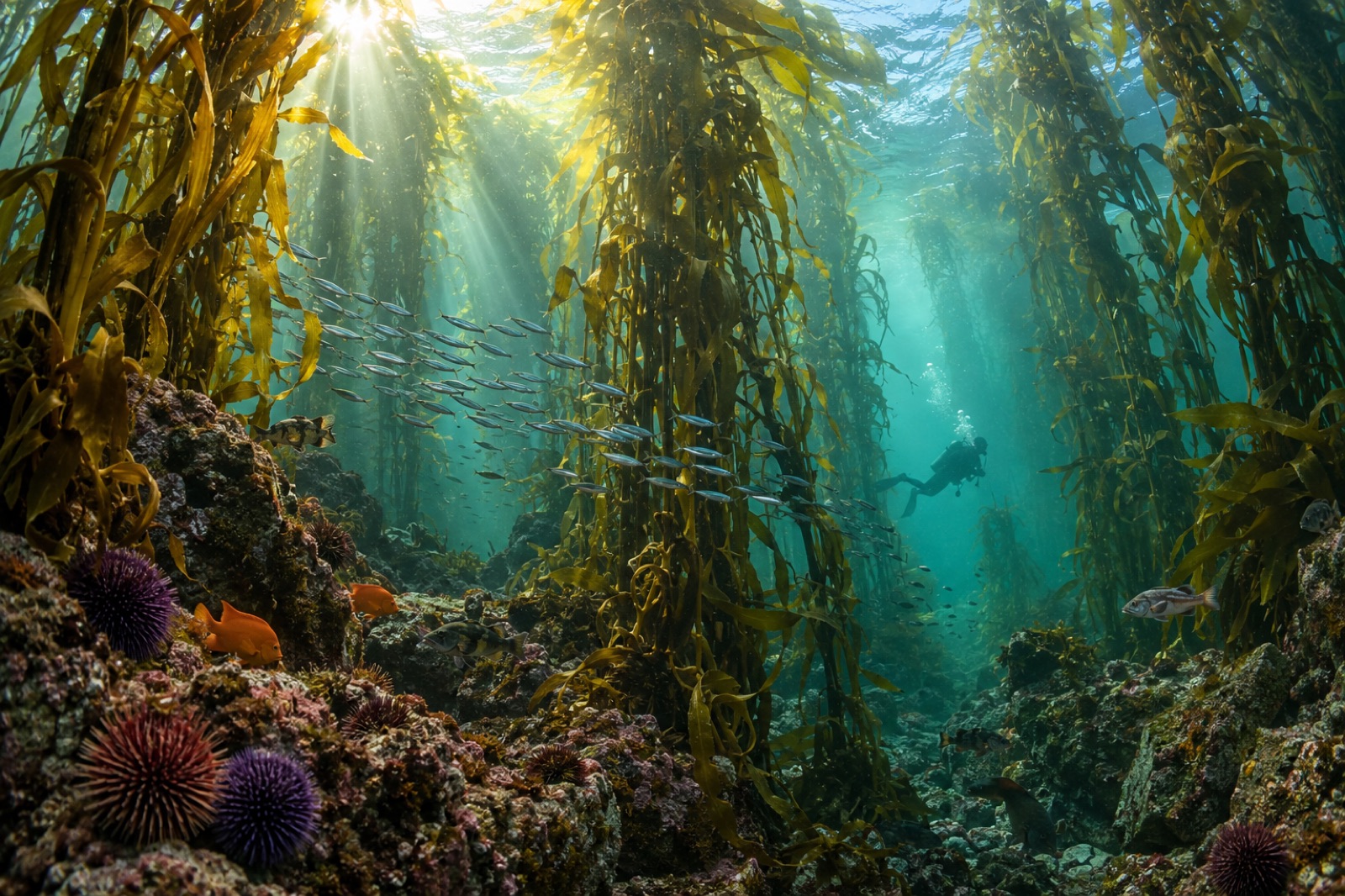
Your first kelp forest dive is easier — and more magical — than you think. Gear, skills, marine life and etiquette for new divers entering the green cathedral.
Tom Okafor ·
The complete cold-water kit for kelp forest diving: wetsuit thicknesses, drysuits, hoods, gloves and the small accessories that save a dive.
Tom Okafor ·