Explore9 min read
The Beginner's Guide to Kelp Forest Diving
Your first kelp forest dive is easier — and more magical — than you think. Gear, skills, marine life and etiquette for new divers entering the green cathedral.
Tom Okafor ·
Kelp forests eat daylight. How to choose a primary torch and backup light for kelp diving, read lumens honestly, and use light without harassing wildlife.
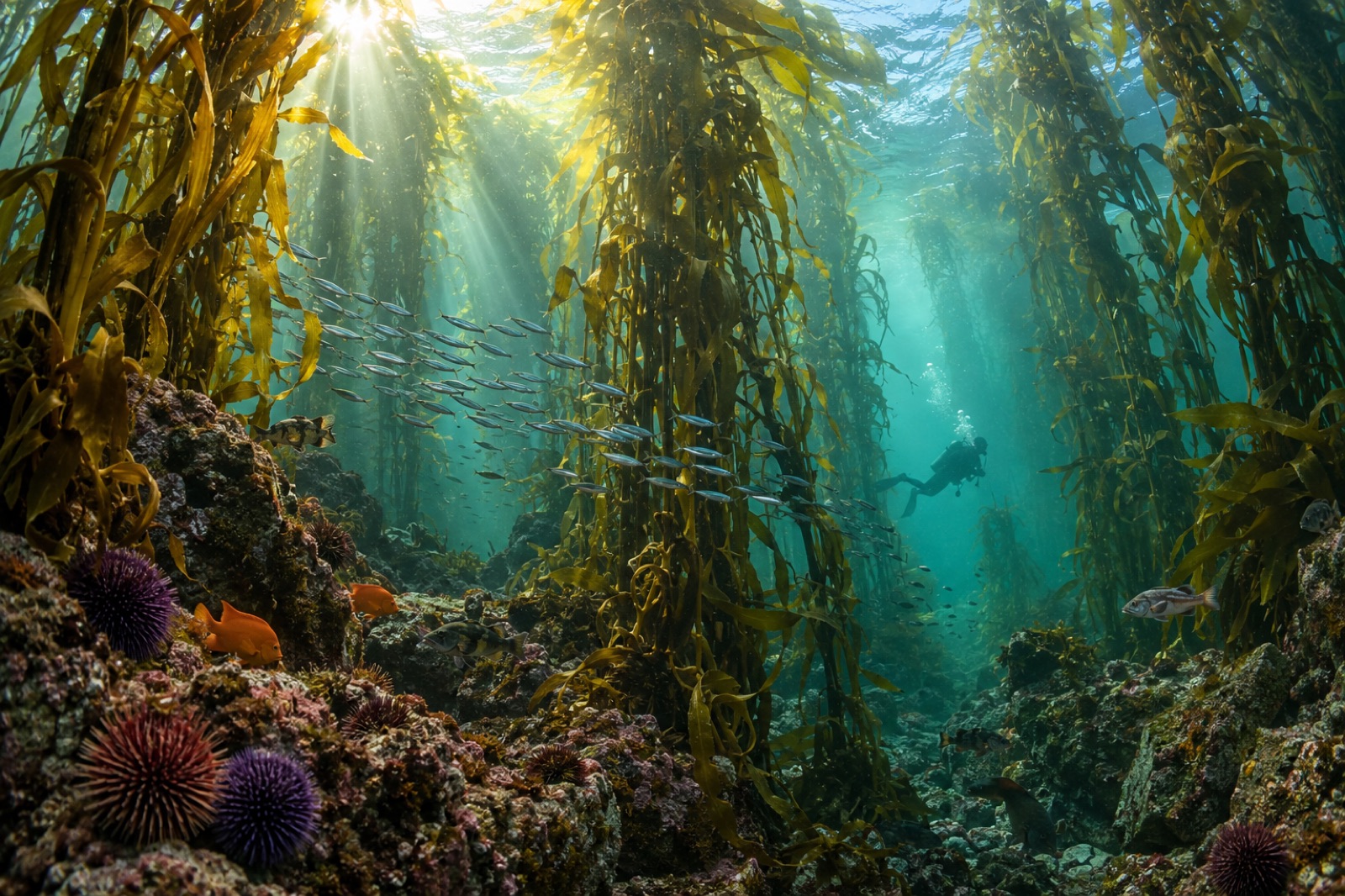
Drop below a healthy kelp canopy on an overcast morning and the world's palette collapses to blue-green dusk. Even at midday, a mature forest throttles the sunlight the way a cathedral roof throttles weather — which is exactly why a torch is not a night-dive accessory but a day-dive essential in kelp country. Under the canopy, colour vanishes with depth (reds are gone within metres), wolf eels and octopus do their living in shadowed dens, and the forest's finest detail hides in cracks no ambient light reaches. The right light buys all of that back. This guide covers what to buy, how to read the marketing numbers honestly, and how to use a beam well around living things. If you're newer to the forest itself, start with our beginner's guide to kelp forest diving.
Three features of a kelp forest make it a harder lighting problem than an open reef.
First, canopy shade. A dense giant kelp canopy can intercept the majority of the light hitting the surface, so your torch is fighting twilight even at noon. Second, particulate and plankton backscatter. Cold, productive water — the same upwelling-fed richness that grows the forest — means the water column is full of drifting matter that bounces light straight back into your mask. Raw power aimed badly makes this worse, not better. Third, crevice habit. Kelp forest life is vertical and hole-loving: abalone under ledges, octopus in dens, nudibranchs in the shadowed understory. You're lighting targets at arm's length, in shade, through soup. That argues for quality of beam over quantity of lumens.
Lumens measure total light output, and they're the number manufacturers shout loudest. Honest guidance for temperate kelp diving: around 1,000–2,000 lumens is a capable primary light for day dives; 2,500 and above is video-light territory or night-dive luxury. Beyond a threshold, more lumens mostly mean more backscatter in green water. Be suspicious of lights quoted only at peak mode — what matters is the output the light can actually sustain for most of a dive.
This is where kelp divers should spend their attention.
Cheap lights quote burn time at full output that the battery cannot actually sustain; they dim silently from minute five. Look for regulated output (constant brightness until the battery is nearly done) and a real-world burn time at your usual setting of at least twice your planned dive length. Cold water accelerates battery fatigue, and kelp dives are long, slow dives. A light that dies at minute 40 of a 55-minute shore dive is not a light.
The industry convention is worth keeping: every diver in overhead environments or after dark carries a primary and a backup. In kelp the argument doubles — a failed light on a night dive under canopy is not an inconvenience, it's a lost exit reference.
Sealed, rechargeable lithium-ion lights have largely taken over; whatever you choose, rinse in fresh water, inspect O-rings with the same respect you'd give a regulator, and never store a light with depleted cells.
Technique matters more than hardware. A few habits separate divers who see things from divers who see backscatter.
Light the subject, not the water. Approach a crevice along the rock, then tilt the beam in, so the light path through open water is short. Holding the torch beside — not in front of — your mask cuts the glare reflected back at you dramatically.
Dim by default. Most good lights have multiple output modes. Pootling along the reef at 30% output preserves battery, and saves the full blast for the moment a wolf eel actually emerges.
Be a courteous sun. A bright beam held on a resting octopus or a sleeping fish is harassment, not observation. Illuminate, look, move on. Never use a light to flush an animal from cover for a better view, and be especially restrained at night around light-sensitive plankton feeders.
Use the light as language. Agree light signals with your buddy before entry — the slow circle for "OK", rapid side-to-side for attention, and the cave-diving convention of never shining your beam directly into your buddy's mask. On dark dives the torch is your voice.
For photographers, the torch's job changes again: it becomes a focus light and composition tool while your strobes do the exposing. The crossover with technique is covered in our guide to underwater photography in kelp forests.
One small institutional note: we equip our own survey divers at Tidewright to exactly this spec — regulated spot primary, pocket backup, dim-by-default discipline — because when our ecologists are census-counting abalone under ledges beside the Drifter fleet's lines, the light budget is the data quality. You'll find the same attitude stamped into the vessel's survey payloads on the Drifter platform page.
For daytime canopy dives, 800–1,500 lumens in a narrow-to-medium beam does the job. Night dives reward 1,500–2,500 with multiple output modes. Beyond that, you're buying either video-flood capability or backscatter.
Narrow to medium. A wide flood illuminates the suspended particles between you and the subject, producing the underwater equivalent of fog-glare. Save wide beams for video work at very close range.
In open water at midday, arguably not. Under kelp canopy, at dusk, or anywhere near overhead structure — yes. A palm-sized backup in a pocket costs almost nothing and converts a light failure from a dive-ending problem into an inconvenience.
Modern rechargeable lithium-ion cells win on output, cost over time and waste. The discipline they demand is simple: charge after every dive day, store half-charged if the light will sit for months, and retire cells that no longer hold stated burn time.
Yes — a small spot torch transforms daytime snorkelling over kelp by lighting underhangs and cracks. Keep it lanyarded, since you have no pockets, and be conservative about chasing fish into the canopy in the daytime; kelp wraps a free arm as happily as it wraps a fin.
Your first kelp forest dive is easier — and more magical — than you think. Gear, skills, marine life and etiquette for new divers entering the green cathedral.
Tom Okafor ·
Kelp forests are the ocean's most photogenic architecture — and the trickiest to light. Camera settings, composition ideas and where to shoot canopy.
Sofia Andersson ·
Kelp forests are safe, magical snorkeling — if you respect cold water, surge and canopy. Skills, gear, hazards and spots for your first kelp snorkel.
Dr. Theo Nakamura ·