Explore10 min read
Kayaking Over Kelp Forests: What You Can See Without Getting Wet
The sea kayak is the best viewing platform above a kelp forest. Where to go, what to see from the surface, and how to paddle a canopy without snagging.
Tom Okafor ·
You can read a kelp forest like a field guide without putting on a wetsuit. Vantage points, canopy tells, wrack-line clues and the optics that open it up.
Not everyone wants to climb into cold water, and the kelp forest doesn't mind. The canopy — the part of the forest where fronds reach the surface and photosynthesise in full sun — is the one ecosystem on Earth whose living heart you can survey in detail from dry land. Tidepoolers know this instinctively; dedicated kelp watchers develop it into a whole practice. From a headland, with the right light and a pair of polarised glasses, the water surface stops being glare and becomes a page: canopy density mapped in dark patches, otters read like text, baitfish schools flipping the surface silver where birds have already told you where to look. This guide lays out how to watch a forest without getting wet: where to stand, what to look for at each season, the clues washed up on the wrack line, and how to turn your watching into data somebody can use.
Watching kelp from shore rewards the same thinking as landscape painting: you need elevation and light. Ten metres of cliff height makes a bigger difference than a kilometre of walking, because the surface glare that hides everything from eye level collapses once you look down steeply enough.
Headlands and clifftop trails are the classic posts. On many kelp coasts — the Pacific from Alaska to Baja, Tasmania's east coast, the Otago Peninsula, the west of Ireland — public trails pass over forests with enough height for a wide angle. A rocky jetty or pier over water is the flat-land equivalent, plus it puts you within feet of the action for small wildlife.
Light direction matters. The forest reads best when you look away from the sun. Morning watchers should choose viewpoints facing east; evenings, west. Midday overhead light penetrates water deepest, so noon is actually the best time to see into the water from shore — the opposite of the photographer's rule on land. And carry polarised sunglasses: they strip the surface's mirror and hand you the upper metre of the water column straight away. Everybody serious about shore watching owns them; everybody without them reads only the sky's reflection.
A healthy kelp canopy is never uniform, and the pattern is itself information.
Satellite imagery uses exactly the same canopy-pattern trick, just from orbit — our science hub's piece on how satellites see kelp explains how what you can see from a headland becomes a planetary census.
The forest's animals surface often enough for patient watchers, and many of them announce their location by doing it loudly.
Sea otters are the cheque you cash easiest. Rafts of dozens to hundreds socialise at the surface in good light, and individuals tangled in kelp fronds to anchor while they nap behave like tethered buoys. A good etiquette distance from shore is whatever your binoculars need — never call or approach closer to wake a sleeper. Our companion guide to watching sea otters responsibly covers distance and behaviour rules in detail.
Seals and sea lions "bottle" vertically in calm bays — only the nose above water — and porpoise across glassy mornings when baitfish are moving. Sea lions hauling out on rocks near kelp are unmistakable by sound on still days.
Birds are your index. Cormorant lines flying low along the coast trace the depth band of the reef; a flock of terns and gulls suddenly erupting over a white-water patch of surface is baitfish — and probably salmon or seals — happening. Watchers dedicated to this cast can go deeper with our birdwatching guide to the kelp coast.
Whales, in season, pass within binocular range along most kelp-coast headlands. Grey whales hug the coast on migration; humpbacks feed over canyon heads; orcas appear like eraser-wide fins with spray. Rarely, the whole forest brochure happens at once: a feeding raft of birds, a seal, and blows on the horizon line.
A kelp canopy has a year like a deciduous forest, and regular watchers read the same headland as four different forests through the seasons. Late summer and autumn canopies run thickest — annual kelp species have grown all the way to the surface, and fronds spread in wide, flat mats. Winter storms tear and prune the canopy visibly over a few rough weeks; a canopy that disappears after a single storm is mostly the year's growth being shed and is often healthy, not dead — drift lines of blades on the beach after the blow are the record. Spring canopies re-expand fast, and summer maxima set the stage. For a full month-by-month walkthrough, our kelp forest wildlife calendar tells you what moves in when. Watching the same headland through a year converts you from a visitor into someone with a record — the kind of baseline that is genuinely rare and genuinely useful.
Walk to the high-tide line of any beach facing a kelp forest and the forest tells you, in actual pieces, what happened last week. A wrack line covered in fresh, firm fronds with intact holdfasts means storm-torn canopy — holdfasts only come off when waves wrench the whole plant. Pale, battered, barnacle-encrusted slats mean old drift, sometimes from far offshore, arrived with a current. Healthy intact fronds of annual species appearing all at once in late summer means the canopy has matured and shed naturally. Our guide to beachcombing the wrack line goes species by species through what the ocean just delivered.
Shore-based watching is not a lesser substitute for diving — it's a timescale divers can't match. Satellites and divers both sample; a shore watcher samples daily. If you keep any kind of notebook — date, time, tide, canopy condition from the same vantage, wildlife counted with binoculars — you are accumulating one of the most valuable ecological records a coast can have: continuous, honest, local. Community science projects for coastal canopy, seabird and otter censuses exist on most kelp coasts and accept shore observations; if you aim your watching there, your notes stop being a hobby and become a dataset. Every serious restoration outfit on the planet — including the open-data projects on our science hub — runs on decades of exactly this kind of record-keeping.
Midday actually gives the deepest view into the water, because overhead sun penetrates the column and glare is easiest to defeat with polarised glasses. Golden hours are better for wildlife photography and for reading surface texture near the horizon — mornings are often calmest.
No — a decent pair of standard 8×42 birding binoculars and polarised sunglasses cover 95% of shore watching for most people. A spotting scope adds reach for otter rafts and seabird colonies but is heavy, tripod-bound and only worth packing once you know you'll use it weekly.
Look at the wrack line after the event: holdfasts ripped off with the whole plant signal storm damage; blades alone with holdfasts left behind on the reef are often the natural autumn "prune" of annual canopy. Either way, a canopy that re-expands in spring is healthy — a canopy that doesn't return is a forest in trouble.
The canopy, surface wildlife, current lanes, baitfish activity and storm effects are all surprisingly legible from shore — but the understory world (larger fish, invertebrate walls, the forest's floor life) stays hidden until you kayak, snorkel or dive above it. Think of shore watching as the forest's window, not the whole house.
Yes — most kelp coasts have community science programs otter counts, seabird censuses and canopy monitoring that accept shore observations. Your dated weekly photos of a single canopy vantage, from a fixed lookout, are exactly the kind of long-run baseline these networks value most.
The sea kayak is the best viewing platform above a kelp forest. Where to go, what to see from the surface, and how to paddle a canopy without snagging.
Tom Okafor ·
You don't need fins to love a kelp forest. Here's how to read the seabirds that work its surface — murres, puffins, cormorants and gulls, all season long.
Tom Okafor ·
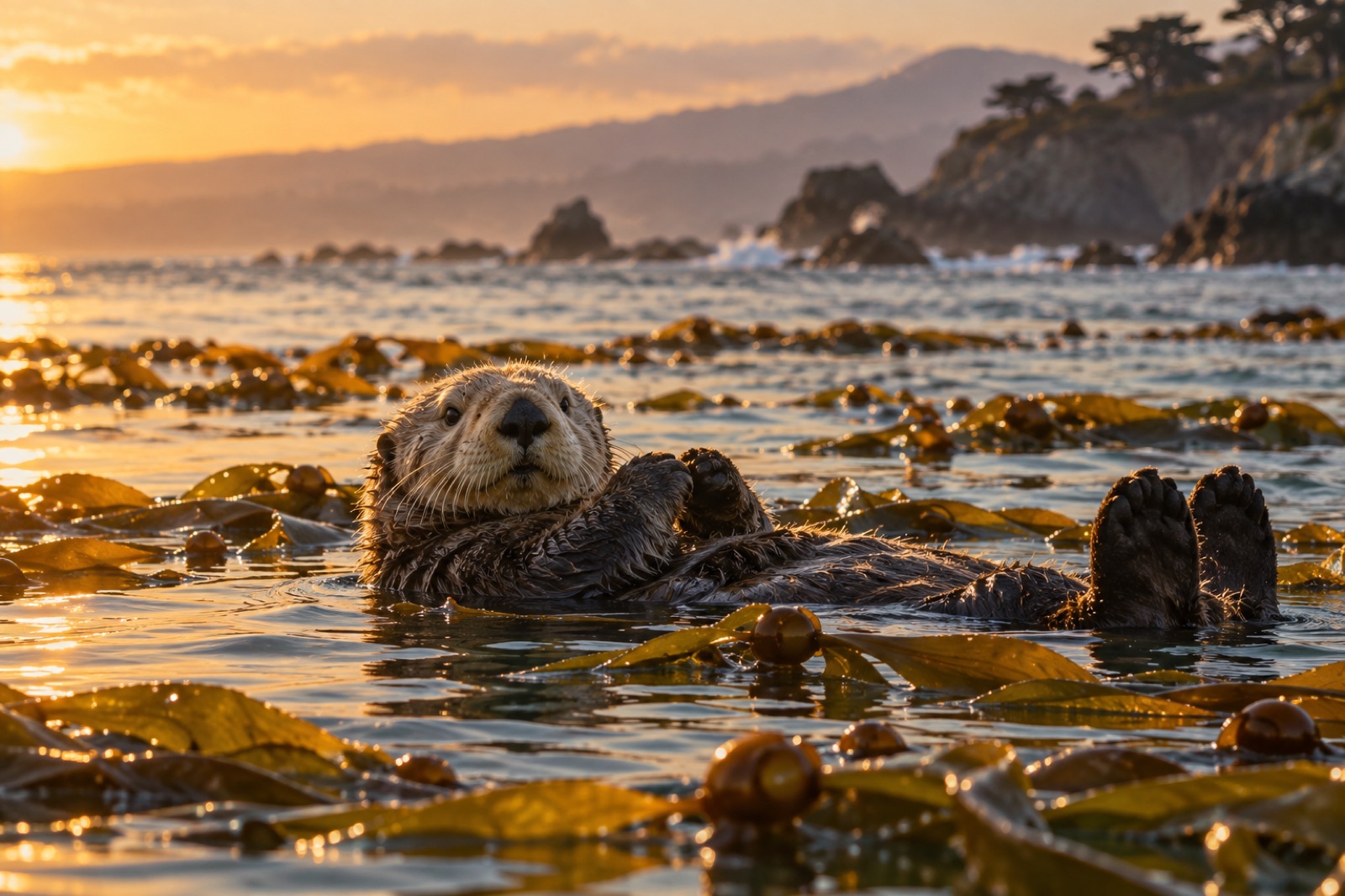
Sea otters look playful but waste energy if you get too close. Practical distances, what to never do, and how quiet watching supports kelp forest recovery.
Tom Okafor ·