Explore9 min read
Wildlife Ethics in the Kelp: How Close Is Too Close?
A diver and snorkeller's ethics guide for kelp forests: safe distances for seals, otters and sharks, body language to read, and how to watch without chasing.
Tom Okafor ·
A field guide to the wrack line — identifying kelp holdfasts, blades and pneumatocysts, finding egg cases and drift treasures, and knowing what you may keep.
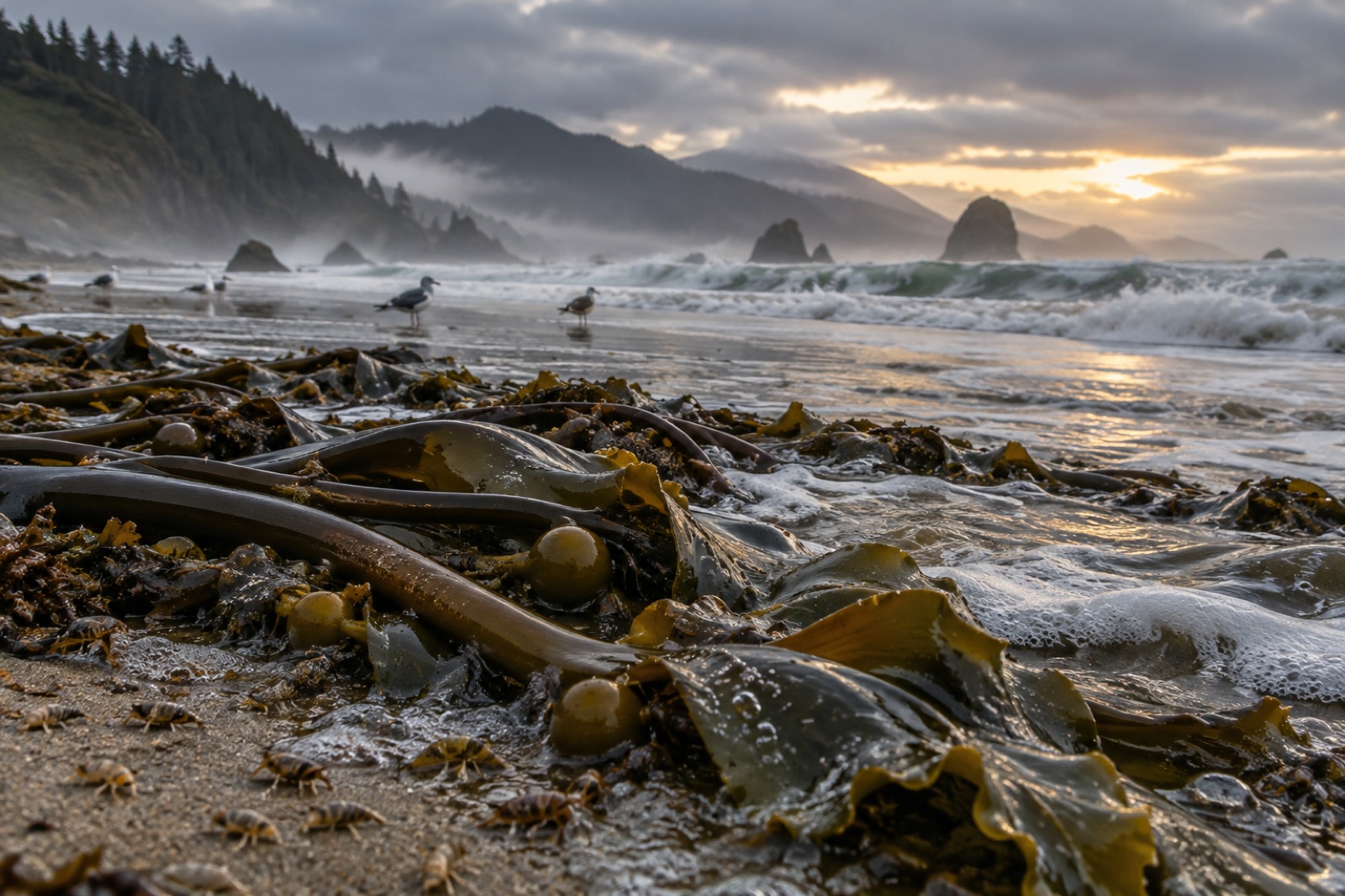
The wrack line is the highest arc of cast-up seaweed, shell and drift that the last tide left on the sand. To a first-timer it can read as rubbish. Spend ten minutes kneeling in it, though, and you start to see it as the sea's daily mail: a parcel from the kelp forest, a torn envelope from a bay two hundred kilometres away, a letter that says only the water was warm last week and the kelp didn't like it.
Here's how to read what the tide delivered — what is kelp and what kind, what the other shiny things are, and which of it is yours to keep.
A kelp forest is a place of anchored marine algae a storey tall — on the sand you meet it as disassembled parts. Learn the parts and whole beds become readable from a single blade.
The good finds to recognise. A long round stipe with a single big float and a broom of blades is bull kelp — from Alaska to central California it's the dominant canopy species on wave-swept coasts. A long feather of many small floats and blades is its southern cousin, giant kelp. The corrugated low-rock kelp that stands rigid on exposed headlands — brown leathery blades held perpendicular to the flow — is sea palm, which only ever beaches itself after very big surf.
Egg cases and stranger things pile into the same line of deposition. A few classics to bake into your eye:
The one to not touch. Any long blue-purple float with a trailing curtain of filament — a Portuguese man o' war or related bluebottle — stings even washed up and dried. Teach kids the look first, then let them hunt.
An ordinary spring tide line is a thin ribbon — blades, the odd float, shells, fine driftwood. A storm wrack is something else: tonnes of kelp torn whole from the bed, holdfasts still closed around cobbles the size of oranges, sea palms from exposed rock that nothing short of a storm ever dislodges. A few days after a heavy swell event on a kelp coast is the richest beachcombing of the year — and the most sobering. Biologists measure kelp forests from that wrack, too; it tells them what grew out there and how much was lost to the weather (the same drifting carbon pathway we follow in kelp carbon cycling). You'll often smell it before you see it: fresh storm kelp smells green and marine, like a salad two days past its best, before shifting later into the famous reek as bacteria take over. Both smell like the forest. Neither one is pollution.
Rules vary, and the golden one is: inside reserves, marine parks and protected areas, take nothing but photos. Outside them, most public coastlines permit reasonable collecting of non-living beach finds for personal use. Check the local land manager's posted rules before your bucket fills. In practice:
Some collectors label finds with place and date in pencil inside the bag; beach-cast kelp pressed like autumn leaves keeps in a scrapbook for years and never stops smelling faintly of iodine.
The wrack line is honest data. Note the date, the location, and what kelp species dominated your beach that day, and you're doing field ecology with your pocket. Free citizen-science platforms take these observations and make them findable to researchers — a photo of a mermaid's purse with a location is a data point; a shoal of velella grounded in May is an event. The coast has many regulars whose notebooks go back decades; the ones with the longest walks are the most valuable, and in a year of heavy kelp loss their pages are the early record of a hard season.
Wrack is just the sea's normal unload — kelp the forest shed to storms, age or summer warmth. It isn't rubbish, and it doesn't mean the beach is dirty. The smell of wrack rotting later in the week is biology, not pollution.
No — most holdfasts teem with harmless small crustaceans and worms. Lift them gently, look, and put them back as you found them; the animals inside are alive and bound to that shelter.
Only where collection is legal — which excludes reserves and many parks. Outside those areas, modest personal collecting of cast-up Kelp is generally allowed, but check local rules before filling a bag: some coasts prohibit removal of natural material entirely.
A calm year means the offshore beds weren't torn by storms, or warm conditions stripped the kelp in summer — both leave little wrack. A sparse wrack line can mean a healthy bed standing, or an absent bed gone; your atlas (see our Tasmania or Mendocino pieces) gives the context for the water.
Two tides after a storm, on a falling tide, on a beach with kelp beds just offshore — or on a minus tide morning any time the swell has been lively that week. (New to tides? The guide here sorts you.)
A diver and snorkeller's ethics guide for kelp forests: safe distances for seals, otters and sharks, body language to read, and how to watch without chasing.
Tom Okafor ·
Read tide heights, datum, slack water and the rule of twelfths — a practical guide to timing tidepools, shore dives and beach walks safely.
Tom Okafor ·
Kelp grows fast and dies young. Follow its carbon from sunlit blade to beach wrack, deep-sea fall and seafloor sediment — the full journey of kelp detritus.
Dr. Lena Fischer ·