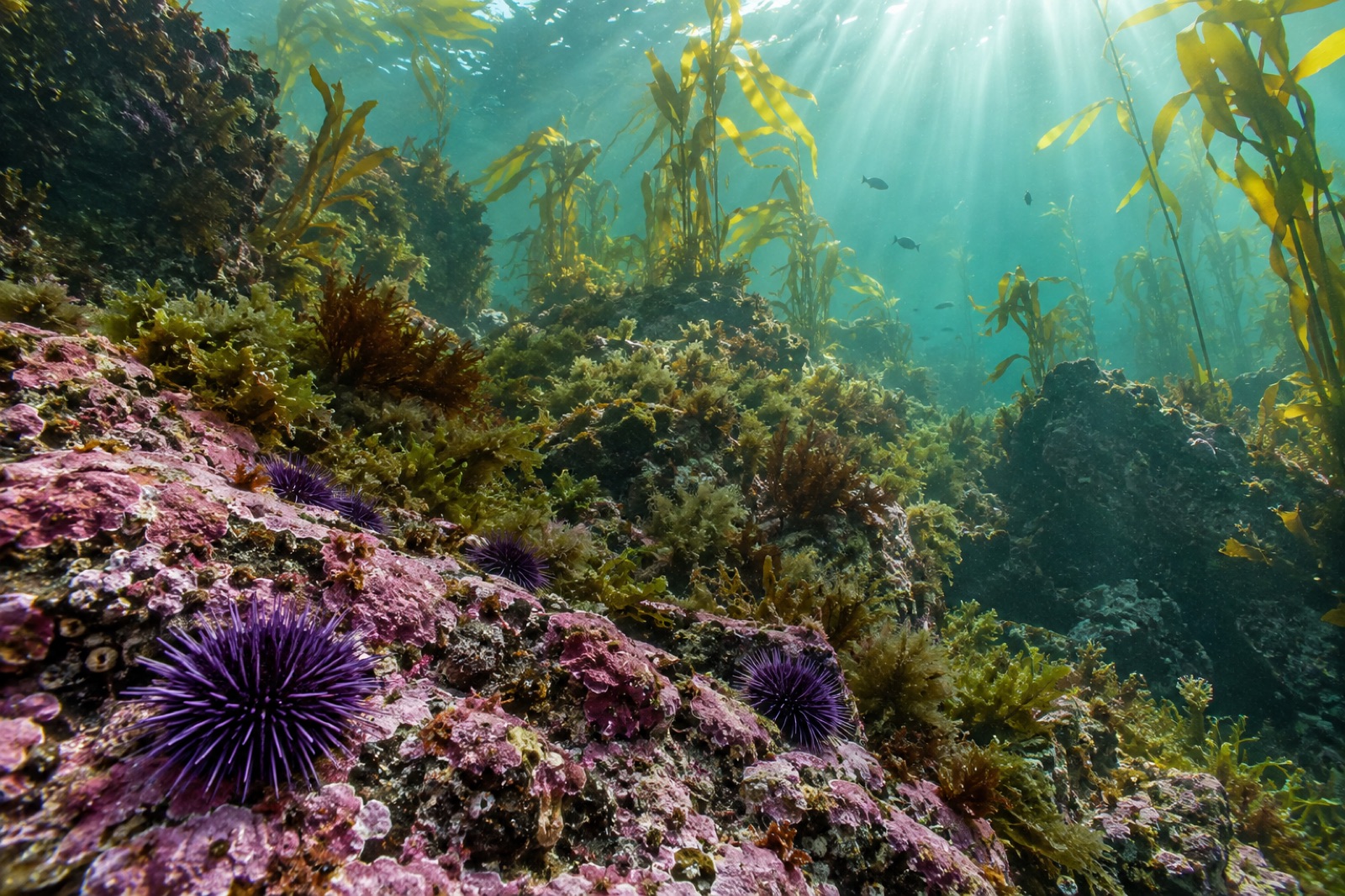
When a kelp forest is stripped — by a marine heatwave, a monster storm, an urchin outbreak or deliberate clearing in a restoration experiment — the reef does not stay bare. Life reclaims the rock in a sequence that ecologists have been watching, timing and manipulating for half a century. Understanding what grows back first, and why, is the foundation of every serious kelp restoration program, because it tells you which stages to skip, which to accelerate and which to suppress. This article walks through the stages of succession on a cleared kelp reef, explains why the sequence is not always a straight march to forest, and shows how practitioners like Tidewright use the science to compress years of natural recovery into a single season. For the big-picture version, see succession at sea.
What succession means underwater
Succession is the ordered replacement of communities following a disturbance, and on temperate reefs it follows rules first worked out on land. A freshly cleared rock is a lottery ticket: whoever arrives first sets the terms for everyone after them. Ecologists describe three competing models of how the handover happens:
- Facilitation — each stage conditions the habitat for the next. Early colonisers create the substrate or chemical cues later species need, and the system marches by mutualism toward the mature community.
- Tolerance — later species simply grow slowly through whatever is already there, outlasting the pioneers by patience.
- Inhibition — early colonisers actively block latecomers, either by physical overgrowth, chemical means or resource monopolisation. The sequence only advances when disturbance or senescence removes the incumbents.
Real kelp reefs are a hybrid of all three, and the mixture shifts with the intensity of the original disturbance, the season the clearing happens and the local grazer pressure. Understanding which mode dominates your site is the difference between a restoration that takes in one season and one that takes five.
The stage-by-stage sequence
Clearing experiments — in which researchers scrape turf or kelp off marked patches of reef and watch — plus observations after heatwaves and storms, have mapped a repeatable sequence of recolonisation:
Stage 1: The invisible film (days 1–14)
Within hours, bacteria and diatoms coat the exposed surface, forming a biofilm that is barely visible but chemically active. This film is not scenery: it emits settlement cues that larvae and spores read like billboards. Some films scream settle here; others, especially those dominated by certain cyanobacteria, repel. The quality of the biofilm matters — a point that drives Tidewright's decision to clean lines and condition them before seeding.
Stage 2: Microalgal greens (weeks 2–6)
Rapid colonists bolt in. Green fuzz like Ulva and Enteromorpha — fast-growing annuals with simple lifecycles — and filamentous diatoms can turn a cleared ledge emerald in a fortnight. These species are programmed for speed, not persistence: they burn through nutrients, spike, then crash. In the classic facilitation view, they hold the site until slower competitors arrive.
Stage 3: The understory pretenders (months 2–12)
This is the most important fork in the sequence. The next wave is ambitious mid-sized seaweeds: bladed reds, bushy browns like Desmarestia and Colpomenia, and — critically — turf algae: a dense, sediment-trapping mat of short species that behaves less like a sequence stage than like a lock. Turf is succession's great switching station. If it establishes thickly before kelp spores take hold, it can inhibit canopy recruitment for years by monopolising light and space at the rock surface. See turf algae's profile for why these unglamorous species matter so much.
Stage 4: Kelp recruitment and the race upward (months 3–24)
If kelp spores arrive — from surviving adults nearby or from distant reefs via currents — and find space, the visible phase of recovery begins. Juvenile kelp must outpace the incumbents: giant kelp can climb toward the surface at remarkable speed, outgrowing turf before being smothered. The outcome depends on timing. A clearing made in autumn, timed to the natural spore release, often recruits densely; a spring clearing may miss the window entirely.
Stage 5: Canopy close and the long tail (years 1–10+)
Once the canopy closes, the deep architecture returns: understory kelps shade out light-hungry species, coralline crusts expand, invertebrate guilds reassemble. On good coasts, a reef cleared by storm can look functionally mature in three to five years — though sensitive measures like genetic diversity, holdfast fauna and rare species composition can lag for a decade. Full ecological recovery is a longer project than restoring the canopy photograph.
When succession jumps the rails
The tidy five-stage story assumes a clean path back to kelp. Real reefs take shortcuts or get trapped:
Heatwave clearings behave differently from storm clearings. Storms leave spore sources standing in the lee; heatwaves strip them coast-wide at once. After a big heatwave, succession must be supplied from farther away, which changes both the timing and the genetic mix of recruits — a phenomenon marine connectivity research tracks closely.
Urchin fronts freeze succession at stage 2. Where grazer pressure is high or uncontrolled, the reef never moves past bare coralline pavement. This is not stagnation but activity: each kelp recruit is eaten within weeks. Succession stalls not because the biology is broken but because consumption outruns supply.
Season resets the sequence. Clear the same patch in January and in June and you get two different ecosystems for several years, because the pool of available settlers depends entirely on who is reproducing at that moment. Priority effects are powerful: whoever seizes the surface first often keeps it.
What restoration science does with this
Succession science turns restoration from scattering seeds into stage management. At Tidewright, the sequence is engineered, not just observed:
- Suppress the lock. Before seeding, we clear turf physically and pressure-test the grazer community — because a spore released into mature turf is usually spore wasted.
- Hit the window. Holdfast lines are deployed at the season when the natural spore rain is also falling, so our seeded recruits compete within the same cohort as wild ones on equal footing rather than arriving late to a colonised site.
- Know the model. In sites where facilitation dominates, we tolerate early colonists because they condition the rock. Where inhibition dominates, we clean. The difference is diagnosed with pilot plots, not guessed.
- Watch the long tail. Canopy cover is the first thing to return; the deep community is the last. Our monitoring, visible on the impact dashboard, tracks metrics beyond canopy — holdfast invertebrates, juvenile fish, genetic diversity — precisely because the photograph lies.
Why the sequence matters beyond science
For councils and reef users, succession science supplies something more valuable than biology: time estimates. A storm-hit reef with active spore sources will self-recover in 2–4 years; a heatwave-cleared reef with distant sources may need 5–10 or intervention; a chronic-grazer barren will never recover without changing the grazer budget. That distinction — between wait it out and it's locked — determines whether to spend restoration money at all. The economics of restoration and the value of doing nothing on the right reefs are covered in our approach to the site we left alone and in the return-on-investment calculus of kelp ecosystem services.
Key takeaways
- Marine succession on a cleared kelp reef typically moves through biofilm → microalgal greens → turf and understory → kelp recruitment → mature canopy, over weeks to years.
- Whether that path is followed depends on facilitation, tolerance or inhibition — the three interaction models that determine whether pioneers help or block the keystone species.
- Turf algae are succession's great roadblock: once locked in, they can suppress kelp recovery for years.
- Season, disturbance type and the distance to healthy spore sources decide whether a reef self-recovers or stalls indefinitely.
- Restoration succeeds by stage-managing the sequence: suppress turf, time seeding to natural recruitment, monitor beyond the first canopy.
FAQ
How long does a kelp forest take to regrow after it's cleared?
In the best conditions — intact spore sources nearby, moderate grazer pressure, favourable season — visible canopy can return in 2–4 years. After coast-wide heatwave events, when local sources are stripped, recovery routinely takes 5–10 years or doesn't happen without intervention, because the next cohort must arrive from distant reefs.
Are the stages always in the same order?
No. The sequence is a probabilistic pattern, not a conveyor belt. Priority effects, season, nutrient supply and grazer pressure can skip, reorder or freeze stages. The famous turf trap — a low, diverse mat that takes over a cleared rock and refuses to yield — is the most important deviation.
What is a "pioneer species" in a kelp forest?
Pioneers are fast-growing, short-lived colonisers like sea lettuce (Ulva) and filamentous diatoms that appear within weeks of a clearing. They exploit the vacant space quickly but cannot hold it against the slower, structurally larger kelp species that arrive later under natural conditions.
Why do some cleared reefs stay bare forever?
Usually because something eats every recruit (chronic grazing pressure), no spores can reach the site (isolation), or environmental conditions like light, sediment or temperature have shifted permanently. In each case succession is blocked rather than absent; unlocking it requires changing the block, not just waiting.
Do kelp restoration projects wait for natural succession or skip it?
The best ones skip strategically. Rather than wait for the wild spore lottery, restoration seeds high densities of genetically matched, climate-tolerant kelp directly onto prepared substrate, compressing the riskiest early stages into a controlled hatchery step. Succession still happens — it just starts from a running jump.