Encyclopedia9 min read
Southern Rock Lobster (Jasus edwardsii): Species Profile
Southern rock lobster (Jasus edwardsii) is the reef's top urchin predator. Its biology, fishery and role in stopping barrens — a species profile.
Dr. Mara Ellison ·
The long-spined sea urchin is reshaping Australia's temperate reefs as warming currents carry it south — a species profile of the barren-builder of Tasmania.
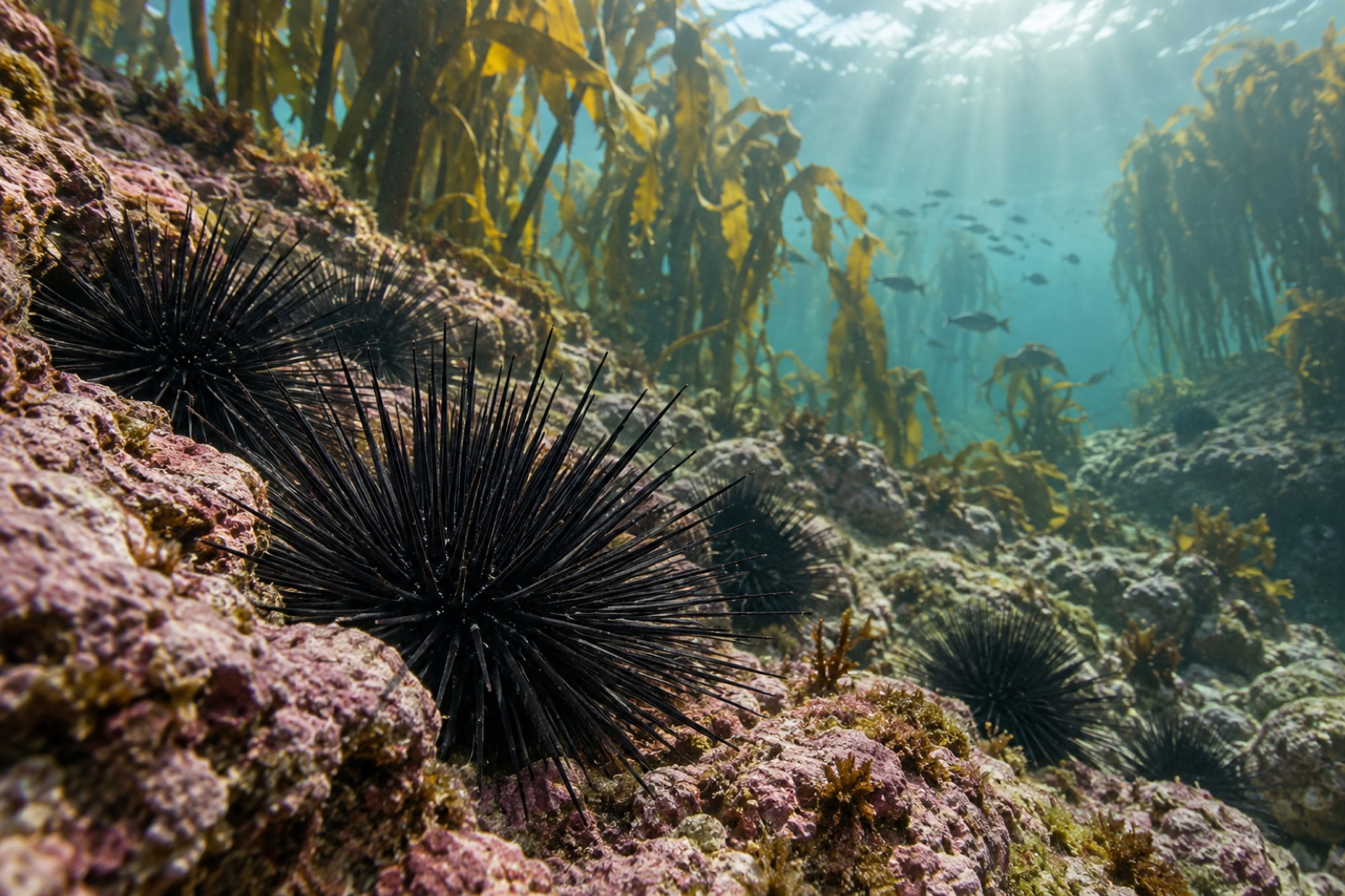
On a handful of Australia's temperate coastlines, the defining ecological story of the past half-century can be told in a single animal. The long-spined sea urchin (Centrostephanus rodgersii) is a handsome, needle-bristled urchin native to New South Wales — and, increasingly, to places it never used to live. Carried south on a warming East Australian Current, it has colonised Tasmania's east coast, survived winters that once would have killed it, and proceeded to graze productive kelp beds into lifeless rock. It is both a species profile and a case study in what a changing ocean looks like on one reef at a time.
| Scientific name | Centrostephanus rodgersii |
| Group | Echinoid sea urchin, family Diadematidae |
| Test (body) diameter | Commonly 7–10 cm; large individuals exceed 12 cm |
| Spines | Long, hollow, needle-sharp; spine span can top 25 cm |
| Native range | New South Wales coast, Australia |
| Expanded range | Eastern Tasmania (first recorded in Tasmanian waters in 1978), with scattered records further afield |
| Depth | Shallow subtidal to well over 100 m; barrens form mostly in the kelp depth band |
| Diet | Kelp fronds, understory algae, encrusting algae, drift kelp and general detritus |
| Notoriety | Principal architect of urchin barrens on Australia's southeast coast |
Centrostephanus rodgersii belongs to the diadematid urchins, a family built like a pin cushion designed by an engineer: a rigid test of fused calcite plates carrying scores of long, thin, hollow spines. The spines are brittle and needle-sharp, they break off in puncture wounds, and they are reason enough for divers to give the animal respectful room. Individuals shelter in crevices and boreholes by day and move out to graze at night or under low light, returning to the same refuges — a daily commute that lets them hold ground indefinitely while their grazing footprint spreads around them.
Like all urchins it feeds with Aristotle's lantern, the five-toothed jaw apparatus that scrapes algae from rock and severs kelp fronds at the base. What distinguishes Centrostephanus from most urchins is a combination of size, density tolerance and appetite. It will eat almost any algae available — living golden kelp fronds within reach, understory reds and browns, encrusting films, drift material — and it can persist at high densities even when food runs thin, hunkering down and living on next to nothing until the reef tries to regrow, then cropping the regrowth. That is the behavioural heart of the barren.
For the full ecological mechanics, see our explainer on how urchin barrens form; the short version specific to this species is a three-step trap:
Barren reefs are not empty — they hold abundant urchins plus a thinned community of barren-tolerant invertebrates — but they are functionally deforested: they support a small fraction of the primary production, fish biomass and habitat complexity of the kelp bed they replaced. Divers who have watched the transition describe it less like a decline and more like a switch flipping.
The southward march of C. rodgersii is one of the clearest examples anywhere of tropicalization and climate-driven range shift. The East Australian Current — the western boundary current running down the continent's east coast — has strengthened and pushed warm water further south over recent decades, part of the broader acceleration of boundary currents under climate change. The urchin's planktonic larvae ride that water. They always did; what changed is that the water at the far end has become warm enough for them, and then for the adults they become, to survive. Tasmania's east coast, once separated from larval supply by a temperature barrier, stopped being a barrier. First confirmed in Tasmanian waters in 1978, the urchin is now entrenched along hundreds of kilometres of coastline and still expanding Tasmania's east coast barrens by the year.
The timing could not be worse for the host ecosystem. Tasmania's giant kelp forests were already collapsing under direct heat stress — marine heatwaves and rising baseline temperatures on a coastline warming several times faster than the global ocean average. Into weakened forests has arrived a new grazer that does not respect winters. The two stressors compound: heat thins the forest, urchins finish it, and warming then protects the barren from the kelp's comeback. It is the one-two-three sequence that makes southeast Australia a global sentinel region for kelp loss — a story told in full in our Tasmanian giant kelp account.
The counterweight in this story is the southern rock lobster (Jasus edwardsii), one of the few local predators large and tough enough to crack an adult long-spined urchin. Experiments on Tasmanian reefs established rock lobster as the system change agent: on reefs where big lobsters are abundant — in effect, reserves — urchin densities stay low and incipient barrens fail to form. On fished reefs, where generations of large lobsters have been removed, urchins establish and barrens follow.
This is a textbook trophic cascade: top predator abundance determines whether the reef stays forested. It has driven a genuinely unusual management experiment — rebuilding stocks of large lobsters explicitly as biological control, alongside a growing commercial urchin fishery that pays divers to harvest Centrostephanus roe, subsidising the removal of millions of urchins. Neither lever alone has stopped the front; together they have flattened it on managed reefs and bought time for kelp. Researchers and managers now treat "fish the urchins down, build the lobster army up" as the working template for defending the Great Southern Reef in a warming sea, while restoration teams experiment with seeding kelp back onto cleared ground.
The species' success as an invader is written into its reproduction. Adults spawn in winter, when southern waters are coolest — females and males release gametes into the water column, and fertilised eggs develop into echinopluteus larvae that drift for weeks. That long planktonic stage is precisely what carries the species downcurrent each year, seeding new territory ahead of the adult front. Settlement prefers crustose-coralline-covered rock — which, uncomfortably, is exactly the surface its own barrens are made of. A barren is, from a larval urchin's point of view, prime real estate: plenty of settlement cue, no kelp canopy shading it out, and grazing space as far as the spines reach.
Growth to adulthood takes several years, and population longevity under barren conditions can extend well beyond a decade — animals on food-poor barrens simply shrink their reproduction and wait. Combined with sheltering behaviour in crevices that protects them from fishing and predation alike, this makes established populations extraordinarily hard to erase once the reef has flipped.
Management now runs on three tracks: the commercial fishery that turns barren urchins into exportable roe; lobster stock rebuilding within no-take zones; and direct restoration on priority reefs, where cleared, urchin-fenced plots are being reseeded with kelp. Tidewright's work on the Great Southern Reef operates inside this framework — our Drifter vessels and Holdfast lines are, in part, tools for exactly the reef this urchin is rewriting. Nobody claims a full reversal is available at the leading edge of the range expansion; the ocean is still warming, the current is still delivering larvae. What the science supports is a mosaic: defended refuges where lobsters and harvesters keep urchins low and kelp standing, holding structure and spore supply in place until — and for when — conditions allow recovery. For a species this successful, strategy beats hope.
The spines are not strongly venomous, but they are extremely sharp, hollow and brittle. Puncture wounds are painful and fragments break off and can fester. The practical advice for divers and snorkellers is simple: don't touch, and watch your buoyancy above urchin-dense reef.
At scale, they can only be suppressed, not eradicated. The fishery removes many tonnes of urchins each year and does clear individual reefs — but larvae keep arriving on the current, and removing enough adults across hundreds of kilometres of coastline is beyond any realistic budget. Targeted clearance plus lobster recovery plus kelp reseeding is the workable mix.
Yes — this is the logic of the fishery. Urchins from kelp-edge and barren zones carry harvestable roe, so commercial removal cuts grazing pressure while paying for itself, though barren urchins are often poor quality and roe enhancement on better ground is sometimes used.
Its planktonic larvae and tolerance for cool water make further spread plausible; scattered establishment southward is monitored closely, and models of its future range under continued warming suggest the frontier has not stopped moving. Biosecurity and early detection are active research areas.
That restoration without grazer control is a garden without a fence. Every successful Tasmanian recovery story pairs urchin suppression — by fishery or by lobsters — with the physical reseeding of kelp. The urchin has made southeast Australia the world's hardest classroom on restoring kelp in a warming ocean.
Southern rock lobster (Jasus edwardsii) is the reef's top urchin predator. Its biology, fishery and role in stopping barrens — a species profile.
Dr. Mara Ellison ·
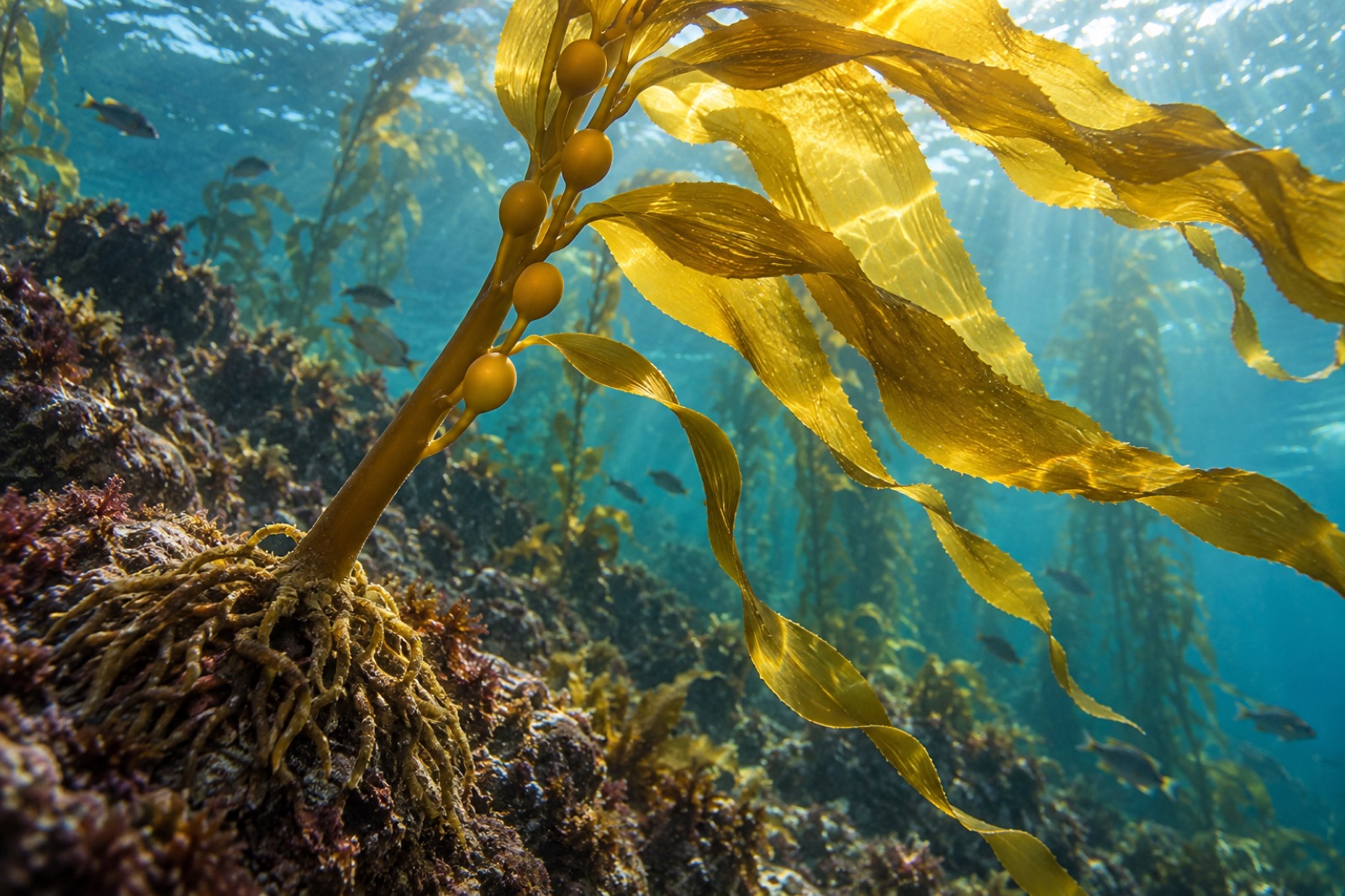
Giant kelp is the fastest-growing organism on Earth and the architect of undersea forests. Learn its biology, life cycle, range and why it matters.
Dr. Theo Nakamura ·
Golden kelp forms the backbone of Australia's Great Southern Reef. Learn to identify Ecklonia radiata and why this habitat-maker is on the move as oceans warm.
Dr. Mara Ellison ·