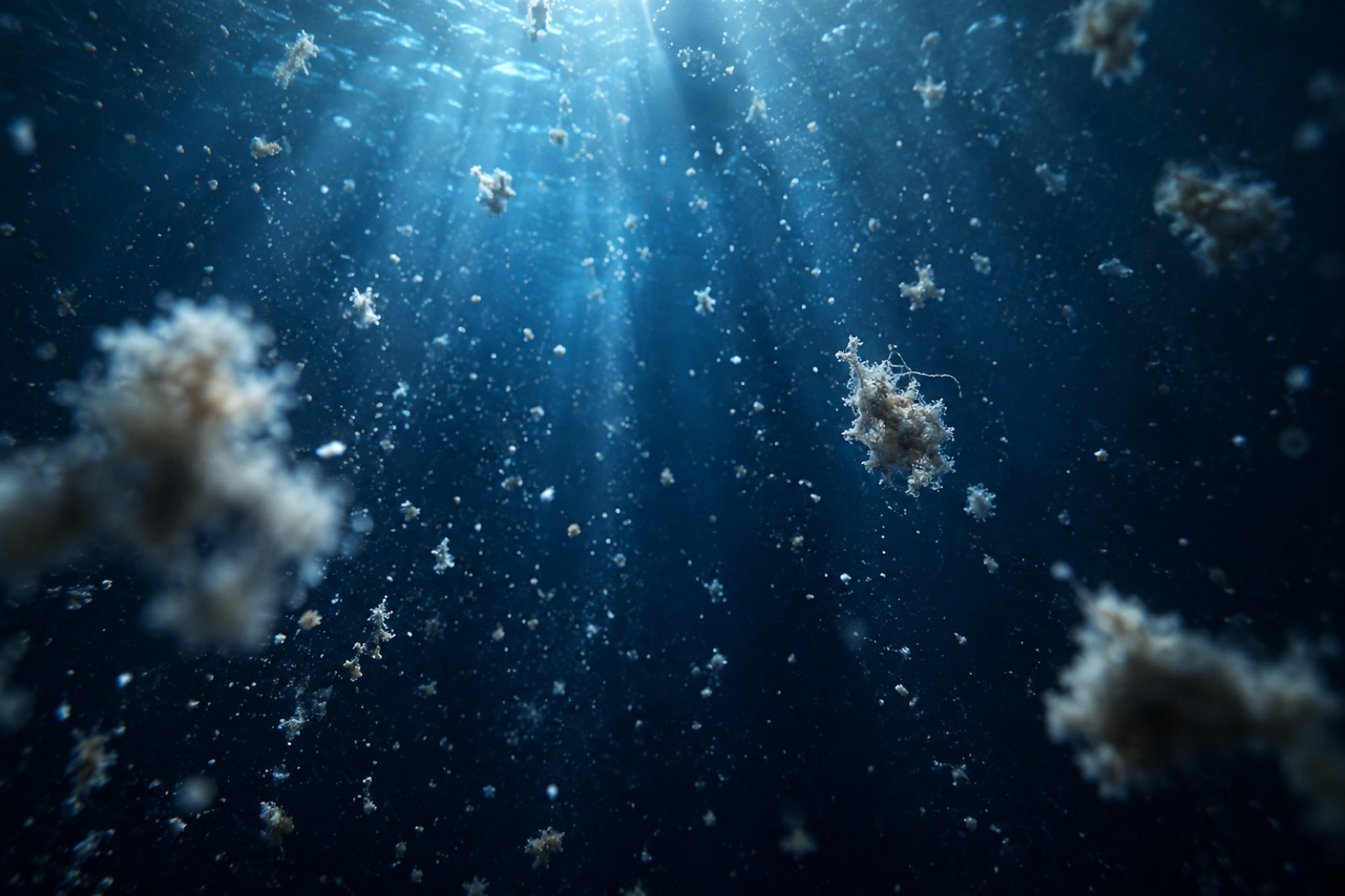
If you sampled a litre of surface water from the middle of the South Pacific and measured the iron in it, you would find a few hundredths of a part per billion — concentrations so low that a single rusty nail dissolved into an Olympic swimming pool would overshoot them many times over. And yet that scarcity governs the entire region. Iron is the ocean's most consequential trace nutrient: where it is missing, vast stretches of otherwise fertile, sunlit sea under-produce, leaving nitrate and phosphate untouched at the surface like uneaten food on a plate.
This explainer covers why iron matters so much, where the ocean's iron actually comes from, and the famous — and fiercely debated — idea of adding iron to the sea on purpose.
The most surprising scarcity in the ocean
Plankton need iron for reasons that go deep into cell chemistry. The enzymes that move electrons through photosynthesis — ferredoxin, the cytochromes, the photosystem complexes themselves — are built around iron atoms. So is nitrate reductase, the enzyme phytoplankton and kelp alike must run to convert nitrate into amino acids (we covered the nitrogen economy in the marine nitrogen cycle). A cell abundant in nitrogen and phosphorus but starved of iron is like a factory fully stocked with raw material and no power supply: the machinery is present, but the wiring is missing.
The scarcity is geochemical, not biological. Iron is hugely common in Earth's crust, but in oxygenated seawater it oxidises into forms that are almost insoluble and quickly scavenged onto sinking particles. The result is an ocean where iron typically exists at nanomolar or even picomolar concentrations — roughly a million times scarcer than nitrate relative to what life requires. Evolution has armed some microbes with exquisite salvage machinery (iron-scavenging siderophores, luxury-uptake proteins), but the armament is a symptom, not a cure. Iron shortage is a chronic condition of the open sea.
HNLC: the regions with full pantries and empty tables
Oceanographers found the signature decades ago. In three enormous regions — the Southern Ocean, the equatorial Pacific, and the subarctic North Pacific — surface waters carry plenty of nitrate and phosphate, yet chlorophyll readings stay stubbornly low. These are the HNLC regions: high-nutrient, low-chlorophyll. Something other than the classic macronutrients must be limiting, and in the 1980s the American oceanographer John Martin assembled the evidence that the something was iron.
The hypothesis got its test in the 1990s and 2000s with a series of openly published experiments — IronEx I and II in the equatorial Pacific, SOIREE and EisenEx in the Southern Ocean — in which research ships dissolved a few tonnes of iron sulfate into a patch of ocean a few kilometres across. Every time, the result was the same: within days the patch greened into a diatom bloom visible from space, chlorophyll rose manifold, and surface nitrate fell as the phytoplankton finally ate their fill. Martin's hypothesis became established oceanography: in HNLC waters, iron is the gate.
Martin also left the field its most repeated line, delivered during a lecture around 1988: "Give me half a tanker of iron, and I'll give you an ice age." It was a provocation, not a plan — but it frames both the palaeoclimate story and the modern fertilisation debate.
Where the sea's iron actually comes from
Because seawater holds onto almost nothing, ocean ecosystems depend on continuous external supply. The main taps:
- Desert dust. Dust plumes off the Sahara fertilise the North Atlantic; Asian desert dust crosses to the North Pacific; Australian dust feeds the Tasman Sea and parts of the Southern Ocean. This aeolian delivery is why the Atlantic side of the tropics is measurably more iron-rich than the Pacific.
- Rivers and coastal sediments. Continental-margin sediments constantly leak iron into shelf waters — a major reason coastal seas, including virtually every kelp coast, avoid chronic iron limitation.
- Glacial flour and ice. Melting glaciers deliver rock-ground dust in meltwater, and seasonal sea ice acts as an iron bank: accumulating dust and sediment iron all winter, then releasing it into sunlit water at melt — one reason Antarctic marginal ice zones bloom so ferociously.
- Hydrothermal vents. A more recent discovery: iron from deep-sea vents, once assumed to die at the vent mouth, in fact stabilises chemically and travels thousands of kilometres through the deep ocean — a subterranean supply line only now being mapped.
- Recycling. The bulk of iron used each day in productive surface waters comes from microbial and grazers' recycling of dead cells — the loop we describe in marine snow.
The geography of these taps explains the HNLC map: the Southern Ocean sits so far from dust sources and deep-water iron that even with enormous nitrogen and phosphorus stocks, it leaves them largely unused.
Islands that fertilise themselves
The most beautiful demonstration is natural experiment: the island mass effect. Around subantarctic islands like the Crozets, Kerguelen and South Georgia, iron leached from shelf sediments and glacial runoff drenches surrounding waters, and the phytoplankton response is visible from orbit — green swirls hundreds of kilometres downstream of bare black rock. The blooms around the Crozet Islands feed penguin colonies, albatrosses and one of the densest predator gatherings in the Southern Ocean — a whole food web literally built on rust.
Dust, ice ages and the climate connection
Ice cores tell the deep-history version. Glacial periods were dustier — drier continents, stronger winds — and Antarctic ice from glacial intervals carries several times more dust-borne iron than interglacial ice. Martin's insight was that this extra iron probably turbocharged Southern Ocean productivity, strengthening the ocean's biological pump and drawing atmospheric carbon dioxide down, amplifying the cold. Modern estimates give iron-fuelled changes a substantial, but not dominant, share of the glacial CO₂ drawdown: the dust story is one dial among several, not the whole machine. But the connection is real — planetary fertility and planetary climate, coupled through a trace metal.
The fertilisation debate: why "just add iron" stays on the shelf
The obvious follow-up — dump iron into the Southern Ocean, grow carbon-sinking blooms, clean up the atmosphere — has attracted commercial schemes, startup proposals and one notorious unauthorised effort: in 2012, roughly one hundred tonnes of iron sulfate were dispersed off Haida Gwaii, Canada, ostensibly to restore salmon, provoking international condemnation. The serious scientific assessment remains sober:
- Efficiency is low and uncertain. Much of an added bloom is eaten, recycled or decomposed in surface waters; the fraction whose carbon actually reaches the deep sea for centuries is small and hard to predict.
- Verification is brutal. Measuring how much carbon a drifting, mixing, eddying patch really sequestered is an MRV nightmare at ocean scale.
- Side effects travel downstream. Stripping surface nutrients in one region can rob productivity further along the circulation; large blooms risk fuelling oxygen loss in mid-depth waters — the deoxygenation pathway.
- Ecosystems shift. Iron additions favour large diatoms over the smaller plankton that anchor many existing food webs.
- Governance exists and constrains. Amendments under the London Protocol now regulate ocean fertilisation activity, reserving it to legitimate research.
Tidewright's position is plain: we do not do ocean fertilisation. Our work is restoring coastal kelp forests — ecosystems that manage their own nutrient economies without anyone touching the open ocean's chemistry.
What iron means for kelp forests
Kelp forests sit where iron is comparatively generous — shelf sediments, rivers and glacial melt supply coastal seas, so kelp is rarely iron-limited the way open-ocean phytoplankton are. But the connection is not zero. Granitic, low-iron coasts show subtly different kelp tissue chemistry than sediment-fed ones; extreme runoff events can drop iron-rich sediment plumes onto reefs; and the micronutrient story folds into the broader kelp nutrient budget our science teams survey at every candidate restoration site. The kelp forest's place in the iron story is mostly as a beneficiary of the coast's geology — another way the fate of a marine forest is written, in part, by the mountains behind it; that is the premise of our science programme.
Key takeaways
- Iron is essential for photosynthesis and nitrate assimilation, yet present in seawater at trace concentrations a million times below demand — making it the ocean's premier limiting micronutrient.
- Three enormous HNLC regions (Southern Ocean, equatorial Pacific, subarctic North Pacific) keep unused nitrate and phosphate at their surface because iron is missing; shipboard iron-addition experiments confirmed the limitation directly.
- The ocean's iron arrives via desert dust, rivers and shelf sediments, glacial melt and sea ice, hydrothermal vents, and microbial recycling — geography decides fertility.
- Extra dust-borne iron during ice ages plausibly amplified carbon drawdown; deliberate iron fertilisation today faces low efficiency, verification difficulty, ecosystem risk and regulatory limits.
- Coastal kelp forests generally escape iron limitation thanks to land and sediment supply — but iron still threads into their nutrient bookkeeping.
FAQ
Is iron really scarcer in the ocean than in soil?
Dramatically so. Typical soils hold percent-level iron; oxygenated seawater holds it at parts per trillion because dissolved iron rapidly oxidises to insoluble forms that stick to sinking particles. The ocean is iron-rich in crust beneath it and iron-poor in the water above — scarcity is a water-chemistry effect.
How much dust does it take to fertilise the Southern Ocean?
Natural dust flux to the Southern Ocean is among the lowest on Earth, which is exactly why that region is iron-limited. Small increments — from subantarctic islands, ice melt or rare long-range dust events — produce visible productivity spikes, which is why the region responds so strongly in iron addition experiments.
Would iron fertilisation stop climate change?
On current evidence, no. Modeled and observed efficiencies suggest even aggressive, sustained fertilisation would sequester a modest fraction of annual emissions, with enormous verification difficulty and ecological side effects. It remains a research topic, not a climate solution — real-world governance now restricts it to legitimate experiments.
Does iron ever limit kelp growth?
Rarely and subtly. Coastal sediments and rivers supply enough that nitrogen or light usually limits kelp first. Iron shows up mainly in tissue chemistry and on unusual rock-bound coasts — worth measuring in site surveys, almost never the headline constraint.
Is the "half a tanker of iron" quote real?
Yes — the quip "Give me half a tanker of iron, and I'll give you an ice age" is widely documented as oceanographer John Martin's line from a late-1980s lecture. It captures the ice-age feedback he proposed; it was a rhetorical flourish, not a proposal to actually do it.