Atlas9 min read
Falkland Islands: The Engine of Southern Ocean Kelp
Inside the Falkland Islands' giant kelp beds — among the most extensive on Earth — and the penguins, seals and steamer ducks that run on them.
Dr. Lena Fischer ·
Falklands kelp grows so dense it damps waves, stalls boats and builds calm harbours. Inside the physics and ecology of the world's thickest kelp belt.
There is a particular kind of water that sailors in the far south Atlantic talk about: bays ringed and roofed by kelp so thick that a small boat has to be pushed through it, oars doubled as punting poles, the outboard lifted and the hull shoved over canopies lying two stipes deep on the surface. That water is Falklands water. Our regional guide, Falkland Islands: The Engine of Southern Ocean Kelp, covers the why of these forests — the currents, the wildlife economy, the carbon story. This article is about the what it's like: the sheer physical density of kelp off these islands, what that density does to waves, boats and coastlines, and why a belt of seaweed in the path of the Roaring Fifties behaves like living infrastructure.
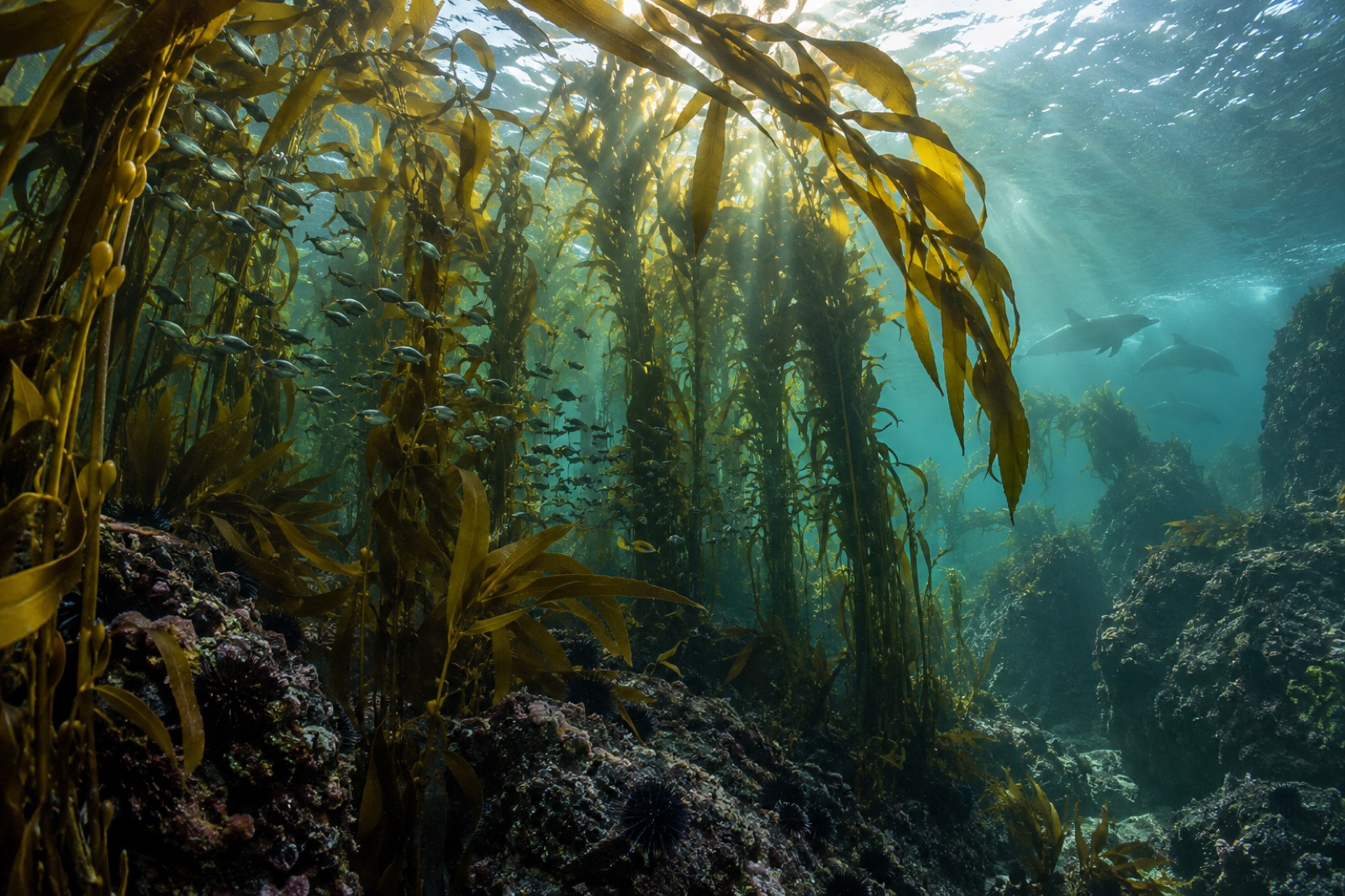
All giant kelp makes canopy; Falkland kelp makes pavement. Off much of the archipelago the beds run from the surf line to depths of ten metres and more without a gap, a continuous band often hundreds of metres wide, every suitable rock occupied. Individual giant kelp plants here are the species at full expression — fronds tens of metres long, dozens of stipes per holdfast — but it is the crowding that makes the difference. Where California divers swim through cathedral columns with clear water between them, a Falklands snorkeller parts double-stacked canopies with both hands.
From the surface, dense kelp reads as a texture change: waves steepen, ruffle and then go smooth as they cross the bed, the swell's rhythm visibly swallowed by the band. From below, the mat is so complete that the light inside the mid-canopy lanes dims to a green fraction of the outside world. Visiting scientists who have worked kelp on five continents still use the word "roadblock" about the Falklands beds. This is what a kelp forest looks like when nothing — no harvest, no disease, no urchin plague — has thinned it in living memory.
The physics are simple and the consequences enormous. A wave crossing a kelp bed does not pass over an empty water column; it pushes billions of fronds back and forth. Every one of those fronds exerts drag, converting the wave's organised energy into thousands of small, chaotic shoves — swash instead of surge. By the time a Southern Ocean swell has crossed a wide Falklands bed it has shed a substantial share of its energy, and the water inshore of the canopy is measurably, sometimes dramatically, calmer.
Three knock-on effects follow, and you can read them on any Falklands chart:
The same physics is why coastal engineers have spent two decades asking whether restored kelp belts could buffer eroding coasts elsewhere — a thread that runs through Tidewright's own programme design and the survey work our Drifter vessels perform before any seeding begins.
Density on this scale rewrites boat handling, and the locals have a body of technique for it. Big vessels give the beds respectful berth — not because kelp is dangerous to a ship, but because a wrapped propeller in 51° south is a miserable way to spend a Tuesday. Zodiacs and skiffs working inshore learn to:
The wildlife, of course, has it mastered. Gentoo penguins commuting to colony porpoise cleanly through lanes a zodiac would foul; Commerson's dolphins bow-ride in the channels and hunt the edges where the forest hides its prey. The kelp's density, an obstacle to us, is the whole point to them: cover, calm, and a stocked larder behind a wall of fronds.
The short version only — our regional guide has the long one. The archipelago sits in cold, stable Falklands Current water in the low single digits Celsius; the shelf water is shallow, mixed and nutrient-loaded; hard rock abounds; and there has been essentially no commercial harvest and no large-scale herbivore collapse. Almost every other great kelp coast has at least one of those dials turned wrong: Tasmania and Norway get marine heatwaves; Chile works its forests hard, as our Humboldt coast guide recounts; southern California has spent decades balancing urchins, heat and history. The Falklands show what the genus does with all dials right. If you have ever wondered what Macrocystis saturation actually means as a landscape, these beds are the control plot for the whole experiment — the same ecological logic that governs the forests of the Strait of Magellan, written at full volume.
You do not have to be a scientist to stand in this story for a day. Most visitors meet Falklands kelp from a ship, in this order: first the texture change offshore, then the way the swell lets go as the coast closes, then islands whose surf lines end not in white water but in a long, low, tan-green band. Expedition zodiacs run the kelp edges on calm days, and standing on a black-sand beach with winter wrack stacked chest-high, striated caracaras working it like a rubbish tip that smells faintly of the energy of the entire Southern Ocean, is as close as most of us will ever come to seeing a primary producer at planetary scale.
Respect follows from physics here: these are beds that earn their keep by being left intact. Watch from the lanes, probe gently, keep the prop out of the canopy — and know that the forest you are easing through may be the densest of its kind left on Earth.
To stop a small one, yes. Zodiacs and skiffs routinely have to kill their outboards and pole across closing canopies, and larger vessels avoid the beds rather than risk wrapping a prop. Gentoo penguins and dolphins pass through the canopy lanes without a thought.
Measurably. A wave crossing a dense bed spends its energy moving trillions of fronds back and forth, and the water inshore of the canopy runs noticeably flatter. It's why some of the islands' popular anchorages are berths largely of the kelp's making, not just the land's.
Essentially no — there is no commercial kelp harvest on the scale of Chile or Norway, and the islanders rightly regard the beds as wildlife engine, coastal shield and carbon sink rather than as a crop. That untouched status is a great part of the Falkland system's scientific value.
The deeper concern. The South Atlantic is warming and Patagonian shelf waters have already seen hot anomalies, but the Falklands' latitude and cold current offer buffer for now. Whether the belt stays saturated through the coming decades is one of the open questions of Southern Ocean science — and a reason the beds are being baselined intensively.
Easily, from a ship or beach. Expedition cruises call regularly and run zodiac edges along the beds; outer-island lodges put the canopy a short walk from your door. What you can't yet do is dive it — formal dive tourism barely exists — but the above-surface show is one of the finest in the kelp world.
Inside the Falkland Islands' giant kelp beds — among the most extensive on Earth — and the penguins, seals and steamer ducks that run on them.
Dr. Lena Fischer ·
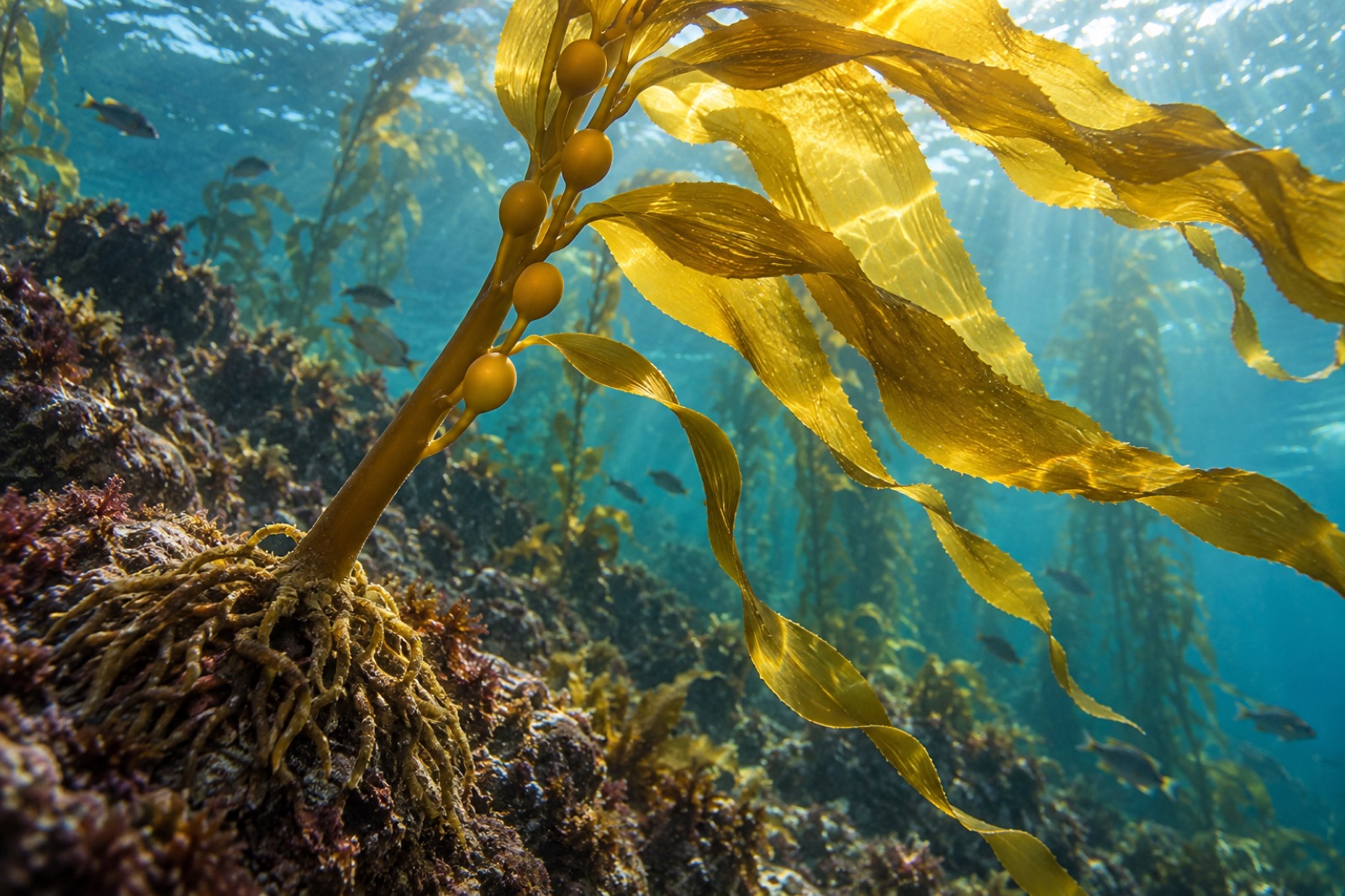
Giant kelp is the fastest-growing organism on Earth and the architect of undersea forests. Learn its biology, life cycle, range and why it matters.
Dr. Theo Nakamura ·
Inside the subantarctic kelp forests of the Strait of Magellan and Tierra del Fuego: cold clear water, drifting kelp highways, and science at the southern frontier.
Dr. Elias Brandt ·