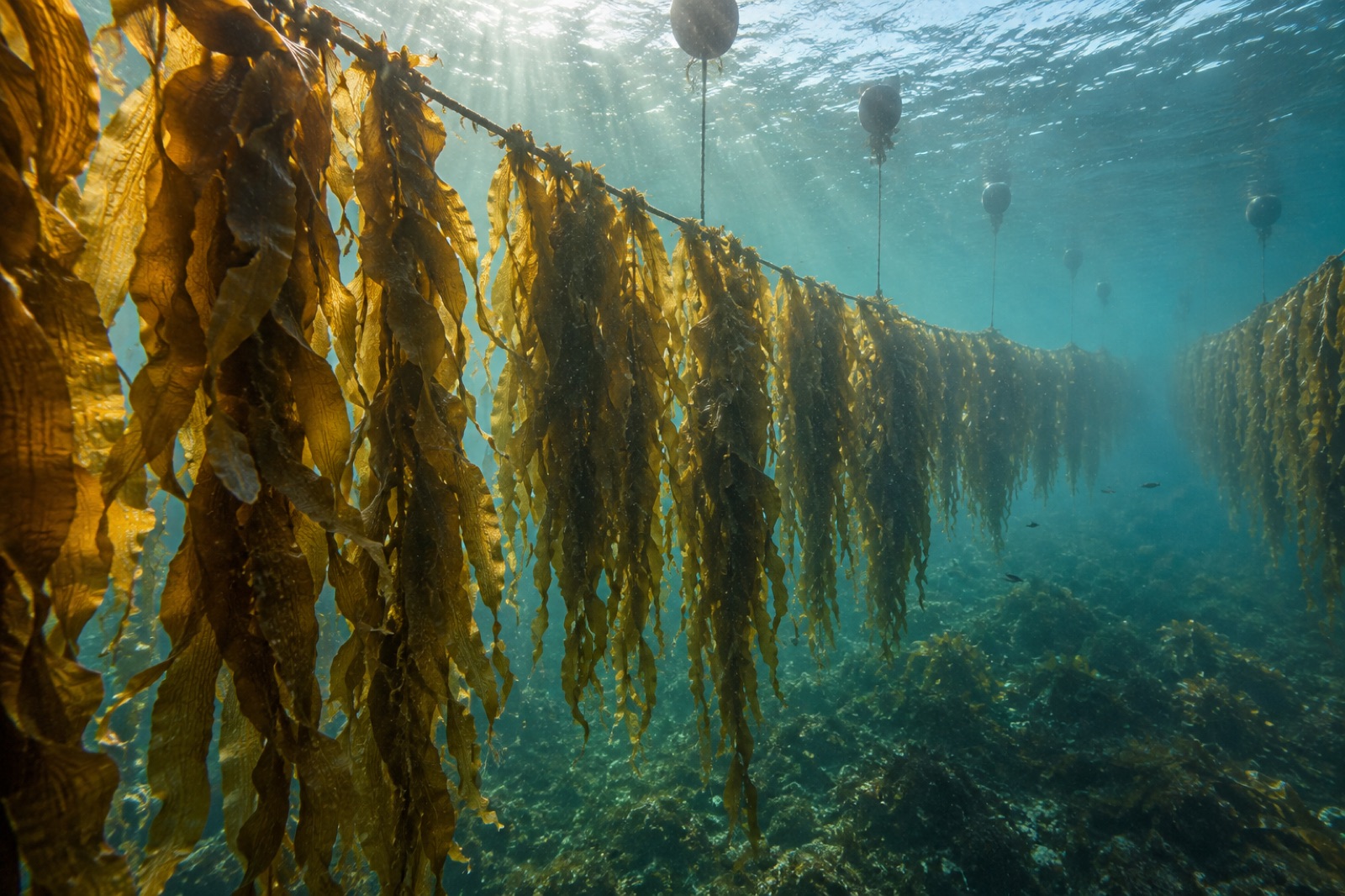
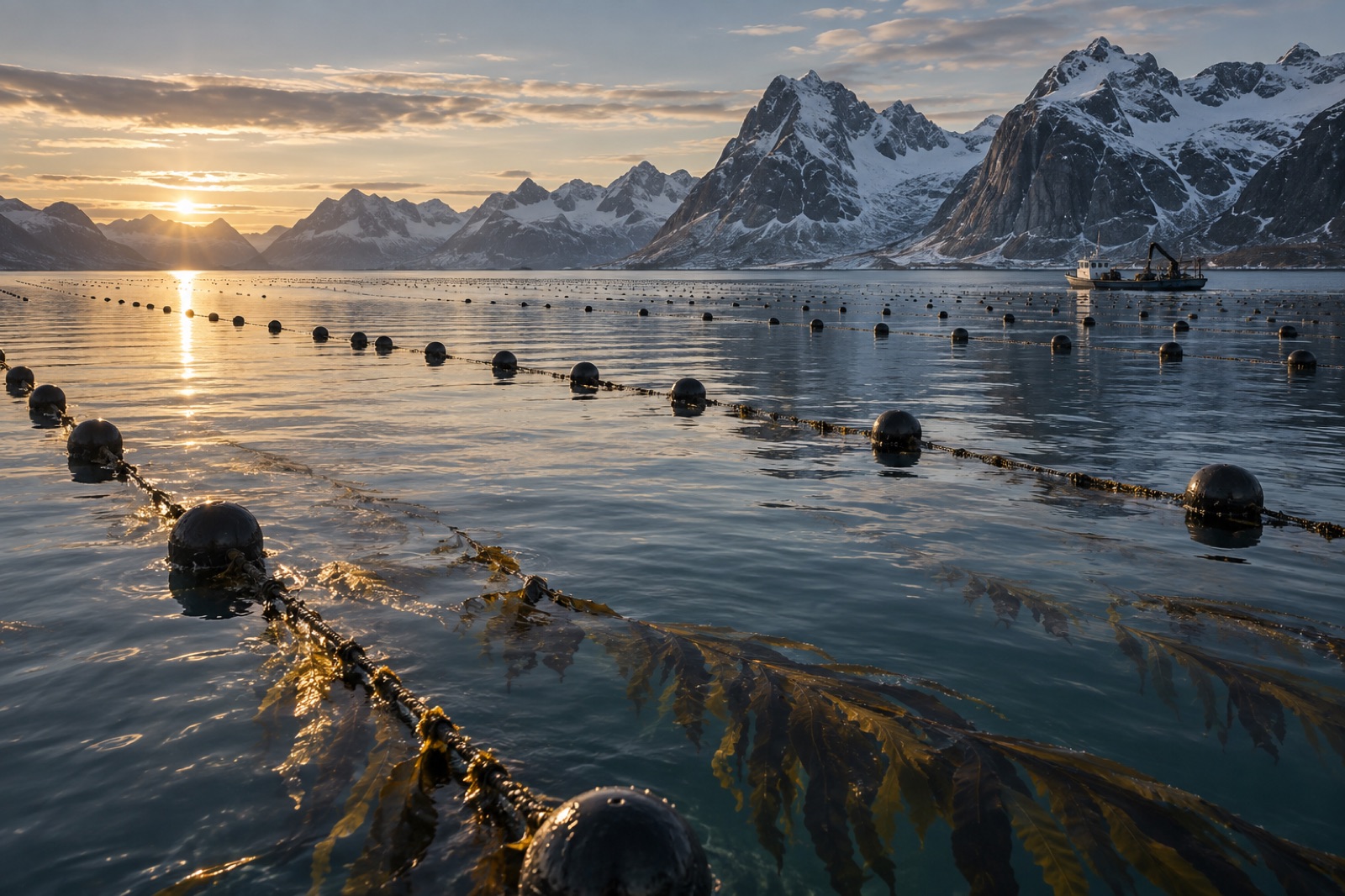
Ask a temperate-zone kelp farmer to picture the Arctic and they'll imagine impossibility: ice-dark winters, frozen lines, a three-month season. Ask a farmer in Tromsø, Kodiak or Nuuk the same question and they'll tell you about the strangest advantage in the business — a growth window made of light. North of 60°, summer delivers up to 20 hours of usable daylight and nutrient-rich water that barely tops 8 °C, and kelp responds with some of the fastest sustained growth rates recorded in aquaculture. Farming the far north is not a marginal version of temperate farming. It is a different sport with its own rulebook. This guide lays that rulebook out.
Why the north is worth the trouble
Three structural facts make Arctic and subarctic farming compelling:
- Pristine water and clean product. Northern seas carry low background pollution and low pathogen loads. For food-grade buyers, "grown in Arctic waters" is a genuine quality marker — contaminant analyses from Alaskan and Norwegian kelp consistently come back clean.
- Cold water, low fouling. The barnacle, bryozoan and epiphyte pressure that forces southern growers to harvest by May often arrives late or weakly above the Arctic Circle, extending the harvest window weeks into summer.
- Communities that want the work. Northern coastal communities — many of them Indigenous, with deep seaweed stewardship traditions — are actively building seaweed economies. In Alaska, Indigenous-led kelp enterprises from Kodiak to Southeast have become the industry's centre of gravity, a model of aquaculture growing with sea-country governance rather than around it. That's an approach Tidewright's own Reef Partners programs try to learn from.
The season: compressed, but turbocharged
A subarctic sugar kelp season runs roughly like this:
- October–November: seeded lines deployed, water still 8–10 °C and falling, light collapsing. Outplanting logistics follow the same principles as anywhere — the calendar discipline in The Seaweed Farm Year still applies, just compressed.
- November–February: the dark interval. North of the Arctic Circle the sun doesn't rise for weeks. Sporophytes essentially pause — near-zero growth, but also near-zero fouling, almost no grazing, and no storms bad enough (if the site is chosen well) to matter. Kelp is metabolically adapted to this; it survives the dark on stored carbon.
- March–May: the ramp. Light returns while water is still 2–5 °C and the spring phytoplankton bloom plus winter wind-mixing leave nitrate replete. Growth accelerates hard.
- May–July: the turbo window. Under 18–24 hours of daylight, well-sited sugar kelp can put on several percent of body length per day. Total season yields at good Alaskan and northern Norwegian sites now match or beat mid-latitude farms that grow over twice the calendar time.
- July–August: harvest, before warming water (occasionally past 12 °C) stresses blades and late fouling arrives.
The lesson: don't be fooled by the short calendar. Northern kelp doesn't grow slowly for nine months; it parks for four and sprints for three.
Species for the far north
Cold adaptation narrows the list, but the list is good:
- Sugar kelp (Saccharina latissima) — the backbone species from Maine to Murmansk. Arctic ecotypes are exceptionally cold- and dark-tolerant; see the sugar kelp species profile and the season-by-season growing guide.
- Winged kelp (Alaria esculenta) — native to exposed subarctic Atlantic shores; handles ice-scoured, high-energy sites better than sugar kelp and carries a premium food market.
- Ribbon kelp (Alaria marginata) and split kelp in the Pacific north.
- Bull kelp (Nereocystis luetkeana) — farmed at smaller scale in Alaska; an annual that rockets up in the long-light window. See the bull kelp profile.
- Dulse (Palmaria palmata) — cold-loving, as an understory or shallow red crop.
One warning: use local ecotypes. An Arctic strain evolved for a polar-night life cycle behaves badly if swapped with stock from 20° of latitude south — it may exhaust itself in the dark or miss the light window. This is why Tidewright's Holdfast nurseries match seedstock to site genetics rather than shipping a "best" strain everywhere, and why our own take on provenance rules is written up in Native Seedstock Rules.
Ice: design for it or lose to it
Ice is the Arctic farmer's defining engineering problem, in three flavours:
- Sea ice can encase and crush structures, or scouring floes can saw through lines.
- Anchor ice forms on the seabed and anything touching it in shallow, supercooled water.
- Spray ice coats buoys and hardware in freezing wind, adding weight and hiding deck hazards.
Working mitigations, used from Alaska to Finnmark:
- Submerge. Sink grow lines to 3–5 m from freeze-up through break-up; a submergence of even a metre usually takes lines below ice scour. Some operators flood flotation and let whole grids winter on the bottom, refloating in spring.
- Site for shelter. Deep, current-swept sites inside islands or headlands resist fast ice formation. The normal siting fundamentals in Choosing a Farm Site apply, with extra weight on fetch, ice history and — critically — local knowledge. Talk to fishers who have watched the bay freeze for thirty years before you trust a chart.
- Strip before winter. Remove buoys, shackles and anything buoyant or fragile from the surface; keep the farm as a minimal, heavy, sub-surface skeleton.
- Plan breaks, not heroics. Build moorings with sacrificial weak links you can re-make in a day. Storm design logic from Storm-Proofing a Kelp Farm doubles as ice design logic.
The water itself: cold, clear and occasionally weird
Northern water has quirks worth respecting, and the monitoring habits in Reading the Water for Farms become survival skills up here:
- Salinity shocks. Spring meltwater can drop surface salinity by several PSU for weeks. Kelp tolerates brief hyposalinity poorly at low temperature — a cold-plus-fresh double hit. Site below the melt layer and watch salinity as closely as temperature.
- Glacial silt. Near glacial outflows, suspended rock flour can cut light by more than half at grow-line depth and abrade young blades. Beautiful water, bad farm.
- pH and ice melt. Cold water holds more CO₂ and meltwater is fresh and acidified; some northern bays already see corrosively low aragonite saturation states seasonally. For shellfish co-crops this matters enormously; for kelp it is mostly a monitoring footnote — kelp's photosynthesis may itself buffer local pH around the lines, one reason integrated northern farms pair kelp with mussels.
For atlas-level context on the region's coasts and kelp ecosystems, see the North Atlantic and Arctic region guide.
Logistics and markets from the top of the map
Everything temperate farmers take for granted must be re-earned in the north: freight legs are long, spare parts are days away, and a processing delay is measured in weather systems. Practical consequences:
- Freeze and dry capacity near the farm. Shipping wet kelp 1,000 km to a dryer is a losing game. Northerly farms increasingly freeze whole blade on-site or co-invest in shared drying hubs; Drying Seaweed runs through the options.
- Anchor the offtake early. Northern kelp's strongest markets are premium food (where the Arctic provenance story has real pull), biostimulants, and — in Alaska especially — direct sales into local reindeer, salmon and processing supply chains. Selling Your Seaweed covers offtake basics; up here, write the contract before you seed the line.
- Hire locally and partner genuinely. The farms thriving in northern Alaska and Arctic Norway are those built with, or led by, local and Indigenous communities — who hold the site knowledge, the social licence and increasingly the permits. Community-consent thinking from Winning Social Licence is not decorative at these latitudes; it is the foundation.
A season that is changing
One more honesty: the Arctic is the fastest-warming ocean region on Earth. Subarctic kelp farms have already seen seasons where 14 °C water arrived in June and sugar kelp quality collapsed weeks early, and where "once-a-decade" winter storms arrived twice. Build the system for the decade you're farming into, not the one described in old pilot studies: deeper lines, broader temperature tolerance in seedstock selection, and harvest equipment that can mobilise fast when a warm spike compresses the window. The adaptation playbook extends beyond what fits here — see Farming Through Heatwaves.
None of it erases the core story. The far north remains one of the last places where growing seaweed at scale is easy on the ecosystem and easy on the product. Short season, long light, cold clean water — and an industry young enough that a well-run farm still shapes it.
Key takeaways
- Arctic kelp farming works because of light, not despite the dark: growth pauses in winter, then sprints under 18–24 hour days in replete, cold water.
- Farm the natives — Arctic ecotypes of sugar kelp, winged kelp, bull kelp — and never import southern strains into northern seasons.
- Ice, not cold, is the engineering problem: submerge lines, site with ice history and local knowledge, and build sacrificial weak links into moorings.
- Watch salinity shocks, glacial silt and low-pH meltwater; monitoring is a survival skill at high latitudes.
- Freeze or dry near the farm, lock offtake before seeding, and partner with the Indigenous and local communities who hold the knowledge and social licence.
- Design for a warming Arctic: deeper lines, thermally resilient seedstock, and the ability to pull harvest forward fast.
FAQ
Can you really grow a full crop in a three-month season?
Yes — at well-sited subarctic farms, sugar kelp growth during the May–July light window is fast enough that season yields match temperate seven-month farms. The crop is "parked," not dead, through the dark months and sprints when light returns.
What's the coldest water kelp will grow in?
Sugar kelp tissue survives at −1.7 °C (the freezing point of seawater) and resumes growth the moment light and nutrients align; measurable growth occurs from about 0–2 °C upward. Cold is rarely the limiter — ice and darkness are.
Is Arctic kelp actually better quality?
For contaminants, often yes: low-pollution waters and low-fouling seasons yield clean blades that test well for heavy metals. For composition, cold-grown kelp tends toward higher storage-carbohydrate content late season. "Better" still depends on handling — cold water doesn't dry your crop for you.
Can I farm year-round in the subarctic?
The crop is seasonal regardless; infrastructure can stay out year-round if designed (and submerged) for ice. Some Alaskan and Norwegian farms now alternate species — kelp through the light season, shellfish on the same moorings continuously.
Where is Arctic seaweed farming actually happening?
Alaska (Kodiak, Southeast, Prince William Sound) hosts the most active growth, much of it Indigenous-led; northern Norway above the Arctic Circle has commercial farms; smaller operations exist in Iceland, the Faroes, Greenland and Arctic Canada. Permitting frameworks differ sharply — research the specifics before buying rope.