On the shore at high water, a ewe and her lambs pick their way across the wrack, chewing ribbons of bladderwrack left by the tide. It is an old scene — performed by the seaweed-eating sheep of North Ronaldsay in Orkney for centuries — and it captures a simple truth that modern animal science has only lately caught up with: ruminants can eat seaweed, thrive on it in the right amounts, and in some cases benefit in ways no terrestrial forage provides. Today the question has sharpened from "can livestock eat seaweed" to "which seaweeds, at what dose, for which benefit — and can we supply them at scale?" This article covers the tradition, the methane science, the species in use and the practical realities of feeding seaweed to animals.
The long tradition: seaweed as coastal forage
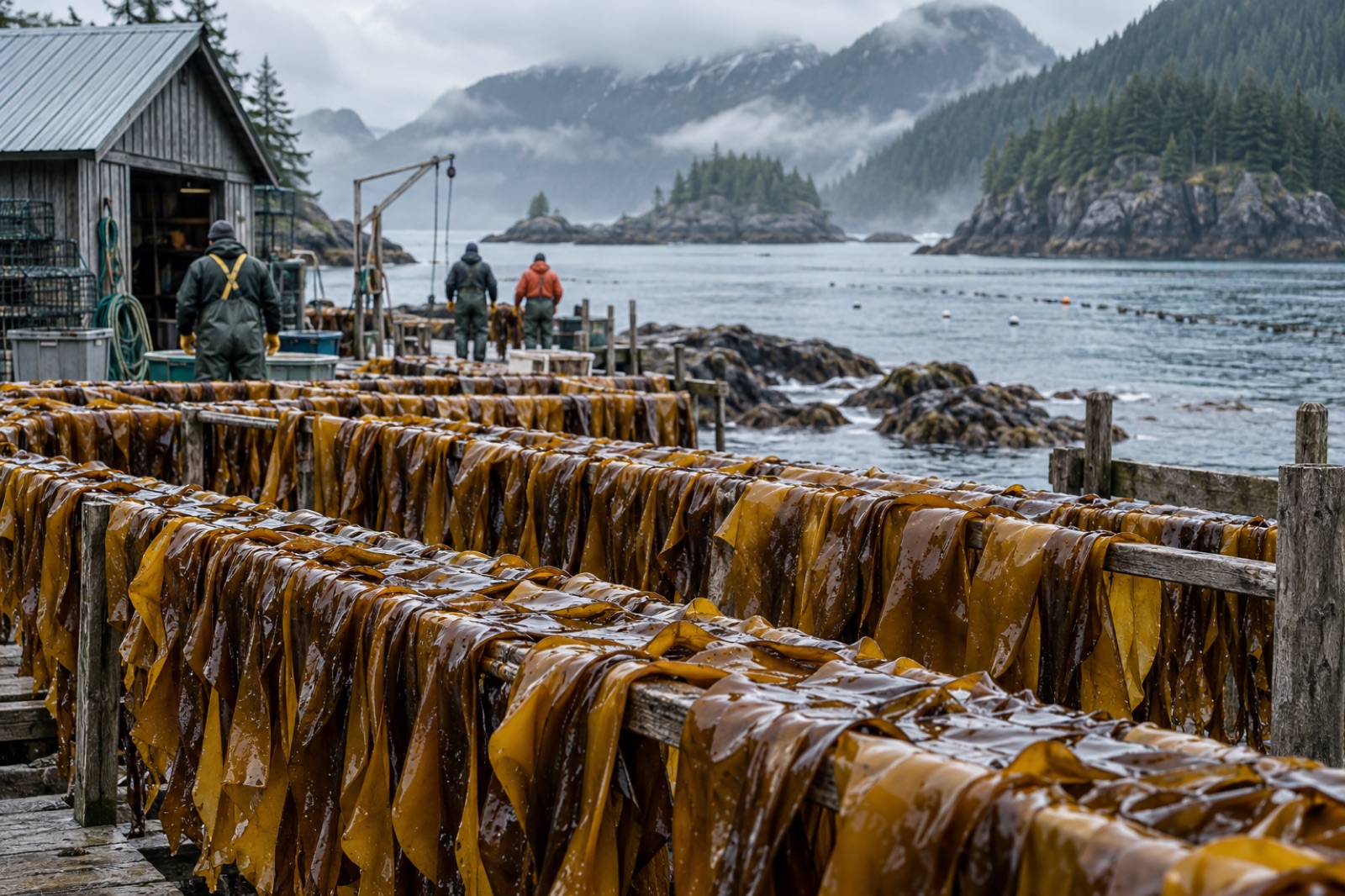
Seaweed feeding is not a startup invention — it is one of the oldest documents in the farming archive. Around the North Atlantic, smallholders bedded sheep on kelp, fed dried wracks through winter, and valued storm-cast kelp for dairy cattle. The sheep of North Ronaldsay survived mostly on intertidal seaweeds for generations. In Iceland and Norway, Ascophyllum nodosum — knotted wrack — was milled into meal long before pelleted feed existed. Through the twentieth century, kelp meal became a standard trace-mineral supplement in smallholder rations across Europe and North America.
The pattern is consistent: where people lived beside productive seaweed beds, they folded seaweed into livestock diets whenever terrestrial forage got scarce. The ingredients weren't exotic; the tradition simply records what worked at the farm gate.
What changed: the methane discovery
The modern seaweed-feed conversation pivots on one finding. When small amounts of dried Asparagopsis — a warm-water red seaweed — are included in cattle feed, the microbes in the rumen make dramatically less methane. The active compounds, principally bromoform and related halogenated molecules, inhibit the enzymatic pathway rumen methanogens use to produce methane, at inclusion rates measured in fractions of a percent of feed dry matter.
Because ruminant methane is a significant share of agricultural greenhouse-gas emissions, that result transformed a cottage tradition into a global research program. Three caveats belong in every conversation:
- Results vary. Reported reductions differ widely with dose, basal diet, animal and product preparation. Headline figures come from particular controlled trials, not from every paddock.
- Residues matter. Regulators and buyers need to know bromoform and iodine don't carry into milk and meat at improper doses; approvals are being worked through jurisdiction by jurisdiction.
- Supply is the bottleneck. The methane case only matters at enormous tonnage, and current production is thin. The full picture of what's involved in growing it is in our farming Asparagopsis guide.
The species, one by one
The methane additives. Production is dominated by land-based tanks and ponds because the filaments are fragile and the species raise biosecurity questions in open water. Dried and stabilized, they enter feed at very low concentrations — which makes quality control on drying and bromoform retention as important as the farming itself.
Kelp meals: Laminaria, Saccharina, Macrocystis
Brown kelps dried and milled into meal have the longest commercial track record. Their value is nutritional rather than miraculous: a broad spread of trace minerals, polysaccharides that may act as gut-conditioners, and a modest protein contribution. Kelp meal typically goes into rations at a few percent or less. The watch-out is iodine: kelps concentrate it well beyond terrestrial forage, and exceeding tolerable intakes shows up first in milk iodine, then in thyroid function. Feeding rate and species choice must account for it.
Ascophyllum nodosum
The Atlantic workhorse of kelp meals, wild-harvested from sheltered shores under strict rotation rules in several jurisdictions. Used in ruminant, pig, poultry and pet rations at low inclusion, chiefly as a mineral and bioactive supplement.
Ulva and other green seaweeds
Fast-growing sea lettuces are being studied as protein-adjacent ingredients for monogastrics and fish — Ulva farming is its own skill. Green seaweeds offer higher protein than browns and interesting functional fibers, but minerals and salt content shape the dose ceiling.
Red seaweeds beyond Asparagopsis
Dulse and relatives enter niche pet and specialty feeds; Chondrus and Gracilaria appear in some aquafeeds. The red family is where much of the current research energy sits, for both methane and gut-health effects.
Beyond methane: nutrition worth taking seriously
Even where methane is irrelevant, seaweeds earn a place in a ration for three solid reasons.
Mineral density. Seaweeds pump seawater chemistry into tissue — iodine, selenium, zinc, cobalt and more, often well beyond forage levels. Used judiciously, kelp meal can correct trace-mineral gaps that cost a farm dearly in fertility and immunity. Used carelessly, the same density becomes toxicity; iodine is the classic case.
Functional carbohydrates. Fucoidans, laminarans and alginates from brown seaweeds, and ulvans from greens, are fermented in the hindgut and have shown gut-health and immune-modulation effects in livestock trials — useful at weaning and transition in pigs and poultry, where antibiotic-alternative demand is strong.
Aquafeed replacement. In fish feed, seaweed meals can displace some fishmeal and soy, add pigments, and bind pellets. The clearest success is in mollusc culture: our piece on kelp as abalone feed shows fresh kelp outperforming formulated feeds in conversion and gonad quality — a rare case where the simplest ingredient is also the best.
The practical realities of adoption
A farmer who wants to feed seaweed this season faces four honest constraints.
- Formulation first. Seaweed is an ingredient, not a ration. Work with a nutritionist; define the target (methane, minerals, gut health) and the dose ceiling (iodine, salt, arsenic in some species), then source to spec.
- Processing quality. Heat-damaged kelp meal loses vitamins and can oxidize; stabilized Asparagopsis products lose activity if dried too hot. The post-harvest chain determines whether the product works at all. Ask suppliers for assay data, not just a spec sheet.
- Regulatory status. Feed ingredients are regulated. Novel additives — and Asparagopsis is one in most markets — require approvals and residue documentation. Buy through channels that can produce them.
- Cost per outcome. High-value doses of specialty seaweeds only pay when the outcome is priced: a methane credit, a weaning-mortality reduction, a fertility gain. Do the arithmetic per animal per day, not per kilogram of seaweed.
For growers, the mirror-image lesson is that feed is a spec business: consistent chemistry, documented safety and certified provenance beat volume. That is why feed-grade supply chains look more like Tidewright Harvest's food-grade handling than like bulk commodity trade — and why fisheries and aquaculture operators integrating feed crops into their sites tend to contract buyers before they seed lines.
Key takeaways
- Seaweed livestock feeding is centuries old; North Atlantic kelp meal and shore-grazing traditions predate the modern industry by generations.
- Asparagopsis at fractions of a percent of feed dry matter can cut rumen methane sharply in controlled trials, but results vary and residue approvals are jurisdiction-specific.
- Brown kelp meals earn their place through trace minerals and functional polysaccharides — with iodine the governing dose limit.
- Processing quality is destiny: drying and stabilization decide whether bioactive compounds survive to the feed bunk.
- Adoption is economics, not enthusiasm: define the outcome, dose to spec, and demand assays from suppliers.
FAQ
Is seaweed safe for cattle to eat?
Yes, at formulated doses. Ruminants have eaten seaweeds for centuries, and modern trials support safety for kelp meals at typical inclusion rates. The main risks are over-supply of iodine and, with some species, heavy metal or arsenic loads — all controlled by species selection, sourcing and dose. Very high inclusion of any seaweed is not advisable.
How much Asparagopsis do cattle need to eat to cut methane?
Published studies differ, but the active doses are small — well under one percent of daily feed dry matter in the most-cited controlled trials. The effective commercial dose depends on the stabilized bromoform content of the product, which is why drying and stabilization quality matter as much as the farming.
Does seaweed in feed change the taste of milk or meat?
At proper inclusion rates, feeding studies have generally found no adverse effect on milk or meat flavor, and residues of bromoform and iodine have been low. This is assessed market by market as part of feed-additive approvals, and reputable suppliers document it.
Can I feed seaweed I harvest myself to my livestock?
Smallholders have always done this with storm-cast kelp, and modest amounts of clean, fresh-cast brown seaweeds are a reasonable traditional supplement. But self-harvested material can't be assayed for iodine or contaminants easily, wild harvest may be regulated, and feeding non-approved novel additives to commercial herds raises regulatory questions. For anything beyond tradition-scale use, buy documented product.
Will seaweed feed replace soy and fishmeal?
Partially, at the margins — seaweed meals can displace some fishmeal and soy in aquafeeds and add functional ingredients terrestrial crops lack. But protein content in most seaweeds is modest, production volumes are small relative to global feed crops, and realistic projections are substitution in the single-digit percent range for specific rations, cheaper and most valuable where the functional benefits, not the bulk nutrients, justify the price.