Atlas9 min read
Kodiak: Bears Above, Kelp Below on Alaska's Emerald Coast
Brown bears above, sea otters in the kelp below — a guide to the reefs, salmon rivers and cold-water richness of Alaska's Kodiak Archipelago.
Tom Okafor ·
From Southeast Alaska's fjords to the Aleutian storm line, the Gulf of Alaska holds one of Earth's largest kelp coasts — and the otters it was built around.
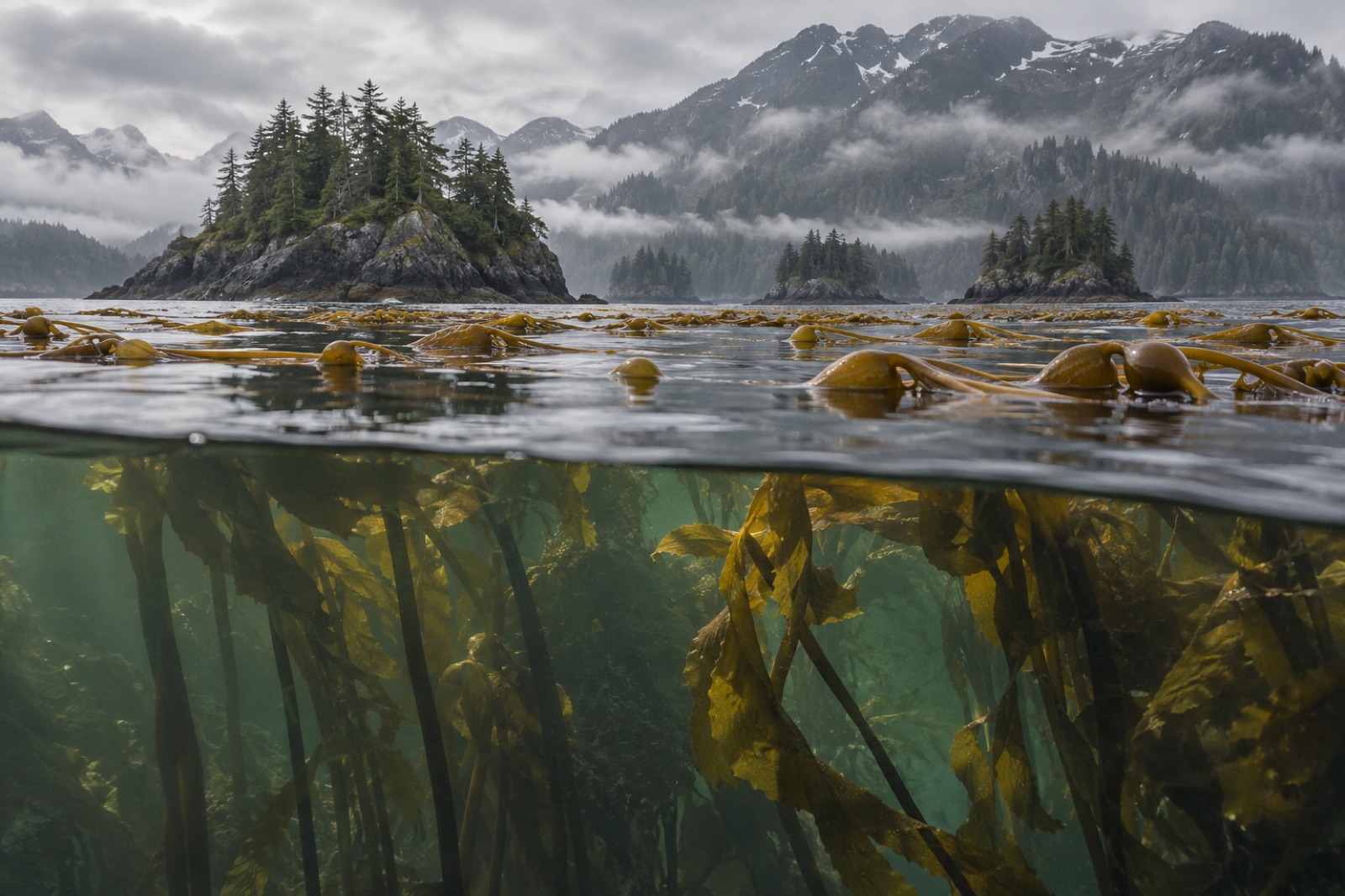
There are longer coasts in the world, but very few coasts that are mostly kelp. The Gulf of Alaska runs some four thousand kilometres along the great crescent between Dixon Entrance at the bottom of Southeast Alaska and the Aleutian storm line, a shore of fjord, island and glacier-scoured arc where cold water, long light and immense tidal mixing build kelp communities at one of the largest contiguous scales on the planet. This is where kelp forest was written into the Pacific's modern history, and where it has been written out and back again more than once. This is the Coastal Atlas entry for the Gulf of Alaska: the colossal shore of the North Pacific's upper arc.
The Gulf of Alaska is the North Pacific's northern shoulder: the ocean body north of latitude 50°N, bounded by Southeast Alaska's fjords in the east, Kodiak Island and the Alaska Peninsula in the middle, and the eastern Aleutians in the west. The shelf here faces west, directly into the prevailing westerlies, and the Alaska Coastal Current runs counter-clockwise along the shore, fed by glacial rivers and mixed by some of the deepest tides anywhere. Upwelling here is not the dominant mechanism the way it is off Oregon or California — this is a downwelling coast — but the nutrients come down differently, from glacial flour ground from the mountains and iron delivered by rivers and wind.
That chemistry matters. The Gulf's water is cold, iron-faint and silicate-rich, and it hosts phytoplankton bloom cycles that power some of the hemisphere's most productive fisheries. The kelp sits in the middle of it all, on every stretch of rocky substrate from the high intertidal down into the blue.
The Gulf of Alaska is not one kelp forest but several intergrown:
The Gulf hosts a second-tier secret as well: it shares the same fundamental kelp biogeography with the Okhotsk and Bering coasts to the west. Species from across the Pacific cross-over through the Aleutian chain. The density of kelp habitat at this scale is enormous — on some remote western stretches, kelp lines most of the coast that is not sand.
No discussion of Gulf of Alaska kelp exists without the two animals that control the canopy: sea otters and sea urchins. The Gulf taught marine ecology this explicitly.
Sea otters were hunted to near-extinction across Alaska in the fur trade era; where they survived, kelp thrived, and where they were extirpated, urchin populations surged into barrens. The classic experiment was written at sea: islands with otters held kelp forests, islands without held urchin deserts. We outline the mechanism in our trophic cascade explainer; the Gulf is its textbook.
The rebound and the reversal both happened here. Otter reintroductions in the 1960s and 70s brought forests back across thousands of kilometres of shore — Prince William Sound recovered its canopy, Southeast Alaska's kelp expanded, and the architecture of a restored ecosystem became practically visible within a decade. Then in the 1990s, the Aleutian and western Gulf otter populations collapsed steeply, likely under increased predation pressure, and urchin barrens bloomed again along vast stretches of the western arc. The lesson from the Gulf, both ways, is that kelp here is otter-managed, and when otters move, the forest follows.
From 2014 through 2016, the Gulf of Alaska was the centre of an enormous, season-long marine heatwave — the event scientists called the Blob, perhaps the most consequential single ocean-temperature anomaly ever recorded at the time. We set out the mechanics of such events in our marine heatwaves explainer; the Gulf was their epicentre.
For kelp, the Gulf mostly held: the water never got truly warm in the deep, current-mixed shelf, and the kelp canopy survived the surface anomaly better than the year's fish did. Other parts of the ecosystem were not so fortunate. Pacific cod stocks collapsed, seabird colonies starved by the tens of thousands, and the reordering of the forage base rumbled through mammals and fisheries for years. The Blob demonstrated that warming water reaches this coast as surely as any — but in the Gulf, the kelp species benefit from a deeply mixed, cold-in-core ocean that spreads even a severe anomaly thin.
That does not make the Gulf immune. Iron and nutrient shifts, altered upwelling of glacial discharge and changing light-timing all ripple into the canopy at the margins. And the deeper, longer pressure — ocean acidification, the region of the planet where atmospheric carbon makes corrosive water first — is especially serious here, for the kelp-grazing urchins that might otherwise expand into reefs and for the calcite-reinforced red algae the kelp recruits on.
The human industries of the Gulf are intertwined with kelp at every level. Salmon, pollock and herring fisheries depend on the forage base the kelp coast supports. A new generation of kelp mariculture is rising in Alaska, with oyster-and-kelp farms spreading through Southeast's fjords and around Kodiak — genuinely regenerative aquaculture that draws directly on the Gulf's nutrient bounty without feeding inputs.
On the west end, in otter-reduced habitat, urchin ranching has been explored for years: catching barrens-violating urchins, raising them on kelp feed until they are fit to eat as uni, and in the process restoring grazed-out reef at a pace no restoration program could match. These two — kelp farming and urchin ranching — are the edges of the idea Tidewright's model is built on: restoration that pays, ecology that survives the market, and the forest rebuilt because the market wants the grazer down as much as the ecologist does.
The Gulf of Alaska is not easy. Road-accessible kelp shores exist in Southeast, at Juneau and Sitka, and at Kodiak; beyond that, the coast is wilderness by boat or floatplane. Expedition cruises round the arc each summer from Vancouver and Seattle; research platforms and the Alaska Marine Highway ferries thread the coast year-round.
The one decent way to see the canopy from a fixed place is to fly or ferry into Kodiak: the Kodiak Island atlas guide has details. It is not warm, it is not dry, and it remains the most ambitious kelp landscape you will ever have to yourself.
Yes, and dramatically at the surface: the 2014–2016 Blob was centred in the Gulf, and subsequent years have produced repeated anomalously warm events. The deeper, mixed shelf stays cold, and the kelp has so far been more resilient than the fisheries around it.
Evolutionarily, Alaska's kelp-urchin balance was set by otter predation. Take the otters away and urchins multiply unchecked until they graze the forest to pavement. The Aleutian collapse of the 1990s provided the clearest natural experiment any marine scientist could hope for, at full landscape scale.
The Gulf's kelp is buffered by its cold, well-mixed shelf water. Sustained heat damages the shallowest bull kelp annuals first, but the mixed cache of species and depth diversity means a bad year rarely kills the system outright. As the ocean warms at scale, that buffer thins.
The ferry towns of Southeast Alaska — Sitka, Juneau, Gustavus — all sit on kelp-lined shores with road or boat access. Kodiak has its own atlas entry for the full-immersion version.
Yes, and the sector is growing: kelp and oyster farms now operate in Southeast's fjords and around Kodiak, using the Gulf's nutrient-rich flow to grow seaweed without feed inputs — one of the largest and genuinely regenerative mariculture industries in North America.
Brown bears above, sea otters in the kelp below — a guide to the reefs, salmon rivers and cold-water richness of Alaska's Kodiak Archipelago.
Tom Okafor ·
Glacial fjords, returning sea otters and slow kelp regrowth after oil and ice loss — a field guide to Prince William Sound, Alaska's living laboratory.
Tom Okafor ·
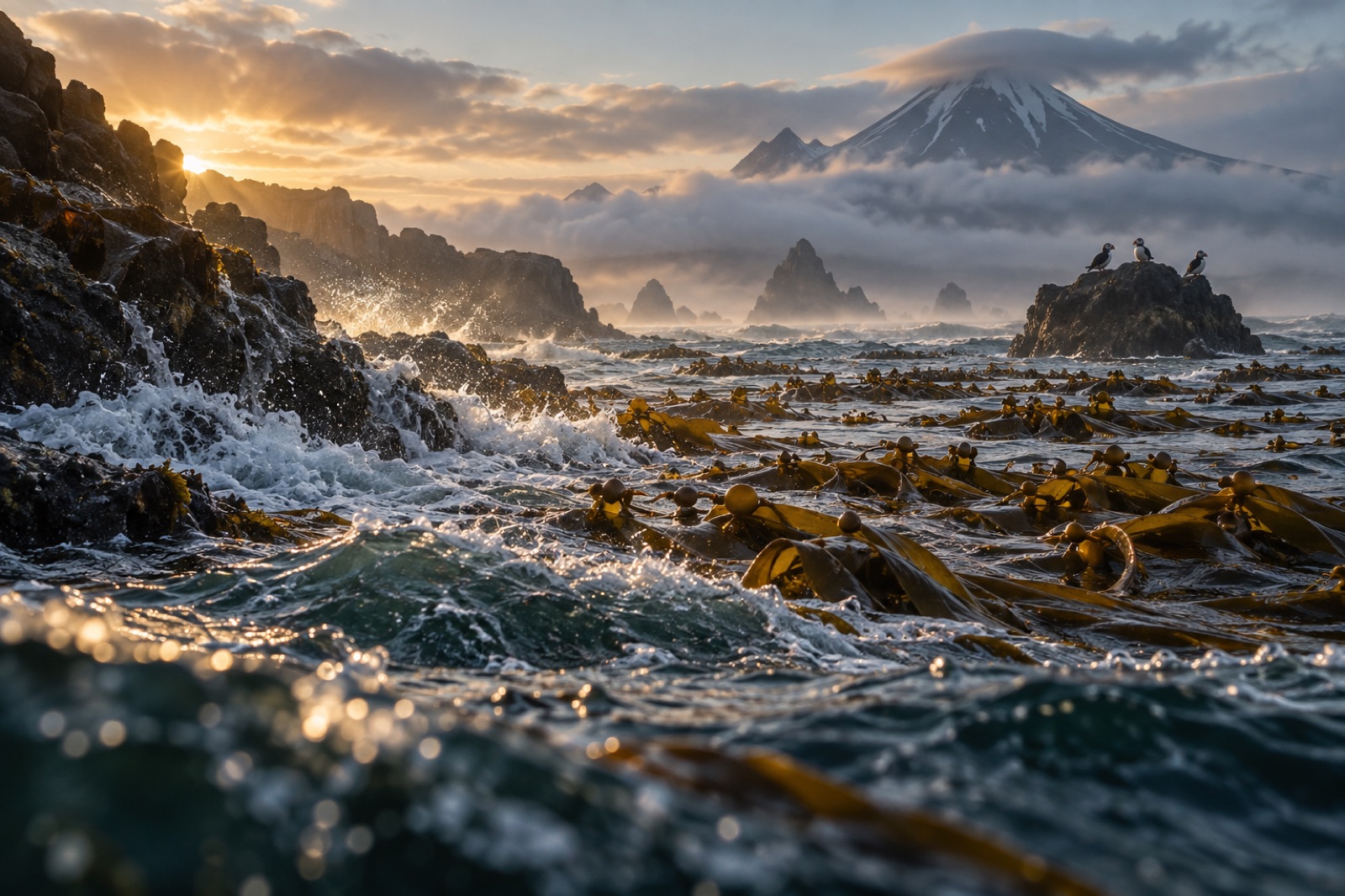
A 1,900-kilometre arc of volcano, fog and kelp strung between Alaska and Siberia — the coastline that taught ecologists how sea otters hold kelp forests together.
Dr. Mara Ellison ·