Atlas8 min read
Baja California: The Southern Frontier of Giant Kelp
Baja California's Pacific kelp beds mark giant kelp's warm-water frontier — a coast of El Niño crashes, fast recovery, red urchin fisheries and hard-won lessons.
Dr. Elias Brandt ·
A volcanic island 250 km off Baja with great white sharks above, recovering fur seals on the rocks, and a giant kelp forest that ride out the great heatwaves.
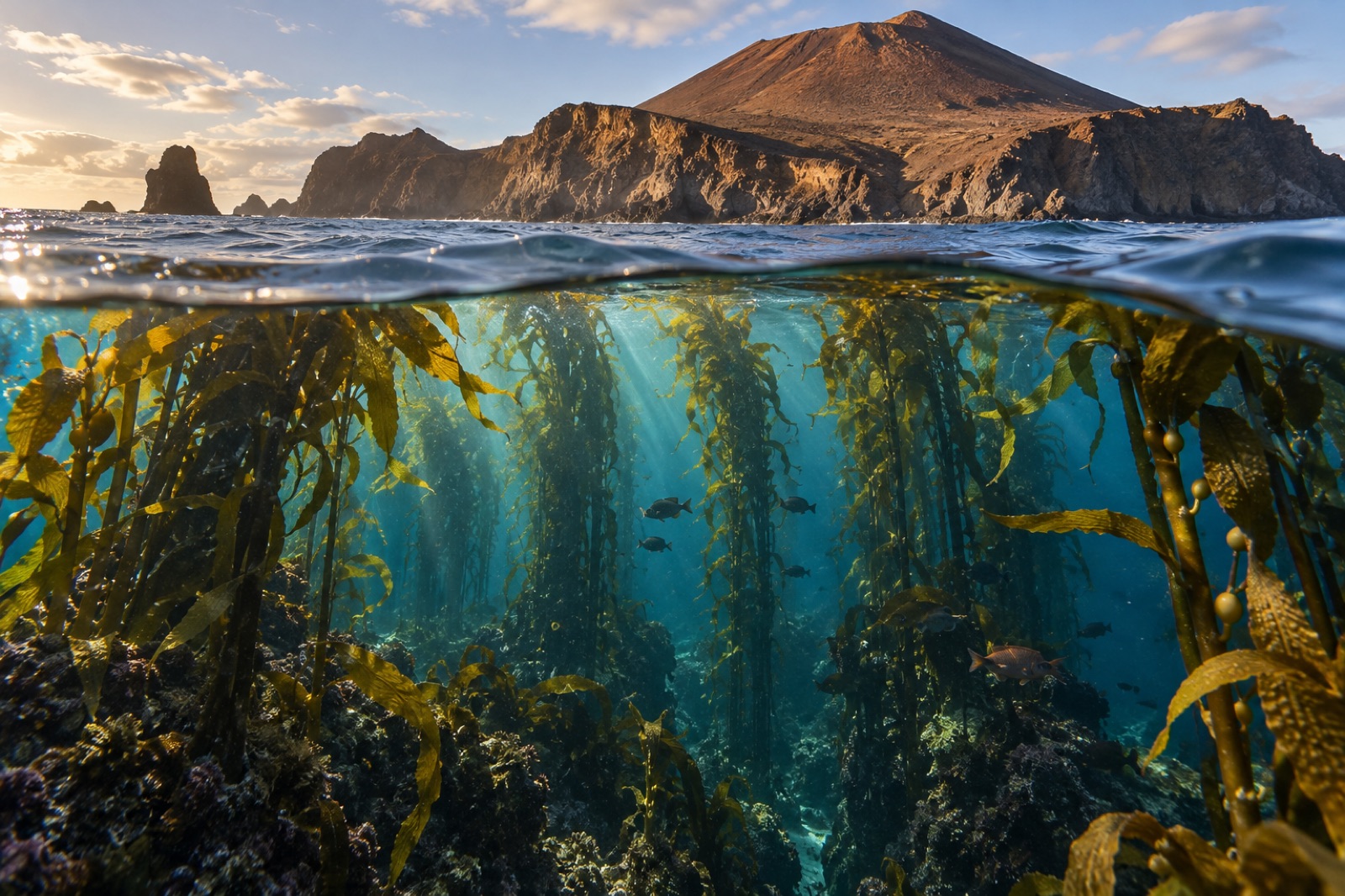
Two hundred and fifty kilometres off the Pacific coast of Baja California — a full day's steam from the nearest port — a volcanic ridge rises nearly 1,300 metres out of the open ocean. This is Isla Guadalupe: a Mexican biosphere reserve famous on land for its white sharks, and quieter-famous underwater for something arguably more important — a kelp forest growing at the very southern edge of its range, around a rock in the middle of nowhere. When marine heatwaves crushed the giant kelp forests around mainland Baja in 2014–2016, Guadalupe's canopy stood. This is why Guadalupe matters to the whole Pacific forest.
Guadalupe is "oceanic" in the strict sense: it was never connected to the mainland, built instead by volcanism rising off the seafloor, a pair of ancient shield volcanoes with younger cinder cones draped down their flanks. Everything living there flew, swam or rafted in — which is why the island's terrestrial story is one of endemics and its marine story one of extremes.
The North Pacific's California Current sweeps cold water down the coast and past the island, and the island itself interferes with the flow: current meets rock, and stirring, upwelling and eddies churn the surrounding blue. The waters around Guadalupe tend to run measurably cooler and more nutrient-rich than the same latitude on the mainland — the kind of local oceanographic quirk that makes thermal refugia on a small scale. It is a case study in how boundary currents decide where kelp can grow.
Two kinds of shoreline ring the island: raw lava cliffs on the weather side, and older, shelf-like platforms on the south — zones where the subtidal bottom is solid volcanic rock, the precursor to kelp described in reading rocky shores.
Giant kelp (Macrocystis pyrifera) grows around Guadalupe in dense beds — a serious, canopy-forming forest, the southernmost major presence of the species on the continent's Pacific rim. Around it grows a supporting cast: understory kelps, red algae mats, the rocky-reef residents that follow. The island's reefs also hold lobsters, abalone history, and big reef fish — the full cold-temperate community meeting warm-water visitors at a latitude where both overlap.
What makes Guadalupe's forest scientifically precious is what it survived. The marine heatwave period of 2014–2016 — "the Blob" and the strong El Niño that followed (El Niño and kelp) — collapsed giant kelp along much of the Baja mainland coast, with some estimates of canopy loss exceeding 90% at the worst-hit mainland sites. Guadalupe's kelp persisted, and researchers proposed the obvious mechanism: the island's currents kept supplying cold, nutrient-rich water while the mainland sweltered. The kelp around Guadalupe may represent a warm-edge population that is also, paradoxically, a refuge — exactly the kind of place conservationists speak of in terms of genetic value to restoration (kelp genetics, provenance), and exactly the kind of survivor our science leads examine when planning which genetics to bank.
Guadalupe's global celebrity is above the kelp, at the surface: the island is one of the world's premier aggregation sites for great white sharks, drawn each summer-through-autumn by the recovering populations of pinnipeds. Cage-diving tourism here became an industry — and in recent years, Mexico has asserted tighter protections over how the activity is conducted on the reserve.
The pinniped story is the conservation headline of the eastern Pacific:
The whole system — seals and sharks above, kelp below — is just the classic trophic tapestry of a kelp coast with a megafauna accent.
Guadalupe distils most of what our century is learning about ocean conservation, in one island:
This is not a shore dive. Guadalupe is reached by liveaboard from Ensenada, roughly 18–24 hours of open ocean each way. Trips are tightly regulated inside the biosphere reserve, and the marquee activity — surface cage diving with whites — is run by licensed operators at the island's south end. The water is cool-temperate (high teens °C in season, colder upwelling pulses), visibility commonly 20–40 metres in the blue, and current is the constant: this is advanced diving country if the kelp beds are the goal, beyond the scope of our beginner's kelp-diving guide.
For the rest of us, Guadalupe is a place to know rather than to visit easily — a forest and a seal rookery on a rock in the open Pacific, holding the southern line of the giant kelp and quietly defining the boundaries of the possible.
In principle yes, and a few research and film expeditions have — but the standard commercial trip centres on the surface shark cages, inside the reserve's rules. In-water access to the kelp is limited, current is serious, and divers need advanced open-ocean training.
The 2014–2016 marine heatwave raised mainland water temperatures well above kelp tolerance for season after season. Around Guadalupe, current-driven mixing and upwelling continued to bring cold, nutrient-rich water to the forest — temperature is destiny where kelp metabolism has a hard ceiling.
Not directly — the Channel Islands lie far to the north (see the Channel Islands guide). But genetically and ecologically, Guadalupe's forest is the southern node of the same giant-kelp system that runs up the Baja coast into Southern California.
No — unlike the Aleutians or Central California, Guadalupe has no sea otter population. Its reefs run on a different balance of urchins, lobsters, fish and the kelp itself.
That refuges are infrastructure. The island shows how rare oceanographic cold pockets can carry a species through its worst decades — and why locating, protecting and drawing carefully from such refuges is central to any serious recovery plan.
Baja California's Pacific kelp beds mark giant kelp's warm-water frontier — a coast of El Niño crashes, fast recovery, red urchin fisheries and hard-won lessons.
Dr. Elias Brandt ·
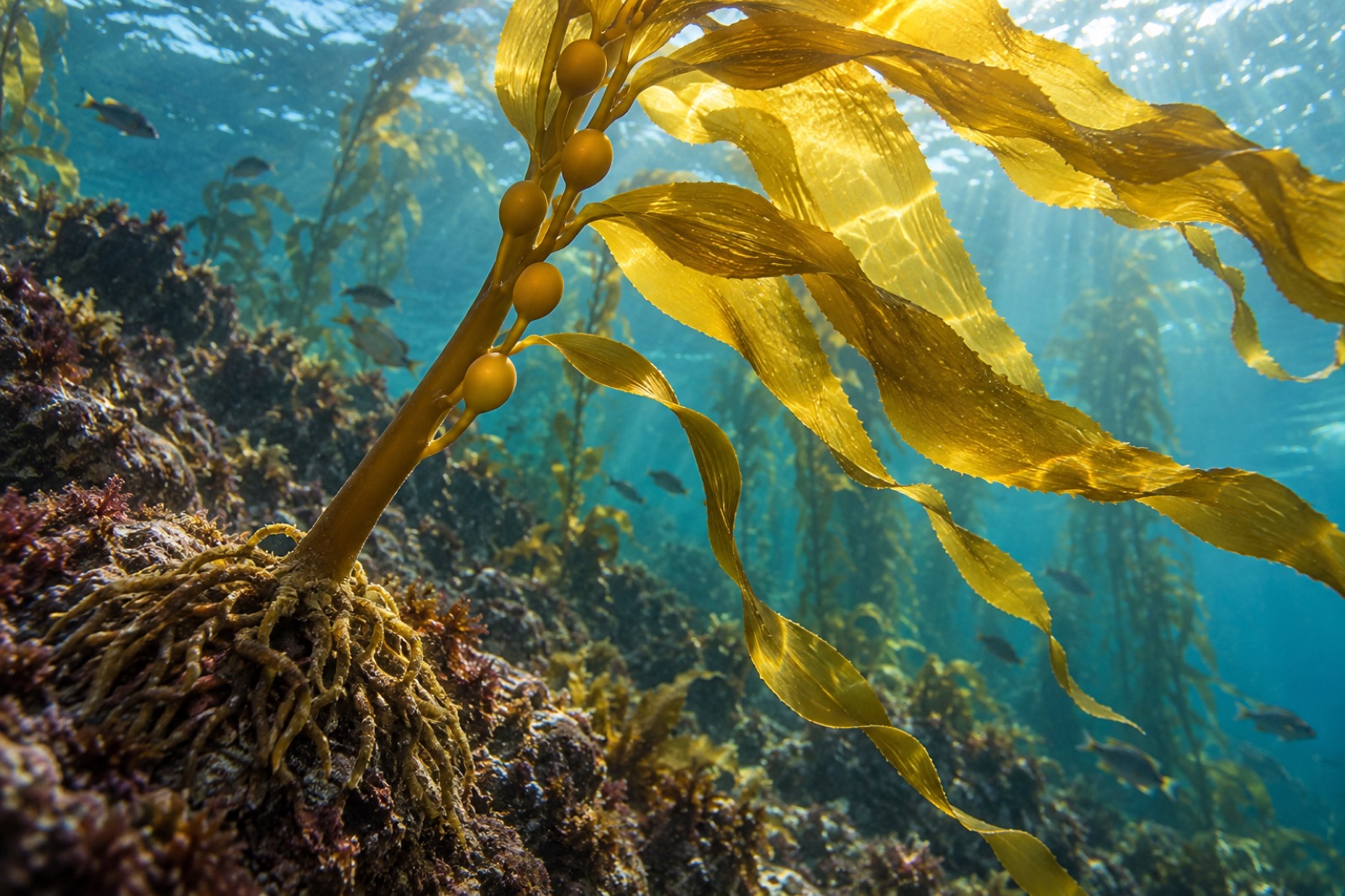
Giant kelp is the fastest-growing organism on Earth and the architect of undersea forests. Learn its biology, life cycle, range and why it matters.
Dr. Theo Nakamura ·
Marine heatwaves are weeks of anomalously hot ocean that can deforest entire coastlines. Here's the science behind them and what restoration can do.
Dr. Lena Fischer ·