Science11 min read
Thermal Refugia: The Cool Pockets Where Forests Survive
When heatwaves strip a coastline's kelp, some reefs stay cool and keep their forests. Here's how thermal refugia form — and why they're restoration gold.
Dr. Lena Fischer ·
A kelp canopy does more than block light — it quietly rewrites the heat below. How canopy shade builds cool micro-refuges during heat spikes.
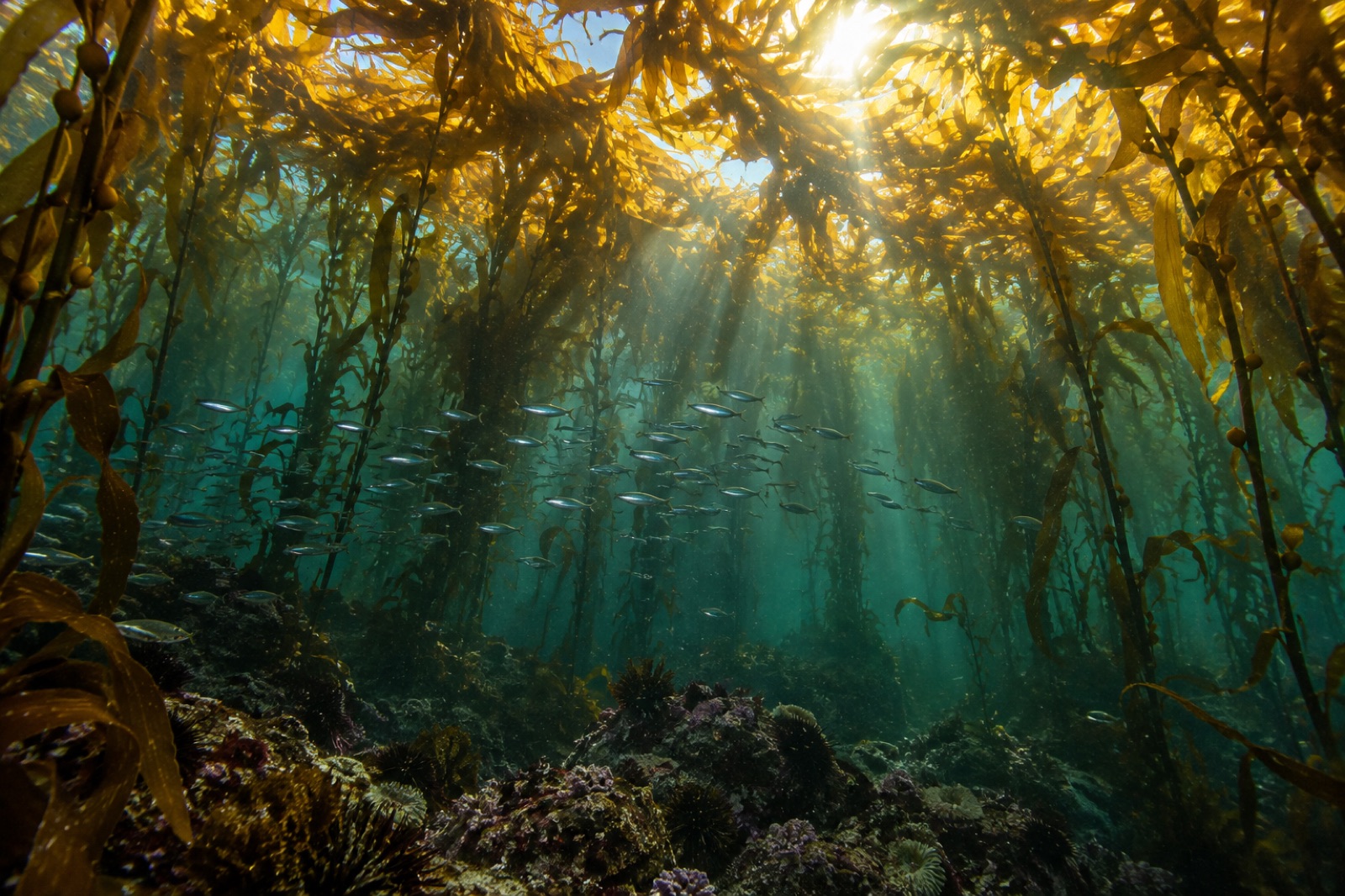
Ask a diver to describe crossing from open water into a mature kelp forest on a hot summer afternoon and the answers are sensual: the light greens and dapples, the swell softens, and — on the good days — the water feels a notch cooler against the skin. That last impression has become a serious research question. If a kelp canopy shades the water column the way a forest canopy shades a woodland floor, then the understory of a dense bed might run measurably cooler than the surrounding sea — a micro-refuge during heat spikes, and a reason canopy recovery matters beyond habitat structure. The honest answer from logger arrays and modelling studies: the effect is real, subtle, and strongly conditional — and understanding its conditions matters for restoration design.
This article is about the metre-scale version; for refuge pockets at the headland-and-bay scale, see our explainer on thermal refugia.
Light is heat's mostly invisible invoice. Sunlight striking the ocean is shortwave radiation: seawater absorbs it and converts it to warmth in the upper water column, which is why a clear summer sea develops its warm, stratified skin — the layering unpacked in ocean stratification. A dense kelp canopy intercepts a large share of that shortwave energy before it becomes water heat. Without shade, an absorbed joule warms the top metre; under a canopy, the same joule warms the living fronds at the surface and, from there, leaves the system along entirely different routes:
The canopy also modifies mixing physics. Fronds extract momentum from flow, damping the small-scale turbulence that otherwise stirs warm surface water downward — a reason the stratified "cool lens" beneath a canopy can persist through a calm, sunny afternoon instead of being homogenised away by wind mixing.
The right instrument story needs humility, because measurements vary with conditions. Temperature loggers moored at paired depths under dense canopy versus adjacent open reef — and the before/after records around canopy collapse events — converge on a consistent pattern:
Two honest qualifiers keep the science straight. First, not every study finds a measurable cooling: in well-flushed, high-energy settings the water masses equilibrate too fast for shade to matter. Second, a canopy is a moderator, not an air conditioner — it cannot cool water below what regional oceanography delivers, and a prolonged basin-scale heatwave eventually warms the source water itself.
Why does a degree here and there matter? Because the understory of a kelp forest is the most crowded real estate on temperate reefs, and it is full of organisms with tight thermal tolerances and no ability to move. Abalone creeping across encrusted rock, juvenile fish using the understory as a nursery, encrusting invertebrates permanently cemented in place, and — most strategically — the recruiting microscopic stages of the kelp itself, the gametophytes and embryonic sporophytes that represent the next forest. Each carries a temperature threshold above which performance falters; our overview of kelp's thermal limits traces how narrow some of those windows are.
During short, sharp heat spikes — the diagonal-up-ramps that punctuate otherwise liveable summers — a canopy's afternoon shading converts an over-threshold event into an under-threshold one for that meter-scale community. Fine-scale surveys after hot spells have repeatedly found better survival of understory assemblages within forested patches than on neighbouring deforested rock, with canopy integrity among the strongest predictors. In a climate of more frequent spikes, the canopy functions less as scenery and more as distributed thermal insurance — a cooling service paid out exactly when the premium was needed.
Here is where buffering stops being a curiosity and becomes a conservation mechanism. Heatwaves strip canopies. A stripped canopy removes the shading that moderated the understory's extremes. The newly exposed bottom water now runs hotter each afternoon — stressing the surviving turf competitors' predators, weakening resistant holdfasts' offspring, warming the micro-habitat where recolonisers must establish — and the now-warmer understory is less hospitable to kelp recovery than the forest's own interior would have been. Canopy loss makes the understory's thermal problem worse, which makes canopy recovery harder. The forest, in this framing, partly creates its own liveability.
Breaking the loop in reverse is the restorative version: a young recovering canopy reinstates dappled cooling before the forest is anywhere near full stature, softening the hottest hours for exactly the recruits the recovery depends on. It suggests a subtle design point for restoration: getting some three-dimensional structure into the water early — seeded lines, transplants, a scaffold of annual species (the options surveyed in the restoration toolkit) — starts the shading service years before the bed regains its climax canopy.
For practitioners this is an empirical question with cheap tools. Moored temperature loggers cost very little, and a design-simple array — paired loggers under canopy and over adjacent open reef, at surface and bottom depths, logging through summer — captures the buffering signal a forest actually delivers at a given site. Coupled with aerial canopy mapping of the sort Canopy Ledger builds from satellites and drones, the pair of datasets tells a managing agency two things it separately could not: how much canopy a reef carries, and how much thermal moderation that canopy is currently buying the understory.
In a marine-protected-area or restoration plan, canopy-aware temperature monitoring earns its keep three ways: identifying beds whose microclimate function punches above their area, prioritising canopy recovery on reefs where fragile understory communities (abalone beds, recruitment hotspots) most need the shade, and tracking whether restoration is delivering the buffering service — measurable long before a rebuilt forest shows statistically robust biodiversity gains. Canopy shade is, in other words, one of the earliest leading indicators of a forest coming back to work.
Context decides. Dense canopy over stratified summer water can register afternoon offsets of a degree or two, occasionally more; in well-mixed, current-swept settings, the measurable difference can be essentially zero. Reported values across studies span that whole range, which is why site-specific logger data beats borrowed numbers.
Partially, and mostly the parts that event biology cares about. Shade trims the peak of short heat events and protects the understory community, including the kelp's own recruits. It does not cool a region against a months-long basin-scale heatwave, which warms the source waters themselves — structural cooling pockets at the refuge scale are the defence the regional picture needs.
Thermal injury in seaweeds and invertebrates accumulates during excursions above tolerance thresholds, not by slow averaging. A week of below-threshold days kills nothing; three afternoons over the line can. Buffering that clips peaks is therefore outsized in ecological value relative to the tiny change it makes in the daily mean.
Anything that intercepts shortwave radiation buffers in proportion to how much light it actually stops. A multi-layered giant kelp canopy reaching the surface absorbs more than a low understory kelp turf — but even modest early structure shades disproportionately well per unit of biomass. In practice, depth-integrated canopy cover is the working proxy.
Inexpensively: deploy paired temperature loggers (bottom + just below canopy depth) in the forest and over adjacent deforested reef, leave them through the warm season, and compare afternoon maxima across calm, stratified days. Several weeks of summer data are usually enough to state whether that particular bed is running a meaningful cool layer.
When heatwaves strip a coastline's kelp, some reefs stay cool and keep their forests. Here's how thermal refugia form — and why they're restoration gold.
Dr. Lena Fischer ·
A kelp canopy is a living skylight — filtering intensity, colour and flicker for everything beneath it. How that sculpted light builds the understorey.
Dr. Mara Ellison ·
Every kelp species has a temperature window. Learn the physiology of heat stress, why gametophytes are weakest, and how scientists measure and breed thermal tolerance.
Dr. Lena Fischer ·