Science11 min read
Sound Underwater: How the Ocean Carries Noise
Underwater, sound is the only sense that travels. How sound speed works in seawater, what the SOFAR channel is, and why the ocean is far noisier than it seems.
Dr. Mara Ellison ·
A kelp forest has a 24-hour soundtrack built by shrimp, rasping urchins and singing fish. Learn who the voices are and how scientists read health by ear.
If you snorkel into a kelp forest and hold still — really still, drifting with your fins tucked — you will begin to notice that the forest is not quiet. There is a faint, continuous hiss, like distance-worn rain. Closer to the bottom, rhythmic scraping rises and falls. If you stay past dusk near the right coast, a low hum gathers from everywhere at once, produced by fish you cannot see. The kelp forest is a talking place, and its conversation is a record of who lives there, who is eating, and who is missing.
This is a field guide to that conversation: the voices of a temperate reef, how the soundtrack changes across a single day and a single year, how scientists translate it into pictures of reef health, and what the silences mean. It is a companion to our piece on how sound travels underwater — this time, we listen to the forest itself.
Kelp itself is nearly mute. Blades rustle softly against one another in the surge and gas vesicles occasionally creak, but the kelp is architecture, not orchestra. The sound of a kelp forest is made by its inhabitants — animals advertising, feeding, fighting, courting — and by the physics around them: surf breaking on the point, rain dimpling the surface, swell passing through thick enough to sift out into a ground tone. Biologists divide any underwater soundscape into three contributions:
A healthy kelp forest scores high on biophony and geophony and low on anthropophony. A degraded one inverts that ratio.
The kelp forest keeps a schedule, and you can read a day's recording like a face. Hour by hour, the soundscape foregrounds different voices.
After dark, grazing invertebrates come out of their shelters. Sea urchins — especially dense aggregations of species like the purple sea urchin — scrape their five-toothed lanterns across encrusted rock in unison, and the summed rasp of tens of thousands of animals becomes one of the loudest biological sounds in temperate seas. New Zealand research has shown this night-time rasping can set the volume floor of coastal sound. Lobsters stridulate against predators. In shallows and estuarine pockets near kelp coasts, fish like the plainfin midshipman drone for hours through summer nights — a sustained hum that underwater mystified houseboat owners in California for years before its fishy source was identified.
Twice a day the forest tends to swell in volume. Many reef fish — drums, croakers, damselfish, ictalids — call most intensely around dawn and dusk, and when dozens call together the individual voices blur into a chorus, a raised band of sound at characteristic frequencies. These choruses are among the most reliable signatures in temperate recordings: they mark spawning seasons, map spawning aggregations, and — because they swell with the number of callers — quietly report fish abundance. Divers who know benthic kelp communities sometimes remark that you can hear a place light up at sunset, and the spectrograms agree.
Through bright hours, the broadband bed of many shallow reefs is held up by snapping shrimp — all a few centimetres long, each armed with a single oversized claw whose closure collapses a cavitation bubble with a crack sharp enough to stun prey. Their combined output is a ceaseless, staticky fizz, energetic enough in some areas that navies and ocean engineers must account for it acoustically. Shrimp activity rises with water temperature, so this layer has its own seasonal and daily arc.
Layered across all of it: sea lion barks, dolphin click trains sweeping through like a creaking door harried down a corridor, the minutes-long passes of small vessels whose propeller noise peaks and recedes. On recorded kelp forests near working harbours, the anthropophony may claim most of the low-frequency daylight hours. The soundscape, in other words, is also a census of what we are doing.
The standard tool for making sense of all this is the spectrogram — a plot of frequency against time, colour-coded by loudness. Reading one for a kelp forest is a learnable skill:
Analysts compress spectrograms into acoustic indices — single numbers summarising complexity, diversity and biological share of sound — that can be compared across sites, seasons and years. The indices are coarse, but run over hundreds of stations and seasons they map the choruses of a coastline.
Two generalisations have held up as temperate-reef acoustic studies accumulated over the last decade:
Neither claim is a law. Healthy soundscapes vary enormously by species pool, salinity, substrate and basin. The way forward is relative comparison: the same recorder, the same reef, year on year, treated as a long trend rather than a one-off reading. In that framing, acoustics becomes one of the cheapest time-series instruments in marine monitoring — recorders run for weeks untended, and archives accumulate.
One of the field's most striking experimental results came from tropical work: broadcasting recordings of healthy-reef sound over degraded coral rubble attracted more juvenile fish, in more species, than silent controls. The principle is old — larval fish and crustaceans use sound as a settlement beacon — but the application is young, and evidence in kelp systems is still thin. Tidewright's field teams have logged arrival rates of settlement-stage fish onto Holdfast-seeded reefs while testing whether broadcast healthy-forest sound speeds the early weeks of community assembly; those trials are ongoing and, like all our numbers, illustrative. The cautious reading: sound may help call the neighbourhood's children home, but only if the food and shelter are real when they arrive.
Because the soundscape is information, it is also a resource that can be destroyed. Chronic engine noise masks fish choruses, interferes with the settlement cues larvae use, and raises stress indicators in several tested species — compounding the direct, kelp-specific pressures our heatwave explainers describe. The pushback in favour of quiet — slower vessel speeds, rerouted shipping, protected quiet hours — is increasingly written into marine spatial planning, and kelp forests, with their concentration of sound-sensitive residents, have a direct stake.
Often, yes. Snapping shrimp are audible through a thin wetsuit hood as a constant faint static; boat hum and dolphin clicks are obvious. Fish choruses take patience — they are loudest at dusk in season and at depths divers can only visit briefly. A sealed-off latitude of hearing, however, shifts underwater: human directional hearing largely fails, and many people initially interpret underwater sound as coming from directly overhead.
Very. The same instruments off Norway, California, South Africa and Tasmania return distinct voices: different snapping shrimp faunas, different chorusing fishes, different pinnipeds. This is why site-specific baselining matters — a "quiet" Antarctic Peninsula kelp edge is not degraded, it is simply a colder, different ensemble.
Not appreciably — passive hydrophones emit nothing, which is a principal attraction of the method compared with active sonar (see Counting Fish With Sound for the active alternative). The main disturbance risk is installing and retrieving moorings, and even that is modest compared to the value of multi-month continuous data.
Within Canopy Ledger, hydrophones work alongside satellite and drone canopy mapping and eDNA sampling as a continuous layer — flagging dawn-chorus energy, grazer rasping balance and vessel-noise burden at our project reefs. All such figures in our dashboard are clearly marked illustrative; the value is demonstrating what integrated, multi-sensor reef monitoring looks like.
Probably, in aggregate: global commercial vessel numbers and tonnage have grown for decades, adding low-frequency energy to most coastal basins. Local trends sometimes run the other way — rerouted lanes, quiet-ship technologies and seasonal restrictions demonstrably lower noise floors. As with coral-vs-kelp geography, the honest statement is spatially uneven, and your best guide is the trend of your own coastline's monitoring network.
Underwater, sound is the only sense that travels. How sound speed works in seawater, what the SOFAR channel is, and why the ocean is far noisier than it seems.
Dr. Mara Ellison ·
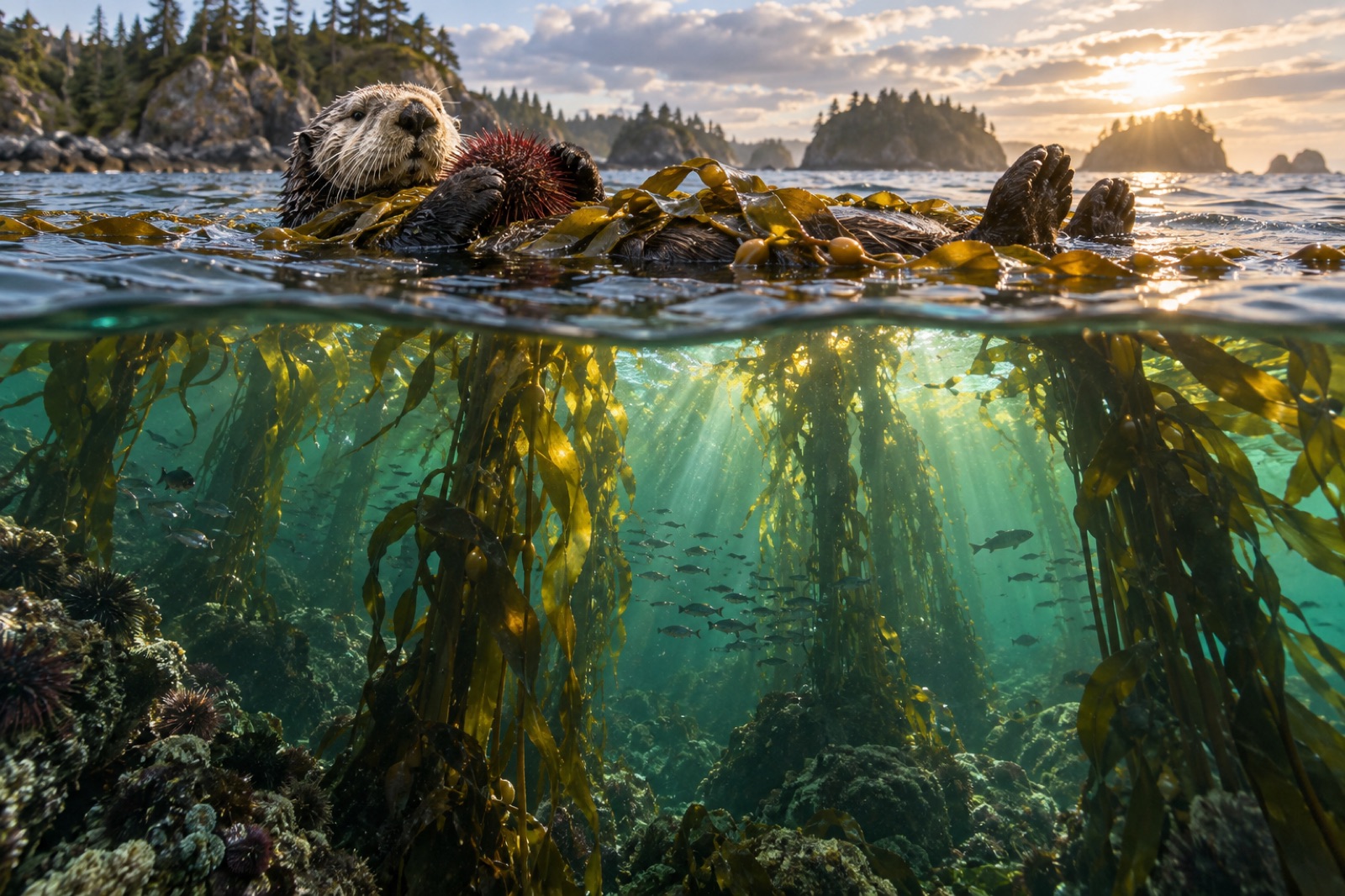
A trophic cascade happens when a predator's removal rewrites an entire ecosystem. The sea otter–urchin–kelp story is ecology's classic case — here's how it works.
Dr. Mara Ellison ·
The science of alternate stable states on rocky reefs: how kelp forests collapse into urchin barrens, why barrens resist recovery, and how reefs flip back.
Dr. Mara Ellison ·