Encyclopedia8 min read
California Market Squid: The Boom-and-Bust Fishery Under the Canopy
California market squid: the boom-and-bust fishery that whitens the seafloor with egg mops and feeds half the coastal food web.
Dr. Mara Ellison ·
Humboldt squid (Dosidicus gigas): the fast-growing red devil of the Eastern Pacific, its twilight-zone life, and its warm-year marches north.
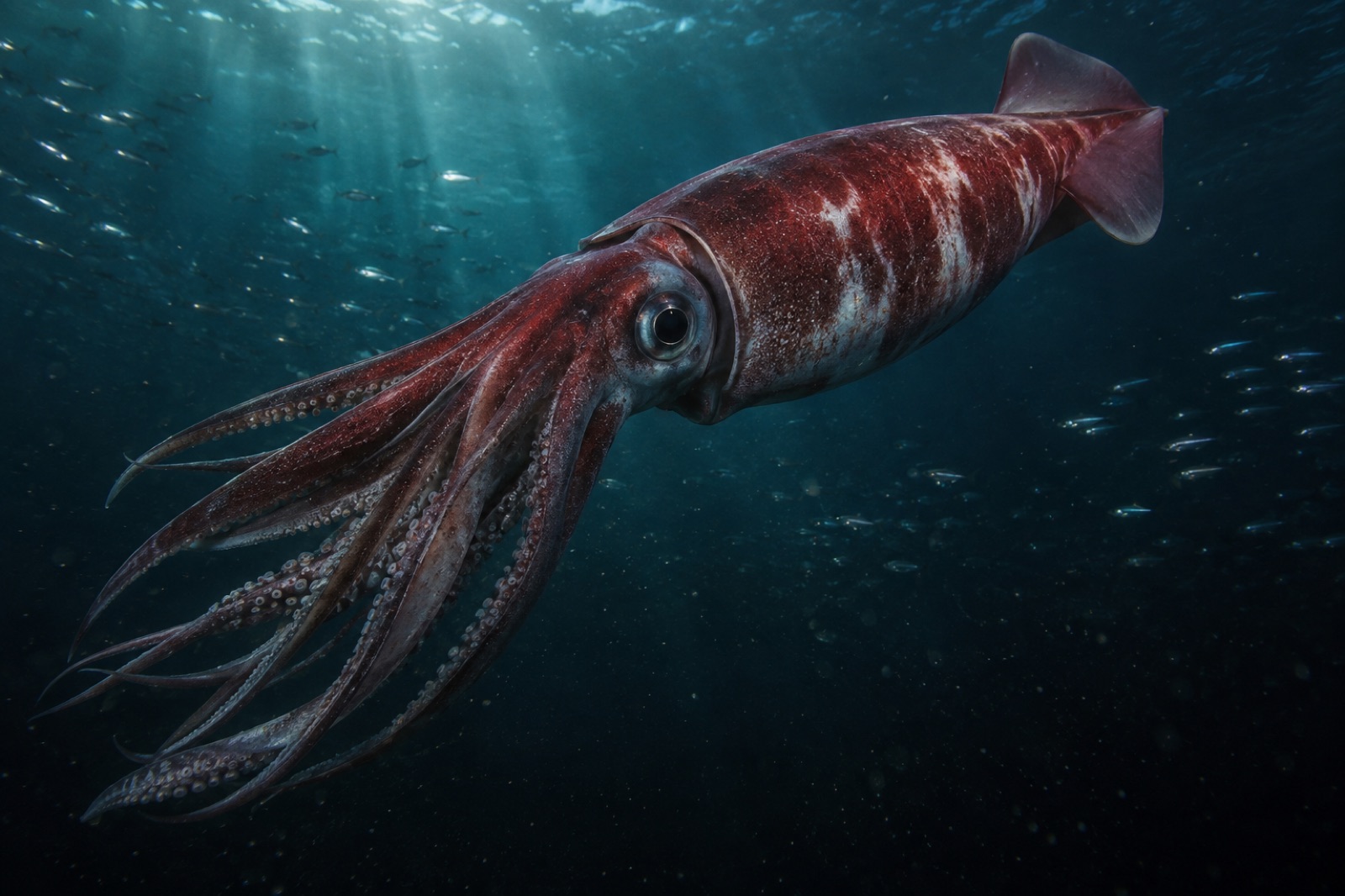
Fishermen in the Gulf of California call it diablo rojo — the red devil. It is a squid the size of a small person, red as arterial blood when it wants to be, armed with a beak like a hawk's and hundreds of toothed suckers, capable of flashing colour signals faster than most eyes can follow. The Humboldt squid (Dosidicus gigas) is the largest and arguably the most formidable of the flying squids, and over the last three decades it has done something few big predators do: it has expanded its range by thousands of kilometres.
For a kelp-coast reader, the Humboldt squid is a creature of the adjacent deep — usually beyond the forest, above the canyon. But the warm years that stress kelp are the same years that invite Dosidicus north, and its story is the clearest window we have into how ocean warming reshuffles predators. It also happens to be one of the most extraordinary animals on Earth.
The Humboldt squid — also called jumbo squid or jumbo flying squid — belongs to the Ommastrephidae, the oceanic "flying squids" that include the neon flying squid famous for gliding out of waves. Its home water is the Eastern Pacific: historically, from central Chile up through Peru — whose fishermen have known it for generations — and along Mexico into the Gulf of California, where it remains most abundant.
The dimensions deserve a pause. The largest animals carry mantles of roughly a metre and a half and weigh towards fifty kilograms — though most caught are smaller, around a metre. The arms and tentacles are lined with suckers ringed in small sharp teeth. The beak, hidden deep in the centre, can take a finger as cleanly as tin snips. And the skin is alive with chromatophores: a hunting squid strobes red-white, red-white at several cycles a second in a display that researchers now read as social signalling among schoolmates — part traffic signal, part language.
Like its smaller local relative, the California market squid, Dosidicus lives fast. Growth rates are astonishing — centimetres of mantle per month on a heavy feeding year — and the full life span is thought to be only a year or two. They hatch millimetre-long and planktonic, and a long-lived individual is one that made it through perhaps eighteen months of constant eating.
What they eat is almost anything: lanternfish and other twilight-zone fishes, krill, small crustaceans, market squid, mackerel, the valuable Pacific hake that Mexican and US fisheries prize — and each other. Cannibalism is routine and apparently unremarkable in a feeding school. Their own predators include sperm whales, which bear the circular sucker scars for life, plus sharks, marlin and big tunas.
By day, Humboldt squid hold deep — typically 200 to 700 metres down — in the cold, low-oxygen core of the Eastern Pacific's oxygen minimum zone (OMZ), a naturally oxygen-starved layer that sits beneath the surface sunlit ocean. Down there, most big fast predators cannot follow at length. Humboldt squid tolerate it: they idle their metabolism, feed selectively on what ventures through, and wait.
At dusk the school rises — tens, sometimes hundreds of metres — to hunt the richer layers near the surface, then sinks again with dawn. This diel vertical migration is the largest commute on Earth by biomass across the whole planet, and Humboldt squid are among its most muscular commuters. The habit puts them where fisheries and divers meet them: near the surface, in the dark, in a mood.
Their tolerance for low oxygen is also, quietly, part of their success story. As the ocean warms and loses breath — the problem explored in our explainer on ocean deoxygenation — OMZs are thickening and shoaling. For tuna and billfish that crowded layer is a ceiling; for the squid, it is a fortified neighbourhood with room to expand.
Until the late twentieth century, Humboldt squid were regulars off Mexico and occasional visitors to Southern California during El Niño years, when warm water extends north up the coast. Then the pattern changed. Through the 2000s, schools appeared with increasing frequency and persistence off California, Oregon, Washington and British Columbia — and in some seasons as far as southeast Alaska. Beach strandings of hundreds of squid made headlines off Oregon and California; fishing boats pulled them from waters where word of them had been folktale a decade earlier.
The drivers appear braided:
Researchers treat the northward pulses as a natural experiment in range expansion: watch, in almost real time, how a large mobile predator integrates into a temperate ecosystem. The answers are mixed. Some years, salmon fisheries report squid stomachs full of juvenile fish; in others, the squid pass through almost incidentally, feeding on their lanternfish staples, and vanish south again as the ocean cools. Along the Humboldt Current coast of Chile, by contrast, they are simply part of the furniture — and have been for centuries.
Here is a fact that surprises people: the Humboldt squid supports one of Earth's largest invertebrate fisheries. Peru's artisanal fleet — thousands of small open boats, hand lines and jigs — takes it by the hundreds of thousands of tonnes in good years; Chile and Mexico fish large fleets of their own, and California has seen episodic domestic seasons. Products go mostly to Asian and domestic markets as tubes and rings.
It is a volatile fishery for the usual reason: an animal with a one-to-two-year lifespan can vanish within two seasons of a bad recruitment year, and local catches swing accordingly. Fisheries science for Dosidicus is correspondingly young and empirical — quotas set against survey abundance rather than long stock-recruit theory. The catch is also, in a warming ocean, one of the few fisheries whose target may actually be favoured by climate trends in its core range, even as the social and ecological consequences of that success ripple outward.
Night divers in the Sea of Cortez sometimes find themselves in a squadron of Humboldt squid — the animals hanging at arm's length, studying, flickering red. Reports of aggression toward divers are real but rare relative to the number of encounters; most interactions are cautious, and the most dramatic stories come from feeding frenzies, when a hooked squid's distress strobes trigger the school. Sensible rules in squid water at night: no knives flashing, no rapid splashing, no injured animal nearby, and a calm, well-lit exit if one takes an interest. Squid can and do bite, and the beak is exactly as good as advertised.
They deserve genuine respect but not the horror-film reputation. Attacks on divers are documented, but actual encounters number in the tens of thousands across dive and fishing operations each decade, and most are uneventful or evasive. The dangerous context is a frenzy — an injured or hooked animal flashing distress — at which point every squid in the school may converge. Standard night-dive discipline keeps the risk very low.
A Humboldt squid's skin is a high-resolution chromatophore display it controls neurally, and the red-white strobing is communication: between members of a school, between predator and prey, and possibly as a counter-signal to confuse prediction. Researchers have decoded patterned sequences that look suspiciously like grammar — an area of active study.
Current estimates, from statolith micro-structure — the squid's analogue of tree rings — point to around one to two years, with two being long. Everything about the animal, from its growth rate to its spawning schedule, is arranged around that compressed calendar.
Partly and materially, but not simply. Warming oceans and expanding oxygen minimum zones tilt the conditions in the squid's favour, while short, strong El Niño events are the obvious transporting events. Separating long-term trend from episodic push is an open scientific problem; what is settled is that the squid is unusually well-engineered for exactly the ocean we are building.
Yes; the mantle is thick and eats like a firm, slightly sweet calamari, and it underpins major export industries in Latin America. Fresh, briefly cooked, or dried and rehydrated for stews, it is closer to chicken than to fish on the plate.
California market squid: the boom-and-bust fishery that whitens the seafloor with egg mops and feeds half the coastal food web.
Dr. Mara Ellison ·
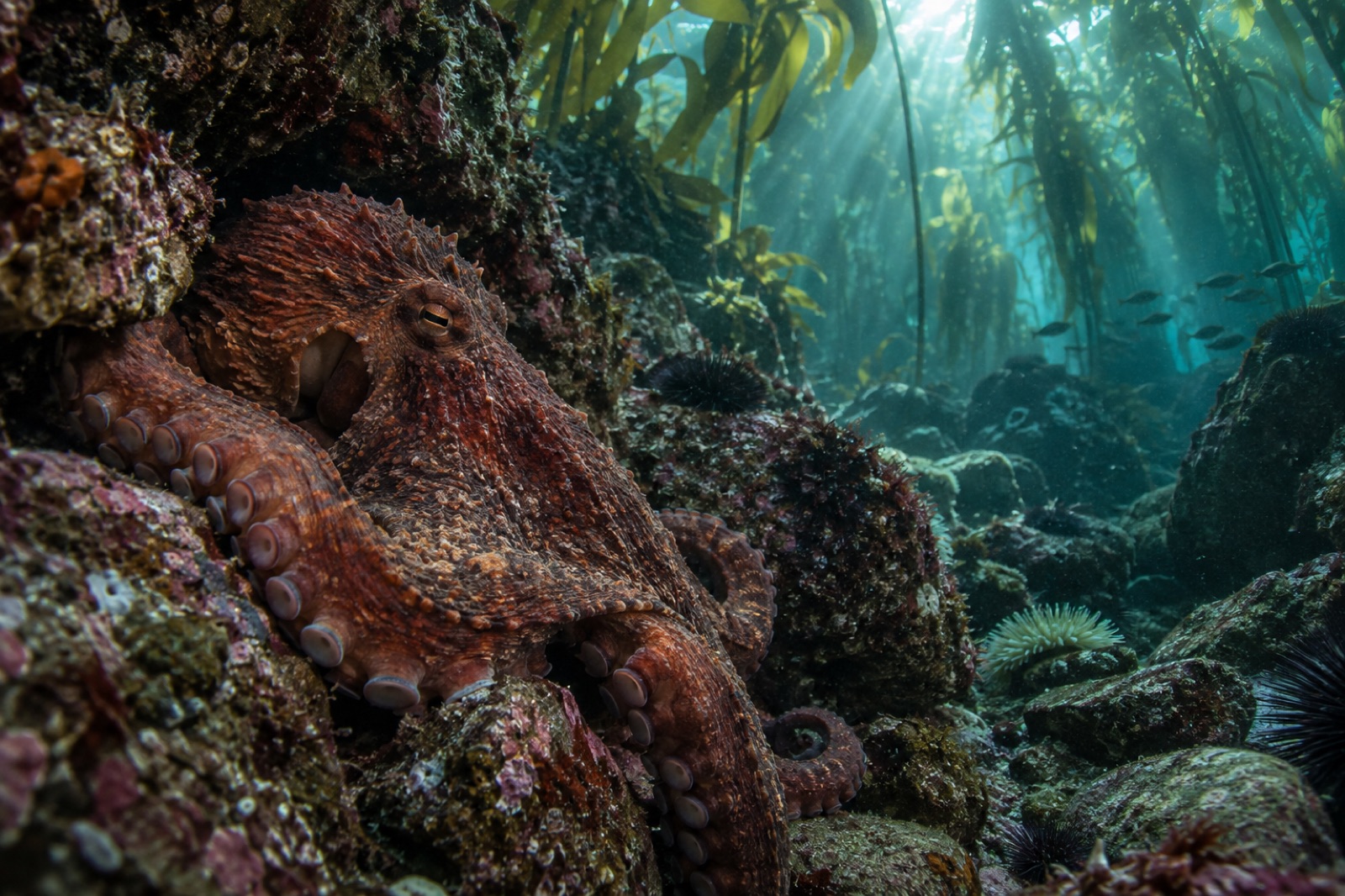
Meet the giant Pacific octopus: the world's largest octopus, a kelp-forest den-dweller with three hearts, blue blood and one shot at motherhood.
Dr. Theo Nakamura ·
California sea lions are the kelp coast's most boisterous residents — acrobatic, intelligent and climate-sensitive. Ecology, biology and the Channel Islands nursery.
Dr. Mara Ellison ·