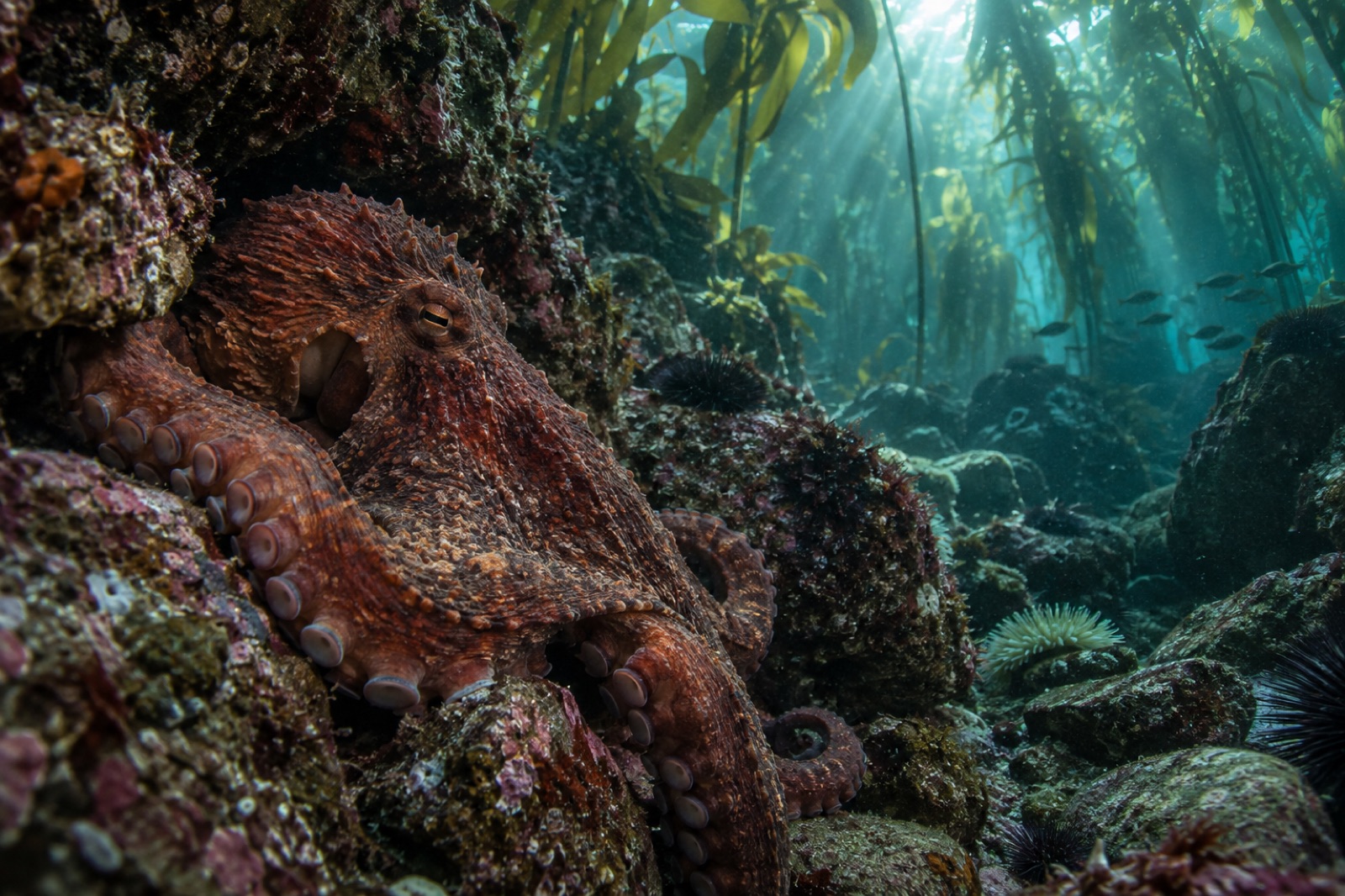
The California market squid (Doryteuthis opalescens) is a small opalescent squid — mantle about the length of a hand — that lives fast, spawns spectacularly on shallow sand next to kelp forest reefs, and supports the largest commercial fishery in California by volume. It is also one of the boom-and-bust-iest animals on the coast: in cool, upwelling-rich years the population explodes, and in warm El Niño years it can collapse almost to nothing.
That volatility is not a flaw in the species. It is the species. Market squid are built to flood the coast with biomass while conditions are good, feed everything in the nearshore food web, and burn out inside a single year.
The species in profile
Market squid belong to the inshore loliginid squids — the same broad group as the calamari of the Mediterranean — and were long classified as Loligo opalescens before a genus reshuffle gave them the name Doryteuthis. They range from southeastern Alaska to Isla Guadalupe off Baja California, but the heart of their world is the current-mixed coast from Bodega Bay south through the kelp forests of Monterey Bay and the Southern California Bight.
An adult's mantle runs to roughly 19 centimetres, occasionally more, with the classic loliginid silhouette: a streamlined tube of muscle with a broad fin along each side and eight arms plus two retractable tentacles packed with toothed suckers. In the water the body is translucent cream flushed with shifting patches of red-brown chromatophore, which flash and pulse as the animal jet-hovers. Hence "opalescent" — a fresh school genuinely shimmers.
Built for speed, not longevity
Almost everything about the species follows from one number: its lifespan. Most market squid live only six to nine months, and few survive much past a year. They grow at extraordinary rates on a diet that shifts with size — copepods and krill as juveniles, then krill, anchovies, sardines and other small fish as adults. Juveniles in turn are planktonic drifters, which means a squid hatched near Point Conception may be courted thousands of kilometres of current before it ever sees a reef.
Like nearly all cephalopods, market squid are semelparous: they spawn once and die. The entire adult generation converts, within weeks, into eggs — and then into food for the scavengers waiting below.
The spawning spectacle
When conditions suit, market squid gather in immense aggregations over sandy bottom next to reefs, often at depths of 10 to 50 metres, frequently tucked right against the outer edge of kelp beds. Courtship is brief and businesslike; males jockey and display, partners embrace, and each female descends to the sand carrying packets of fertilised eggs.
What she lays is one of the strangest sights in temperate seas: a white finger-shaped capsule, about the size and shape of a human little finger, embedded by one end in the sand. Each capsule holds on the order of a couple of hundred eggs. A single female deposits several capsules — and she is not alone. Thousands to millions of squid spawn together, anchoring capsules by the hectare until the seafloor turns white. Divers call these fields "egg mops" or "egg gardens"; from a few metres up they look like a crop of pale fingers waving in the surge.
The eggs incubate for roughly three to five weeks depending on temperature, then release rhynchoteuthion paralarvae — planktonic infants with their tentacles fused into a single beak-like probe — into the current. The parents, spent, drift and die. After a big run, dead and dying squid wash into the kelp and onto beaches, a sudden nutrient pulse that gulls, crabs and the kelp forest's detritus food web absorb within days.
Everyone's favourite meal
It is hard to overstate how many animals time their lives to squid. California sea lions shadow the spawning aggregations so closely that fishers sometimes use their wheeling to locate the schools; the California sea lion is effectively a squid specialist when the runs are on. Salmon, white seabass, halibut, rockfish, sharks, dolphins and gulls all gorge. Even the kelp canopy participates: baitfish and juvenile squid shelter under its fronds, and spawning beds crowd its sandy borders. In the ledger of the kelp forest food web, the market squid is the great middleman, converting open-water plankton into meals the reef's top predators can catch.
The fishery
Squid have been fished off California since the 1860s, when Chinese immigrant fishers dried them by the ton at Monterey. The modern fishery took off in the 1980s and today is a night operation: light boats hang banks of lamps over the water to draw schools to the surface, then purse seiners circle the aggregation, or brail nets scoop directly. Much of the catch is exported or processed as calamari and bait.
In volume and often in value, market squid tops the list of California's commercial fisheries. But its landings trace the climate almost perfectly. Cool, upwelling-boosted years deliver enormous harvests that can push past 100,000 tons in a season; warm years — strong El Niños above all — have driven catches down toward, and at times virtually to, zero, as the squid fail to show wherever fleets look. The fishery's history is a seismograph of Pacific variability.
How California manages a boom-and-bust stock
You cannot manage a six-month animal the way you manage a 40-year rockfish, and California's approach reflects that. The state fishery management plan sets a seasonal catch limit of 118,000 short tons — a ceiling sized to leave abundant spawning escapement even in strong years — and closes the fishery each week from Friday to Sunday noon so that a share of every aggregation spawns unharried. There are wattage caps and shielding rules on the attracting lights, a permit system limiting fleet size, and a mesh of marine protected areas where squid fishing is off-limits entirely. In recent years the fishery has earned third-party sustainability certification, a rarity for a stock so climate-sensitive.
The open question ecologists keep asking is whether the weekend respite and the cap are enough during back-to-back warm years — when spawning habitat shrinks and the ocean physics of El Niño stretch the population across the whole coast's worth of poor conditions. Squid fishermen ask it too; their seasons live and die by the answer.
Squid and kelp: neighbours with benefits
Market squid do not eat kelp, and kelp does not shelter squid paralarvae — the link is subtler and, for restoration science, more interesting. Spawning aggregations pick flat sand immediately adjacent to reef because the reef is where the food is: rockfish, sea lions and seabass hunting the same squid from the kelp edge make the boundary between forest and open sand one of the most energetic seams in coastal ecology. A healthy, structurally complex reef concentrates that edge habitat. When urchin barrens flatten a reef, the whole neighbourhood — squid runs included — loses participants.
There is also the nutrient loop. Post-spawning die-offs wash tonnes of squid tissue into kelp beds and onto beaches, subsidising scavengers and shoreline communities alike. A coast with regular squid runs is a coast with a moving feast, and the kelp forest is always at the table.
Watching a squid run yourself
If you want to see the phenomenon firsthand, you have two honest options. From shore on calm nights, watch for the working lights of the squid fleet offshore — harbours from Monterey to Ventura brighten like small cities when a run is on. In the water, experienced cold-water divers can sometimes find spawning beds or cruising schools on a guided night dive in kelp country; hovering at the edge of a baitball of opalescent squid while sea lions carve through it from the dark is one of the great experiences in temperate diving. Give working fishing vessels a wide berth, and never disturb egg capsules — each waving finger is a few hundred of next year's food web.
Key takeaways
- The California market squid (Doryteuthis opalescens) is a short-lived, fast-growing coastal squid, central California to Baja, and the backbone of the state's largest fishery by volume.
- Most individuals live only six to nine months, spawn once in huge aggregations over sand beside reefs, and die; egg capsules carpet the seafloor in white "egg mops."
- The population booms in cool, upwelling-fuelled years and collapses in El Niño warmth — landings have swung from well over 100,000 tons to near zero.
- Management centres on a 118,000-short-ton seasonal cap, weekend fishing closures to protect spawning, and light restrictions.
- As prey, market squid link the open ocean to the kelp forest, feeding sea lions, salmon, seabirds and dozens of other predators.
FAQ
Is market squid the same as calamari?
Yes — when you order calamari in California you are very often eating market squid, and large volumes are also processed for export and for fishing bait. "Squid" is the animal; "calamari" is the menu word.
Why do market squid landings crash some years?
Adults live less than a year, so the population is essentially one generation deep. If an El Niño or marine heatwave spoils a spawning season or starves the planktonic young, there is no reserve of older squid to carry the stock — the boom simply fails to arrive until cold water returns.
Is the California squid fishery sustainable?
By conventional standards, yes: the state manages it under a fishery management plan with a seasonal catch limit, weekly spawning closures, light limits and protected areas, and it has earned independent sustainability certification. The genuine uncertainty is climate, not harvest — repeated warm years stress the stock more than boats do.
Can I see squid eggs while snorkelling or diving?
Yes. Spawning beds in 10–20 metres of water over sand near reefs can be visited during runs, especially in Southern California and Monterey Bay. The white capsules are attached at one end and wave in the surge; look, photograph, but never pull one from the sand.
Do market squid live inside kelp forests?
Adults school along the kelp edge rather than inside the canopy, spawning on the sand just outside it. The association matters most as a food-web connection: reef predators hunt the squid, and the squid's post-spawning die-off feeds the reef.