Encyclopedia10 min read
Humboldt Squid: The Red Devil That Rides the Warm Years North
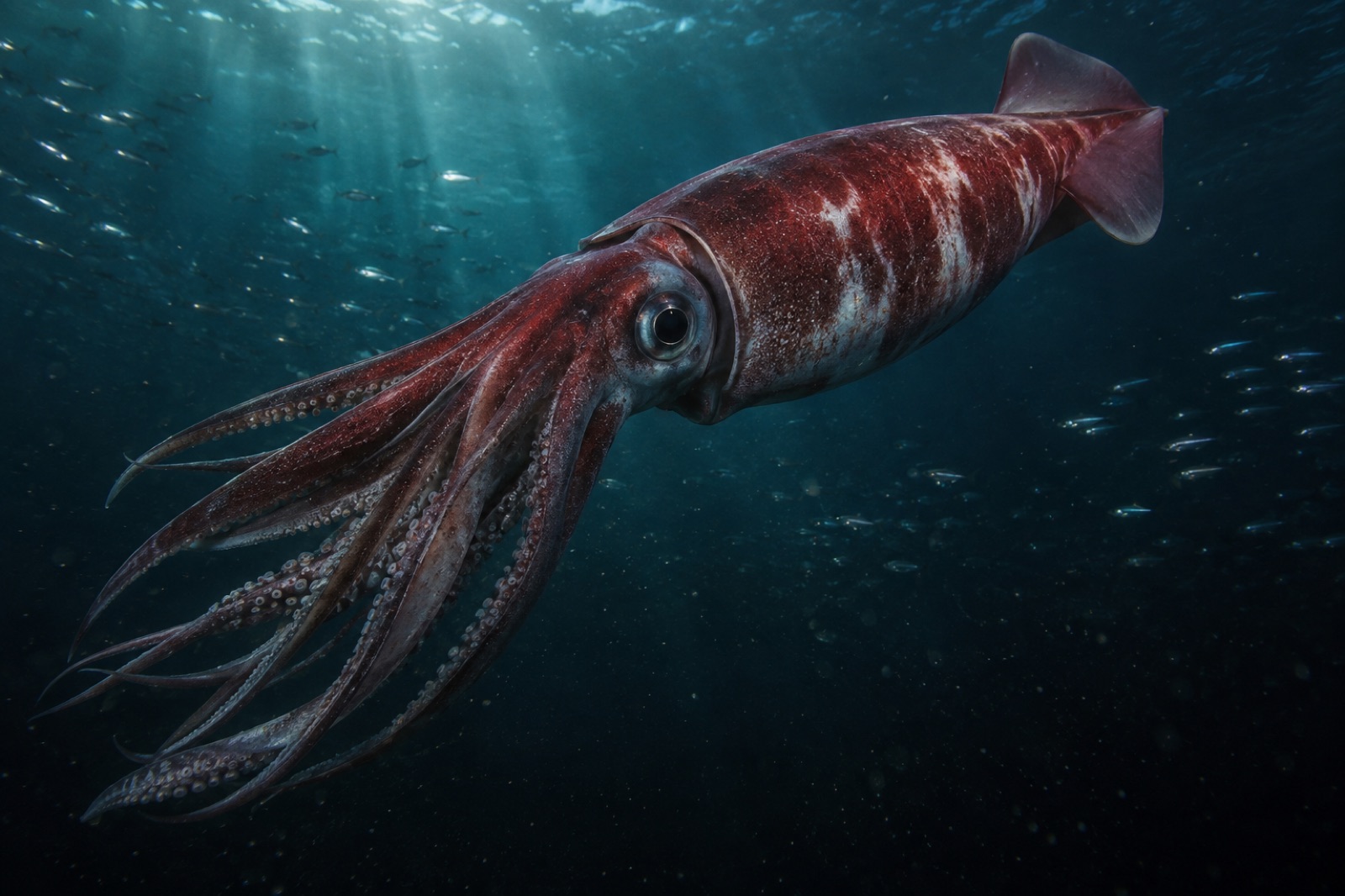
Humboldt squid (Dosidicus gigas): the fast-growing red devil of the Eastern Pacific, its twilight-zone life, and its warm-year marches north.
Dr. Lena Fischer ·
California flying fish: the biggest glider above the kelp coast. How they launch, why they arrive with warm water, and what eats them.
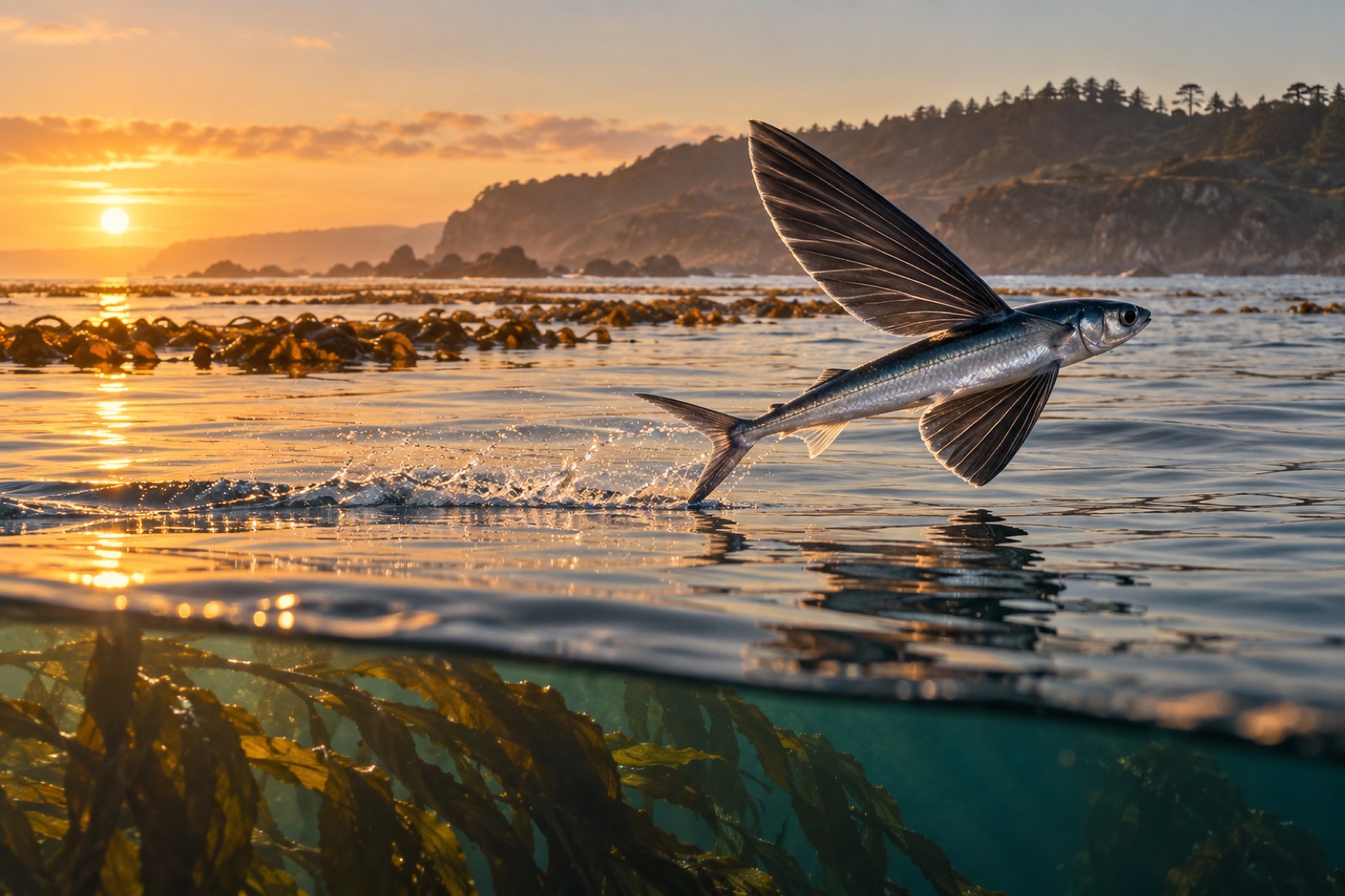
On a glassy summer evening off Catalina Island, the surface of the Pacific does something it should not: it throws fish. A streak of silver bursts from a wave face at speed, spreads two pairs of wide, dark, wing-like fins, and simply stays aloft — ten metres, twenty, thirty — before touching down on the tail, beating the water into a blur, and gliding on again. This is the California flying fish (Cheilopogon pinnatibarbatus californicus), the largest flying fish in North American waters, and one of the warm season's surest signs that the southern end of kelp country has switched moods.
For kelp-coast readers, the flying fish is a horizon species: it lives beyond the canopy in the open water where the kelp forest's larvae, drift fronds and plankton exports also travel. Its comings and goings track the ocean's warm pulse so faithfully that fishermen, pilots and biologists all read it as a calendar.
The California flying fish is generally treated as the Pacific subspecies of the spotfin flying fish — Cheilopogon pinnatibarbatus californicus — and some authorities raise it to a full species. Either way, it is the heavyweight of the family Exocoetidae in this hemisphere: big adults reach roughly 38–40 centimetres, thick-shouldered and torpedo-shaped, dark above and silver below in the countershaded uniform of everything fast in blue water.
Its name is a small anatomy lesson. Pinnatibarbatus means "feather-bearded," a nod to the fleshy chin barbel of the young fish, which shrink as the animal matures. The spots that name the broader pinnatibarbatus group — dark flecking on the pectoral fins — vary with age and light. The reliable field mark is simpler: size, the broad dark "wings," and the deeply forked tail with its elongated lower lobe, the tell-tale of every true flying fish.
Its range runs from the warm-temperate eastern Pacific around central and southern California down through Baja California and into the Sea of Cortez, riding the warm side of the California Current system. It is a surface animal, a creature of the top few metres — exactly the layer, incidentally, where marine heatwaves bite hardest, as our explainer on marine heatwaves details.
Flying fish reproduce at the surface too, and in the strangest possible register. The eggs carry long adhesive filaments; parents lay them on floating debris — rafts of kelp, palm fronds, drifting trash — so that whole clutches hitchhike the currents like a mobile nursery. Drift kelp torn loose from forests south of Point Conception becomes, in summer, a kind of convoy of flying fish eggs moving with the gyre. It is a tidy illustration of benthic–pelagic coupling: a forest anchored to rock, feeding an open-water fish economy, one torn frond at a time.
Flying fish do not fly. Every millisecond of time aloft is a glide — and the physics of that glide is one of evolution's better engineering feats.
Take-off begins deep in the body. Approaching the surface at speed, the fish folds its pectoral fins tight and accelerates, then breaks through with its body in the air and only the tail — specifically that elongated lower lobe — still in the water. In this "taxiing" phase the tail sculls laterally at astonishing frequency — dozens of beats per second — while the wingspread fins generate lift. Measurements on flying fish generally put launch speeds around 10 metres per second, and glide speeds of roughly 15–20 metres per second are commonly recorded once airborne.
What follows is what makes the California species watchable: endurance. Where a small tropical flying fish arcs down after a few seconds, the big Cheilopogon can hold a shallow glide for tens of metres, and — crucially — can re-enter with the tail still sculling, "topping up" its speed mid-flight and chaining glide after glide across hundreds of metres without ever committing to a dive. Total airborne time in a well-measured chained flight can approach half a minute.
The consensus is that flight is an anti-predator manoeuvre with a travel bonus. Below the surface wait Pacific barracuda, yellowtail, tuna and dolphin fish, all faster swimmers than a flying fish. A low glide to clear air breaks the pursuit profile entirely: predators built for underwater speed lose the scent, the sightline and the geometry all at once. The chained glides let the fleeing animal cover serious distance before re-committing to the water column — an expensive getaway in energy, but a very effective one.
The California flying fish is, above everything, a seasonal migrant in the mind of the coast. Its stronghold lies to the south; off California it is a summer-and-autumn fish, appearing as surface temperatures climb, thick in warm years, thin or absent when the water stays cool. Fishermen at the Channel Islands have watched this pattern for over a century: when the flying fish turn up, the bonito and yellowtail usually aren't far behind.
El Niño years amplify the whole pattern. The warm-water surge that reorganises the California Current — the same physics walked through in our piece on El Niño and kelp — loosens the thermal fence at Point Conception and lets southern species roam. Flying fish press north, following their plankton prey and their own temperature preferences, and become briefly common where they were a rumour. In that sense they are one of the most legible range-shift indicators on the coast: a signal you can watch from a kayak, no instruments required.
At Catalina, the fish gave rise to one of California's odder pieces of folklore: the famous evening flying fish boat trips out of Avalon, running every summer since the early twentieth century, when spotlights were said to draw the fish gliding toward the boats. The boats still run in summer; the fish still cooperate, though a little more thinly in the cold years.
Being the largest flying fish doesn't make you safe: it makes you a meal worth the chase. The predator list reads like a who's-who of the open Pacific — yellowfin and bluefin tuna, dorado, marlin and striped marlin, yellowtail, barracuda, dolphins and sea lions. Sport fishermen learned long ago that a live flying fish on a hook is among the finest billfish baits in the sea, and a small bait fishery for them operated off Catalina and southern California for decades.
In the water-column food web, the flying fish is a classic forage species: it grazes surface zooplankton — copepods, larval crustaceans, the small fry of other fishes — and converts that diffuse crop into concentrated protein for everything bigger. It shares that role off this coast with market squid and the anchovy schools, and like them it booms and fades with the plankton supply, which is ultimately set by the upwelling physics of the California Current.
The flying fish matters beyond its own charm because of what its timing says. Long records of first-arrival dates and season length are the kind of citizen-scale observation that climate science feeds on: when a thermally sensitive species shifts its calendar or its address consistently across decades, the signal is hard to argue with. On the warm edge of kelp country — where giant kelp itself is losing ground as summers lengthen — the flying fish is the inverse witness, the species that profits from the same shift.
Neither story is complete without the other. A summer thick with flying fish over a thinning kelp canopy is not a contradiction; it is the ocean being honest about which way the water is moving.
No. Despite their size and speed they are harmless — their "flight" is escape behaviour. The only historical nuisance is an airborne fish colliding with night boaters, which is startling rather than dangerous.
Single glides of 30 metres or more are routine, and by re-touching the surface tail-first to regain speed the fish can chain glides across several hundred metres in one escape run.
Mid-summer through early autumn, in warm years — typically July to October — especially around Catalina and the Channel Islands. Calm mornings and evenings offer the best viewing.
They cruise above them and over the open water beyond. The real link is the eggs laid on rafts of drift kelp torn from the forest, which carry developing young on the currents.
They appear to benefit from surface warming in the short term, expanding poleward with warm anomalies — but the full picture includes changes in upwelling driven plankton supply, which sets their food, and is itself shifting.
Humboldt squid (Dosidicus gigas): the fast-growing red devil of the Eastern Pacific, its twilight-zone life, and its warm-year marches north.
Dr. Lena Fischer ·
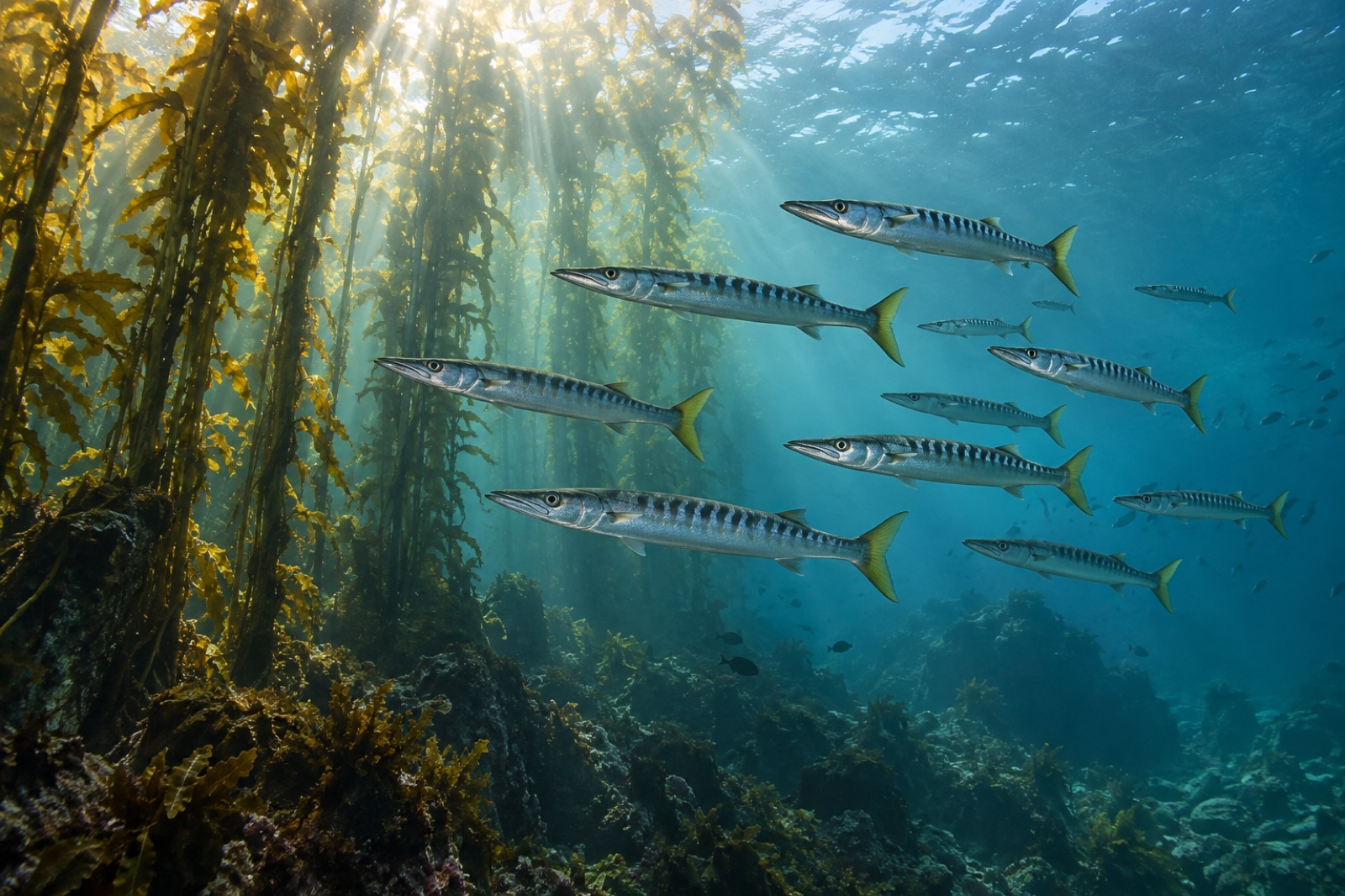
The Pacific barracuda (Sphyraena argentea) hunts in silver schools over California kelp beds. Profile: biology, range, fishery and how it differs from its tropical cousin.
Dr. Mara Ellison ·
California market squid: the boom-and-bust fishery that whitens the seafloor with egg mops and feeds half the coastal food web.
Dr. Mara Ellison ·