Encyclopedia9 min read
Cystoseira: The Mediterranean's Lost Canopy Forests
Cystoseira and kin built the Mediterranean's underwater forests for millennia. Why these canopy algae are retreating, and what it takes to bring them back.
Dr. Mara Ellison ·
In the brackish, landlocked Black Sea, Cystoseira barbata once built kelp-like forests on shallow rock. Eutrophication broke them; now the coast is rebuilding.
Strictly speaking, there is no kelp in the Black Sea. The true kelps — the laminarian giants of the Pacific and Atlantic coasts — cannot live here, because the Black Sea is too brackish and too enclosed for them. Surface salinity runs at roughly half the ocean's, and the basin's only connection to the wider sea is the narrow Bosphorus. And yet, from the rocks of Crimea to the Bulgarian cliffs, from the Turkish shallows to Romania's shrinking shores, the Black Sea once grew something that worked exactly like a kelp forest: dense beds of the bushy brown alga Cystoseira barbata, rising two metres off the rock, thick enough to snag fishing nets and shelter a complete coastal ecosystem. The story of what happened to those forests — and the slow, unfinished story of their return — is one of the most instructive case studies in marine conservation anywhere on Earth.
The Black Sea is the world's largest permanently stratified, almost-landlocked sea: about 436,000 square kilometres bordered by Ukraine, Russia, Georgia, Turkey, Bulgaria and Romania. It is an estuarine sea — massive rivers (the Danube, Dnieper, Dniester, Don) freshen the surface layers, while a thin, salty inflow from the Mediterranean sinks beneath them. The two layers almost never mix, which is why the deep Black Sea is famously anoxic: below a couple of hundred metres there is virtually no oxygen, and the biological action of the whole basin plays out in a surface slab of water.
Cystoseira barbata lives where the rock lives — the shallow photic rim. Our species profile of the Cystoseira forests covers the genus as a whole; the Black Sea's version is adapted to the brackish edge, a specialist at exactly the salinity limit our atlas of the Baltic kelp coasts also explores.
Growing a marine forest in brackish water is a physiological tightrope. Every cell of a seaweed must manage its salt and water balance; dilute the seawater and most marine algae lose their footing. Cystoseira has solved this enough to dominate the Black Sea's rocky shallows, historically forming a nearly continuous belt of canopy along hundreds of kilometres of coastline. Divers who worked the coast in the mid-twentieth century described swimming through thickets where the fronds overlapped into an unbroken roof — a genuine temperate-style forest, all in water you could almost half-drink.
That forest was the coast's keystone real estate. Canopy thinned the swell before it hit the shore, damped the sediment, shaded the turf and held a complete food web: mussel beds on the rock below, crab and goby communities in the understory, juvenile fish of the Black Sea's once-great fisheries — turbot, sturgeon, mullets — recruiting through its fronds. This is the standard architecture of an algal forest; the only difference was the salinity of the water the forest was pumping.
In the 1970s and 1980s the Black Sea became the world's cautionary tale about coastal eutrophication. Fertiliser-rich water from the Danube and the other great rivers dumped nitrogen and phosphorus into the northwestern shelf on an enormous scale. The phytoplankton bloomed; the water went green and dark; the light that Cystoseira needs was stolen by the plankton the rivers were feeding. At the bottom, the accumulated plankton rotted, and vast seasonal dead zones opened along the northwestern shelf — hypoxia on a scale the world had not previously seen in a semi-enclosed sea.
The canopy-forming seaweeds went first, as they always do. Slow-growing, light-hungry and vulnerable at recruitment, Cystoseira beds collapsed across much of the Black Sea within a couple of decades. In their place came the weedy winners of the turbid, nutrient-rich new sea: ephemeral green and red algae, free-floating and fast. Then came the invaders from across the Atlantic: the ctenophore comb jelly Mnemiopsis leidyi, arriving in ballast water in the 1980s, consumed the zooplankton that had kept the fish larvae fed, and the Black Sea's great anchovy and sprat fisheries collapsed in step with its forests. The sea that had been famous for its abundance became, in a single human generation, the most infamous example of an ecosystem flipped.
Then the Black Sea did something almost no one expected: it started to heal. Several things happened together. The collapse of the eastern bloc's economies at the end of the 1980s cut fertiliser use abruptly; international agreements through the 1990s and 2000s reduced nutrient loads further; and a second invader, the predatory comb jelly Beroe ovata, arrived in the 1990s and began to eat the Mnemiopsis that had eaten the food web. Water clarity improved. The plankton dialed back toward something like its historical range.
And on the rocks, slowly, the Cystoseira began to come home. Surveys over the past two decades have reported recovering beds along several coasts, with the strongest returns where water quality improved and the shoreline stayed hard and unwalled. The recovery is partial, patchy and fragile — and deeply studied, because the Black Sea is now the world's great natural experiment in whether a flipped ecosystem can flip back. The principles our science team has written about in the restoration toolkit — light first, nutrients second, recruitment third — are all playing out here in public.
No honest atlas entry can stop at the recovery story, because the Black Sea's new century has brought new pressures on every coast at once. The water is warming, and the basin's enclosed geography leaves temperate species fewer escape routes. Shipping and associated invasives continue to arrive through the Bosphorus. Tourism development and armouring of the shoreline keep eating the natural rock the forests recruit onto. And the war that erupted in the northwestern Black Sea in the 2020s has introduced a wholly new layer of marine damage — unexploded ordnance, sunken shipping, disrupted monitoring and damaged catchments — whose full ecological accounting is still being written. The resilience story of the 1990s–2010s is real; so is the new uncertainty.
The Black Sea matters to kelp conservation far beyond its own coastline, because it is the clearest large-scale proof of the two propositions our work at Tidewright is built on. First, canopy forests can collapse quickly, region-wide, when light and nutrients turn against them — there is no "resilience floor" that saves a forest by itself. Second, recovery is possible — genuinely, forest-scale possible — when the load is removed and the recruits can find a way back. The same two-way switch governs the urchin barrens of temperate coasts and the turf-algae flips of the Mediterranean's Cystoseira forests, and it is the scientific basis of every restoration project we run: find the limiting factor, remove it, then help the forest walk home. Our Impact methodology exists precisely to measure whether the forest is truly walking.
Not true laminarian kelps — the brackish water rules them out. Its functional equivalent is the bushy brown alga Cystoseira barbata, which historically formed tall, dense shallow-water forests playing the same ecological role.
It is nearly landlocked and estuarine: huge rivers freshen the surface while a thin Mediterranean inflow sinks below. The layers almost never mix, leaving the deep basin permanently anoxic and compressing almost all marine life into the surface slab.
Primarily eutrophication. Nitrogen and phosphorus from fertiliser-heavy rivers fed phytoplankton blooms that blocked light to the seabed; the rotting plankton then created vast hypoxic zones. The invading comb jelly Mnemiopsis leidyi compounded the damage through the 1980s.
Partially, and genuinely. Reduced nutrient loads and the arrival of the Mnemiopsis-predator Beroe ovata improved water clarity from the 1990s onward, and Cystoseira has returned to several coasts. But warming, development, new invasives and the current war all cloud the outlook.
Because it is the largest real-world proof that coastal marine forests can collapse basin-wide — and can recover when the pressure is removed. It is the case study that underwrites the logic of all modern marine forest restoration.
Cystoseira and kin built the Mediterranean's underwater forests for millennia. Why these canopy algae are retreating, and what it takes to bring them back.
Dr. Mara Ellison ·
How nutrient pollution from land tips coastal reefs from kelp forest to turf algae, why the shift is so hard to reverse, and what actually brings the canopy back.
Dr. Mara Ellison ·
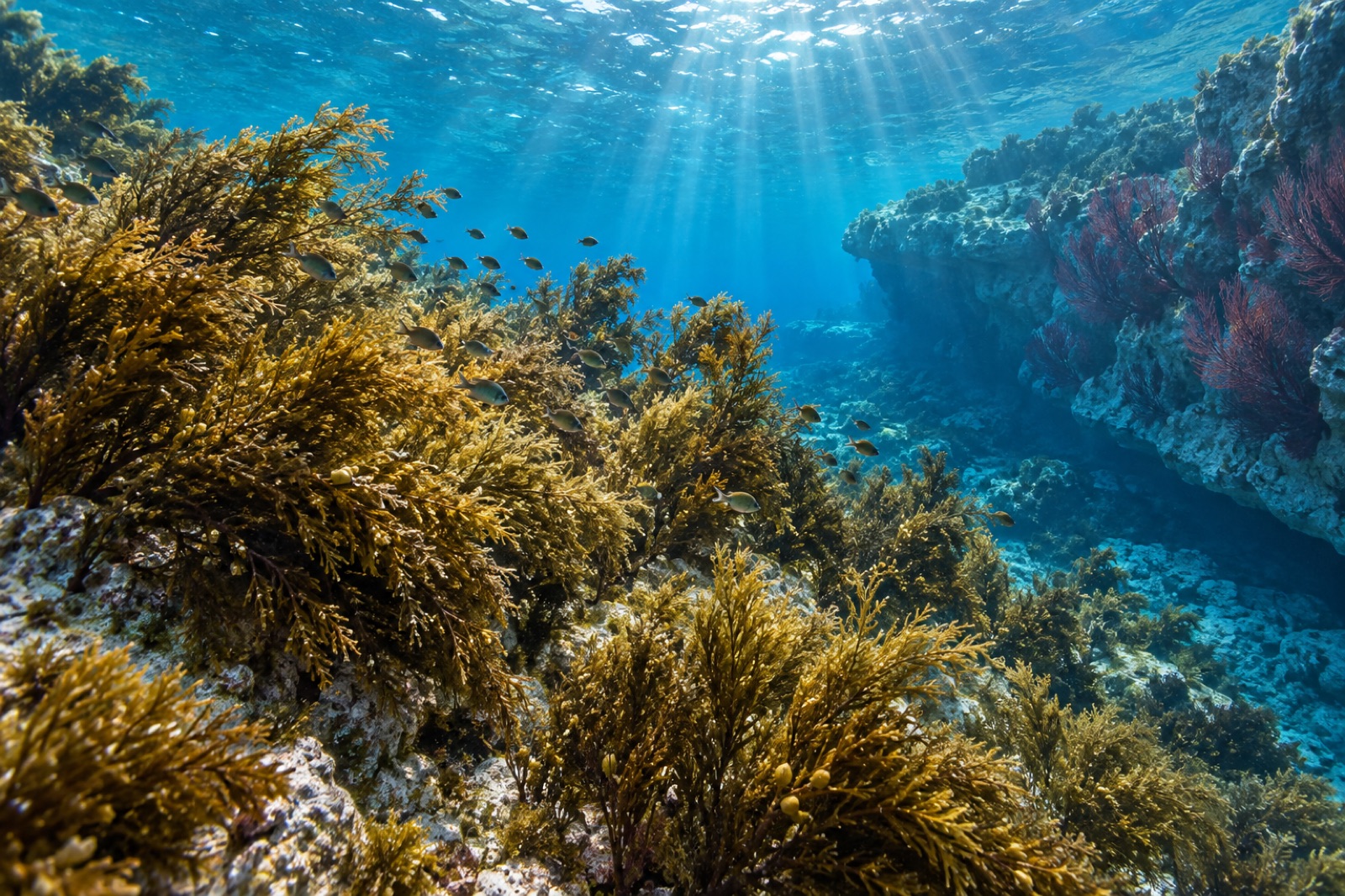
Croatia's island-chained coast grows the Mediterranean's great brown algal canopies on drowned karst — clear water, coralligenous reefs and forests now measured in fragments.
Dr. Theo Nakamura ·