Blue Carbon9 min read
The Core Carbon Principles, Explained for Ocean Projects
What the ICVCM's Core Carbon Principles are, how the CCP label works, and what it does — and doesn't — tell buyers of blue carbon credits.
Priya Raman ·
How do you tell a real marine climate commitment from greenwash? A plain-language framework for reading net-zero ocean claims — and the questions that expose the gaps.
Part of a learning path
This article is stop 9 of 10 on Blue Carbon for Buyers — From first question to a defensible contract.
The ocean has become a brand asset. Cruise lines sail with "net-zero" ambitions, consumer brands print wave motifs on "ocean positive" labels, and companies that have never owned a vessel announce kelp-carbon portfolios. Some of this is real and badly needed. Some of it is marketing with a wetsuit on. The difficulty for a coastal council, an investor, or a curious consumer is that the two look identical in a press release.
Net zero is, at heart, a measurable idea: reduce your emissions as far as possible, then neutralise what remains with durable removals. Ocean-themed claims should be read through the same lens as any climate claim — but with a few extra wrinkles that the marine setting introduces. Here is a practical reading framework: what the claim types actually mean, the questions that separate integrity from imagery, and where ocean claims get especially slippery.
A credible net-zero commitment has four load-bearing pieces:
Independent frameworks — the Science Based Targets initiative's definition of net zero, the Oxford principles for offsetting, the Core Carbon Principles for credit quality — all converge on this shape, as we outline in The Core Carbon Principles, Explained. Any claim that is fuzzy on one of these four is leaving itself room to manoeuvre later.
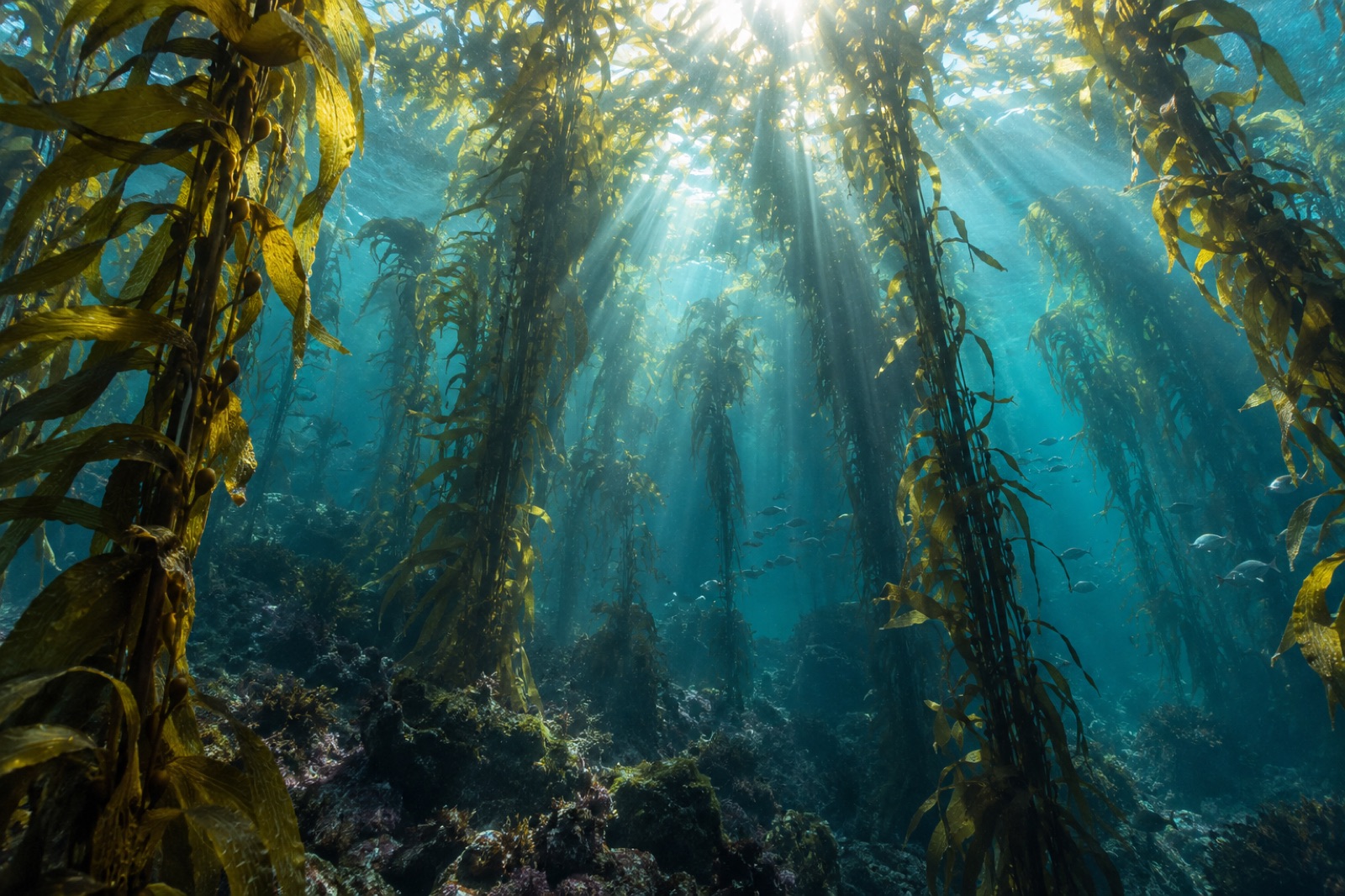
Terrestrial forestry carbon has decades of methodological consensus. Blue carbon from tidal wetlands is increasingly well-understood, but kelp and macroalgae pathways are still scientifically young — biomass export fractions, deep-sea deposition rates and sediment burial signals carry genuine uncertainty that the best projects state openly. We devoted a whole article to the honest accounting of kelp carbon and another to the active scientific debate. A company whose ocean credits are built on kelp claims should be able to name the methodology and the uncertainties; silence on methodology is information.
A forest can be protected with a land-title conservation easement. A kelp forest sits in a jurisdiction that can change fisheries rules, issue an aquaculture permit, zone a wind farm, or approve a dredge — often without any obligation to preserve the carbon the buyer paid for. Serious ocean claims therefore disclose how permanence is enforced: protected-tenure agreements, buffer pools (mechanics here), and reversal insurance. Vague "the project will steward the site" language is a gap.
Who gets to count a coastal reduction toward a national inventory, and whether a corresponding adjustment was made when a foreign buyer used it, is exactly the legal frontier on which ocean claims can quietly double-count. The deep dive is in Double Counting, Explained. For now, honest projects disclose their authorisation status; boastful ones rarely mention it.
"Ocean positive." Not a regulated term. It can mean anything from "we fund restoration beyond our footprint" to "we photographed our CEO on a boat." Ask: positive relative to what baseline, measured how?
"We offset our shipping with blue carbon." Entirely plausible — ask for the vintage and serial numbers, whether credits are removals or avoidance (shipping offsets should be the former for net-zero purposes), and whether the project has buffer and reversal provisions for a storm-prone environment.
"Carbon-neutral seafood." Fish have footprints; aquaculture has diesel. A credible version publishes the lifecycle assessment (fishing gear, transport, feed) and explains what's reduced versus offset. The same diligence questions for any product claim apply.
"Nature-based / regenerative blue sourcing." Sometimes a genuine procurement commitment (paying suppliers for verified ecological outcomes) and sometimes a vibe. Ask which outcome metrics are contracted.
"Insetting" in seafood supply chains. A company paying its own suppliers to decarbonise or restore inside its value chain can be among the most legitimate claims in the ocean space — or a way to blur scopes. See Insetting vs Offsetting.
Whatever the packaging, a net-zero ocean claim should survive these questions without sweating:
The well-behaved pattern across all five is the same one we've written about in Nature-Based Solutions: What Integrity Actually Requires: specificity everywhere. Greenwash is allergic to specifics.
A credible ocean-linked claim is unglamorous: a published emissions boundary, interim cuts on the record, a small residual footprint neutralised with clearly labelled removals, serial-number-level disclosure of retirements, buffer-pool or insurance provisions against reversal, and plain acknowledgement of where the science is still settling. That combination exists in the market already — it just doesn't make for splashy posters. If you're a buyer, the questions in our buyer's guide will get you to the boring-good suppliers fast.
Tidewright's own fictional commitments (a company claiming to be a design demo is a fine place to practice honesty) are documented on our impact methodology page — including the explicit note that our numbers are illustrative, which is the cheapest and most important disclosure any fictional-or-real company can make.
There is no ocean-specific certification of net zero, but general frameworks apply: science-based targets for the reduction pathway, the Core Carbon Principles and integrity-led guidance for credit quality, and Article 6 authorisation status for international transfers. Serious ocean projects are transparent about which of these they invoke.
Funding restoration is good. The question is only about the claim attached to it. Funding ocean recovery is admirable whether or not it is then also booked against a net-zero target; only the second use raises double-counting and neutrality questions.
"Carbon neutral" has been used loosely for decades, often relying on avoided-emission offsets. "Net zero," under current integrity frameworks, demands deep reductions first and durable removals for what remains. The latter is stricter — a tight definition that makes greenwash harder.
Not inherently — mangrove, seagrass and saltmarsh methodologies are mature; kelp and macroalgae pathways are earlier-stage and should carry clearer disclosures about uncertainty. Good sellers price, disclose and over-deliver against this science; bad ones pretend the uncertainty doesn't exist.
In practice it's shared: securities and consumer-protection regulators for the legal floor, integrity initiatives for voluntary-market standards, journalists and researchers for rigour, and buyers — the most powerful policemen — by demanding registries, serial numbers and named methodologies before paying.
What the ICVCM's Core Carbon Principles are, how the CCP label works, and what it does — and doesn't — tell buyers of blue carbon credits.
Priya Raman ·
Nature-based climate solutions can fund real restoration or sell attractive stories. The integrity checklist that separates credible projects from greenwash.
Priya Raman ·
Blue carbon credits can fund real coastal restoration — or expensive stories. A practical due-diligence checklist for corporate buyers before they sign.
Priya Raman ·