Watch a sea otter work a kelp bed and you are watching one of the great physiological balancing acts in nature. Here is a small mammal — by far the smallest of the marine mammals — living its whole life in water cold enough to kill an unprotected human within the hour, diving dozens of times a day to pry hard-shelled prey from the reef, with no blubber layer at all. Everything about how an otter survives is a story of heat and energy: where it comes from, how carefully it's spent, and how exquisitely the body is tuned to keep the ledger balanced. For the full species portrait, see our sea otter profile. Here we go under the hood.
The Problem: Small Body, Cold Sea, No Blubber
Heat loss in water is brutal. Water conducts heat away from a warm body roughly twenty times faster than air at the same temperature. The standard marine-mammal fix is blubber — a thick insulating jacket of fat. Otters skipped it. Blubber is heavy, restricts flexibility, and matters most at depth where pressure compresses air; otters live shallow and agile, threading kelp strands and rolling on their backs.
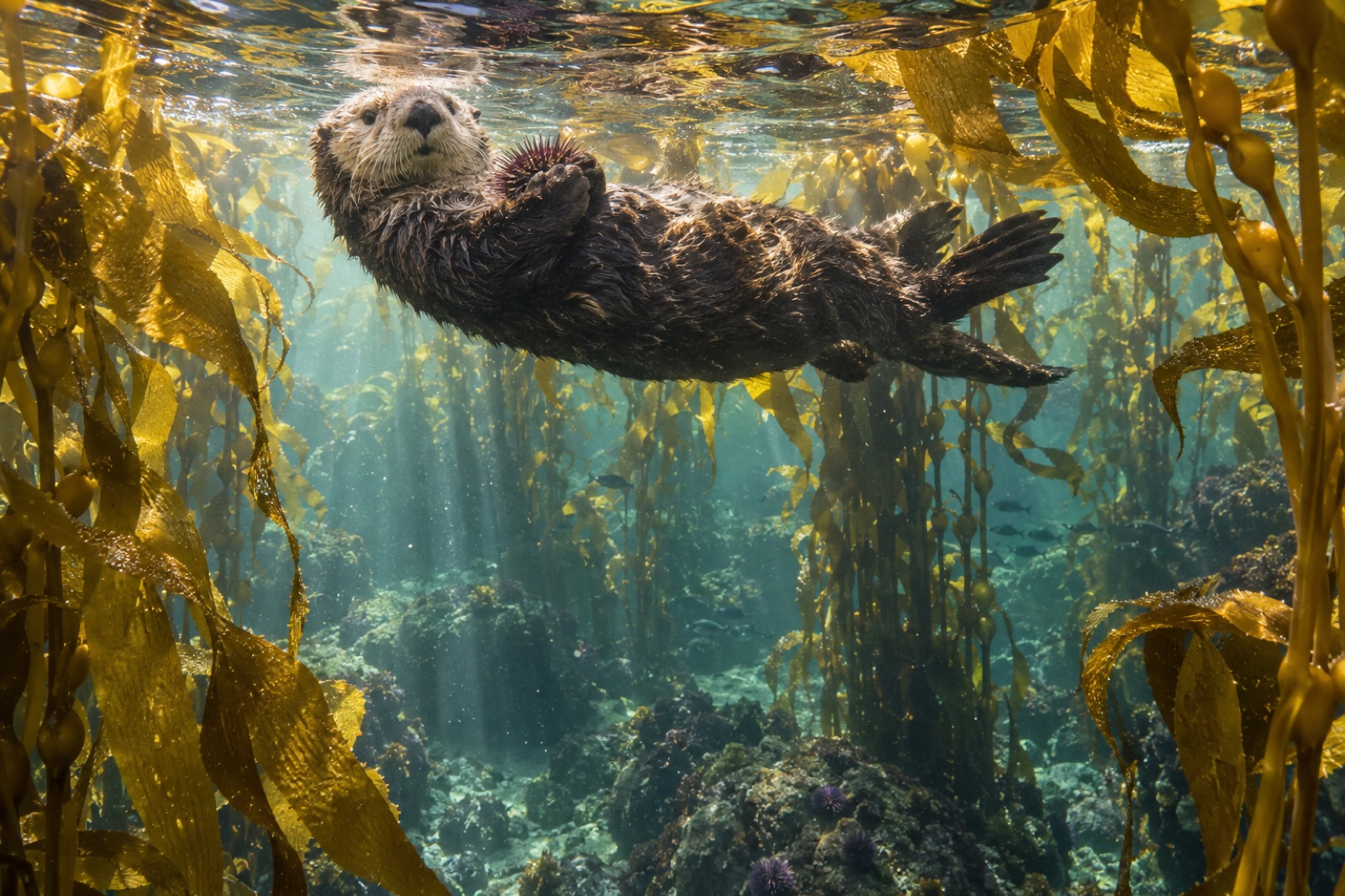
Instead they carry the densest fur of any mammal. Where a human head might hold around a thousand hairs per square centimetre, sea otter fur packs extraordinary densities — the underfur traps a layer of air against the skin, and it is that air, not the hair itself, that insulates. The whole system has one weakness: it only works when the fur is clean and properly arranged. Which is why otters spend hours each day grooming — not vanity, but a daily re-pressurising of their survival suit. Oiled fur collapses the air layer, and a chilled otter can die of exposure in water that was previously comfortable. It's the central reason oil spills are so catastrophic for otters: the catastrophe is thermal before it is toxic.
A Furnace That Never Switches Off
The price of that thin-fur strategy is paid in metabolism. Sea otters run one of the highest mass-specific resting metabolic rates of any mammal their size — a furnace that simply does not turn down. Sustaining it requires eating on the order of a quarter of their body weight in prey each day. For a 30-kilogram adult, picture seven or eight kilograms of urchins, crabs, clams and abalone, gathered one dive at a time.
That appetite is the engine behind the otter's outsized ecological role. An animal consuming that much benthic invertebrate biomass per year — selectively, reef by reef — inevitably restructures the community it feeds on. The urchins suppressed; the kelp released. The full food-web consequence is told in our piece on trophic cascades in kelp forests, but it begins here, in a metabolic rate with no off switch.
The Working Dive: Short, Shallow, Relentless
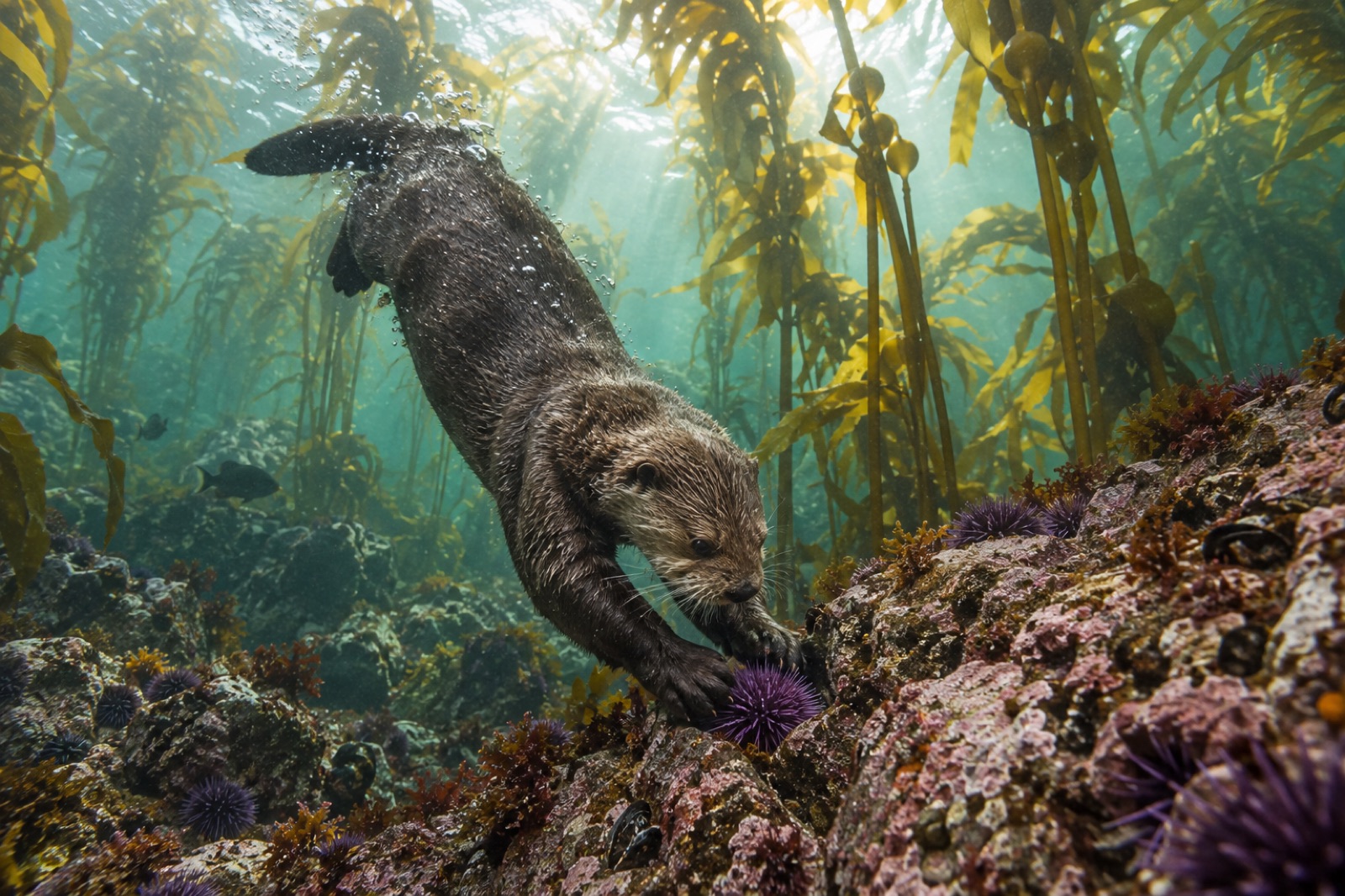
Otter dives are not the epic plunges of seals or whales. A typical foraging dive is shallow — rarely deeper than the tens of metres of sunlit reef where their prey lives — and short, generally under two minutes, most under ninety seconds. They are aerobic working dives, fuelled from onboard oxygen rather than borrowed against anaerobic debt.
Oxygen storage explains the limit. Big deep divers carry oxygen in three tanks: inflated lungs, oxygen-saturated blood, and myoglobin-laden muscle. Otters are notable in that they dive on full lungs — a real lungful of air carried down, unlike seals which exhale before deep dives. The lungful buys buoyancy problems (otters must work to stay down) but lets the respiratory gas contribute directly to the dive budget, and suits an animal that also needs to float at the surface between efforts. Their blood and muscle oxygen stores are respectable for their size but nothing exotic. The arithmetic enforces the working rhythm: dive, hunt, surface, breathe, repeat — dozens to hundreds of cycles a day, with surface pauses to handle, crush and eat inside the fur's air-layered raft.
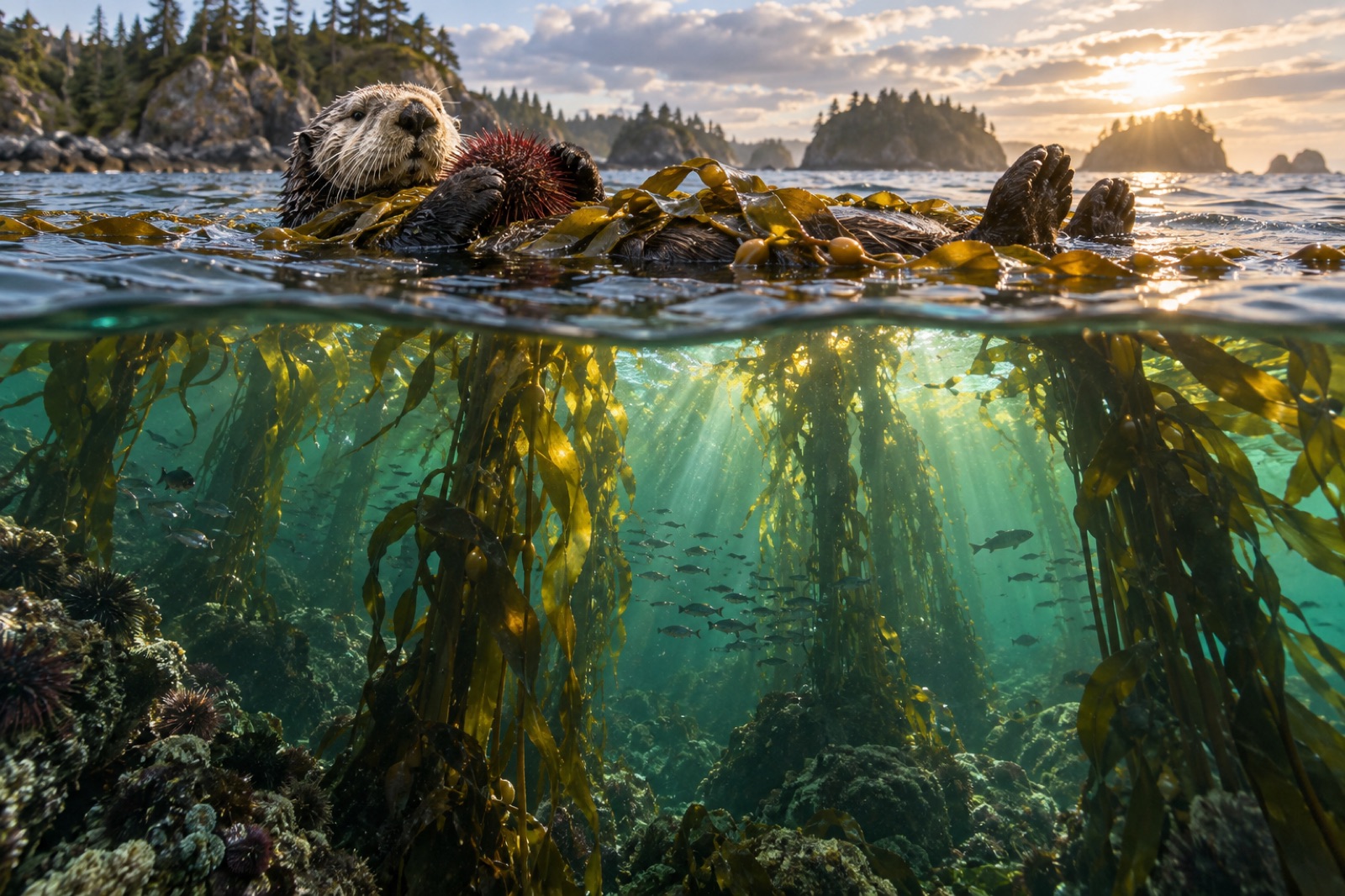
Otters are famous tool users: an urchin pried from rock is brought to the surface, the otter rolls onto its back, and a favoured stone — kept in a loose flap of skin under the forearm — becomes an anvil for cracking shells on the chest. It is one of the clearest cases of tool use in a non-primate wild mammal, and it is an energetics story too: shells that would be uneconomic to chew through become accessible, broadening the menu of calorie-dense benthic prey.
Taste in prey is pragmatic — otters take what's abundant — but their preferences have sharp ecological edges. Where sea otters are established, large sea urchins are cropped hard; where otters are absent, urchins can multiply into the grazing fronts that turn kelp forests into barrens, the dynamic at the heart of our urchin barren explainer. Otters will also run down the calorie rankings as conditions shift: energy-rich crabs and clams preferred where present, with low-calorie urchins taken more heavily when urchins dominate — a predator effectively price-shopping its own metabolism through the reef's offerings.
Raising a Pup on an Otter's Budget
If the adult energy ledger is tight, the breeding ledger is brutal. Otter mothers raise a single pup and provision it entirely: nursing at the surface, then diving-weaning provisioning that makes the mother's daily intake requirements climb substantially. While she dives, the pup floats — buoyant and windblown on its own infant-fur air layer, a fact that anchors mothers to wind-sheltered kelp fringes. Many of the classic sightings of mothers anchoring pups to kelp fronds or wrapping loosely in kelp are a working solution to a working constraint: you can't hold a baby and hammer a clam at the same time.
From Physiology to Forest
Loop the whole story back: a small, warm, blubberless hunter — kept alive by groomed fur, stoked by a quarter-weight daily intake, working shallow reefs in ninety-second bursts — ends up, through sheer energetic necessity, as the kelp forest's grazing regulator. The forests that otters keep standing are the same ones that shelter young fish, slow water, store carbon and anchor coastal communities — the living system mapped in our kelp forest food web explainer. Amplified at coastline scale — along the Aleutians, the British Columbia kelp frontier, California — a metabolic constraint becomes a landscape. Reading an otter's dive pattern on any one reef is, in a real sense, reading the forest's future.
Key takeaways
- Sea otters have no blubber; they insulate with the densest fur of any mammal, whose trapped air layer must be obsessively maintained by grooming — collapsed fur means fatal heat loss.
- Their resting metabolic rate is among the highest for a mammal of their size, forcing daily intake of roughly a quarter of body weight in benthic prey and driving their huge ecological footprint.
- Otter dives are short (mostly 40–90 seconds), shallow and aerobic; otters dive on full lungs and float between dives, a rhythm built around surface handling and eating.
- Tool use — the chest-anvil stone — expands the accessible prey menu, an energetics adaptation as much as a behavioural one.
- Pup provisioning raises female energy demands sharply and tethers mothers to sheltered kelp fronds and calm fringes — a physiological reason healthy kelp edges are outdoor nurseries too.
FAQ
How deep can a sea otter dive?
Foraging dives are mostly in the upper tens of metres, matching the sunlit rocky reef where their prey lives; recorded maxima reach towards 100 metres but are rare and not the working norm. Shallow, fast, repeatable is the strategy.
How do otters stay warm without blubber?
Through extremely dense fur that traps an insulating air layer, plus a very high metabolic rate continuously generating heat. The system depends on grooming; oiled or matted fur loses its air and its insulation.
Why do otters use stones to open shells?
Because many calorie-rich prey — clams, mussels, large urchins — have shells beyond comfortable tooth pressure. A chest-stone anvil turns them into accessible packages. Individual otters often keep and reuse favoured stones held in a skin fold under the arm.
Are otters endangered by their own energy needs?
The high-throughput lifestyle makes them sensitive to prey crashes and to any contamination of their fur — oil spills are the sharp example. It also makes individual otter survival a sensitive marker of reef productivity and water quality.
Do otters dive at night?
Yes, they forage around the clock, with activity bouts through day and night. Diving at night offers new prey — some invertebrates emerge and move after dark — at the same physiological cost structure as daytime dives.