Encyclopedia8 min read
Ochre Sea Star (Pisaster ochraceus): The Original Keystone Species
Meet the ochre sea star, the purple tidepool predator whose removal in a famous 1960s experiment coined the keystone species concept.
Dr. Theo Nakamura ·
Henricia leviuscula, the scarlet blood star of Pacific reefs — smooth-skinned, patient, and able to catch plankton with its stomach. A complete species profile.
On a misty morning in the low intertidal, the creature most likely to stop a tidepooler mid-step is a small starfish the colour of arterial red — a blood star, Henricia leviuscula. It does not loom like a sunflower star, marching across the reef on thousands of tube feet, and it does not throw its stomach at mussels like the famous ochre sea star. It simply sits, arms slightly upturned, looking less like an animal than a fact of the reef: five smooth arms, one flat body, an intensity of colour that seems painted on. Yet this unassuming star has one of the strangest feeding tricks in the kelp forest, and a biology that rewards a closer look.
| Scientific name | Henricia leviuscula |
| Group | Echinoderm, class Asteroidea (sea stars), family Echinasteridae |
| Size | Arm radius to about 12 cm; full span commonly 12–20 cm, rarely 30 cm |
| Colour | Bright crimson-orange typical; also tan, yellow, cream or mottled |
| Depth range | Intertidal to at least 60 m |
| Range | Bering Sea and southern Alaska to southern California |
| Diet | Detritus, encrusting organisms, planktonic particles — a true omnivore |
Three features separate the blood star from its neighbours in the low intertidal:
It is most easily confused with the leather star, which shares smooth skin but is thicker, slippery to the touch, and usually patterned in orange-gold with mottling rather than a clean solid red. Young ochre stars can also be reddish, but their surfaces are rough with distinctive white knobby spines.
Sea stars are stereotyped as shell-crushing predators, but the blood star breaks the mould. It is an omnivore that feeds on the reef's background noise: the film of detritus settling onto rock, encrusting algae and tiny sessile invertebrates, and stray organic matter drifting out of the kelp canopy above. It grazes these surfaces slowly, everting its thin stomach over small patches of rock the way its predatory cousins evert theirs — but over films and crumbs rather than mussels.
The blood star's most remarkable behaviour is suspension feeding. When the water is rich with plankton or drifting kelp particles, the star lifts the centre of its body on the tips of its arms — rearing into a low tripod — and everts its stomach into the passing current, trapping food particles on a mucous surface before drawing the stomach back in. It is one of the few sea stars known to filter-feed this way, effectively turning itself into a small, patient plankton net. On a reef swept by the nutrient-laden water of coastal upwelling, a blood star can harvest a living straight from the water column.
This flexible diet is part of why the species succeeds across such a broad range and depth band: it never depends on a single prey.
From the Bering Sea through the Aleutians, down the coasts of British Columbia, Washington, Oregon and into southern California, the blood star occupies rocky reefs and kelp forest floors from the intertidal into the subtidal. It favours surfaces encrusted with coralline algae and areas where current delivers a steady rain of settling particles. Look for it on shaded rock faces, under ledges, and along the margins of bull kelp beds, where drifting blades and spore-bearing material accumulate.
Like many reef invertebrates, its distribution stacks with the layered structure of the subtidal — the zonation pattern we describe in Life in Layers — with blood stars occupying the grazer-and-omnivore zone low in the water column, below the canopy but well above the anemone-covered bottoms.
Blood stars are broadcast spawners. In summer, males and females release sperm and eggs into the sea on warming-water cues, relying on proximity and current to make fertilisation happen. The larvae that result are tiny bipinnariae — transparent, ciliated swimmers with paired "wings" of arms — that feed and ride the plankton for weeks. When one finally finds suitable substrate it settles and metamorphoses, folding itself into a miniature five-armed star only a millimetre or two across.
Two further survival tricks:
The blood star will never headline a trophic cascade; it leaves that to the otters and sunflower stars described in our trophic cascades explainer. Its job in the forest is sanitation and rotation: converting the thin layers of organic fallout — shredded kelp, faecal pellets, drifted spore matter — back into living tissue that larger animals, from crabs to fish, can then eat. In an ecosystem built on the enormous primary production of kelp, the organisms that process kelp litter are load-bearing infrastructure, and the blood star is one of them.
For divers and tidepoolers, it also serves as a dependable indicator of a functioning reef floor. Where coralline crust flourishes, detritus settles and currents move, the little red stars gather. When surveying a reef from a survey drone's view of canopy down to the bottom, plankton-rich water and blood star abundance often travel together — a reminder of how the forest above feeds the characters below.
Sea star pigments come largely from carotenoids obtained in the diet and modified by the animal itself; in the blood star they produce reds so saturated they stand out even at depth. Exactly why some individuals are crimson and others tan or gold is not fully understood — genetics, diet and habitat may all play a part.
Not quite. The familiar Atlantic species is Henricia sanguinolenta, and the genus as a whole is a taxonomic puzzle — many regional populations blur into one another. If you see a small red star on a Pacific reef, you are almost certainly looking at H. leviuscula.
Technically yes, but it is a poor beginner's star. It needs cool, stable, well-oxygenated water, live rock with natural film to graze, and near-zero trace pollution. It also grows slowly. Enjoy it on the reef instead — it is far more rewarding in the wild.
No. They lack the powerful stomach-everting style needed to overpower bivalves. Their feeding is gentle — grazing films and crumbs, and filtering particles from the water — with none of the predatory drama of an ochre star.
That raised, tip-of-the-arms stance is the blood star's suspension-feeding pose. It has lifted its central disc into the current and everted its stomach to act as a plankton trap. If your dive light shows fine particles in the water, you may be watching dinner arrive.
Meet the ochre sea star, the purple tidepool predator whose removal in a famous 1960s experiment coined the keystone species concept.
Dr. Theo Nakamura ·
The leather star (Dermasterias imbricata) is a smooth, slippery, garlic-scented sea star that hunts anemones and sea cucumbers — biology, range and how to find it.
Dr. Theo Nakamura ·
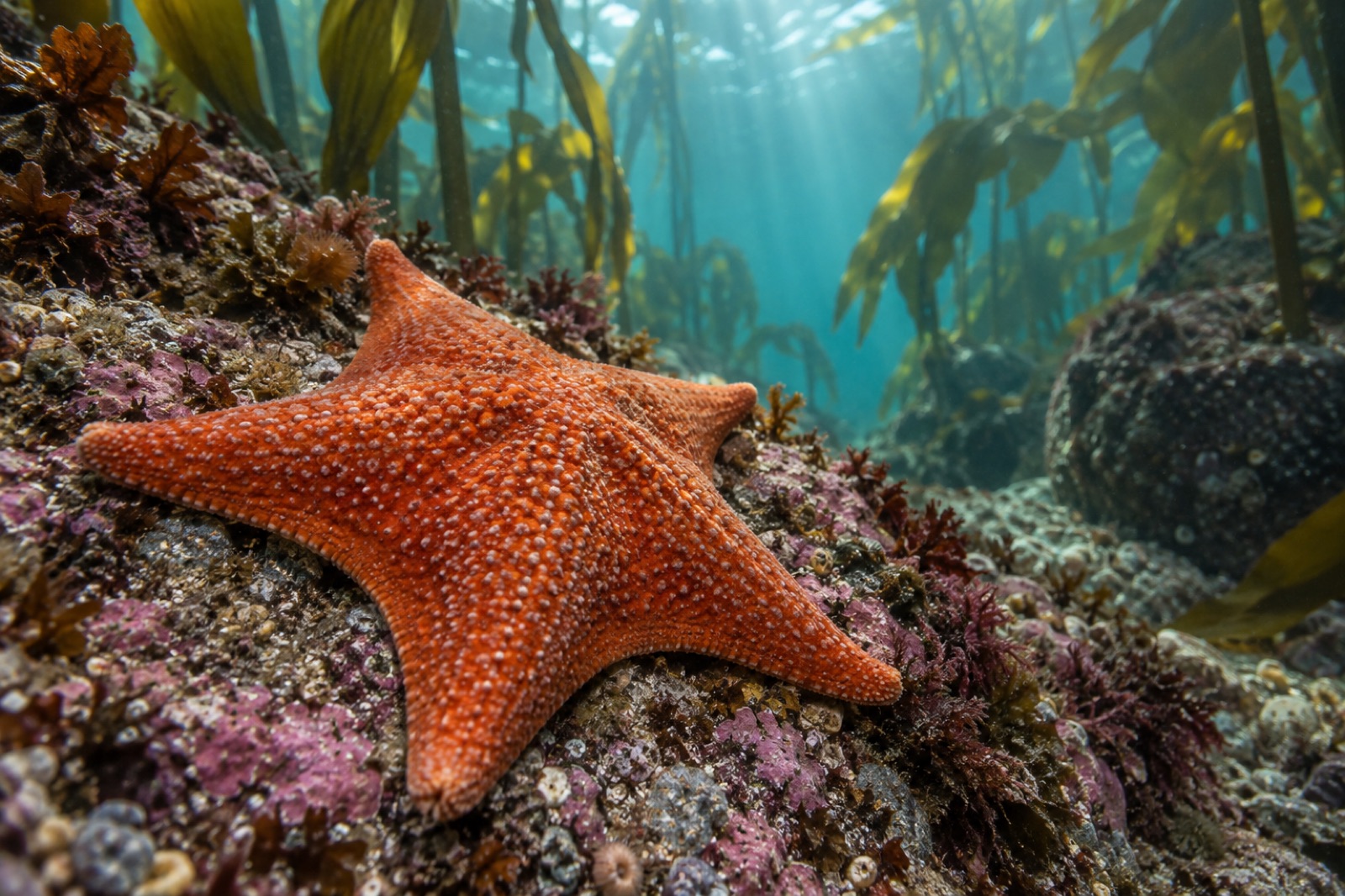
The bat star (Patiria miniata) is the kelp forest's web-fingered clean-up crew — a slow omnivore that turns detritus into reef fertility. Facts, ecology, where to see one.
Dr. Theo Nakamura ·